Best Full-Stack Projects for Leveling Up Your Skills This Fall

ALT: Senior developer reviewing best full-stack projects to level up coding skills this fall
Best Full-Stack Projects to Sharpen Your Skills This Fall
What separates engineers who grow steadily from those who plateau? The answer is almost always the quality of what they choose to build. Tutorials and coding challenges have their place, but nothing accelerates skill development like designing, building, and shipping a complete full-stack project — something with a real frontend, a real backend, real data, and real users. This list is a practitioner's answer to that gap: a curated set of full-stack project ideas that deliver maximum learning value across the technologies that matter most right now, including AI integration, systems design, authentication, real-time data, and API architecture.
These projects were selected based on a consistent pattern seen across engineering teams and individual contributors alike — the ones that generate the deepest learning are those that force you to make real architectural decisions, not just follow a prescribed path. Each project here is scoped to be completable in a focused fall season, yet substantial enough to anchor a portfolio and open genuine conversations in interviews or client pitches. Whether you are a senior engineer looking to break into AI-integrated systems, a startup CTO evaluating what your team should be building, or a founder who codes, each of these projects delivers high ROI on your time investment.
High-Impact Full-Stack Projects Worth Building Right Now
AI-Powered Personal Finance Dashboard
An AI-powered personal finance dashboard is a full-stack application that ingests transaction data, categorizes spending automatically, and surfaces plain-language insights using a language model. This type of project is particularly valuable right now because it sits at the intersection of financial data handling, third-party API integration (think bank data aggregators), and AI-assisted summarization — three skills in genuine demand.
From an architectural standpoint, you will work with a relational database for transaction storage, a backend API layer to process and classify data, and a frontend that renders charts alongside natural language summaries. The AI layer — typically a prompt-engineered call to an LLM — teaches you how to structure data for inference and how to present model outputs responsibly.
Best for: Engineers who want hands-on experience combining LLM APIs with structured data pipelines, or founders validating a fintech product concept before investing in a full build.
Watch out: Financial data handling carries real compliance considerations. Keep this as a demo environment using synthetic or anonymized data unless you intend to pursue formal compliance certification.
Real-Time Collaborative Document Editor
A real-time collaborative document editor — similar in concept to shared editing tools — is a full-stack project that teaches WebSocket communication, operational transformation or conflict-free replicated data types (CRDTs), and state synchronization across multiple clients. This is one of the technically richest project categories because it exposes you to problems most tutorials never surface: what happens when two users edit the same character simultaneously?
Building this project forces decisions about backend architecture (event-driven vs. request-response), in-memory data stores for session state, and frontend rendering performance. According to the IEEE, distributed systems design is among the most consistently valued competencies for senior software engineers, and this project puts you squarely in that territory.
Best for: Senior engineers aiming to deepen their systems design credentials, or engineering managers who want to genuinely understand the tradeoffs their team faces in real-time feature development.
Watch out: The conflict resolution logic can become a rabbit hole. Define a minimum viable consistency model before you start, or you risk spending your entire fall semester on edge cases.
AI-Integrated Job Application Tracker
An AI-integrated job application tracker is a full-stack productivity tool that stores job listings, tracks application status, and uses an LLM to analyze job descriptions — extracting required skills, flagging missing qualifications, and suggesting resume edits. It sounds deceptively simple, but the implementation depth is significant.
On the backend, you are building a structured data model with status workflows, email parsing (if you pull in application confirmation emails), and prompt chaining to handle multi-step AI analysis. On the frontend, you are building a dashboard with filtering, sorting, and inline AI output rendering. This project is particularly well suited to learning how to ship fast without sacrificing product quality — the scope is contained, but the architectural decisions are genuine.
Best for: Full-stack engineers who want a portfolio project that demonstrates AI integration without building a toy app, and early-career developers who will actually use the tool themselves.
Watch out: Prompt engineering for structured output (getting the LLM to return consistent JSON, for example) is harder than it looks. Budget time for iteration on your prompting strategy.
Multi-Tenant SaaS Starter Kit
A multi-tenant SaaS starter kit is a full-stack application scaffold that implements organization-level data isolation, role-based access control, subscription billing via a payment processor, and a basic admin interface — everything a SaaS product needs before it gets to its actual feature set. This is arguably the highest-ROI project on this list for engineers who plan to work on or build SaaS products professionally.
Building this project teaches you tenant isolation strategies at the database level (row-level security vs. schema-per-tenant vs. database-per-tenant), JWT-based authentication flows, webhook handling for billing events, and the frontend patterns needed to render organization-scoped data correctly. According to Masai School's full-stack developer curriculum guidance, multi-tenant architecture and authentication are among the most consistently underrepresented skills in junior-to-mid developer portfolios — and among the most valued in hiring decisions.
As covered in resources on build vs. buy decisions for AI infrastructure, the underlying data isolation and access control patterns you learn here transfer directly to AI product architecture — particularly when you need to serve multiple clients from a shared model infrastructure.
Best for: Engineers targeting senior full-stack or solutions architect roles, and technical founders who want to understand the plumbing of SaaS before hiring a team to build it.
Watch out: Billing integration surface area is deceptively large. Scope your billing implementation to a single provider and a limited plan structure, or it will consume a disproportionate share of your project time.
RAG-Powered Knowledge Base with Document Ingestion
A retrieval-augmented generation (RAG) system is an AI application architecture in which a language model is grounded in a private document corpus — enabling it to answer questions accurately using your own data rather than only its training knowledge. Building a RAG-powered knowledge base from scratch is one of the most educational AI architecture projects available right now, and it remains highly practical: most serious AI applications in production use some form of retrieval augmentation.
The project involves a document ingestion pipeline (chunking, embedding generation, vector storage), a retrieval layer that surfaces relevant context, and a generation layer that wraps the context in a coherent response. You will encounter decisions about chunking strategy, embedding model selection, vector database choice, and re-ranking — decisions that have real performance and cost implications. For a deeper look at the financial dimensions of running such a system, the breakdown of RAG system monthly operating costs is worth reviewing before you architect your storage and inference layers.
Best for: Engineers looking to build credible AI architecture experience, technical founders evaluating whether to build or buy a knowledge management product, and CTOs preparing their teams for AI-integrated product development.
Watch out: Vector database performance degrades predictably as corpus size grows. Design your ingestion pipeline with re-indexing in mind from day one, not as an afterthought.
Full-Stack E-Commerce Platform with Inventory Intelligence
A full-stack e-commerce platform with inventory intelligence is a project that extends a standard online store implementation — product catalog, cart, checkout, order management — with a lightweight AI layer that generates demand forecasts or restocking recommendations based on historical order data. This project is valuable precisely because e-commerce is a well-understood domain, which means you can focus your energy on the architectural quality rather than domain modeling.
The AI component here does not need to be sophisticated to be instructive. Even a simple time-series analysis passed through an LLM for plain-language summarization teaches you how to structure analytical queries, how to present model outputs in a business context, and how to keep the AI layer loosely coupled from the core transactional system. According to dev.to's full-stack developer skill guidance, e-commerce projects consistently rank among the most recognized portfolio signals for hiring managers evaluating full-stack breadth.
Best for: Engineers who want a portfolio project that non-technical stakeholders (investors, product leaders, potential clients) immediately understand, and founders who are exploring commerce or marketplace products.
Watch out: Do not let the storefront UI consume your project time. Use a component library or a headless commerce frontend scaffold, and invest your energy in the backend architecture and the AI integration layer.
Developer Portfolio with CMS and Analytics
A developer portfolio with a headless CMS backend and a self-hosted analytics layer is a deceptively rich full-stack project. The goal is not just a personal website — it is a fully engineered content platform that separates content management from presentation, tracks visitor behavior without relying on third-party cookies, and serves as a live demonstration of your technical judgment.
This project teaches you content modeling in a headless CMS, API-first content delivery, server-side rendering vs. static generation tradeoffs, and privacy-conscious analytics implementation. It is also a project you will actually maintain and use, which is a meaningful forcing function for quality. Per the IEEE's software engineering competency frameworks, the ability to make principled architectural tradeoffs — including the build-vs-buy decision for infrastructure components — is a defining characteristic of senior engineering practice.
Best for: Engineers who need a portfolio anchor that demonstrates architectural thinking to technical interviewers, and founders who want a content platform they control end-to-end.
Watch out: Headless CMS selection is a consequential decision. Evaluate the API query model carefully before committing — some CMS platforms impose query constraints that become frustrating at scale.
Event-Driven Microservices Notification System
An event-driven microservices notification system is a full-stack project that implements a message broker, multiple independent services that publish and consume events, and a frontend dashboard that displays real-time notification delivery status. This project is specifically designed to teach distributed systems patterns that most monolithic application tutorials never expose you to.
Building this system forces decisions about message broker selection, event schema design, idempotency handling, dead-letter queues, and service failure recovery. These are the exact architectural questions that come up in production-grade system design interviews and in real system architecture reviews. The competencies built here align directly with what engineering directors and principal engineers are expected to understand — not just implement.
Best for: Senior engineers preparing for staff or principal-level roles, and engineering managers who want to gain direct experience with the architectural patterns their teams navigate daily.
Watch out: The operational complexity of running multiple services locally can become a friction point. Set up Docker Compose for local orchestration from the beginning, and treat that configuration as a first-class deliverable.
Quick Comparison at a Glance
Selecting the right project comes down to matching the skill gap you want to close with the learning density of the project. The table below is designed to make that mapping fast.
| Project | Best For | Key Strength | Limitation |
|---|---|---|---|
| AI Finance Dashboard | LLM + structured data integration | Combines AI with real business data modeling | Compliance complexity with real financial data |
| Real-Time Collaborative Editor | Systems design, distributed state | Deepest systems-level learning on this list | Conflict resolution scope creep risk |
| AI Job Application Tracker | AI integration, portfolio signal | Well-scoped, practical, immediately usable | Prompt engineering for structured output takes iteration |
| Multi-Tenant SaaS Starter Kit | SaaS architecture, billing, auth | Highest direct professional ROI | Billing integration is broad; requires tight scoping |
| RAG Knowledge Base | AI architecture, vector systems | Most directly relevant to production AI systems | Vector store performance requires forward-looking design |
| E-Commerce with Inventory AI | Full-stack breadth, business context | Immediately legible to non-technical stakeholders | Frontend can consume project time if not constrained |
| Portfolio with CMS and Analytics | Personal brand, architectural signal | Live, maintained, functional artifact | CMS selection has long-term implications |
| Event-Driven Notification System | Distributed systems, senior-level prep | Closest to production microservices architecture | Local development complexity without orchestration |
How to Choose the Right Project for Where You Are
The right project is the one that closes your most valuable skill gap without exceeding your available time budget. Here is how to map your situation to the list above.
If your goal is AI credibility — you need to demonstrate that you can build production-relevant AI systems, not just call an API — prioritize the RAG knowledge base or the AI finance dashboard. Both require genuine architectural thinking about data pipelines, model integration, and output handling. If you are just starting to explore AI integration and want a lower-stakes entry point, the AI job application tracker is a better starting point: the scope is tighter, and the feedback loop is faster.
If your goal is systems design depth — you are preparing for a senior, staff, or principal-level role and need to demonstrate distributed systems competency — the real-time collaborative editor and the event-driven notification system are your strongest options. Both generate the kind of architectural decisions that come up in system design interviews and in real engineering leadership conversations.
If your goal is immediate professional leverage — you are a technical founder, a freelance engineer, or someone who needs a portfolio piece that clients or hiring managers immediately understand — the multi-tenant SaaS starter kit and the e-commerce platform with inventory AI are the highest-signal choices. Both map directly to product categories that buyers recognize.
A common misconception worth addressing directly: many engineers believe that building a technically sophisticated project automatically creates a strong portfolio signal. It does not. What creates signal is the combination of technical depth and clear communication of the architectural decisions you made and why. Whatever project you choose, document your tradeoffs explicitly — in a README, a short write-up, or a brief architecture diagram. That documentation is often what separates a memorable portfolio from a forgettable one.
If you are thinking about how these project types connect to larger professional opportunities — particularly in AI system architecture — understanding what to expect when starting an AI architecture engagement can help you understand the professional context your project skills feed into.
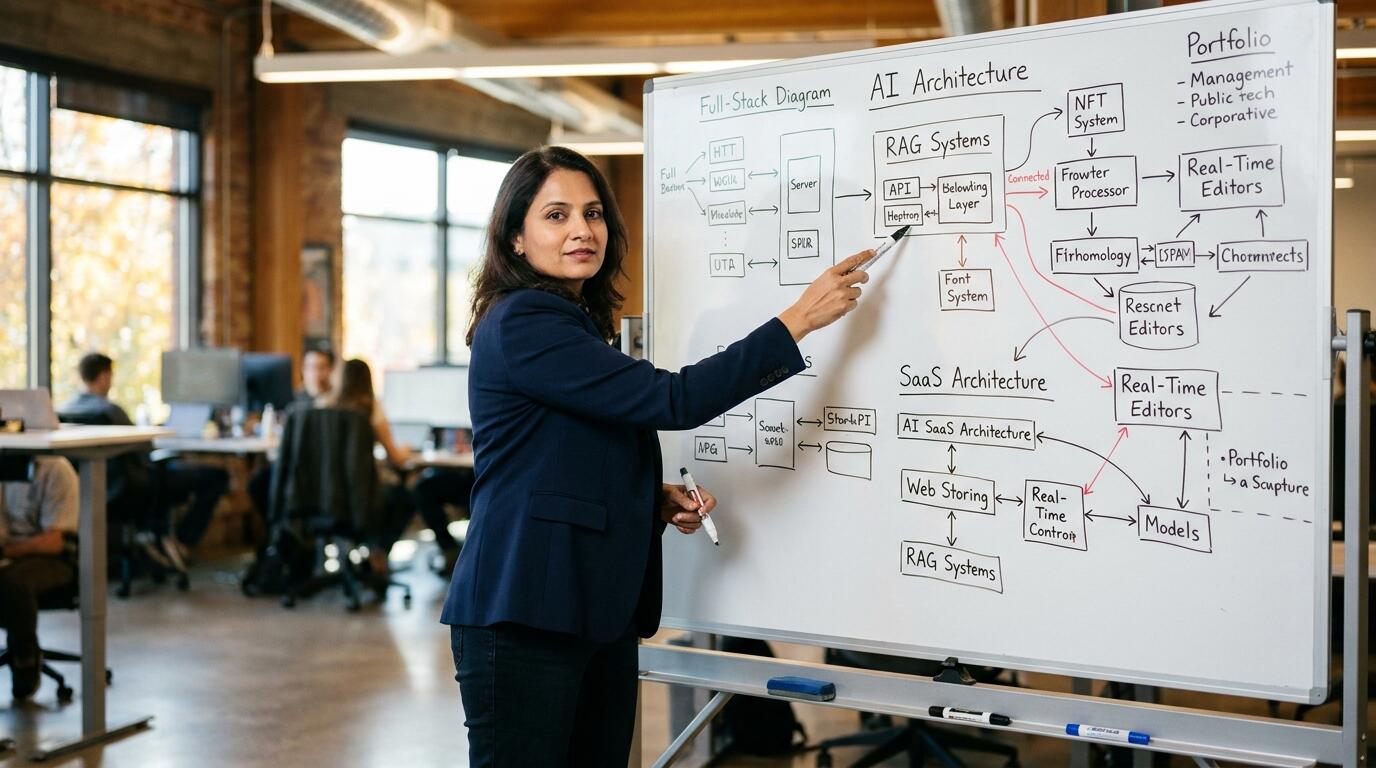
ALT: Engineering director reviewing full-stack project options for skill development and AI architecture portfolio building this fall
Frequently Asked Questions FAQ
Q1: How long does it typically take to complete a full-stack portfolio project?
Project completion time depends heavily on scope discipline. Most of the projects on this list are completable in six to twelve focused weeks for an experienced developer working part-time — roughly ten to fifteen hours per week. The key variable is how aggressively you constrain your MVP scope. According to full-stack developer skill guides published by Masai School, developers who ship a constrained, functional version first and iterate afterward consistently produce stronger portfolio artifacts than those who aim for completeness before launch.
Q2: Are these full-stack projects relevant for engineers who already have production experience?
Yes — and arguably more so. These projects are specifically chosen for their architectural depth, not their surface-level novelty. A senior engineer or engineering manager building a RAG knowledge base or a multi-tenant SaaS scaffold is not doing tutorial work — they are making real design decisions about data isolation, retrieval strategy, and service boundaries. The depth of learning scales with the depth of implementation. For engineers at the director or principal level, the value is often in gaining direct hands-on fluency with patterns their teams navigate, rather than purely in portfolio building.
Q3: How much does it cost to run these projects during development?
Most of these projects can be developed and demonstrated for minimal cost. Cloud compute for a small backend, a managed PostgreSQL instance, and LLM API calls during development typically run in the range of low to moderate monthly spend — well within a reasonable learning budget. The notable exception is vector database hosting for the RAG project, which can escalate with corpus size. Designing with cost awareness from the start — caching aggressively, batching embedding calls, using free tiers where available — is itself a valuable engineering practice that carries directly into professional work.
Key Takeaways
- Project selection is a strategic decision. The highest-ROI projects are those that close your specific skill gap while producing an artifact that communicates clearly to your target audience — whether that is a hiring manager, a client, or a co-founder.
- AI integration is not a separate track. The best AI-integrated projects on this list treat the AI layer as a first-class architectural component, not a bolt-on feature. Building with that mindset is what separates engineers who understand AI systems from those who simply use AI APIs.
- Scope discipline determines outcomes. Every project on this list can expand indefinitely. Define your MVP boundary before you write a line of code, and treat any work beyond that boundary as a second-phase decision.
- Documentation is part of the deliverable. The technical decisions you make during a project — and your ability to explain them clearly — are as important as the code itself, particularly for senior roles and client-facing work.
- Fall is a particularly effective time to build. The combination of a defined season, professional momentum post-summer, and the current pace of AI tooling evolution makes this a high-signal window to invest in a substantial project.
The next practical step is to pick one project from this list — not the most ambitious one, but the one that most directly addresses your current skill gap — and define your MVP scope in writing before you touch your editor. That single constraint will determine whether you ship something or spend the season in scope drift.
If this resonated with you, explore more insights and real-world engineering breakdowns at Darius's portfolio and wiki. Whether you're architecting an AI system from scratch, untangling a complex technical stack, or looking to turn an idea into a live product, Darius brings the hands-on experience of an Engineering Director and AI Architect who has done exactly that. Visit the site to dive deeper into frameworks, case studies, and thinking that helps you build and ship with confidence.
Sources & Further Reading
- dev.to / catmcgeecode. "Want to be a full-stack developer without a degree? This is what you need."
https://dev.to/catmcgeecode/want-to-be-a-full-stack-developer-without-a-degree-this-is-what-you-need-2kmm - Masai School. "Your Path to Becoming a Skilled Full-Stack Developer."
https://www.masaischool.com/blog/your-path-to-becoming-a-skilled-full-stack-developer/ - Enhancv. "Guide to 99 Technical Skills to Include in Your Resume."
https://enhancv.com/resume-skills/technical/
Note: Standards and best practices in software engineering evolve continuously; please consult the latest official documentation and professional advisors for current guidance.