Which Cloud Platform Offers the Best Uptime for Production Apps This Year
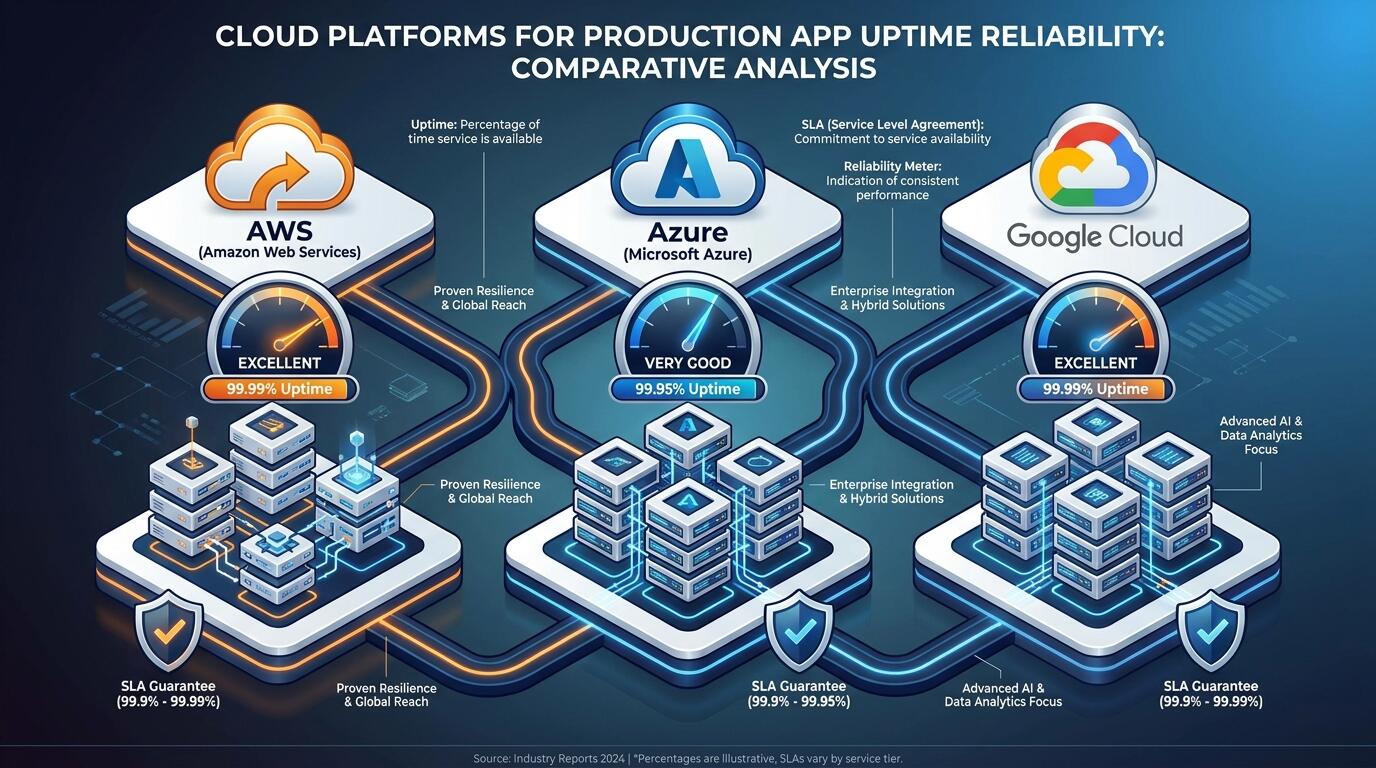
ALT: Comparing cloud platform uptime reliability for production apps AWS Azure Google Cloud
Cloud Platform Uptime for Production Apps: Which Provider Actually Delivers?
Reliability is the silent foundation of every successful production application. When a cloud platform goes down, so does your revenue, your user trust, and your team's credibility. As cloud infrastructure has matured, the market's leading providers have all made bold claims about their availability commitments — yet a pattern we consistently see in engineering practice is that contractual SLAs and real-world uptime are two very different conversations. According to analysis tracked by Network World, uptime performance varies meaningfully across providers depending on the region, service tier, and workload type — which means choosing a cloud platform purely on name recognition or price is a common and costly mistake.
This guide cuts through the marketing noise and evaluates the major cloud platforms against the standards that actually matter for production workloads: documented availability, service-level agreements (SLAs are formal contractual commitments that define the minimum uptime a provider guarantees, typically expressed as a percentage), architectural redundancy, and the practical experience of engineering teams who ship real products on these platforms. The list below covers the most widely used providers — selected on the basis of market presence, enterprise adoption, and documented reliability track records — and maps them to the situations where each genuinely excels or falls short.
Whether you are a founder evaluating your first cloud vendor, a CTO migrating a legacy system, or an engineering lead designing for high availability, this comparison is structured to help you make a grounded, defensible choice.
The Major Cloud Platforms Ranked by Production Uptime Reliability
Amazon Web Services (AWS): The Benchmark for Enterprise-Grade Availability
Amazon Web Services (AWS) is the cloud computing division of Amazon that provides on-demand infrastructure, managed services, and a global network spanning more regions than any other provider. AWS has long been the default choice for production workloads that demand consistent, well-documented reliability, and for good reason: its multi-region architecture, mature service catalog, and granular SLA commitments across individual services give engineering teams a level of operational predictability that is difficult to match.
In practice, AWS offers some of the most detailed per-service availability commitments in the industry. Core compute services like EC2, combined with managed databases like RDS with Multi-AZ configurations, allow teams to architect for availability at a fine-grained level rather than relying on platform-level promises. The trade-off is complexity — achieving high availability on AWS requires deliberate architectural decisions, not passive reliance on the platform.
Best for: Teams with mature DevOps practices, enterprises running mixed workloads, and startups that expect to scale aggressively and need access to the broadest ecosystem of managed services.
Watch out: AWS's regional outages, when they occur, can cascade across multiple services simultaneously because many third-party SaaS products and internet infrastructure also run on AWS. Putting all production workloads in a single AWS region without a multi-region failover strategy introduces concentrated risk.
Google Cloud Platform (GCP): Network Performance as a Reliability Advantage
Google Cloud Platform (GCP) is Google's public cloud offering, distinguished primarily by its private global fiber network — the same infrastructure that powers Google Search and YouTube. For latency-sensitive and globally distributed production applications, GCP's network architecture translates directly into more consistent end-to-end performance, which is a component of perceived reliability that pure uptime percentages often fail to capture.
GCP's global load balancing — a system that routes user requests across data centers worldwide from a single anycast IP address — is a genuine architectural differentiator. It means that even if one region experiences degraded performance, traffic is automatically shifted without requiring manual intervention or complex DNS failover setups. GCP has also made notable investments in its committed use pricing and managed Kubernetes offerings, making it a strong choice for containerized workloads where reliability is engineered at the application layer.
Best for: AI/ML-intensive workloads, globally distributed consumer applications, and teams already invested in Kubernetes (GCP's managed Kubernetes Engine, known as GKE, is widely regarded as the most mature hosted offering).
Watch out: GCP's regional footprint, while expanding, is narrower than AWS in certain geographies. Teams serving users in specific emerging markets may find fewer region options, which can affect latency and data residency compliance.
Microsoft Azure: The Enterprise Integration Play
Microsoft Azure is Microsoft's cloud platform, purpose-built for organizations deeply embedded in the Microsoft ecosystem — including Windows Server, Active Directory, and Microsoft 365. Azure's reliability story is strongest in enterprise and hybrid environments, where its integration with on-premises infrastructure allows organizations to build active-active architectures (where two or more systems run simultaneously and share the production load, rather than one sitting idle as a backup) that span both cloud and existing data centers.
Azure's SLA commitments for core services are comparable to AWS and GCP, and the platform has made significant investments in its availability zones — physically separate data centers within a single region — over recent years. For organizations running .NET workloads, Microsoft SQL Server, or requiring tight integration with Azure Active Directory for identity management, Azure often delivers the smoothest operational experience with the least friction.
Best for: Enterprises with existing Microsoft licensing agreements, regulated industries that require hybrid cloud architectures, and development teams working primarily within the Microsoft technology stack.
Watch out: Azure's user interface and service naming conventions have historically been a source of operational friction for teams without prior Azure experience. Misconfigured services are a common cause of preventable downtime, and Azure's complexity in certain areas demands experienced platform engineers to manage correctly.
Cloudflare Workers and Pages: Edge-First Reliability at Global Scale
Cloudflare Workers is a serverless execution platform from Cloudflare that runs code at the network edge — meaning application logic executes in data centers physically close to end users, across more than 300 cities worldwide. For front-end applications, APIs, and latency-sensitive microservices, this distributed execution model produces availability characteristics that are structurally different from traditional cloud regions.
Because Cloudflare's network is designed to absorb massive distributed denial-of-service (DDoS) attacks as a core function, applications deployed on Workers inherit a baseline resilience against traffic-based outages that most regional cloud providers cannot replicate without additional paid services. This makes Cloudflare particularly compelling for any production application where reliability threats include malicious traffic as well as infrastructure failure.
Best for: Static sites, JAMstack applications (a modern web architecture that pre-renders pages and relies on APIs for dynamic functionality), globally distributed APIs, and any team that wants high availability as a default rather than an architectural exercise.
Watch out: Cloudflare Workers operates within execution time and memory limits that make it unsuitable for long-running compute tasks. Complex stateful applications require pairing with external data stores, which adds architectural surface area and potential failure points.
Oracle Cloud Infrastructure (OCI): The Uptime Challenger with Aggressive SLAs
Oracle Cloud Infrastructure (OCI) is Oracle's second-generation cloud platform, designed from the ground up after Oracle analyzed the architectural shortcomings of first-generation cloud providers. OCI has publicly committed to SLAs that, in certain service categories, exceed what AWS and Azure offer — including financial penalties if availability targets are missed, not merely service credits.
A pattern we consistently see when engineering teams evaluate OCI is surprise at how competitive its core compute and database reliability story is, particularly for Oracle Database workloads and applications requiring Exadata infrastructure. OCI's flat, non-oversubscribed networking architecture means that compute instances deliver more predictable performance under load, which translates to more consistent application-level uptime in compute-intensive scenarios.
Best for: Oracle database workloads, enterprises migrating from on-premises Oracle infrastructure, and teams that want contractually aggressive SLAs with meaningful financial accountability.
Watch out: OCI's ecosystem of managed services is narrower than AWS or Azure. Teams that need a broad catalog of third-party integrations or managed services may find OCI limiting outside of its core compute and database strengths.
DigitalOcean: Simplicity-Driven Reliability for Smaller Teams
DigitalOcean is a cloud provider positioned explicitly for developers and small-to-medium businesses that prioritize operational simplicity over feature breadth. Its managed database offerings, Kubernetes clusters, and App Platform (a fully managed deployment service) are designed to reduce the operational complexity that is itself a source of unplanned downtime on more complex platforms.
As noted in reporting from sources tracking cloud platform reliability, per Northflank's analysis of reliable cloud platforms for app hosting, simpler platforms often produce strong reliability outcomes for smaller workloads precisely because there are fewer configuration surfaces where mistakes can occur. DigitalOcean's managed offerings handle many of the operational tasks — patching, failover, backup — that teams on raw infrastructure must manage themselves.
Best for: Early-stage startups, developer tools, internal applications, and teams that need production-grade uptime without the operational overhead of managing complex cloud infrastructure.
Watch out: DigitalOcean's global region footprint is smaller than hyperscaler alternatives, and its SLAs, while reasonable, do not carry the financial accountability clauses of enterprise-tier contracts. As workloads grow in scale and complexity, teams may outgrow DigitalOcean's managed offerings.
IBM Cloud: Regulated Industry Reliability and Compliance Depth
IBM Cloud is IBM's cloud platform, differentiated primarily by its depth of compliance certifications and its long-standing relationships with regulated industries including financial services, healthcare, and government. IBM Cloud's Financial Services Cloud — a dedicated deployment model with hardened controls — represents one of the most documented compliance frameworks available from a public cloud provider.
For production applications where the definition of "uptime" extends beyond availability to include audit continuity, regulatory compliance, and data sovereignty, IBM Cloud's architecture addresses requirements that generalist cloud platforms handle less gracefully. The platform's reliability story is less about raw availability percentages and more about the integrity and auditability of the production environment over time.
Best for: Financial institutions, healthcare organizations, and government contractors where compliance is a non-negotiable dimension of reliability.
Watch out: IBM Cloud's broader service catalog and developer experience lag behind AWS, GCP, and Azure. Teams without specific regulated-industry requirements will typically find better ecosystem support and tooling on alternative platforms.
Hetzner Cloud: Cost-Efficient European Reliability
Hetzner Cloud is a German cloud provider offering dedicated and virtual servers with a strong track record of uptime in European data centers. For production applications serving European users, Hetzner delivers competitive reliability at a price point significantly below hyperscaler alternatives, with the added benefit of simplified GDPR (General Data Protection Regulation — the European Union's data privacy framework) compliance given its EU-based infrastructure.
Engineering teams working on lean budgets — a common constraint for early-stage startups — often find that Hetzner's straightforward infrastructure, combined with careful application-level architecture, produces production uptime that rivals far more expensive alternatives. For teams building machine learning pipelines or data-intensive systems and looking to manage infrastructure costs, designing those systems to scale past prototype stage often involves exactly the kind of provider-agnostic architecture that makes Hetzner viable in a multi-cloud strategy.
Best for: European startups and SMBs, GDPR-sensitive workloads, and teams that prioritize cost efficiency without sacrificing reasonable availability guarantees.
Watch out: Hetzner's data center footprint is concentrated in Europe and has limited presence in North America and Asia-Pacific. Applications with globally distributed users should pair Hetzner with a CDN or global load-balancing layer to compensate.
Quick Comparison at a Glance
Selecting a cloud provider for production uptime is a multi-dimensional decision. The table below summarizes the core trade-offs across each platform to help you scan and shortlist based on your situation.
| Platform | Best For | Key Strength | Limitation |
|---|---|---|---|
| Amazon Web Services (AWS) | Enterprise and high-growth workloads | Broadest service ecosystem, granular SLAs | Regional outages can cascade; requires deliberate HA architecture |
| Google Cloud Platform (GCP) | AI/ML and globally distributed apps | Private global network, best-in-class managed Kubernetes | Narrower regional footprint in some geographies |
| Microsoft Azure | Enterprise Microsoft ecosystem | Hybrid cloud and Active Directory integration | Complexity and configuration friction for non-Microsoft teams |
| Cloudflare Workers | Edge APIs and globally distributed front ends | 300+ edge locations, DDoS resilience built in | Execution limits; unsuitable for long-running stateful compute |
| Oracle Cloud Infrastructure (OCI) | Oracle database and compute-intensive apps | Aggressive SLAs with financial accountability | Narrower managed service ecosystem |
| DigitalOcean | Developer teams and early-stage startups | Operational simplicity, managed services | Smaller region footprint; may be outgrown at scale |
| IBM Cloud | Regulated industries (finance, healthcare, government) | Compliance depth and audit continuity | Developer experience and ecosystem lag behind hyperscalers |
| Hetzner Cloud | European startups on lean budgets | Cost efficiency, GDPR-native infrastructure | Limited global presence outside Europe |
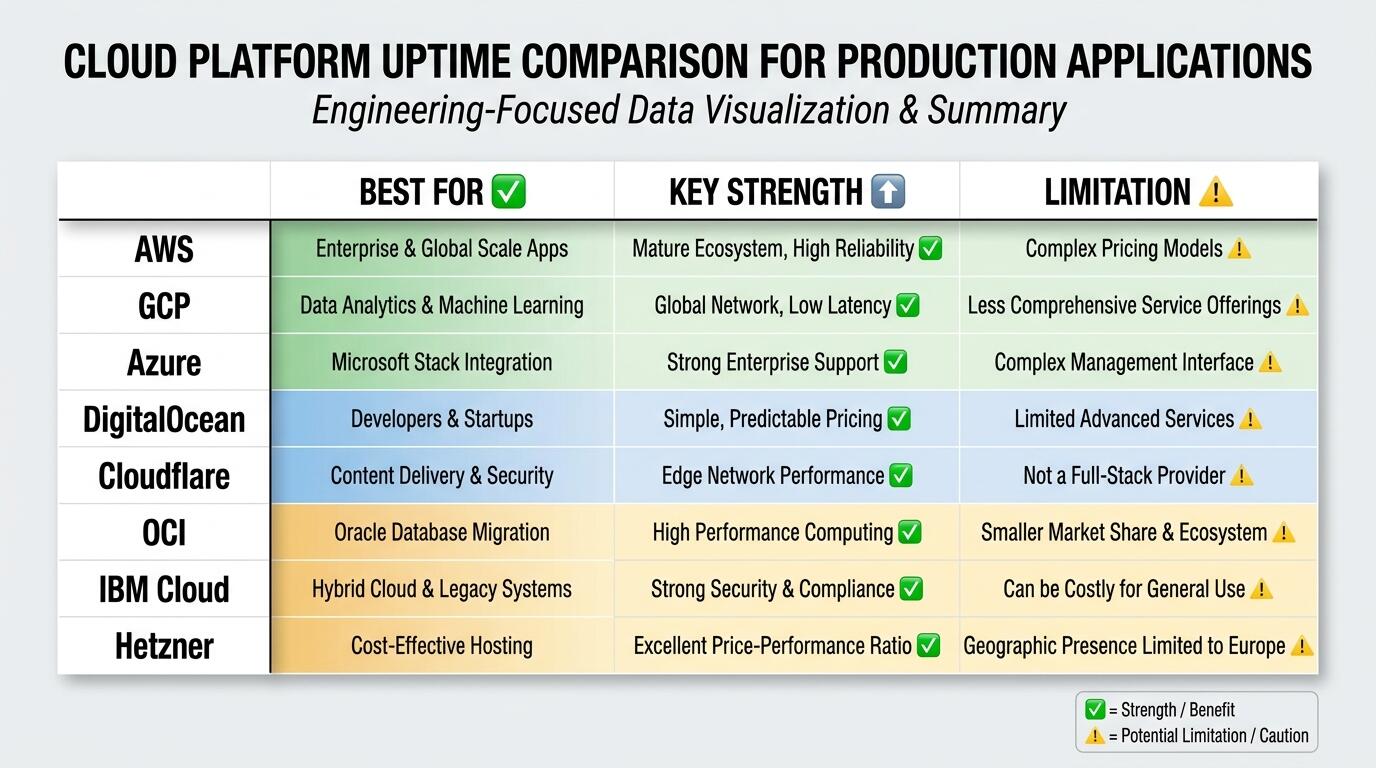
ALT: Cloud platform uptime comparison table for production apps including AWS GCP Azure DigitalOcean and Cloudflare reliability trade-offs for engineering teams
How to Choose the Right Cloud Platform for Production Uptime
The right cloud platform for production uptime is the one that matches your application's architecture, your team's operational capability, and your users' geographic distribution — not necessarily the one with the highest-advertised SLA percentage.
A common misconception is that a higher SLA percentage directly translates to a more reliable production application. In practice, a 99.99% SLA on a single compute instance is meaningless if your application has no redundancy layer and a single database with no failover. Real production uptime is an outcome of architecture, not a feature of the platform. The platform's SLA is a floor, not a ceiling, and it only applies to the specific services named in the contract.
Here is how to map your situation to a decision:
If your team is small and moving fast, operational simplicity matters more than feature breadth. DigitalOcean or Cloudflare Workers will likely produce better real-world uptime outcomes than a complex AWS setup managed by engineers who are not yet fluent in cloud operations. An under-engineered application on a simple platform often outperforms an over-engineered application on a powerful one.
If you are building AI-intensive or globally distributed products, GCP's network and managed Kubernetes offering, or AWS with its breadth of AI managed services, are the strongest choices. In our work with clients on AI architecture and systems design, the infrastructure layer is rarely the primary reliability risk — the bigger risk is upstream in the application design. Getting cloud security and compliance right for AI workloads is equally important alongside the uptime question, and both decisions should be made in concert.
If you operate in a regulated industry, IBM Cloud or Azure — depending on your specific compliance framework — provide documented audit trails and certification depth that generalist providers cannot replicate without significant additional work.
If cost efficiency is a binding constraint and your users are primarily in Europe, Hetzner combined with a CDN layer is a legitimate production architecture, not a compromise.
Finally, if your application must be resilient against both infrastructure failure and malicious traffic, Cloudflare's edge network is a structural advantage worth prioritizing over raw regional availability statistics.
Questions & Answers
Q1: How do cloud providers calculate and measure uptime for production services?
Cloud providers measure uptime as the percentage of time a service is available within a given month, typically calculated as: (total minutes - downtime minutes) / total minutes × 100. According to tracking published by Network World and infrastructure monitoring services, individual service uptime is measured at the service endpoint level, not the application level — meaning your application's actual availability depends on the combined availability of every service it depends on, including databases, queues, and networking components. A 99.9% uptime on each of three dependent services compounds to lower overall application availability.
Q2: Are cloud provider SLAs sufficient protection for mission-critical production applications?
Cloud SLAs are a starting point, not a complete reliability strategy. SLAs typically offer service credits — partial refunds on your cloud bill — rather than compensation for lost revenue or reputation damage caused by downtime. Per Total Uptime, application delivery solutions that layer additional redundancy and failover mechanisms above the cloud platform level consistently produce higher observed availability than relying on a single provider's SLA alone. For mission-critical workloads, a multi-region or multi-cloud architecture, combined with regular failover testing, is the standard engineering practice.
Q3: How long does it typically take to see uptime improvements after migrating to a more reliable cloud platform?
Uptime improvements from a cloud migration are rarely immediate and depend heavily on how thoroughly the application architecture is re-evaluated during the migration process. A lift-and-shift migration — moving an application to a new cloud without architectural changes — often replicates existing reliability problems in a new environment. Meaningful, sustained uptime improvements generally emerge after the first full production incident cycle on the new platform, when the team has tuned monitoring, alerting, and runbooks to the new infrastructure. Planning for a stabilization period after migration is standard practice.
Key Takeaways
Choosing the best cloud platform for production app uptime requires matching three things simultaneously: the platform's architectural strengths, your team's operational maturity, and your application's reliability requirements. No single provider is universally superior — AWS leads on ecosystem breadth, GCP on global networking and AI workloads, Azure on enterprise Microsoft integration, and specialized providers like Cloudflare and Hetzner deliver outstanding reliability for specific use cases that the hyperscalers handle less efficiently.
The three core points to carry forward are: first, real production uptime is an architectural outcome, not a platform feature — design for redundancy at every layer. Second, SLA percentages are contractual floors and should be evaluated alongside the financial accountability clauses, not treated as reliability guarantees. Third, the best platform for your production workload is the one your team can operate correctly under pressure, not the one with the most impressive feature list.
If your organization is evaluating its infrastructure strategy as part of a broader product or AI initiative, the infrastructure choice should be made alongside the application architecture decision, not before or after it. A pragmatic, context-aware approach to cloud selection — grounded in real shipping experience — is what consistently separates high-availability production systems from expensive downtime events.
Ready to make the right infrastructure call for your next production system? Visit the Darius website to explore real shipped projects, detailed technical insights on AI architecture and systems design, and to connect directly with an Engineering Director who has navigated exactly these decisions across multiple live products.
Sources & Further Reading
- Northflank. "Most reliable cloud platforms for app hosting in 2026".
https://northflank.com/blog/most-reliable-cloud-platforms-for-app-hosting - Network World. "Which cloud providers had the best uptime last year?".
https://www.networkworld.com/article/934276/which-cloud-providers-had-the-best-uptime-last-year.html - Total Uptime. "Application Delivery Solutions".
https://totaluptime.com/ - IEEE (Institute of Electrical and Electronics Engineers). Standards and technical resources on cloud computing reliability and systems availability.
https://www.ieee.org/
Note: Standards and cloud provider SLAs may be updated; please check the latest official documentation or consult qualified infrastructure advisors before making production architecture decisions.