Cloud Security and Compliance Requirements for AI Workloads This Year
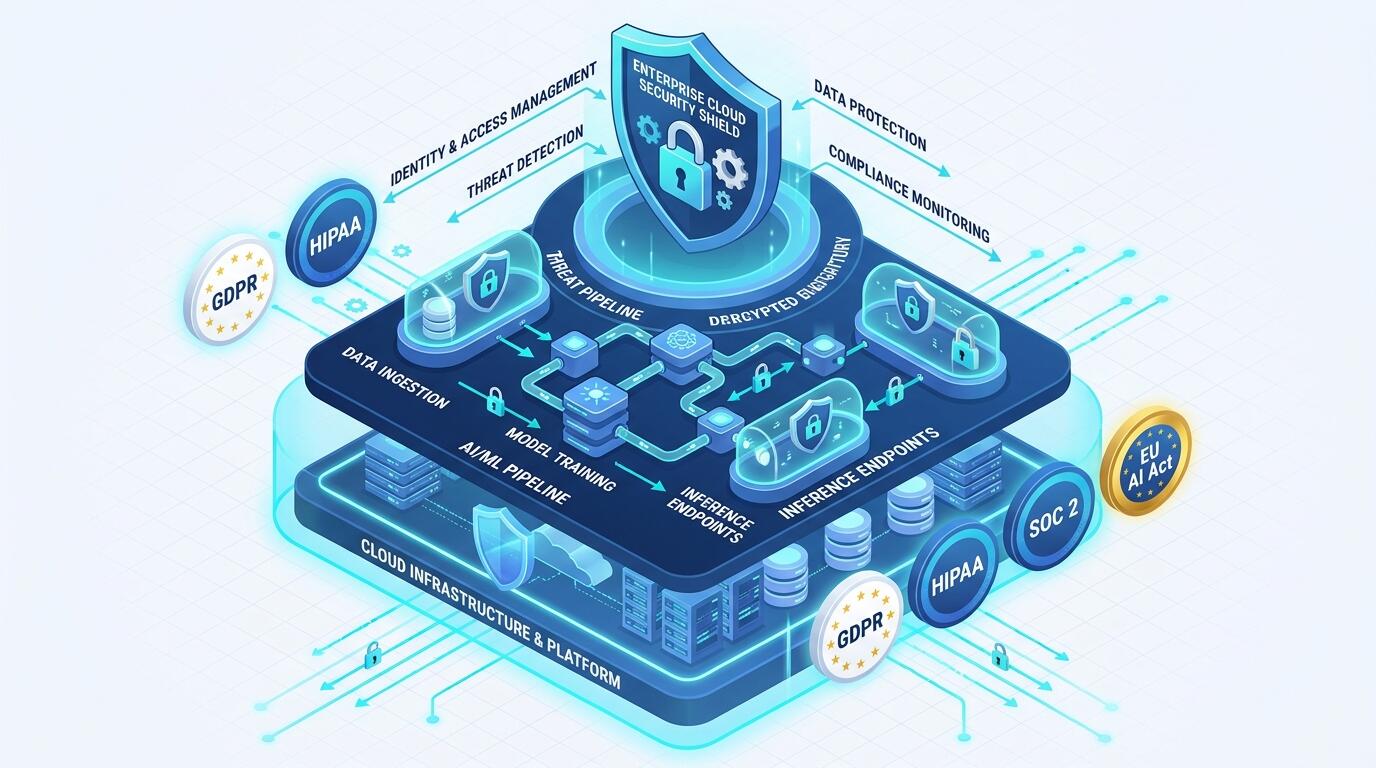
ALT: Cloud security and compliance requirements for AI workloads running on enterprise cloud infrastructure
What You'll Achieve: A Compliance-Ready Cloud Architecture for AI Workloads
Key Conclusion: By following this guide, you will understand the specific cloud security controls, regulatory frameworks, and architectural decisions required to run AI workloads compliantly in today's environment. You will leave with a structured approach to data governance, model security, access control, and audit readiness — covering the full compliance surface area that AI introduces beyond conventional cloud deployments.
Modern AI workloads are not simply "more compute." They introduce a distinct threat surface — training data pipelines, model artifacts, inference APIs, and LLM integrations — that existing cloud security frameworks were not originally designed to address. This guide is written for CTOs, Engineering Directors, and technical founders who are deploying AI systems in production and need clarity on both the security architecture and the compliance obligations that come with it. If you are trying to satisfy enterprise procurement security reviews, prepare for regulatory scrutiny, or simply build a system you can defend, this is where to start.
Before You Start: Prerequisites and Preparation
Cloud security compliance for AI workloads is not a one-time checklist — it is an ongoing architectural discipline. Before engaging with the step-by-step guidance below, you need a clear picture of what you are starting from.
Know your cloud provider's shared responsibility model. Every major cloud provider — AWS, Google Cloud, Microsoft Azure — operates on a shared responsibility model that defines what the provider secures versus what the customer secures. For AI workloads, this model has nuanced implications: the provider may secure the underlying GPU infrastructure, but the customer is responsible for the data fed into training pipelines, the model artifacts stored in object storage, and the access controls governing inference endpoints. Misunderstanding this boundary is one of the most common sources of compliance gaps in our work with clients.
Understand the regulatory landscape your AI system touches. Compliance requirements are not uniform. A health-tech startup using AI to analyze patient records faces HIPAA obligations. A fintech using ML for credit scoring must contend with Fair Credit Reporting Act considerations and, increasingly, the EU AI Act's requirements for high-risk AI systems. A SaaS company processing EU citizen data through AI features must align with GDPR. Identifying your applicable frameworks before designing security controls saves significant remediation cost later.
Have visibility into your data flows. Compliance for AI specifically requires understanding where training data originates, how it moves through preprocessing pipelines, where it lands at rest, and what data touches the inference layer at runtime. Without a data flow inventory, you cannot meaningfully address data residency, retention, or access control requirements.
Align your team on roles and ownership. Security and compliance work that falls between engineering, legal, and operations without clear ownership tends to stall. Before starting, designate who owns compliance documentation, who owns technical controls implementation, and who is the decision-maker for architectural trade-offs.
Checklist before starting:
- Cloud account structure documented, including which accounts host AI workload components
- Data classification scheme defined for training data, model artifacts, and inference inputs/outputs
- Applicable regulatory frameworks identified (GDPR, HIPAA, SOC 2, EU AI Act, NIST AI RMF, or others)
- Cloud provider shared responsibility boundaries understood for AI-specific services in use
- Data flow diagram drafted covering ingestion, preprocessing, training, storage, and inference
- Key stakeholders identified and compliance ownership assigned
The effort required to build a compliant AI cloud architecture is substantial upfront and moderate ongoing. Teams that treat it as a foundational engineering concern from the start consistently find the process more tractable than those who retrofit compliance after launch.
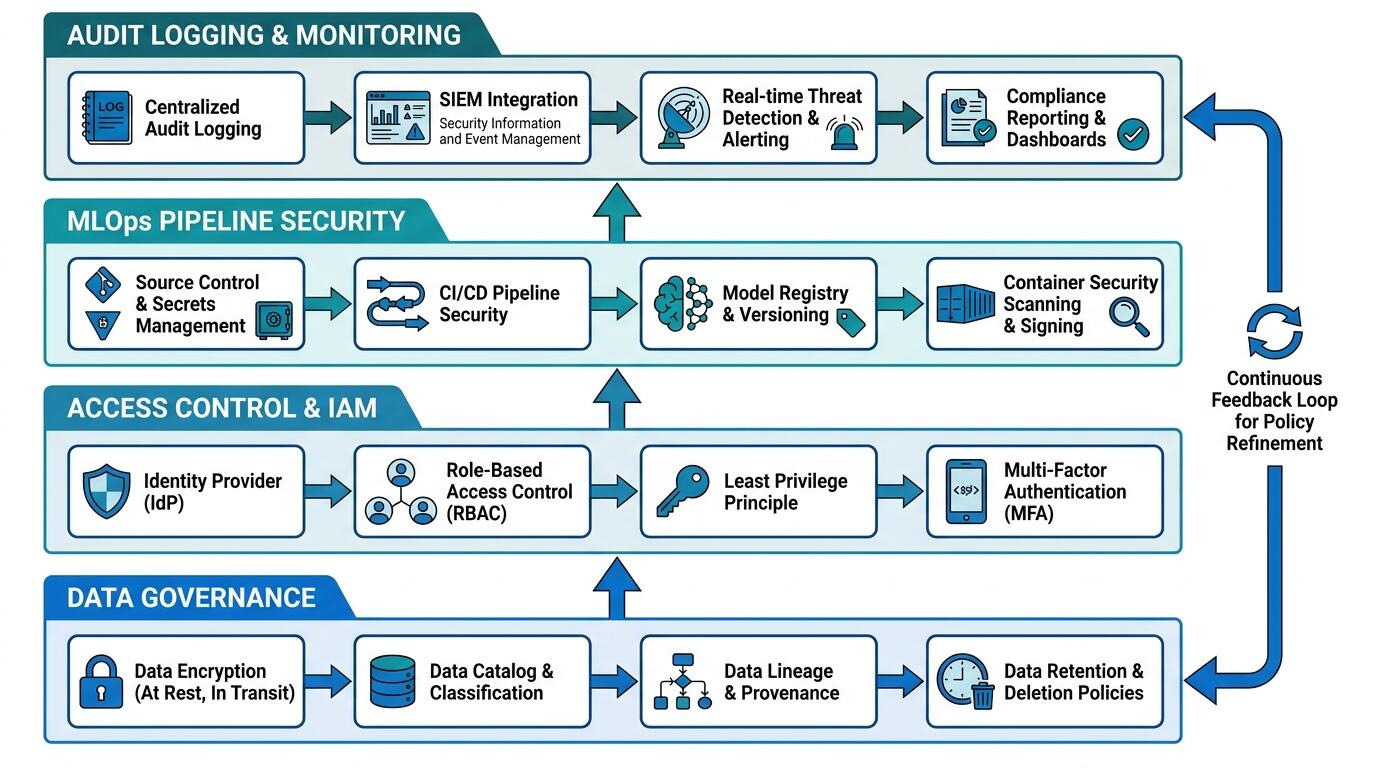
ALT: Step-by-step cloud compliance architecture diagram for AI workloads showing data governance, access control, and audit logging layers
Step-by-Step: Building Cloud Security and Compliance for AI Workloads
Step 1: Define Your AI Workload Threat Model
The first step in cloud security for AI workloads is producing an explicit threat model that reflects the AI-specific attack surface — not just generic cloud threats. AI systems introduce novel risks including training data poisoning, model inversion attacks, prompt injection in LLM-based systems, and adversarial input manipulation at inference time.
Work through each component of your AI system — data ingestion, preprocessing, model training, artifact storage, serving infrastructure, and monitoring — and enumerate threats at each layer. Ask what happens if the training dataset is tampered with. Ask what an attacker could learn by querying your inference API repeatedly. For LLM integrations, prompt injection deserves explicit treatment: an attacker supplying malicious user input that manipulates model behavior is a live threat, not a theoretical one.
Tip: Use an established framework to structure your threat model. STRIDE (Spoofing, Tampering, Repudiation, Information Disclosure, Denial of Service, Elevation of Privilege), adapted for ML systems, provides a solid starting scaffold. NIST's AI Risk Management Framework (AI RMF) also provides a structured vocabulary for AI-specific risks that maps well to regulatory expectations.
Step 2: Implement Identity and Access Control Across Every AI Component
Access control for AI workloads must be applied at a more granular level than most teams initially design for. The principle of least privilege should govern not just human access, but also service-to-service communication, pipeline automation, and API access to inference endpoints.
In practice, this means separate IAM roles for the data ingestion pipeline, the training job executor, the model registry, and the serving infrastructure — not a single shared role with broad permissions. Training data buckets should be accessible only to the training job, not to the inference service. Model artifacts in storage should be versioned and access-logged. Inference APIs should require authenticated requests, with rate limiting applied as both a security and a cost control measure.
For organizations using managed AI services — such as cloud-hosted vector databases, embedding APIs, or LLM endpoints — review the authentication mechanisms those services expose. A pattern we consistently see is teams applying strong IAM controls to their own infrastructure but leaving third-party AI service integrations secured only with a single API key stored insecurely in environment variables. Secrets management — using a dedicated vault service rather than environment-level secrets — is non-negotiable in a compliance context.
Tip: Audit your access control configuration by attempting to answer: "If a training pipeline credential were compromised, what is the blast radius?" If the answer is "a lot," your access segmentation needs work.
Step 3: Enforce Data Governance, Classification, and Residency Controls
Data governance is the highest-leverage compliance control in AI systems because training data is the foundation of everything downstream. Cloud compliance for AI workloads requires knowing precisely what data you hold, how it is classified, where it resides, and how long you retain it.
Establish a data classification policy that covers training data, validation data, synthetic data, and inference-time inputs and outputs. For systems processing personal data, the classification must align with your applicable privacy regulation — GDPR requires that you can demonstrate a lawful basis for processing, and that you can fulfill subject access and deletion requests. Deletion requests are particularly complex in AI: if a subject's data was used to train a model, simply deleting the record from your database may not constitute full compliance. This is an evolving area, and legal counsel should be consulted for your specific context.
Data residency requirements — rules about where data must physically reside — are enforced through cloud region selection and explicit storage configuration. Most cloud providers allow you to pin storage buckets and compute workloads to specific regions; confirm this is configured and that no data replication crosses restricted borders, including automated backups and disaster recovery replication.
Tip: Document your data retention schedule and automate enforcement. Manual retention policies are among the most common compliance failures because they depend on human action at a point in the future. Lifecycle policies on cloud storage are straightforward to configure and should be treated as mandatory, not optional.
Step 4: Secure the Model Development and MLOps Pipeline
The model development pipeline — from data preprocessing through training, evaluation, and deployment — is a continuous attack surface that most compliance frameworks are only beginning to address explicitly. According to the Cloud Security Alliance's research on the state of cloud and AI security, the MLOps pipeline represents one of the most underexamined areas of cloud security posture for organizations adopting AI.
Concretely, securing the pipeline means version-controlling model artifacts with integrity verification (cryptographic hashing of model weights), enforcing code review and approval gates before training configurations change, and treating ML infrastructure-as-code with the same security review standards applied to application code. Supply chain security matters here: third-party model weights, pre-trained embeddings, and open-source ML dependencies all carry risk if sourced without verification.
Container security is a practical concern for teams running training workloads in Kubernetes or managed container services. Container images used for training should be built from verified base images, scanned for known vulnerabilities before use, and pinned to specific digest hashes rather than mutable tags. The same applies to inference serving containers.
Tip: Treat your model registry as a security boundary. Access to promote a model from staging to production should require explicit approval, logged with the identity of the approver. This creates an audit trail that is directly useful in compliance reviews and incident investigations.
Step 5: Configure Comprehensive Logging, Monitoring, and Audit Trails
Audit readiness is not achieved by collecting logs — it is achieved by collecting the right logs and demonstrating you can answer specific questions from them. For AI workloads in regulated environments, this means logging at the data access layer, the model training layer, the inference API layer, and the administrative control plane.
Inference logging is a nuanced area. For some AI applications, logging all inference inputs and outputs is straightforward and valuable. For others — particularly those processing sensitive personal data at inference time — extensive inference logging may conflict with data minimization principles under GDPR. The correct approach is to log at the level necessary to detect anomalies and fulfill audit requirements, while applying retention limits and access controls to inference logs themselves.
Monitoring should cover both security signals and operational signals. Unusual query volumes against an inference endpoint may indicate an adversarial probing attempt; they may also indicate a runaway client. Integrating inference metrics with your existing cloud security monitoring tooling — SIEM platforms, anomaly detection, alerting pipelines — extends your security operations coverage to AI-specific components.
Tip: Define your incident response playbook for AI-specific incidents before you need it. What is the procedure if your inference API begins returning anomalous outputs? What is the response if you detect that training data may have been tampered with? Documenting this before an incident means your team makes better decisions under pressure.
Step 6: Align with Regulatory Frameworks and Conduct Gap Assessments
Cloud security compliance for AI is increasingly governed by explicit regulatory requirements. The EU AI Act, which applies tiered obligations based on AI system risk level, is the most significant new regulatory development for AI practitioners. High-risk AI systems under the Act face mandatory conformity assessments, transparency obligations, and human oversight requirements that have direct architectural implications.
NIST's AI Risk Management Framework (AI RMF) provides a voluntary but widely adopted structure for governing AI risk across the govern, map, measure, and manage functions. Many enterprise procurement security reviews now reference the AI RMF explicitly. SOC 2 Type II certification, while not AI-specific, provides a recognized attestation of security controls that satisfies a broad range of enterprise customer requirements.
IBM's analysis of AI-driven compliance approaches highlights that organizations increasingly use automated policy enforcement and continuous compliance monitoring to reduce the manual burden of maintaining compliance posture across rapidly changing AI infrastructure. This pattern — automating compliance checks into CI/CD pipelines and infrastructure provisioning — is one we have seen adopted by teams that successfully sustain compliance as their AI systems evolve.
Conduct a gap assessment by mapping your current controls to each applicable framework's requirements. For each gap, produce a remediation item with a priority, an owner, and a target state. This document is the living artifact of your compliance program.
Tip: Do not try to achieve full compliance with every framework simultaneously at launch. Prioritize the frameworks that gate your go-to-market — enterprise customer requirements, regulatory obligations in your operating jurisdictions, and any certifications required by your industry vertical. Build toward additional frameworks progressively.
Step 7: Establish Ongoing Compliance Operations and Review Cadence
Cloud security compliance for AI workloads is not a milestone — it is a continuous operational function. Infrastructure changes, model updates, new data sources, and evolving regulatory guidance all create compliance drift if there is no mechanism to detect and address it.
Establish a recurring review cadence that covers: access control reviews (verifying that permissions remain appropriate as team members and service integrations change), data inventory reviews (confirming that new data sources have been classified and governed), security finding remediation tracking, and regulatory update monitoring. The EU AI Act and other frameworks are actively evolving; staying current requires a deliberate process, not passive awareness.
Automated compliance scanning — tools that continuously evaluate cloud configuration against policy baselines — dramatically reduces the human effort required to maintain compliance posture. Most cloud providers offer native policy enforcement tooling. Supplementing this with infrastructure-as-code policy scanning catches compliance issues before they reach production.
Tip: Treat your compliance program documentation as a product artifact. Keep it version-controlled, keep it accurate, and keep it accessible to the people who need it — engineers, legal counsel, and customer-facing teams responding to security questionnaires.
Common Mistakes and Troubleshooting
| Symptom | Likely Cause | How to Fix |
|---|---|---|
| Audit fails due to missing inference logs | Inference endpoints were not included in logging scope; only infrastructure logs were configured | Extend log collection to cover API gateway access logs and application-level inference request/response metadata with appropriate retention policies |
| Training data deleted from storage but GDPR deletion request remains unfulfilled | Misunderstanding that database-level deletion satisfies all personal data obligations, including derived model weights | Engage legal counsel on AI-specific deletion obligations; implement a data lineage system that tracks which records contributed to which training runs |
| Security questionnaire reveals that third-party AI API keys are stored in plaintext environment variables | Secrets management was not treated as a priority during early development | Migrate all secrets to a dedicated vault service; rotate affected credentials immediately; audit all service integrations for the same pattern |
| Compliance posture degrades rapidly after initial certification | No ongoing compliance operations process; controls reviewed once and assumed to remain valid | Implement automated configuration compliance scanning and establish a recurring review cadence anchored to a named owner |
| Prompt injection vulnerability discovered in LLM-integrated feature | Threat model did not include LLM-specific attack vectors; input validation was not applied to user-supplied content passed to model | Add prompt injection to the threat model; implement input validation and output filtering at the application layer; consider sandboxing LLM calls |
| Data residency violation discovered in disaster recovery configuration | DR replication was configured by default to cross regions without checking residency constraints | Audit all replication and backup configurations against residency requirements; pin DR destinations to compliant regions |
Pro Tips for Better Results
Model explainability is becoming a compliance requirement, not just a best practice. The EU AI Act's transparency obligations for high-risk AI systems require that decisions can be explained in human-understandable terms. Building explainability capabilities — whether through interpretable model choices, post-hoc explanation methods, or confidence scoring — is increasingly something you will need to demonstrate to regulators and enterprise customers alike. Designing for explainability from the start is far less costly than retrofitting it.
Red-team your inference API before production launch. Security testing for AI systems should include deliberate adversarial testing of the inference layer — not just conventional penetration testing of the surrounding infrastructure. This means probing for prompt injection, testing for data leakage through model outputs, and verifying that rate limiting and authentication are enforced under realistic load patterns. In our work with clients building LLM-powered features, this step consistently surfaces issues that automated scanning does not catch.
Treat compliance documentation as a first-class engineering artifact. The organizations that consistently pass enterprise security reviews are those whose compliance documentation is maintained with the same discipline as their codebase — version-controlled, reviewed, and updated when the system changes. Compliance documentation that lives in a forgotten shared drive and reflects last year's architecture is a liability, not an asset.
Federated identity matters more than many teams realize. For teams building multi-tenant AI products, ensuring that inference requests cannot access or influence results from other tenants' data is a fundamental isolation requirement. This goes beyond network-level segmentation; it requires careful architectural design of how models are served, how context is passed at inference time, and how any fine-tuning or retrieval-augmented generation components are scoped.
A common misconception to correct: Many teams believe that using a major cloud provider's managed AI services automatically satisfies their compliance obligations. This is incorrect. Managed services reduce the scope of infrastructure you are responsible for securing, but they do not transfer accountability for data governance, access control, or regulatory compliance to the provider. The shared responsibility model places those obligations squarely with the customer.
Frequently Asked Questions FAQ
Q1: How does the EU AI Act affect cloud-hosted AI workloads for non-European companies?
The EU AI Act applies based on where an AI system's output is used, not where the company developing it is headquartered. A startup based outside the EU that deploys an AI system used by EU residents may be subject to the Act's requirements — particularly if the system falls into a high-risk category such as hiring, credit scoring, or biometric identification. Companies should assess their user base geography and the risk classification of their AI systems against the Act's framework, regardless of their own location.
Q2: Is SOC 2 certification sufficient for enterprise AI compliance requirements?
SOC 2 Type II certification demonstrates that a defined set of security controls were operating effectively over a review period, and it satisfies a broad range of enterprise procurement requirements. However, SOC 2 is not AI-specific and does not address requirements such as model transparency, AI risk governance, or data subject rights in AI systems. Many enterprises are beginning to supplement SOC 2 requirements with AI-specific security questionnaires. SOC 2 remains a valuable and widely recognized baseline, but it is increasingly a floor rather than a ceiling for AI workloads.
Q3: How long does it take to build a compliance-ready cloud architecture for AI workloads?
The timeline varies significantly based on starting point, applicable regulatory frameworks, and team capacity. Achieving an initial compliant architecture — with access controls, logging, data governance, and a documented gap assessment — is achievable in a matter of weeks for a focused team with the right expertise. Achieving formal certifications such as SOC 2 Type II requires a sustained review period. Treating compliance as an architectural concern from the beginning consistently reduces the total effort compared to retrofitting controls onto a system already in production.
The Bottom Line
Cloud security and compliance for AI workloads is a discipline that rewards proactive architectural thinking and penalizes retrofitting. Three core points define the path forward.
First, AI workloads expand the compliance surface area in ways that conventional cloud security guidance does not fully address — training data governance, model artifact integrity, inference API security, and LLM-specific threats all require explicit treatment. Per the Cloud Security Alliance's research on cloud and AI security, the MLOps pipeline and AI-specific attack vectors remain among the most underaddressed areas in organizational security postures.
Second, the regulatory environment is actively evolving. The EU AI Act, NIST AI RMF, and continued expansion of GDPR enforcement into AI applications mean that compliance obligations will increase, not decrease. Building architecture that is designed for compliance from the ground up positions teams to adapt as requirements evolve rather than scramble to catch up.
Third, compliance operations must be continuous. A compliant architecture at launch that is not maintained is a liability by the next audit cycle. The teams that sustain compliance effectively treat it as an engineering function with the same ownership, tooling, and review cadence as any other operational concern.
If you are building an AI-powered product and need expert technical leadership to get the architecture right from the start, explore the work and insights at the Darius website — where engineering depth meets real-world execution.
Ready to build a production-grade AI system with security and compliance designed in from day one? Visit the Darius website to explore how hands-on AI architecture expertise translates into systems that ship, scale, and satisfy enterprise requirements.
Sources & Further Reading
- Cloud Security Alliance. "The State of Cloud and AI Security 2025".
https://cloudsecurityalliance.org/artifacts/the-state-of-cloud-and-ai-security-2025 - IBM. "AI-driven compliance: The key to cloud security".
https://www.ibm.com/think/insights/ai-driven-compliance-key-to-cloud-security - SentinelOne. "Cloud Compliance: Importance & Challenges".
https://www.sentinelone.com/cybersecurity-101/cloud-security/cloud-compliance/
Note: Standards and regulatory frameworks may be updated; please check the latest official documents or consult professional advisors for current requirements.