A Beginner's Guide to RAG: Chunking and Metadata Basics
ALT: Beginner's guide to RAG chunking and metadata basics for AI product builders
Build Smarter RAG Systems: A Practical Guide to Chunking and Metadata
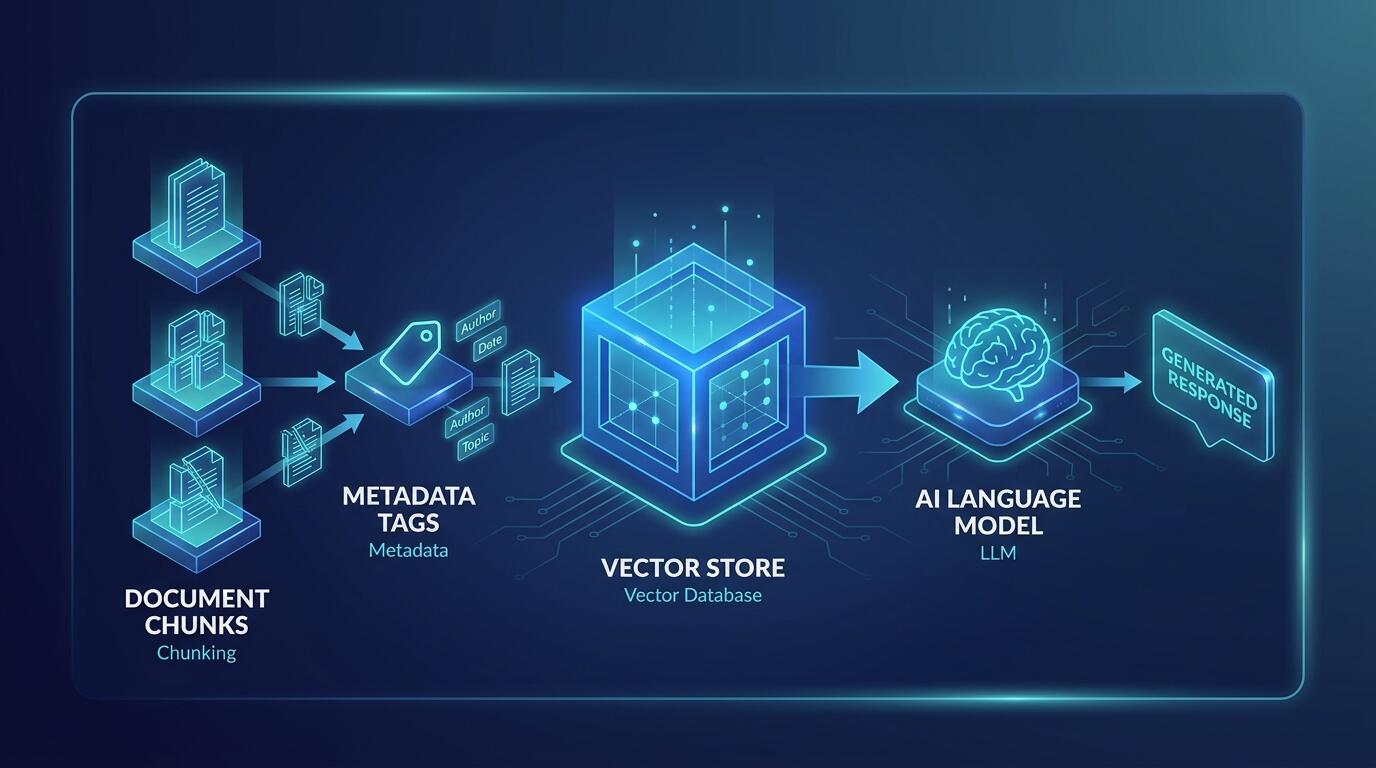
Retrieval-Augmented Generation (RAG) is a technique in which a language model is paired with an external retrieval system so it can ground its responses in specific documents or knowledge bases rather than relying solely on parameters learned during training. It has become one of the most practical patterns for shipping AI products that need to stay accurate and up to date. But here's what most tutorials skip: getting RAG to work in a demo takes an afternoon; getting it to work reliably in production requires deliberate decisions about how you slice your data and how you label it.
This guide is for engineers and technical product builders who are standing up their first RAG pipeline — or who have a pipeline running but are seeing degraded retrieval quality and aren't sure why. We'll cover chunking strategy and metadata design in concrete, opinionated terms, grounded in patterns I've seen work (and fail) across the AI products I run.
Before You Start: Prerequisites and What to Have Ready
Before you touch chunking configuration or metadata schemas, you need a clear picture of your source material and your retrieval goal. Jumping straight into splitting logic without this context is one of the most common early mistakes — it leads to configurations that look fine on toy examples but fall apart on real queries.
Here is what you should have in place before working through the steps below.
A corpus you understand. Know your document types before you design chunks. Are your documents long technical manuals with structured sections, or short news articles with dense paragraphs? Are they mostly prose, or do they contain tables, code blocks, and bullet lists? The answer directly shapes which chunking approach is appropriate.
An embedding model selected (or at least shortlisted). Chunking decisions interact with your embedding model's context window. Different models handle different token lengths with varying quality. Know the model you're working with before locking in chunk sizes.
A vector store or retrieval backend provisioned. You don't need it fully configured, but you should know which system you're using — whether that's a managed service or an open-source database — because metadata filtering capabilities vary significantly across backends.
A basic understanding of vector similarity search. You don't need to understand the mathematics deeply, but you should understand that retrieved chunks compete by similarity score, and that returning the wrong chunk with high confidence is a real failure mode.
A set of representative test queries. This is non-negotiable. Without a small evaluation set — even five to ten realistic user questions — you have no signal on whether your chunking decisions are improving or degrading retrieval quality.
Time and effort. Expect to spend meaningful time iterating. The initial setup of a chunking pipeline is relatively fast; the evaluation and tuning loop is where the real work lives. There is no shortcut around empirical testing on your own data.
Checklist before starting:
- Source documents assembled and understood (format, length, structure)
- Embedding model chosen with context window limits noted
- Vector store backend selected
- At least five representative test queries written down
- Basic retrieval pipeline scaffolding in place (even if not yet tuned)
- A simple evaluation method ready (even manual spot-checking is enough to start)
Step-by-Step: Designing Your RAG Chunking and Metadata Strategy
Step 1: Understand What a Chunk Actually Represents
A chunk is a segment of text that will be independently embedded and stored as a single retrievable unit. When a user submits a query, the retrieval system compares the query embedding against chunk embeddings and returns the most similar ones — these chunks are then passed to the language model as context.
The core tension in chunk design is this: chunks that are too small lose surrounding context and retrieve fragments that are hard for the model to reason over; chunks that are too large dilute the relevance signal and may exceed the model's effective context window. Neither failure mode is obvious until you test with real queries.
Tip: Think of each chunk as a unit of meaning that should be able to answer something on its own. If a chunk makes no sense in isolation, it will likely make retrieval worse, not better.
Step 2: Choose a Chunking Strategy That Matches Your Document Structure
Different chunking strategies suit different document types. A fixed-size strategy splits documents into equal-length segments, which is simple to implement but structurally naive — it will cut sentences, split table rows, and sever list items mid-thought. A sentence-based or paragraph-based strategy respects linguistic boundaries and tends to produce more coherent chunks from prose-heavy documents. A hierarchical or recursive strategy attempts to split by document structure first (headings, sections) and falls back to smaller units when sections are too large.
For structured documents like API reference pages, legal contracts, or technical specifications, structure-aware chunking that follows headings and sections consistently outperforms character-count splitting. For conversational or unstructured text, sentence or paragraph boundaries are usually a better guide than arbitrary token counts.
One pattern that consistently surfaces in production RAG systems is the use of overlapping chunks — where consecutive chunks share a short overlapping window of text. Overlap helps preserve context at chunk boundaries and reduces the chance that a relevant answer gets split between two non-adjacent chunks. The tradeoff is increased index size and some redundancy in retrieval results.
Tip: Start with a structure-aware strategy and add overlap only after you've confirmed that boundary splits are causing retrieval failures. Don't add complexity preemptively.
Step 3: Define Your Chunk Size Empirically, Not by Convention
There is no universally correct chunk size. Any specific token count you find cited online reflects a particular combination of corpus type, embedding model, and retrieval task. Treating it as a default is a mistake.
The right approach is to pick a reasonable starting range based on your embedding model's characteristics, index a sample of your corpus, run your evaluation queries, and then adjust based on what you observe. Watch for two specific failure patterns: retrieved chunks that are clearly relevant in topic but lack the specific detail the query needs (a signal that chunks are too large and the relevant sentence is buried), and retrieved chunks that contain the right phrase but lack enough surrounding context for the model to use it well (a signal that chunks are too small).
Evaluating chunk quality requires looking at actual retrieved chunks for real queries — not just final model outputs. Debugging at the output level without inspecting retrieved context is like debugging a rendering bug by looking at the final screenshot without inspecting the DOM.
Tip: Keep a simple log of which chunks are retrieved for your evaluation queries. This makes tuning mechanical rather than intuitive.
Step 4: Design a Metadata Schema Before You Index
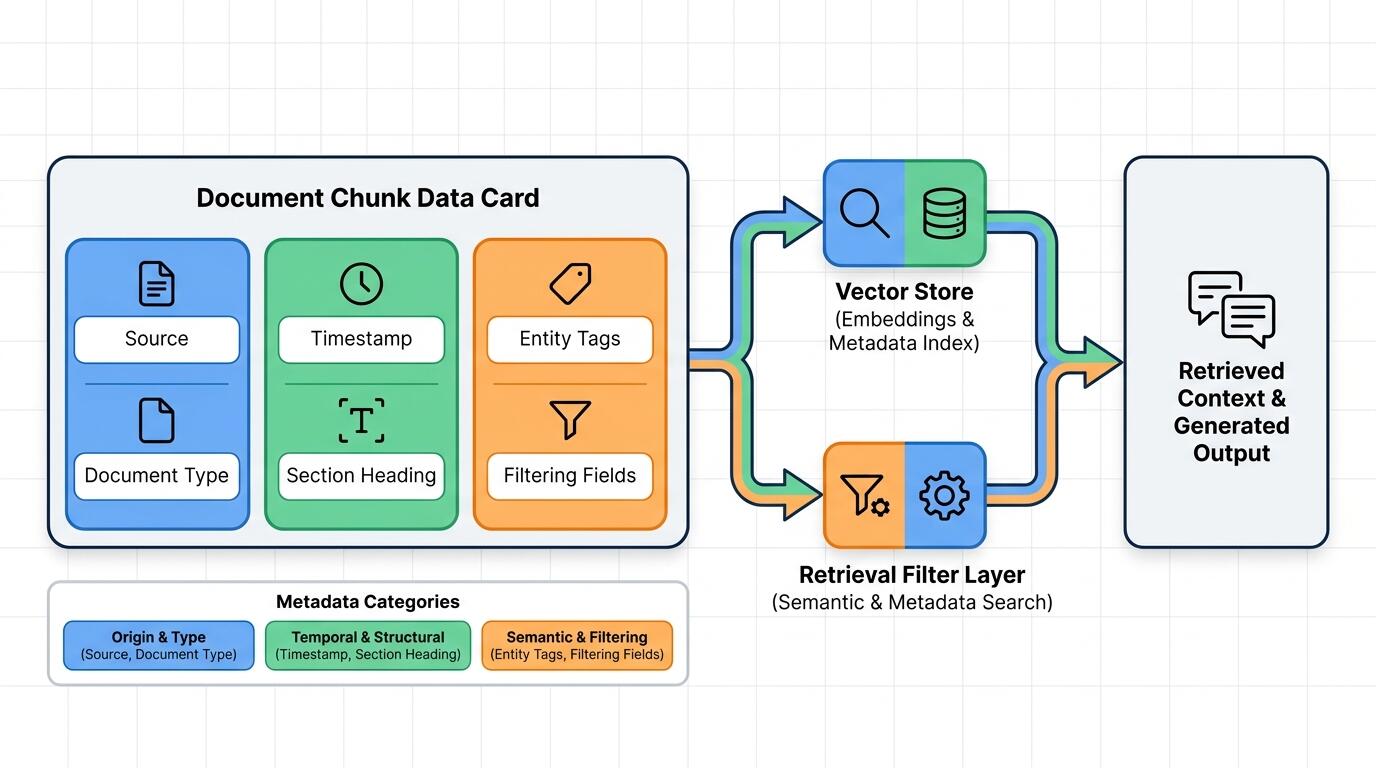
Metadata is structured information attached to each chunk that is not embedded but is used for filtering, ranking, and provenance tracking. A well-designed metadata schema is what separates a RAG system that works in demos from one that holds up under real user load.
At minimum, every chunk should carry the document source (filename, URL, or document ID), the document type or category, and some form of temporal signal if your content changes over time. Beyond that, what metadata matters is specific to your application domain.
For a product that ingests support documentation, useful metadata might include the product version the document applies to, the category of issue it addresses, and whether the content has been reviewed recently. For a research assistant product, metadata might include the authoring organization, the subject domain, and the publication context. The key principle is that metadata fields should correspond to dimensions along which users actually want to filter — not just dimensions that are easy to extract.
A mistake I see frequently is adding metadata fields speculatively ("we might want to filter by this someday") without confirming the backend supports efficient filtering on those fields. Metadata that can't be queried is just storage overhead.
Tip: Before finalizing your schema, write out the five most important filtering queries your application will need to support, and confirm each field is filterable in your chosen vector store.
ALT: Diagram showing RAG metadata schema design with chunk source, document type, and filtering fields for production AI retrieval systems
Step 5: Enrich Chunks with Contextual Metadata at Indexing Time
Static metadata extracted from document properties is a starting point, but the highest-value metadata often comes from processing the document at indexing time. This means extracting section headings and attaching them to chunks that fall within that section, tagging chunks with entity types they contain (product names, dates, locations), and in some cases generating a short summary of each chunk and attaching it as a metadata field.
One approach that has proven particularly useful in practice is storing both the full chunk text for retrieval and a shorter, cleaner summary as a metadata field. The summary can be used as a secondary display field in the UI, or surfaced as part of a re-ranking step before the retrieved chunks reach the model.
This enrichment step is where a well-designed retrieval and verification pipeline pays dividends — the indexing pipeline becomes not just a splitting process but a structured enrichment process that makes every chunk more queryable and more interpretable.
Tip: Section heading metadata is cheap to extract from structured documents and yields disproportionate retrieval quality gains. If your documents have consistent heading structure, always propagate headings down to child chunks.
Step 6: Implement a Retrieval Test Loop Before Connecting the LLM
A pattern I consistently see in teams that ship reliable RAG products is that they decouple retrieval evaluation from model evaluation. Before wiring the retrieved chunks into a language model prompt, they validate retrieval quality in isolation: given a query, do the top-k retrieved chunks actually contain relevant information?
This matters because retrieval failures and generation failures have different root causes and different fixes. Retrieval failures — wrong chunks, irrelevant results, missing chunks — are fixed by adjusting chunking, metadata filtering, or embedding choice. Generation failures — hallucinations, incomplete answers, misunderstandings — are addressed at the prompt and model layer. Conflating the two makes both harder to debug.
Build a lightweight evaluation harness that logs, for each test query: the query text, the top-k retrieved chunks with their metadata and similarity scores, and a manual relevance label (relevant / partially relevant / not relevant). Even a small labeled set gives you a directional signal on whether a chunking change is helping.
Tip: Automate this logging from the start. The cost of setting it up is low; the cost of trying to reconstruct retrieval behavior after the fact when something goes wrong in production is high.
Step 7: Plan for Index Maintenance and Chunk Staleness
RAG systems that work well at launch often degrade gradually as the underlying documents change and the index falls out of sync. A chunk that was accurate when indexed can become misleading or wrong if the source document has been updated — and the retrieval system has no way to know this unless you've built for it.
Document-level versioning in metadata, combined with a strategy for invalidating or re-indexing stale chunks, is essential for any production system with mutable source content. At minimum, track the indexing timestamp and the document modification timestamp as separate metadata fields. This gives you a simple staleness signal you can act on during scheduled re-indexing runs.
For a deeper look at how this kind of pipeline maintenance plays out in a real production system, the build-vs-buy considerations around AI infrastructure choices are worth thinking through early — the decision of how much pipeline logic to own versus delegate to managed services directly affects how much index maintenance you'll be doing by hand.
Tip: Re-indexing is less expensive than it sounds if your chunking and enrichment pipeline is well-structured. Make re-indexing easy to trigger and easy to monitor.
Common Mistakes and How to Fix Them
| Symptom | Likely Cause | How to Fix |
|---|---|---|
| Retrieved chunks are topically relevant but don't contain the specific answer | Chunks are too large; relevant detail is diluted by surrounding text | Reduce chunk size and re-evaluate; consider sentence-level splitting for dense factual content |
| Retrieved chunks contain the right keywords but lack usable context | Chunks are too small; fragments are missing surrounding reasoning | Increase chunk size or add overlap; consider propagating section headings into chunk text |
| Retrieval quality is good for simple queries but degrades on complex or multi-part questions | Single-pass retrieval can't handle questions that span multiple document segments | Implement multi-step retrieval or query decomposition before retrieval |
| Metadata filters return empty result sets unexpectedly | Metadata values are inconsistent or not normalized at indexing time | Enforce metadata validation at indexing; normalize values (e.g., lowercase, trim whitespace) |
| Retrieval quality looks good in testing but degrades in production | Test queries are not representative of real user queries | Expand evaluation set using real query logs; add continuous monitoring |
| Indexing pipeline is slow and fragile on large documents | Chunking and enrichment logic is not handling edge cases (empty sections, malformed structure) | Add robust preprocessing and error handling; log and inspect documents that fail cleanly |
Pro Tips for Better Results
Use hybrid retrieval rather than pure vector search. Pure vector similarity search is excellent at semantic matching but can miss exact keyword matches that matter for specific product names, version numbers, or proper nouns. Hybrid retrieval combines dense vector search with sparse keyword search (such as BM25) and then merges results. Many production RAG systems see meaningful retrieval quality improvements from this approach without significant added complexity.
Separate your chunk text from your embedding text. The text you store in a chunk for display and the text you embed for retrieval don't have to be identical. In some cases, embedding a cleaned or summarized version of the chunk while returning the full original text on retrieval improves both relevance and readability of results. This technique is sometimes called "late chunking" or "embedding-at-index-time enrichment" and is worth experimenting with for document types where raw text is noisy.
Don't ignore re-ranking. Retrieval narrows the candidate set; re-ranking orders it. A cross-encoder re-ranker applied to the top-k retrieved chunks before they're passed to the model can substantially improve the quality of what the model actually sees. This step is often skipped in early implementations because it adds latency, but for precision-sensitive applications it's worth the cost.
Version your index alongside your application. When you update chunking logic or metadata schema, you need to rebuild the index — partial updates lead to inconsistent retrieval behavior that is very hard to debug. Treat your vector index as an artifact with a version, not as a mutable store you modify in place.
A common misconception to correct: Many beginners treat chunk size as a hyperparameter to tune in isolation, running grid searches over token counts without changing anything else. In reality, chunk size interacts with your embedding model, your overlap setting, your metadata schema, and your retrieval k value. Changing one without considering the others can produce misleading results. Tune chunking as part of an end-to-end retrieval evaluation, not in isolation.
People Also Ask
Q1: How do I choose the right chunk size for my RAG system?
Choosing the right chunk size depends on your embedding model's effective context window, your document structure, and the nature of user queries. There is no universally optimal value. A practical starting point is to pick a range aligned with your embedding model's characteristics, index a representative sample, run evaluation queries, and observe retrieval behavior. Chunks that bury relevant detail in surrounding text are too large; chunks that return isolated phrases without usable context are too small. Empirical testing on your own data always outperforms convention.
Q2: Is metadata filtering necessary for a basic RAG pipeline?
Metadata filtering is not strictly required for a minimal RAG prototype, but it becomes important quickly in production systems. Without metadata filtering, retrieval relies entirely on vector similarity, which can surface outdated, irrelevant, or inapplicable chunks — especially when the corpus covers multiple product versions, time periods, or topic domains. Even a minimal metadata schema (source document, document type, indexing timestamp) meaningfully improves the reliability of retrieval in real-world conditions and makes debugging much easier.
Q3: How long does it take to set up a production-ready RAG chunking pipeline?
The initial implementation of a chunking and indexing pipeline can be completed in a short period for a well-scoped corpus. However, "production-ready" requires an evaluation loop, metadata validation, staleness handling, and index maintenance strategy — work that typically takes several iterations beyond the initial build. The most time-consuming part is not the code but the evaluation: writing representative test queries, inspecting retrieved chunks, and iterating on configuration. Teams that skip this step ship pipelines that look fine in demos but degrade under real usage.
Key Takeaways
- RAG chunking is not a one-time configuration decision — it is an empirical tuning loop that requires real evaluation queries and inspection of actual retrieved chunks, not just final model outputs.
- Chunk size should be determined by document structure and embedding model characteristics, not by convention. Chunks that are too large dilute relevance; chunks that are too small lose context.
- Metadata is the control plane of your retrieval system. A well-designed metadata schema enables filtering, provenance tracking, and staleness management — all of which are necessary for production reliability.
- Retrieval evaluation and generation evaluation are distinct problems. Debug them separately, with a retrieval-only evaluation step before wiring the LLM.
- Index maintenance is part of the system design, not an afterthought. Track document versions and indexing timestamps from the beginning so you can detect and remediate stale content.
The natural next step after working through these fundamentals is to evaluate your retrieval pipeline on a real query set and instrument it with logging that gives you visibility into what gets retrieved and why. If you're still making infrastructure decisions — what to build, what to buy, how to structure the pipeline — that's the right time to work through the full architecture before committing.
If you're building AI products and want to cut through the noise, subscribe to the Darius bilingual AI newsletter — each issue covers the developments that actually matter for production systems, with first-hand context from someone running AI products daily. Visit Darius to get precise, actionable analysis alongside engineers who are building at the frontier.
Sources
- Atlan. "Chunking Strategies for RAG: A Complete Guide for 2026".
https://atlan.com/know/chunking-strategies-rag/ - YouTube / AI Retrieval Education. "Chunking, Metadata & Indexing for Better AI Retrieval".
https://www.youtube.com/watch?v=3p9UnvgR4DI - Amir Malik. "RAG Embeddings, Chunking, and Retrieval Basics".
https://amirmalik.net/2025/08/26/rag-embeddings-chunking-retrieval-basics - IEEE. IEEE Standards for Artificial Intelligence and Machine Learning Systems.
https://www.ieee.org/ - ACM (Association for Computing Machinery). Research and Publications on Information Retrieval and Natural Language Processing.
https://www.acm.org/
Note: Standards and best practices in AI retrieval systems evolve rapidly. Check the latest official documents and consult technical advisors when making production architecture decisions.