Avoiding AI Feature Bloat: Staying Focused on Core Product Value in 2026

ALT: Engineering team avoiding AI feature bloat to maintain core product value in 2026
Why AI Feature Bloat Is the Quiet Product Killer of 2026
The single question most AI-powered product teams are wrestling with right now is deceptively simple: when do you stop adding? The thesis here is direct — in 2026, the products that win are not the ones with the most AI capabilities; they are the ones that relentlessly subordinate every AI feature to a sharply defined core value proposition, and have the discipline to cut everything else.
This topic deserves a sharper analysis now because the conditions that produce bloat have never been more favorable. Foundation models are cheaper, APIs are more accessible, and the pressure on product teams to appear "AI-forward" has reached a peak that feels less like strategy and more like marketing anxiety. The result, across a broad swath of startups and enterprise teams alike, is products that do many things adequately and almost nothing exceptionally well.
How We Got Here: The AI Capability Explosion and Its Consequences
AI feature bloat is the phenomenon in which a product accumulates AI-powered capabilities beyond what its core user value requires, resulting in a product that is harder to use, more expensive to maintain, and less trustworthy to the users it was meant to serve.
The conditions enabling this pattern have been building for several years. The rapid commoditization of large language models and multimodal AI systems means that nearly any engineering team can bolt on summarization, classification, generation, or recommendation with relatively modest effort. What once required months of custom model training now takes days of prompt engineering and API integration. According to the Stanford HAI AI Index, the cost of AI inference has dropped dramatically year over year, making experimentation cheap — sometimes dangerously so.
This affordability has coincided with a wave of investor and stakeholder pressure to surface AI features prominently in product roadmaps. The pattern we consistently see in our work with clients is that roadmap conversations shift from "what does the user need next?" to "how do we show AI doing more?" Those are fundamentally different questions, and confusing them is where the trouble starts.
The market has responded accordingly. A generation of products now ships with AI assistants, smart suggestions, automated workflows, predictive dashboards, and generative content tools layered on top of one another — each individually defensible, collectively incoherent. User onboarding becomes a maze. Core workflows get buried under contextual menus. The product's original promise gets diluted by the weight of its own capabilities.
The enterprise software world has seen this pattern before with workflow automation and analytics dashboards in the previous decade. What is different now is the speed of accumulation and the opacity of the added complexity. When you add a new analytics widget, users can see and ignore it. When you add an AI layer that rewrites query results or reranks search, the effect on behavior is invisible and often unintentional. Bloat becomes architectural before it becomes apparent.
The Root Causes: Why Smart Teams Still Build Bloated Products
AI feature bloat rarely happens because a team lacks intelligence or intention. It happens because specific, well-documented organizational and technical forces push toward accumulation and against focus.
The Demo-Driven Roadmap
The most common driver is what practitioners often call the demo-driven roadmap — features scoped primarily for their impressiveness in pitch decks, investor reviews, or conference demonstrations rather than for their contribution to daily user value. A conversational AI layer looks extraordinary in a fifteen-minute demo. In production, where users are not onboarded, motivated, or patient, it often becomes an obstacle that a simpler UI element would have handled better. Teams ship the demo feature, never revisit it, and the product carries the maintenance cost indefinitely.
Competitive Mimicry Under Uncertainty
Competitive mimicry is the second major driver. When a market leader ships a new AI capability, product teams face immediate pressure to match it — not because the capability fits their product, but because absence looks like a gap. This is particularly acute for startups whose competitive positioning is fragile. The risk calculus is asymmetric in the wrong direction: the cost of not shipping the feature feels concrete (a lost deal, a negative comparison), while the cost of shipping it feels abstract (increased complexity, diluted focus). Over time, products in the same market converge toward the same bloated feature set regardless of whether it serves any of their specific user bases.
Underestimating the Maintenance Surface
A pattern that consistently surfaces in technical audits is the underestimation of the AI maintenance surface. A standard software feature, once shipped, is relatively stable. An AI feature has a dependency chain that extends to model providers, embedding pipelines, retrieval systems, evaluation harnesses, and monitoring infrastructure. Per guidance published by the IEEE on AI system reliability, AI components in production require ongoing behavioral monitoring in ways that traditional deterministic code does not. Each AI feature added to a product multiplies the surface area that must be observed, tested, and updated when model behavior drifts. Teams that account for development time but not operational burden consistently find themselves overwhelmed six months post-launch.
The Absent Removal Reflex
Finally, most product processes have a strong instinct for addition and a weak instinct for removal. Shipping a new feature is legible progress. Removing an underperforming one requires justification, stakeholder negotiation, and the willingness to absorb short-term friction. In AI products, this asymmetry is particularly costly because underperforming AI features are not inert — they consume infrastructure budget, introduce latency, and create unpredictable user experiences. Without a structured process for deprecation, the feature set grows monotonically toward incoherence.
Misaligned Success Metrics
Underlying all of these is a metric problem. Teams that measure success by feature count, AI call volume, or capability breadth will build bloated products by design. The organizations that avoid this trap measure the right things — task completion rate, time-to-value for new users, retention at specific workflow stages, and the frequency with which users actually engage with AI-driven outputs versus ignoring or overriding them.
Evidence and Approaches: What Focus Actually Looks Like in Practice
The case against AI feature bloat is not a case against ambition. It is a case for sequencing. The most defensible AI products in production today are characterized by a narrow, well-defined problem scope, a small number of AI interactions that are deeply integrated into core workflows, and infrastructure designed to support those interactions reliably at scale.
In our work with clients building AI-powered products, the teams that ship durable value share a consistent pattern: they define the one or two user outcomes that justify the product's existence, and they evaluate every proposed AI capability against its contribution to those outcomes. Features that fail that test go to a backlog — not because innovation is unwelcome, but because premature complexity is a form of technical debt with an AI-specific compounding rate.
It is also worth noting what the research community has documented about user trust in AI systems. According to the MIT Sloan Management Review's ongoing coverage of enterprise AI adoption, user trust in AI-assisted tools declines sharply when the AI's behavior is unpredictable or inconsistent. Every additional AI feature added to a product is another opportunity for unpredictable behavior, and unpredictability compounds across features. A product with five AI capabilities, each individually imperfect, does not deliver average reliability — it delivers the joint probability of all five behaving well simultaneously, which is substantially lower.
The build-versus-integrate decision is also directly relevant here. Teams considering whether to develop proprietary AI capabilities or integrate third-party models should treat scope control as a first-order criterion — and the build vs. buy framework for AI infrastructure is a useful structure for making that call rigorously rather than reactively.
| Perspective / Approach | Strengths | Trade-offs | Best Fit |
|---|---|---|---|
| Minimum Viable AI (narrow, deep) | High reliability, clear user value, lower operational burden | Slower perceived feature velocity, may feel limited in demos | Early-stage products, domain-specific tools, high-trust use cases |
| Broad AI Feature Portfolio | Comprehensive capability surface, competitive parity | High maintenance cost, diluted UX, trust erosion risk | Mature platforms with dedicated AI ops teams and clear modular architecture |
| AI-as-Infrastructure (embedded, invisible) | Seamless UX, AI enhances rather than interrupts core workflow | Harder to demonstrate AI value explicitly, requires strong evaluation tooling | Products where speed, accuracy, or personalization is the core value driver |
| Modular AI Add-ons (opt-in features) | User control, lower adoption risk, easier to deprecate | Fragmented experience if not designed carefully, feature discovery challenges | Enterprise tools with diverse user segments and variable AI readiness |
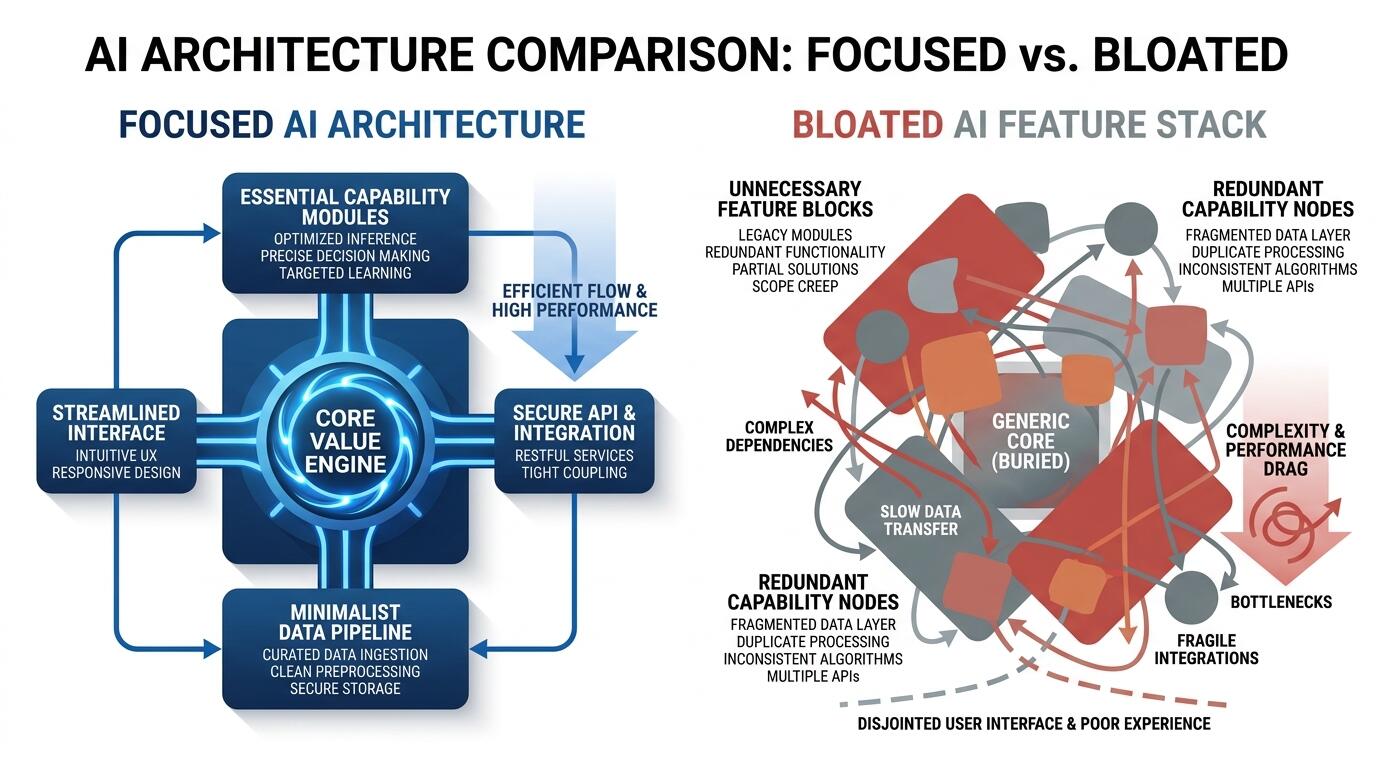
ALT: Side-by-side comparison of focused AI product architecture and bloated AI feature stack showing core product value versus scattered capabilities in 2026
The modular opt-in approach deserves particular attention for enterprise contexts. When AI features are embedded invisibly into workflows without clear user control, the failure mode is invisible too — and invisible failures are the hardest to debug and the most damaging to trust. Giving users the ability to enable, disable, or override AI behavior is not a UX concession; it is a reliability strategy.
For teams thinking through the architectural underpinning of these decisions, the AI system architecture patterns every CTO should evaluate offer a structured lens for ensuring that AI capabilities are designed for coherence rather than accumulation.
Where This Is Heading and What It Means for Your Product
The trajectory in 2026 and beyond points toward a market correction. Products that accumulated AI features during the capability arms race are beginning to face user fatigue, elevated churn at the workflow level, and infrastructure costs that are difficult to justify against measurable outcomes. According to the OECD's ongoing research on AI adoption in enterprises, organizations that struggle most with AI ROI are consistently those that expanded AI capability surface faster than they could build the evaluation and governance infrastructure to support it.
The teams that will lead the next phase are those building with intentional constraint — not because they lack imagination, but because they understand that a product's credibility is earned through reliable delivery of a specific promise, not through the breadth of its feature set.
For founders and CTOs specifically, this means three practical shifts. First, establish a feature value threshold — every proposed AI capability must demonstrate a direct, measurable contribution to the core user outcome before it is scoped. Second, build a deprecation reflex into the product process: features that do not meet engagement or reliability thresholds after a defined evaluation window are removed, not maintained in perpetuity. Third, invest in AI evaluation infrastructure before expanding capability surface. You cannot govern what you cannot observe, and without behavioral monitoring, AI features drift silently toward unreliability.
For teams currently scoping an AI architecture engagement, the questions founders should ask when choosing an AI architecture partner are a useful starting point for ensuring that external expertise is aligned with disciplined product focus rather than feature maximalism.
The directional shift is clear: the AI product market is maturing from "what can AI do?" to "what should this product do with AI?" That is a better question, and the teams asking it first will build the more durable products.
Common Questions
Q1: How do you identify which AI features are contributing to bloat versus genuine product value?
The most reliable signal is whether users actively seek out the feature to complete a task they could not accomplish otherwise, or whether the feature is present but routinely ignored or overridden. In our experience, usage instrumentation at the feature level — not just overall session metrics — reveals this quickly. Features with low engagement, high override rates, or disproportionate infrastructure cost relative to adoption are prime bloat candidates. Start there before adding anything new to the AI surface.
Q2: Is there a risk that removing AI features will make a product less competitive?
The risk is real but often overstated. Competitive differentiation in AI products increasingly comes from reliability, trust, and depth of integration with core workflows — not from feature count. Products perceived as doing one thing exceptionally well tend to generate stronger word-of-mouth and higher retention than those perceived as doing many things adequately. Removal is also reversible; you can re-introduce a capability once the infrastructure to support it reliably is in place.
Q3: How long does it typically take to see the benefit of reducing AI feature scope?
The timeline is context-dependent, but the pattern we consistently observe is that the operational burden reduction — lower infrastructure cost, fewer model-related incidents, simpler evaluation overhead — is felt within a single release cycle. User experience improvements take longer to surface in metrics, typically across one to two full retention cohorts. The key is instrumenting clearly before the change so that you can attribute improvements accurately rather than inferring them qualitatively.
The Bottom Line
Avoiding AI feature bloat is not a defensive strategy — it is a product discipline that compounds over time. The core findings are three:
First, bloat is a structural outcome of specific forces — demo-driven roadmaps, competitive mimicry, underestimated maintenance surface, and absent removal reflexes — not a random or inevitable product of AI development. Understanding the mechanism is the first step to interrupting it.
Second, the products with the highest long-term defensibility are those built on a narrow, deeply integrated AI surface rather than a broad, shallow one. Reliability and trust accumulate around focused capabilities; they erode under the weight of indiscriminate feature addition.
Third, governance and evaluation infrastructure must precede capability expansion. You cannot make good decisions about what to add, keep, or remove without clear behavioral data on how existing AI features are performing in production.
The immediate action is to run an audit. Map every AI capability in your current product against a single question: does this feature directly and measurably contribute to the core outcome your product was built to deliver? The ones that cannot answer that question clearly are your starting point.
If you are working through these architecture decisions and want rigorous technical guidance grounded in shipped production systems, visit Darius — where the focus is on turning ambitious ideas into live, working products, not just well-architected plans.
Sources & Citations
- Stanford University Human-Centered Artificial Intelligence (HAI). "AI Index Report".
https://www.stanford.edu - IEEE (Institute of Electrical and Electronics Engineers). "Standards and Guidelines on AI System Reliability and Behavioral Monitoring".
https://www.ieee.org - OECD (Organisation for Economic Co-operation and Development). "AI Adoption, ROI, and Governance in Enterprise Organizations".
https://www.oecd.org - MIT Sloan Management Review. "Enterprise AI Adoption and User Trust in AI-Assisted Tools".
https://www.mit.edu - NIST (National Institute of Standards and Technology). "AI Risk Management Framework".
https://www.nist.gov
Note: Standards and research findings may be updated; please check the latest official documents or consult professional advisors.