Async Communication Frameworks That Keep Remote Engineering Teams Aligned
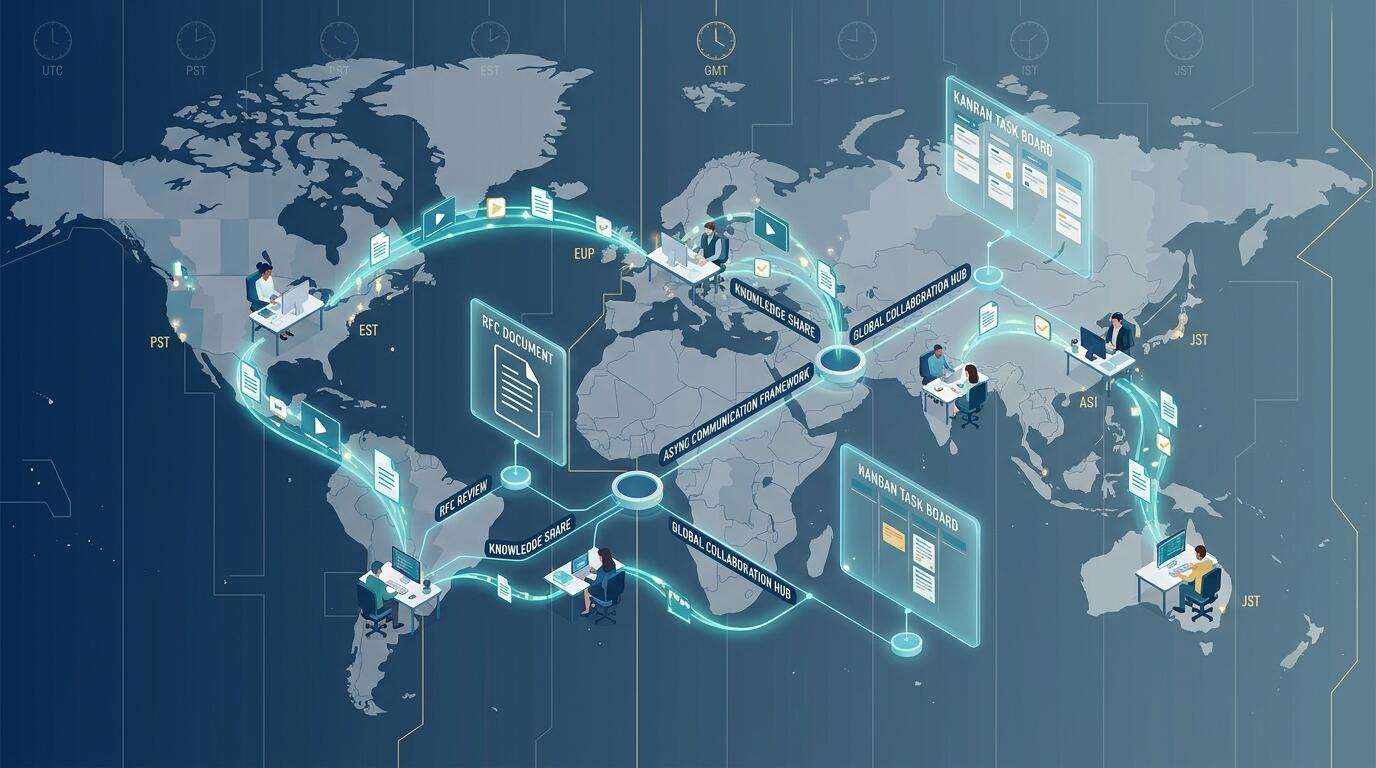
ALT: Async communication frameworks keeping remote engineering teams aligned across time zones
Sync vs. Async: How Remote Engineering Teams Stay Aligned Without Endless Meetings
Picture this: a distributed engineering team spanning three continents, a product deadline approaching, and a critical architectural decision sitting unanswered in a Slack thread because the two people who need to weigh in are nine hours apart. Sound familiar? This is the alignment problem that quietly erodes velocity in remote teams — not a lack of talent or effort, but a breakdown in communication infrastructure.
The good news is that async communication frameworks — structured, intentional systems for moving work, decisions, and context forward without requiring everyone online at the same moment — offer a practical solution. This article compares the dominant approaches to async communication for remote engineering teams: structured documentation-first workflows, asynchronous video and audio tools, and task-centric project management frameworks. We evaluate them against the criteria that matter most to technical leaders: decision latency, context fidelity, team overhead, scalability, and cost-effectiveness.
Evaluation Criteria for Remote Engineering Alignment Frameworks
Choosing the right async communication approach is not about which tool is most popular — it is about which framework actually reduces friction for engineers while keeping product decisions moving. Here are the five dimensions that matter.
Decision latency measures how quickly a team can reach a shared understanding and move forward after a question or blocker surfaces. High latency kills sprint velocity and makes distributed work feel chaotic.
Context fidelity refers to how much relevant background and nuance is preserved when information travels asynchronously. A Slack message can answer a question but strip away the reasoning. A well-maintained architecture decision record preserves the "why," which is invaluable months later during a post-launch review.
Team overhead captures the cognitive and time cost of maintaining the communication system itself. Any framework that requires more energy to sustain than it saves is a liability, not an asset. In a pattern we consistently see across distributed teams, the best systems are the ones that feel lightweight to contributors but dense with information for readers.
Scalability determines whether the framework holds up as the team grows. What works for a five-person startup team often collapses under the weight of a twenty-person engineering org with multiple parallel workstreams.
Cost-effectiveness considers both direct tooling costs and the indirect cost of engineering hours lost to redundant communication. According to research from academic institutions studying distributed work patterns, organizations that invest in structured async practices consistently recover measurable developer hours per week — time that translates directly into shipped features and reduced context-switching.
The Contenders: Three Async Communication Frameworks for Engineering Teams
Documentation-First Workflow (RFCs, ADRs, and Written Decision Records)
A documentation-first workflow is an async communication approach in which written artifacts — Request for Comments (RFC) documents, Architecture Decision Records (ADRs), and structured design documents — serve as the primary medium for proposing, debating, and recording technical decisions.
Organizations like Amazon, Google, and Basecamp have long championed variations of this model, and for good reason. When a team writes before they talk, the quality of the thinking improves. RFC-style workflows force the author to articulate assumptions, constraints, and tradeoffs in full before inviting feedback. Reviewers can respond on their own schedule, and the record of the discussion is permanently searchable.
The headline characteristics of this framework are high context fidelity and strong scalability. The primary cost is the upfront investment in writing discipline. Teams that are not accustomed to structured technical writing often find this framework uncomfortable at first — but in our work with clients building distributed engineering organizations, this discomfort is almost always temporary and pays dividends quickly. For teams building AI-powered products, evaluating AI system architecture patterns through written design docs before committing to an implementation path has repeatedly proven to be one of the highest-leverage practices available.
Asynchronous Video and Audio Tools (Loom, Video Memos, Recorded Walkthroughs)
Asynchronous video and audio tools are platforms that allow one team member to record a video or audio message — a code walkthrough, a design review, a status update — and share it for teammates to watch or listen to on their own schedule.
Loom is the most widely recognized tool in this category, though the pattern itself is framework-agnostic. The core value proposition is that video preserves tone, facial expression, and demonstration capability that text strips away. A two-minute screen recording can convey what would take twenty paragraphs to write and still leave room for misinterpretation.
The headline characteristics here are lower decision latency for nuanced topics and higher engagement for complex demonstrations. The limitation is that video is non-indexable without transcription, which creates a context fidelity problem at scale — you cannot grep a video library the way you can search a documentation wiki.
Task-Centric Project Management Frameworks (Linear, Jira, GitHub Issues with Structured Workflows)
Task-centric project management frameworks are async communication systems built around structured work items — tickets, issues, pull requests — where each unit of work carries its own context, discussion thread, status, and history.
Linear, Jira, and GitHub Issues represent different points on the same spectrum. What unites them is the principle that the work item itself is the communication artifact. Instead of discussing work in a chat thread that scrolls away, the conversation lives attached to the task. Engineers know where to look for context because the system enforces a single source of truth.
The headline characteristics are strong traceability and low decision latency for implementation-level questions. The limitation is that task-centric systems tend to capture the "what" and "when" of work, but not the "why" — which is where ADRs and written design documents serve as a necessary complement. Teams that treat their project tracker as their only async communication layer often find themselves unable to answer "why did we build it this way?" six months after launch.
Head-to-Head Comparison: Async Communication Frameworks for Engineering Teams
| Criterion | Documentation-First (RFC/ADR) | Async Video/Audio | Task-Centric PM Framework |
|---|---|---|---|
| Decision Latency | Moderate — requires writing and review cycle | Low to moderate — fast for nuanced topics | Low — immediate for implementation questions |
| Context Fidelity | High — full reasoning captured in writing | Moderate — tone preserved, but not searchable without transcription | Moderate — captures task history, not architectural intent |
| Team Overhead | Moderate-high — requires writing discipline | Low — quick to produce, requires consumption time | Low to moderate — depends on ticket hygiene |
| Scalability | High — scales well with team size and time | Moderate — video libraries become unwieldy without structure | High — most tools scale with proper configuration |
| Cost-Effectiveness | High — minimal tooling cost, high signal-to-noise | Moderate — tooling costs vary; value depends on consumption habits | Moderate-high — tooling costs significant at enterprise scale, but ROI is strong |
| Search & Discoverability | Excellent — text is inherently searchable | Poor without transcription | Good within the tool, limited cross-system |
| Onboarding Value | Very high — documents serve as living institutional memory | Moderate — recordings go stale | Moderate — ticket history useful, but fragmented |
The most important pattern that emerges from this comparison is that no single framework is sufficient on its own. Documentation-first workflows deliver the highest long-term value in terms of preserved institutional knowledge — but they require deliberate investment in writing culture and are best suited to architectural and strategic decisions. Async video tools are most effective for bridging the nuance gap on complex topics without scheduling a meeting, but they become a liability if treated as a primary record-keeping system.
Task-centric frameworks are the connective tissue of daily engineering execution. They reduce friction for the "what are we doing today?" question but say little about the "why did we make these tradeoffs?" question. In our work with distributed product teams, the highest-performing async communication systems combine all three layers — written records for decisions, video for complex demonstrations, and structured task management for execution — rather than betting everything on one approach.
The cost-effectiveness calculus also shifts depending on team stage. Early-stage teams operating with a small founding engineering group often find that lightweight async video combined with a simple GitHub Issues workflow delivers the best ROI per engineering hour. As the team grows and institutional knowledge becomes a competitive asset, the investment in structured documentation practices compounds significantly.
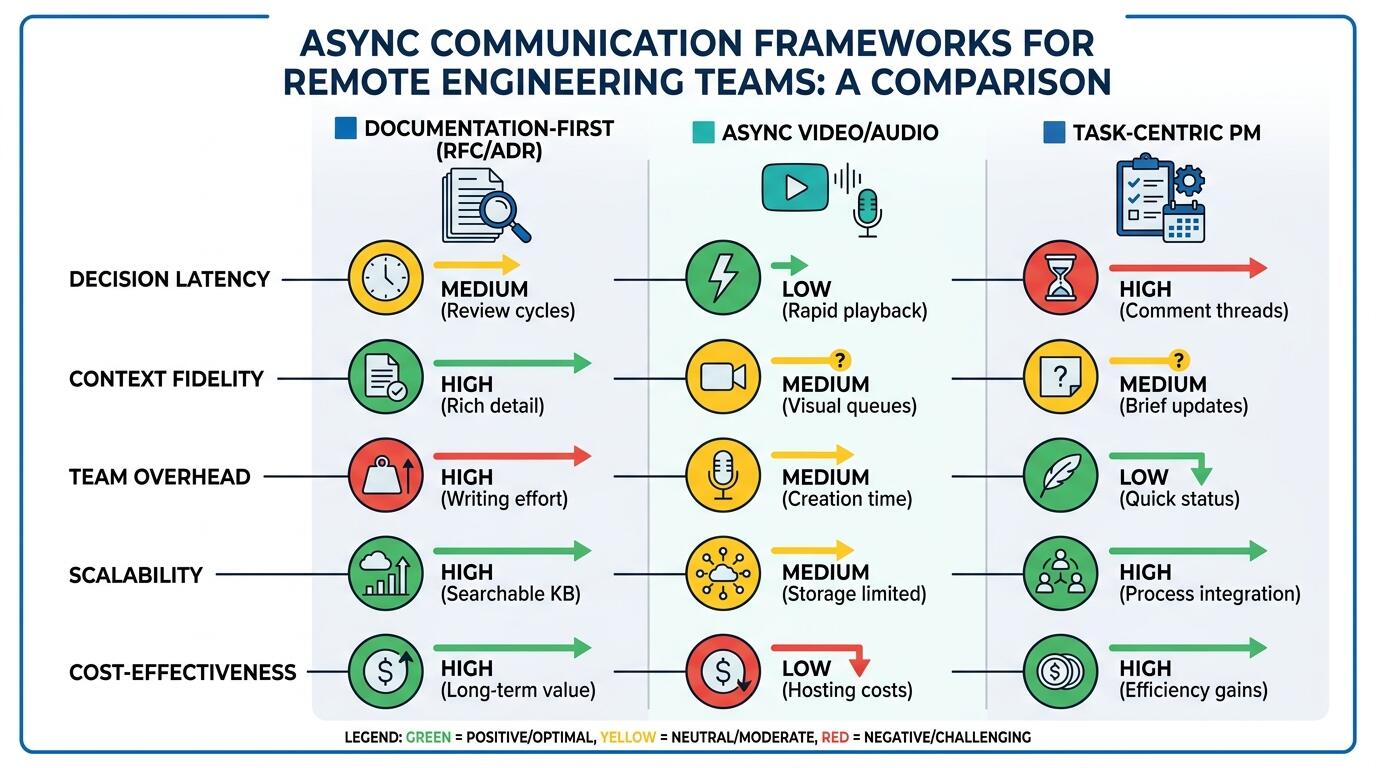
ALT: Comparison table of async communication frameworks used by remote engineering teams to maintain alignment across time zones and decision cycles
Which Should You Choose? Scenario Recommendations for Remote Engineering Teams
The right async communication framework depends on where your team is today, what decisions you are making, and how much alignment overhead you can afford to carry.
If you are a founding engineering team of fewer than ten people shipping your first product, prioritize task-centric tools with strong GitHub integration and supplement with async video for design reviews. The overhead of a full RFC process is likely premature, but beginning to capture lightweight ADRs for major architectural decisions — even as brief GitHub Discussion posts — builds a habit that will pay off at scale. For teams navigating AI product decisions early in their lifecycle, understanding what to ask an AI architecture partner before committing to a technical direction is a worthwhile investment of async documentation effort.
If you are a scaling team of ten to thirty engineers with multiple workstreams running in parallel, invest seriously in documentation-first practices. Decision latency at this scale is almost never caused by a shortage of opinions — it is caused by a shortage of written context that allows people to align without a synchronous call. Establishing a lightweight RFC template and requiring ADRs for all significant architectural choices will reduce your reliance on "let's hop on a call" as a default resolution mechanism.
If you are an enterprise engineering organization where onboarding speed and compliance requirements are significant concerns, your async communication framework is effectively an institutional knowledge management system. Documentation-first workflows and structured task management with strong audit trails are non-negotiable. Async video has a role in internal training and knowledge transfer but should never be the primary decision record.
If your primary bottleneck is time zone spread and your team struggles most with nuanced design conversations, async video tools deserve a serious look. A recorded design walkthrough with timestamped comments can replace a poorly scheduled meeting that half the team attends at an inconvenient hour — and produces a referenceable artifact in the process.
Pros and cons summary for the top choices:
- Documentation-first (RFC/ADR): High long-term value, strong onboarding and compliance fit, requires writing discipline and cultural buy-in.
- Task-centric PM frameworks: Low friction, excellent for execution-layer alignment, insufficient on its own for architectural reasoning.
- Async video/audio: High nuance preservation, low production overhead, limited discoverability without transcription infrastructure.
Common Questions
Q1: How do async communication frameworks reduce meeting load for remote engineering teams?
Async communication frameworks reduce meeting load by shifting the default mode of decision-making from synchronous conversation to structured written or recorded artifacts. When an RFC or a well-formed task ticket carries enough context to allow independent review and feedback, the number of decisions that require everyone online at the same time drops significantly. According to research published by academic institutions studying distributed software teams, teams with mature async practices report meaningfully lower synchronous meeting hours per week without sacrificing decision quality.
Q2: Are asynchronous video tools like Loom effective replacements for written documentation?
Asynchronous video tools are effective supplements to written documentation, but not replacements. Video preserves tone, demonstration, and nuance that text cannot easily convey — making it valuable for design walkthroughs and complex technical explanations. However, video is not searchable without transcription, goes stale as codebases evolve, and cannot serve as a reliable source of institutional memory at scale. The most effective remote engineering teams use async video alongside, not instead of, written decision records.
Q3: How much does it cost to implement a documentation-first async communication framework?
The direct tooling cost of a documentation-first framework is typically low — most teams start with GitHub Wikis, Notion, or Confluence, all of which offer accessible pricing tiers. The real investment is cultural: engineering hours spent writing, reviewing, and maintaining documents. That said, teams consistently find that the indirect cost savings — fewer redundant meetings, faster onboarding of new engineers, and reduced "why did we do it this way?" investigation cycles — make this one of the highest-ROI process investments available to a distributed engineering organization.
Final Thoughts
Remote engineering alignment is not a tooling problem — it is a communication architecture problem. The teams that ship consistently across distributed time zones are not the ones with the largest Slack instance or the most Zoom licenses. They are the ones that have made deliberate choices about how decisions are captured, how context travels through the organization, and how engineers can do their best work without waiting for the next available calendar slot.
Three points worth carrying forward: First, no single async framework is sufficient — the most effective systems layer documentation, structured task management, and async video purposefully. Second, the ROI of investing in communication infrastructure compounds with team size; the right time to establish good async habits is always earlier than it feels. Third, the written record is the most durable asset a distributed team produces — it outlasts any individual contributor and accelerates every new hire who joins after the initial build.
If you are a technical leader responsible for shipping AI-powered products with a distributed team, the quality of your async communication framework is as much a part of your engineering system design as your cloud architecture or your CI/CD pipeline. Treat it accordingly.
Ready to build a technical organization that ships with clarity and confidence — whether your team is in the same city or spread across six time zones? Visit the Darius website to explore real-world engineering insights, shipped project case studies, and practical guidance from an engineering leader who builds and ships alongside you — from first sketch to final deployment.
References & Further Reading
- IEEE Computer Society. "IEEE Software: Distributed and Agile Engineering Practices".
https://www.computer.org/ - Association for Computing Machinery (ACM). "Research on Collaborative Software Engineering and Remote Team Communication".
https://www.acm.org/ - MIT Sloan School of Management. "Studies in Organizational Communication and Distributed Team Effectiveness".
https://mitsloan.mit.edu/ - Stanford University Human-Computer Interaction Group. "Research on Asynchronous Communication Tools and Knowledge Work".
https://hci.stanford.edu/ - Project Management Institute (PMI). "Standards and Research on Remote Project Communication and Team Alignment".
https://www.pmi.org/
Note: Standards and research may be updated; please check the latest official documents or consult professional advisors.