AI Orchestration Frameworks Compared: Which One to Use Right Now
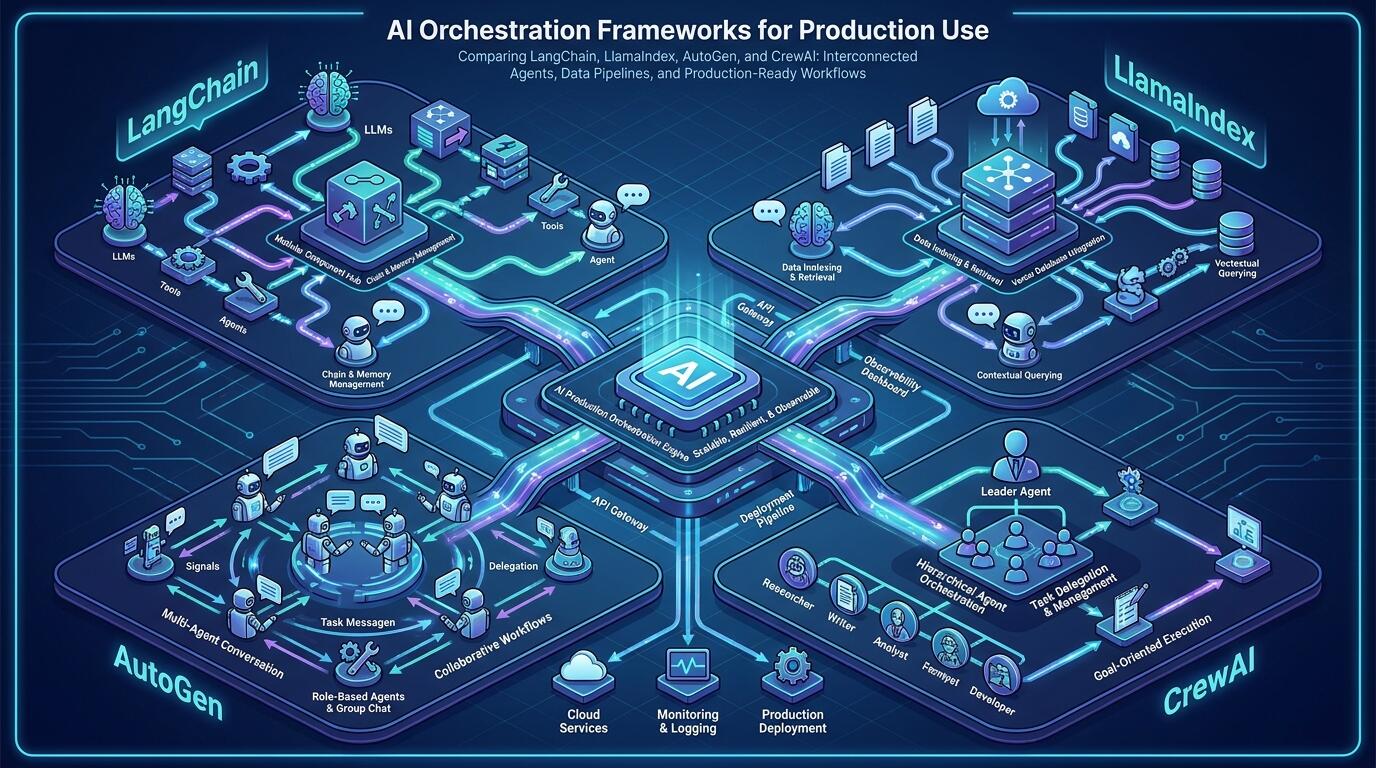
ALT: Comparing AI orchestration frameworks including LangChain, LlamaIndex, and AutoGen for production use
Choosing the Right AI Orchestration Framework: What Actually Matters in Production
You're three weeks into scoping an AI agent system, and the framework question keeps surfacing in every architecture call. The team is split between LangChain's ecosystem breadth, the leaner appeal of LlamaIndex, and the agent-native design of AutoGen. Everyone has an opinion, but nobody has shipped the thing yet — and the wrong choice at this stage will cost you months of refactoring later.
The verdict: there is no universally best AI orchestration framework. The right choice depends on your system's complexity, your team's familiarity, and the specific workloads you're orchestrating. What this article does is cut through the noise and give you a structured basis for that decision — comparing LangChain, LlamaIndex, AutoGen, and CrewAI across criteria that matter in production, not just in demos.
These four frameworks represent distinct architectural philosophies for coordinating AI models, tools, and data pipelines into coherent application workflows. The comparison criteria used here are production readiness, multi-agent capability, developer experience, ecosystem breadth, observability, and community momentum — dimensions that consistently surface as decision factors in real engineering work.
Evaluation Criteria for AI Orchestration Frameworks
Selecting an AI orchestration framework on the basis of GitHub stars or a trending blog post is a pattern that consistently leads to painful rearchitecting. The dimensions below are grounded in what actually matters when a system moves from prototype to production.
Production readiness refers to how well a framework handles real-world demands: error handling, retry logic, streaming support, and deployment maturity. A framework that excels in Jupyter notebooks but falls apart under load or in containerized environments is a liability, not an asset.
Multi-agent capability measures how naturally the framework supports systems where multiple AI agents collaborate, delegate tasks, and maintain shared or isolated state. As compound AI systems become more common — per observations from the research community at institutions like Carnegie Mellon and MIT — multi-agent architectures are increasingly the norm, not the exception.
Developer experience encompasses the quality of documentation, the learning curve for onboarding new engineers, and how much boilerplate the framework demands. In fast-moving projects, developer friction compounds quickly.
Ecosystem breadth covers integrations with LLM providers, vector databases, memory systems, and external tools. A narrow ecosystem forces you to build connectors yourself; a broad one lets you move faster — but also introduces dependency risk.
Observability and debugging is often underweighted until something breaks in production. Frameworks that expose tracing, token usage, and agent decision paths make diagnosis tractable. Those that don't turn production incidents into guesswork.
Community and maintenance momentum determines how long the framework will be a viable long-term bet. A stagnant project means you're eventually maintaining a fork. An overly reactive changelog means your code breaks on every minor release.
The Contenders: Four Leading AI Orchestration Frameworks
LangChain: The Ecosystem Heavyweight
LangChain is an open-source orchestration framework, maintained by LangChain AI, that provides composable abstractions for chaining LLM calls, tools, memory, and retrieval into complex pipelines. It is arguably the most widely adopted framework in this space, with an extensive library of integrations covering dozens of LLM providers, vector stores, document loaders, and agent types.
LangChain's strength is its breadth. If you need to connect an LLM to a SQL database, a PDF reader, a web search tool, and a custom API in a single pipeline, LangChain likely has a built-in integration for each. Its Expression Language (LCEL) provides a declarative way to compose chains, and LangSmith — the companion observability platform — addresses one of the framework's historically weakest areas.
The risk with LangChain is complexity creep. Its abstraction layers can obscure what's actually happening, making debugging difficult without LangSmith. The changelog has historically been aggressive, and teams working on longer-horizon projects have found that API stability is not guaranteed between minor versions.
LlamaIndex: Purpose-Built for RAG and Data-Heavy Pipelines
LlamaIndex is an open-source data framework, developed by LlamaIndex (formerly Jerry Liu's project), designed specifically for building retrieval-augmented generation (RAG) systems and connecting LLMs to structured and unstructured data sources. Where LangChain aims to be a general orchestration layer, LlamaIndex goes deep on data ingestion, indexing, and retrieval.
If your primary workload involves querying documents, knowledge bases, or structured data — and you want fine-grained control over chunking strategies, embedding pipelines, and retrieval ranking — LlamaIndex is purpose-built for exactly that. It also supports agent workflows, but its agent abstractions are less mature than dedicated agent frameworks.
The trade-off is scope. LlamaIndex is excellent for what it does, but teams building complex multi-agent systems with dynamic tool use will find it reaches its limits faster than LangChain or AutoGen.
AutoGen: Microsoft's Agent-Native Framework
AutoGen is an open-source multi-agent orchestration framework developed by Microsoft Research, designed to enable groups of AI agents to converse, collaborate, and autonomously execute multi-step tasks. It takes a fundamentally different approach from LangChain and LlamaIndex: the primary abstraction is the agent, not the chain or the data pipeline.
AutoGen's conversation-driven architecture allows agents to negotiate task decomposition, verify each other's outputs, and loop until a goal is met — a pattern that aligns well with complex reasoning tasks. According to Microsoft Research, AutoGen is designed to support flexible, conversational agent workflows that can incorporate human feedback at configurable points.
The pitfall with AutoGen is that its flexibility can become chaos without disciplined system design. Agents that can freely converse without well-defined termination conditions and guard rails have a tendency to loop indefinitely or produce inconsistent outputs. Production deployments require careful prompt engineering and robust evaluation pipelines — a topic covered in depth in the guide on LLM integration patterns every engineering team should know.
CrewAI: Role-Based Agent Orchestration for Structured Workflows
CrewAI is an open-source framework, independent of any major cloud vendor, that organizes AI agents into "crews" with defined roles, goals, and task assignments. It abstracts multi-agent coordination into a crew-and-task model, where each agent has a declared role (e.g., researcher, writer, reviewer) and operates within a structured workflow.
CrewAI's appeal is its conceptual clarity. The role-based model maps naturally to how humans think about team-based work, making it accessible to teams that are new to multi-agent system design. It has seen rapid adoption since its release, and its integration with LangChain components means existing LangChain users can migrate incrementally.
The limitation is maturity. CrewAI is the newest entrant in this comparison, and its production track record is still accumulating. Teams building mission-critical systems should evaluate its error handling and observability support carefully before committing.
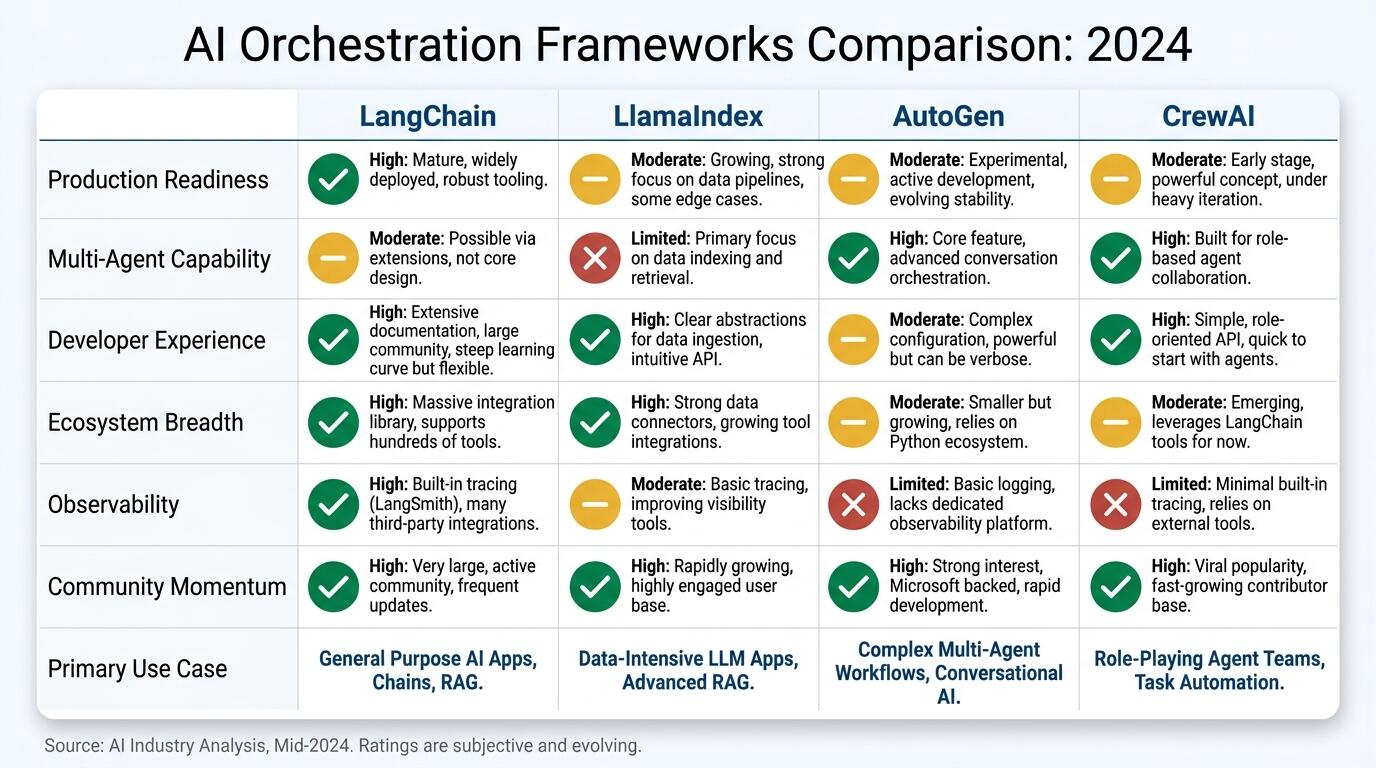
ALT: Comparison table of AI orchestration frameworks LangChain LlamaIndex AutoGen and CrewAI evaluated across production readiness multi-agent capability and observability criteria
Head-to-Head Comparison: LangChain vs. LlamaIndex vs. AutoGen vs. CrewAI
| Criterion | LangChain | LlamaIndex | AutoGen | CrewAI |
|---|---|---|---|---|
| Production readiness | High, with caveats around API stability | High for RAG workloads | Moderate; requires disciplined design | Moderate; maturity still accumulating |
| Multi-agent capability | Supported; via LangGraph extension | Limited; agents are secondary | Native; core design principle | Native; role-based crew model |
| Developer experience | Steep learning curve; rich documentation | Focused and well-documented for RAG | Moderate; Python-native, conversational | Accessible; clear mental model |
| Ecosystem breadth | Widest in class | Strong for data/retrieval integrations | Strong Microsoft/Azure integration | Growing; leverages LangChain integrations |
| Observability & debugging | Good, via LangSmith (paid tiers) | Moderate; improving | Moderate; limited native tooling | Limited; early-stage tooling |
| Community momentum | Very large, active | Large, focused | Strong (Microsoft-backed) | Fast-growing, early-stage |
| Best fit | General-purpose LLM apps & pipelines | RAG-heavy, data-intensive systems | Complex reasoning, multi-step agent tasks | Structured multi-agent team workflows |
The most important distinction in the table above is the split between general-purpose frameworks and specialized ones. LangChain and LlamaIndex are not direct competitors — they solve adjacent problems, and in practice, many production systems use both. A common architecture involves LlamaIndex handling document ingestion and retrieval while LangChain manages the broader pipeline orchestration.
AutoGen and CrewAI occupy a distinct category: they are agent-first frameworks where the orchestration model centers on autonomous agent collaboration rather than deterministic chains. The trade-off is control versus capability — agent-first systems can handle tasks that exceed what static chains can express, but they introduce nondeterminism that demands rigorous evaluation and monitoring. For teams building systems where reliability and predictability are non-negotiable, this nondeterminism is the central risk to manage.
According to a comparative analysis published by TrueFoundry, multi-agent orchestration frameworks vary significantly in how they handle agent memory, state management, and inter-agent communication protocols — and these differences have direct implications for system reliability at scale. A review of agent orchestration platforms by Redis similarly highlights that production viability hinges not just on feature sets but on how well a framework exposes internal state for debugging and monitoring.
For teams designing systems intended to scale to production, the architectural decisions that underpin framework selection deserve careful treatment. The principles covered in this guide on designing scalable AI architecture for production directly complement the framework-selection process discussed here.
Which Should You Choose? Scenario-Based Recommendations
The right framework is determined by the specific demands of your system, not by what's trending on the developer circuit. Here is how to map your situation to the right choice.
If you are building a general-purpose LLM application — chatbots, document Q&A, tool-using assistants — choose LangChain. Its ecosystem breadth means you will rarely hit an integration wall, and LangSmith gives you observability that less mature frameworks cannot match. Accept the complexity tax and invest time in understanding LCEL properly. The biggest mistake teams make here is using LangChain's high-level abstractions without understanding what's happening underneath — this creates brittle systems that are hard to debug.
If your system is primarily retrieval-augmented generation over large or heterogeneous document sets, choose LlamaIndex. Its indexing primitives, query engine abstractions, and retrieval pipeline controls are significantly more sophisticated than what LangChain offers for the same use case. Attempting to replicate LlamaIndex's RAG capabilities in LangChain from scratch is a pattern in our work with clients that consistently results in more code, more bugs, and worse retrieval quality.
If you need to orchestrate complex, multi-step reasoning tasks where agents must decompose problems, verify outputs, and iterate autonomously, choose AutoGen. This is particularly relevant for code generation, research summarization, and tasks where the steps cannot be fully pre-specified. The critical warning: invest in termination conditions and evaluation from day one. AutoGen deployments that skip this step tend to produce spectacular demos and unreliable production behavior.
If your team is newer to multi-agent design and you need a framework with a clear conceptual model and fast ramp-up, consider CrewAI. Its role-based abstraction makes multi-agent coordination legible to a broader team. Use it for workflows where the task structure is relatively well-defined and you can tolerate some observability limitations in exchange for developer velocity.
If you are operating in a Microsoft/Azure ecosystem and need deep platform integration, AutoGen is the natural choice. Its alignment with Azure OpenAI and the broader Microsoft toolchain reduces integration friction considerably.
Pros and cons, distilled: LangChain wins on ecosystem and observability but loses on simplicity and stability. LlamaIndex wins on RAG depth but is narrow in scope. AutoGen wins on agent-native capability but demands the most rigorous engineering discipline. CrewAI wins on conceptual clarity and developer onboarding speed but carries maturity risk.
Common Questions
Q1: How do LangChain and LlamaIndex work together in a production system?
LangChain and LlamaIndex are frequently used in combination rather than as alternatives. A common pattern is to use LlamaIndex for document ingestion, chunking, embedding, and retrieval — where its specialized tooling provides better control over retrieval quality — and then pass retrieved context into a LangChain pipeline for downstream LLM reasoning, tool use, or response generation. This composability is a documented integration pattern supported by both projects, and it avoids forcing either framework to operate outside its strongest domain.
Q2: Is AutoGen suitable for production deployments, or is it primarily a research framework?
AutoGen is designed for production use, but it carries production risks that require deliberate mitigation. Its multi-agent conversation loops can produce nondeterministic behavior if termination conditions and agent prompt boundaries are not carefully specified. According to Microsoft Research, AutoGen supports configurable human-in-the-loop checkpoints precisely to address this. Teams running AutoGen in production should invest in robust evaluation frameworks, structured logging of agent conversations, and well-defined fallback behaviors before launch.
Q3: How long does it typically take to migrate from one orchestration framework to another?
Migration timelines vary considerably based on system complexity and how deeply the original framework's abstractions are embedded in application logic. In our work with clients, teams that built directly against high-level framework abstractions rather than isolating orchestration logic behind clean interfaces consistently face longer migrations. Frameworks like LangChain with frequent API changes amplify this risk. The best mitigation is to treat your orchestration layer as an internal implementation detail — wrap it behind domain-specific interfaces from day one so a framework swap is a bounded refactoring effort, not a full rewrite.
Key Takeaways
Three points bear repeating as you make this decision.
First, framework selection is an architectural decision, not a preference — and it compounds over time. Choosing LangChain when your system is fundamentally a RAG pipeline over internal documents is like using a general-purpose web framework to build a specialized database engine. Match the tool to the dominant workload, not to the framework with the most GitHub stars.
Second, observability is non-negotiable in production AI systems. A pattern we consistently see is teams that defer instrumentation until after launch and then spend weeks diagnosing agent behavior in the dark. Whichever framework you choose, budget for observability infrastructure — whether that's LangSmith, a custom tracing layer, or framework-native tooling — before you ship.
Third, the right architecture isolates your orchestration framework behind clean boundaries. This principle applies equally whether you are building with LangChain, LlamaIndex, AutoGen, or CrewAI. Frameworks in this space evolve rapidly, and the teams that can adapt are those whose application logic is not tightly coupled to any single framework's abstractions.
The next step is to prototype your dominant workload in two candidate frameworks side-by-side — not a toy demo, but a slice of your actual data and task structure. That experiment will surface friction and constraints that no comparison article, including this one, can fully anticipate.
Visit the Darius website to explore real shipped AI products, technical deep-dives on architecture and engineering, and to connect with an Engineering Director who can help you move from framework decision to live product — across the full stack, from system design to deployment.
Sources & Citations
- TrueFoundry. "Best Multi-agent Orchestration Frameworks in 2026".
https://www.truefoundry.com/blog/multi-agent-orchestration-frameworks - Redis. "Compare top 8 AI agent orchestration platforms now".
https://redis.io/blog/ai-agent-orchestration-platforms/ - Domo. "10 AI Orchestration Platform Options Compared for 2026".
https://www.domo.com/learn/article/best-ai-orchestration-platforms - IEEE. IEEE Standards and Publications on AI Systems Engineering.
https://www.ieee.org