Turning an AI Experiment Into a Shippable Product Feature
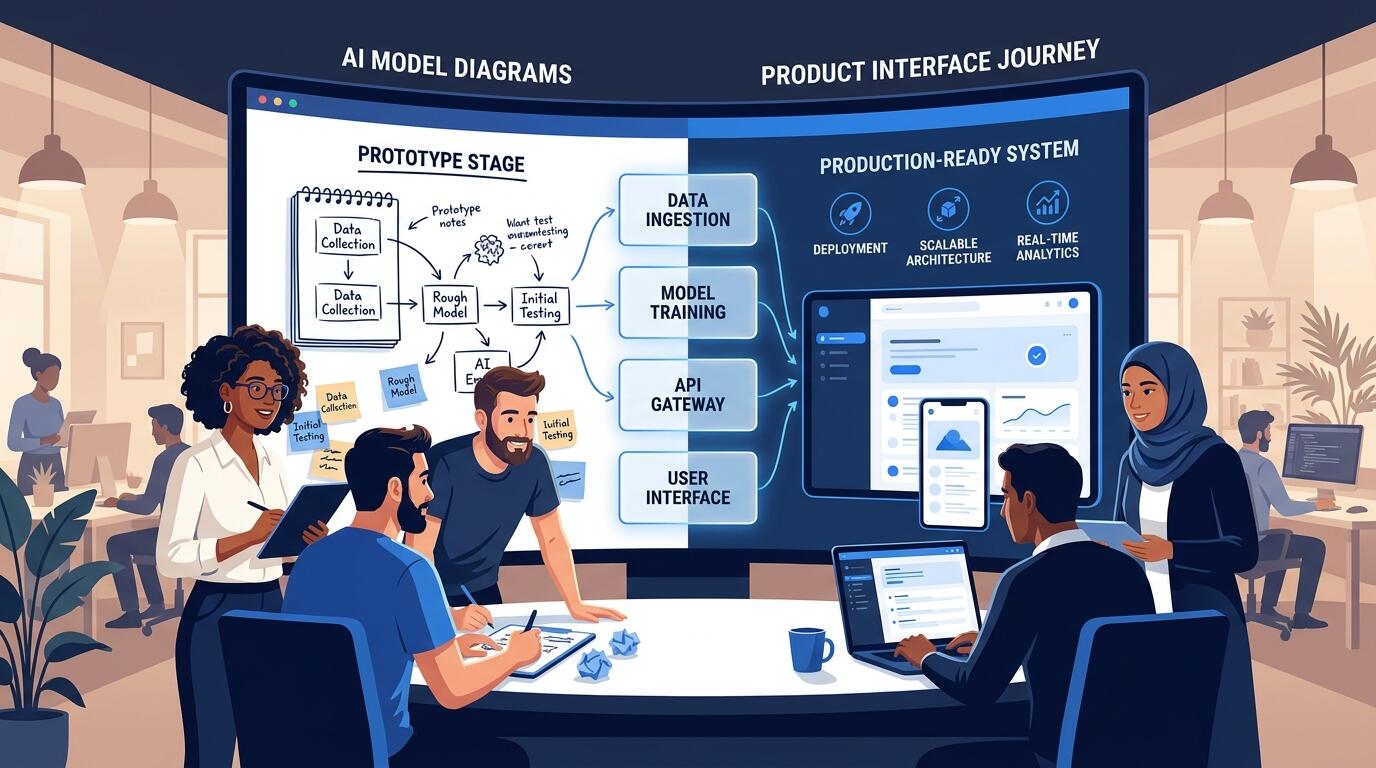
ALT: Engineering team transitioning an AI prototype into a shippable product feature in production
From Proof of Concept to Production: What It Actually Takes to Ship an AI Feature
You've run the experiment. The model performs well in a notebook, the demo impresses stakeholders, and the excitement in the room is real. Then someone asks, "So how do we ship this?" — and the silence that follows says everything. Turning an AI experiment into a shippable product feature is one of the most misunderstood transitions in modern software development, and it's where a disproportionate number of AI initiatives stall out or quietly die.
The core conclusion is this: shipping an AI feature is not a software engineering problem bolted onto a data science problem. It requires a unified approach that treats model behavior, system design, user experience, and operational reliability as a single integrated challenge. Teams that succeed are the ones who stop thinking in stages — "first we build the model, then we productionize it" — and start designing for production from the very first experiment.
This article is a practitioner's guide to that transition. It covers the common failure modes, the structural decisions that matter most, and a concrete path from experiment to live feature — informed by the patterns we consistently see when working with founders and engineering teams on high-stakes AI product launches.
Where This Approach Applies — and Where It Doesn't
This guide is most directly useful in the following situations:
- You have a working AI prototype or proof of concept and need a structured path to make it production-ready.
- You are a founder, CTO, or senior engineer trying to determine which parts of an AI experiment are actually shippable versus which parts need rethinking.
- You are building a user-facing product feature powered by a language model, a recommendation system, a classification pipeline, or a similar AI component — and reliability, latency, and cost all matter.
This approach is less applicable in these cases:
- You are still in early exploratory research with no product hypothesis to validate — in that case, production-readiness thinking is premature and may even be counterproductive.
- You are building internal tooling where failure tolerance is high and users are technically sophisticated enough to work around rough edges.
Why the Gap Between Experiment and Shipped Feature Is Wider Than It Looks
The gap between a working AI experiment and a shippable product feature is wider than most teams expect, and it almost always comes as a surprise. The reason is structural: AI experiments are optimized for insight, while production features are optimized for reliability, predictability, and user value. These are genuinely different goals, and the tools, habits, and success metrics that serve one goal often actively obstruct the other.
In a typical experiment, a data scientist or ML engineer is asking: "Can this model do this task acceptably well on this dataset?" In production, the questions multiply: How does the model behave on inputs it has never seen? What happens when an upstream API times out? How does the feature degrade gracefully when the model returns low-confidence output? Who monitors for drift, and what does a regression look like in terms of user behavior rather than model metrics?
According to research and practitioner reporting from Product School's experimentation resources, a large share of AI product initiatives fail not because the underlying model is inadequate, but because the integration layer — the connective tissue between model output and user-facing behavior — is underdesigned. This is a pattern we see consistently in our work with teams: the model gets 80% of the engineering attention, and the integration layer gets the remaining 20%, even though the integration layer is where most production failures originate.
The broader industry context reinforces this. As AI components become more accessible — through foundation model APIs, open-source frameworks, and cloud-hosted inference endpoints — the barrier to building an impressive demo has dropped significantly. But the barrier to shipping a reliable, maintainable AI feature has not dropped at the same rate. If anything, the operational complexity has grown as systems become more heterogeneous. Understanding AI system architecture patterns every CTO should evaluate is no longer optional — it is foundational to making good decisions early in the build process.
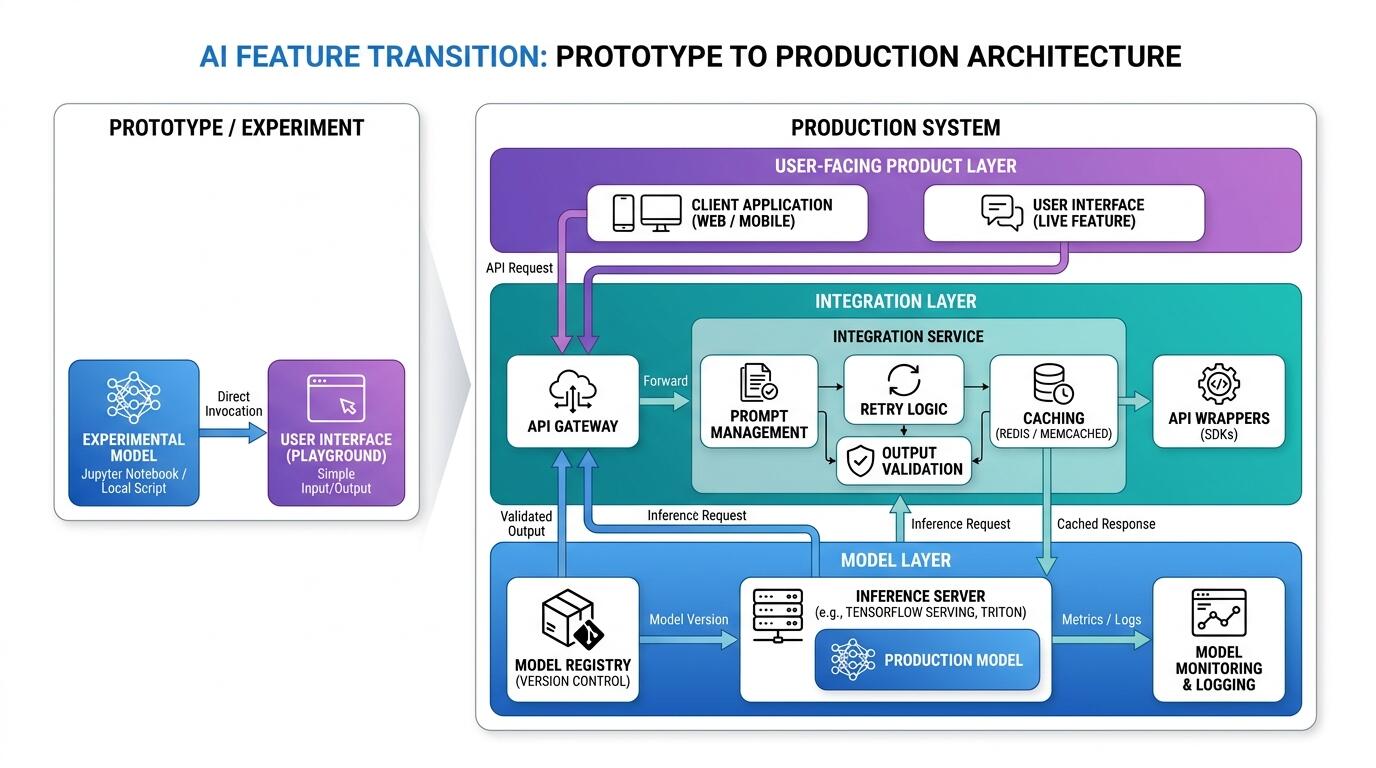
ALT: Diagram showing the transition from AI experiment prototype to production-ready shippable feature with system architecture layers
The Practical Path: From Experiment to Shipped Feature
Three Steps to Start the Transition
Step 1: Audit What You Actually Have
Before writing a single line of production code, do a structured audit of your experiment. Document what the model can do reliably, what it does inconsistently, and what categories of input it handles poorly. This is not a quality gate — it is a scoping exercise. The goal is to define a "safe operating envelope" for the feature: the conditions under which the AI component can be trusted to behave well enough to be useful. This typically takes a few focused working sessions and should involve both whoever built the experiment and whoever will own the product surface.
Step 2: Design the Integration Contract
An integration contract is a definition — ideally written, not just understood — of how the AI component will interact with the rest of the system. It specifies what inputs the model receives, in what format, from what source; what outputs it produces; what happens when output is unavailable, low-confidence, or malformed; and what the fallback behavior is. Teams that skip this step tend to discover its absence painfully, when a model timeout cascades into a broken user experience with no graceful degradation path. This design work typically surfaces dependencies and edge cases that the experiment phase never encountered.
Step 3: Build the Observability Layer Before the Feature Layer
This is the most counterintuitive step, and it is the one most frequently skipped in favor of moving fast. Before you build the user-facing surface of the AI feature, instrument the system so you can see what is happening in production. That means logging model inputs and outputs (with appropriate data privacy controls), tracking latency and error rates at the inference layer, and defining at least one behavioral health metric that reflects user-facing quality — not just model-level accuracy. According to Optimizely's guidance on AI in product development, teams that establish observability infrastructure early are substantially better positioned to detect and respond to the inevitable drift and regression that comes with live AI systems.
Comparing Approaches to the Experiment-to-Production Transition
Different teams take meaningfully different approaches to this transition, each with distinct tradeoffs. Understanding the options helps you make a deliberate choice rather than defaulting to habit.
| Comparison Dimension | Incremental Integration | Full Rebuild for Production | Parallel Track |
|---|---|---|---|
| Time to first shipped feature | Faster initial delivery | Slower — requires significant upfront investment | Moderate |
| Code quality and maintainability | Risk of experiment-era shortcuts persisting | Higher — designed for production from the start | Variable |
| Model-to-system integration risk | Higher — integration is designed around existing experiment structure | Lower — integration is designed deliberately | Moderate — depends on coordination |
| Suitable team size | Small teams, early-stage products | Larger teams with dedicated ML and platform engineers | Teams that can run parallel workstreams |
| Recommended when | Tight timeline, high uncertainty about user demand | High confidence in product direction, scaling context | Product has proven demand, team has capacity |
In our experience, the incremental integration path is chosen most often — and is also the path that most frequently produces technical debt that becomes a serious drag six to twelve months after launch. The full rebuild feels expensive upfront but often pays for itself quickly in operational stability. The right choice depends heavily on your team's capacity and your confidence in the product direction.
The Integration Layer: Where AI Features Actually Break
The integration layer is the set of components that sit between the AI model and the rest of your product system — the API wrappers, prompt engineering logic, output parsers, caching mechanisms, retry handlers, and routing logic that translate raw model capability into reliable product behavior. This is where AI features most commonly break in production, and it is the layer that receives the least design attention during the experiment phase.
A few integration-layer patterns are worth understanding in detail.
Output validation and fallback design is the practice of treating model output as untrusted input to the rest of your system — the same way you would treat input from an external API. Every AI output that flows into a user-facing surface should pass through a validation step that checks for the expected format, detects failure modes (empty output, truncated output, output that triggers a content filter), and routes to a fallback behavior when validation fails. The fallback does not need to be sophisticated — a sensible default or a graceful error message is far better than a broken UI — but it must exist and must be tested.
Latency budgeting is the practice of explicitly allocating time budgets to each component in the inference pipeline before you build it. AI inference calls, particularly to large language models, are slow by the standards of typical API calls. If your product's user experience depends on a response within a few hundred milliseconds, and your inference call reliably takes several seconds, you have a design problem that cannot be solved by optimization alone. Recognizing this early — during integration design, not after the feature is built — allows you to make the right architectural choices: asynchronous processing, streaming responses, pre-computation, or a different model altogether.
Prompt management as an engineering discipline is a pattern that distinguishes teams who ship reliable AI features from teams who ship brittle ones. Prompts are code. They determine model behavior, and changes to them can have large and unpredictable effects on output. Storing prompts in version-controlled configuration, testing prompt changes against a regression suite, and deploying prompt updates through a controlled process (rather than editing them directly in a database or environment variable) dramatically reduces the risk of silent regressions.
For teams weighing how much of this infrastructure to build versus buy, the build vs. buy decision framework for AI infrastructure is a useful starting point for structuring that conversation with your team.
Operationalizing the AI Feature After Launch
Shipping the feature is not the end of the transition — it is the beginning of a new operational phase that most teams are underprepared for. AI features behave differently from deterministic software features in one critical way: their behavior can change without any code change. Model providers update base models. The distribution of user inputs drifts over time. Prompt interactions that worked reliably at launch begin producing degraded output as context shifts. This means that the operational discipline required to maintain an AI feature is qualitatively different from what most engineering teams are accustomed to.
Effective post-launch operations for an AI feature require three things. First, a behavioral monitoring system that tracks user-facing quality signals — not just infrastructure metrics like uptime and error rate, but signals that reflect whether the AI component is actually doing its job. Second, a feedback loop that routes production failures and edge cases back to the team that owns the model and integration layer, so they can respond to real-world behavior rather than hypothetical test cases. Third, a lightweight governance process that defines who owns the decision to change the model, the prompts, or the fallback behavior — and what level of testing is required before those changes go live. According to LinkedIn practitioner reporting on AI-powered product development, teams that establish these operational habits early ship subsequent AI features significantly faster, because they have the infrastructure and the institutional knowledge to move with confidence.
Advanced Considerations for Teams Ready to Scale
Once you have shipped your first AI feature and established the operational basics, a new set of challenges emerges. These are worth anticipating rather than discovering under pressure.
Handling non-determinism at scale becomes a product design challenge, not just an engineering one. When your AI feature is used by thousands of users, the variance in model output that was acceptable in a low-traffic context can produce a long tail of user experiences that range from excellent to genuinely harmful. This requires investing in output quality distribution — understanding not just average output quality but the shape of the distribution, and designing the product to handle the low end of that distribution gracefully.
Cost management at scale is frequently underestimated. AI inference costs — particularly for large language model APIs — can grow non-linearly with usage, and the cost profile of a feature that works fine at low traffic can become unsustainable at scale. Understanding the real cost structure of your inference pipeline before you scale is essential. The practical analysis of what it costs to run an AI system in production for a month gives a concrete picture of the cost dynamics that teams need to plan around.
A common misconception worth addressing directly: many teams believe that once a model is performing well on their evaluation benchmark, the hard work is done. In practice, benchmark performance and production performance are often weakly correlated, because benchmarks are designed around anticipated inputs and production surfaces genuinely novel ones. The hard work of making an AI feature reliable in production is largely the work of discovering and handling inputs and contexts that your benchmark did not anticipate.
Frequently Asked Questions
Q1: How do you know when an AI experiment is ready to be turned into a product feature?
An AI experiment is ready for the transition to a product feature when it meets three conditions: it performs reliably within a well-defined operating envelope (a specific range of inputs and contexts), the failure modes outside that envelope are understood and can be handled gracefully, and there is a clear user value proposition that justifies the operational investment of running the feature in production. Readiness is not about achieving perfect model performance — it is about having enough understanding of the model's behavior to design around its limitations.
Q2: Is it necessary to rebuild an AI experiment from scratch for production, or can you productionize the existing code?
In most cases, some degree of rebuilding is necessary, but a full rewrite is rarely required. The experiment code typically needs to be refactored significantly: dependencies need to be pinned, error handling needs to be added throughout, the integration layer needs to be designed deliberately, and observability infrastructure needs to be built in. Teams that try to ship experiment code to production without this work typically encounter reliability problems within weeks. The practical question is not whether to refactor, but how much — and the answer depends on the quality of the original experiment code and the reliability requirements of the production context.
Q3: How long does the transition from AI experiment to shippable feature typically take?
The timeline varies considerably based on the complexity of the AI component, the maturity of the existing product infrastructure, and the team's familiarity with AI system operations. In our experience with clients across different contexts, a well-scoped AI feature with a clear integration contract and a small, focused team can move from experiment to initial production deployment in a matter of weeks. A more complex feature, or one that requires significant integration with existing systems, typically takes longer. The most reliable predictor of timeline is not the complexity of the model — it is the clarity of the integration design and the existence of the observability infrastructure before development begins.
Summary
Turning an AI experiment into a shippable product feature is a discipline in its own right — distinct from both research and conventional software engineering, and more demanding than either in some respects.
Key Takeaways:
- The gap between a working prototype and a production-ready AI feature is almost always wider than it appears, because the failure modes of production are fundamentally different from the failure modes of an experiment.
- The integration layer — the components between the model and the user-facing product — is where AI features most commonly break, and it deserves more design attention than most teams give it.
- Observability infrastructure should be built before the user-facing feature, not after, so that production behavior can be monitored and responded to from day one.
- Post-launch operations for AI features require qualitatively different habits than conventional software — including behavioral monitoring, feedback loops, and lightweight governance for model and prompt changes.
- The teams that ship AI features reliably are the ones who treat production constraints as design inputs from the beginning of the experiment, not as deployment problems to solve at the end.
The clearest next step for most teams is to do the audit described in Step 1 of this guide: a structured review of what your experiment can actually do reliably, where it fails, and what a safe operating envelope looks like. That audit almost always surfaces the decisions that need to be made before any production engineering begins — and making those decisions deliberately is what separates teams that ship from teams that stay in demo mode.
If you're ready to move from experiment to live product, visit Darius to explore the technical insights, architecture guidance, and real shipped projects that can help you get there — whether you're a founder, a CTO, or an engineering team that needs a clear path forward.
Sources & Further Reading
- Product School. "The Product Experimentation Playbook for AI PMs".
https://productschool.com/blog/product-fundamentals/product-experimentation - Optimizely. "AI in product development: Here's how to get started".
https://www.optimizely.com/field-notes/articles/how-to-start-using-ai-in-product-development - LinkedIn / Practitioner Community. "AI-Powered Product Development: 21 Ways to Ship Faster".
https://www.linkedin.com/posts/hemansnation_how-ai-product-leaders-are-shipping-faster-activity-7411622929039499264-MPic - IEEE. Standards and technical guidance on AI systems engineering and software reliability.
https://www.ieee.org/
Note: Standards and best practices in AI system development evolve rapidly. Verify the latest guidance from official bodies and consult qualified technical advisors for production-critical decisions.