How AI Creator Tools Are Changing Content Workflows in 2026

ALT: AI creator tools transforming content workflows with intelligent automation and production pipelines in 2026
How AI Creator Tools Are Reshaping the Way Teams Build and Ship Content in 2026
Picture this: a small content team is staring down a quarterly roadmap that would have taken three times their headcount to execute just two years ago. Instead of panicking, they spin up an AI-assisted workflow, and within a week, they're producing at a pace that would have been unthinkable before. This isn't a hypothetical — it's a pattern we consistently see across engineering teams, product studios, and solo creators who have made AI a native part of how they work.
The core conclusion is straightforward: AI creator tools in 2026 are no longer productivity accessories bolted onto existing workflows. They are becoming the workflow itself — reshaping how content is planned, drafted, reviewed, distributed, and iterated. For technical practitioners and product builders, understanding this shift isn't optional. It's the difference between shipping at the speed of the market and perpetually playing catch-up.
This article breaks down what's actually changing, where these tools deliver genuine ROI, and how to build a content workflow architecture that treats AI as a first-class capability rather than an afterthought.
Where These Changes Apply — and Where They Don't
✅ Applicable Scenarios:
- Engineering teams and product studios that produce technical documentation, developer content, or product marketing at scale
- Solo creators and small teams looking to maximize output quality without proportionally scaling headcount or budget
- Technical leads and CTOs evaluating how to integrate AI content capabilities into their product's native experience
❌ Not Applicable/Cautions:
- Workflows requiring high-stakes legal, medical, or regulatory precision where AI-generated content must be rigorously verified before publication
- Contexts where brand voice is so nuanced and relationship-dependent that unreviewed AI output would erode trust with a specialized audience
- Teams that haven't yet established a baseline content strategy — AI amplifies direction, it doesn't replace it
The Shift That's Already Happened: Why 2026 Is a Turning Point for Content Workflows
For years, the conversation around AI and content creation was dominated by demos and prototypes — impressive in isolation, unreliable in production. The tools were good enough to generate a paragraph but not good enough to own a workflow step. That era is over.
What's different in 2026 is the maturation of AI creator tools from single-task assistants into multi-step workflow engines. We're now seeing systems that can handle ideation, drafting, SEO structuring, image captioning, localization, and distribution scheduling — not as separate tools stitched together with duct tape, but as integrated pipelines with shared context and memory.
The market reflects this. Surveys and industry roundups (see References) consistently show that content teams are no longer asking "should we use AI?" but rather "which combination of AI tools gives us the best output-to-cost ratio?" That's a fundamentally different question, and it signals a maturation in how practitioners think about these capabilities.
From a builder's perspective, this matters because the architectural decisions you make now — about which tools you integrate, how you structure your content data, and where you keep humans in the loop — will determine your team's velocity and quality ceiling for the next several years. The teams that treat this as a tooling decision rather than a workflow architecture decision are the ones who end up rebuilding from scratch six months later.
The cost-effectiveness angle is also impossible to ignore. AI creator tools have dramatically compressed the cost-per-piece of content production. But raw volume isn't the win — the win is the reallocation of human creative energy toward strategy, judgment, and refinement, while AI handles the high-frequency, lower-judgment tasks. That's where the real ROI lives.
For teams already thinking about how AI capabilities should be embedded natively into their products — not just their internal workflows — the principles here connect directly to broader questions of the difference between AI prototypes and production-ready AI systems. The same discipline that separates a demo from a deployable product applies to content workflow architecture.
Building an AI-Native Content Workflow: From Setup to Scale
Three-Step Quick Start
Step 1: Audit Your Current Workflow for AI-Replaceable Steps
Before touching a single tool, map your existing content workflow end-to-end. Identify every step that is high-frequency, rule-following, or template-driven — these are your best candidates for AI augmentation. Brief generation from a keyword list, first-draft outlines, meta description writing, and image alt-text creation are typical early wins. This audit typically takes a focused half-day session and produces a prioritized list of integration points that will guide your tool selection.
Step 2: Select a Core AI Toolchain Aligned to Your Output Types
Not all AI creator tools are built for the same output format or workflow stage. Choose a primary writing and ideation tool, a visual content assistant if your workflow includes imagery, and a distribution or scheduling layer if you're managing multi-channel publishing. Resist the temptation to adopt every tool at once — a lean, well-integrated stack outperforms a bloated one. Evaluate tools on output quality for your specific content type, integration flexibility (APIs matter), and total cost at your expected volume.
Step 3: Instrument Feedback Loops Before You Scale
This is the step most teams skip, and it's the one that separates sustainable AI workflows from ones that quietly degrade in quality. Before you scale volume, define what "good output" looks like with measurable criteria — readability scores, brand voice consistency checks, SEO structure compliance. Build lightweight review checkpoints into the workflow. The goal isn't to review everything forever; it's to catch drift early and retrain your prompts or tool configurations before bad patterns compound.
Comparing AI Creator Tool Approaches for Content Workflows
The landscape of AI creator tools in 2026 can be broadly categorized into three architectural approaches, each with distinct tradeoffs for teams at different scales and with different technical capabilities.
| Comparison Dimension | All-in-One AI Content Platforms | Modular AI Tool Stacks | Custom AI Pipeline (Built In-House) |
|---|---|---|---|
| Setup Complexity | Low — designed for fast onboarding | Medium — requires integration work | High — requires engineering investment |
| Workflow Flexibility | Moderate — constrained by platform design | High — composable by design | Very High — fully custom |
| Output Quality Control | Platform-dependent | Tunable per tool | Fully controllable |
| Cost Structure | Subscription-based, predictable | Variable, scales with usage | High upfront, lower marginal cost at scale |
| Best Fit | Small teams, fast start | Mid-size teams with technical capacity | Engineering orgs with specific requirements |
| AI Customization Depth | Limited | Moderate | Unlimited |
The right choice depends heavily on your team's technical maturity and content volume. In our work with clients, we consistently see small teams over-invest in custom pipelines before they've validated their workflow, and larger engineering orgs under-invest in customization and end up constrained by platform limitations. Match the architecture to your current stage, not your aspirational one.
The Mechanics of Modern AI Content Workflows — and Where the Real Value Hides
Ideation and Brief Generation at Scale
The first place AI creator tools deliver compounding value is at the top of the funnel: ideation and brief generation. Traditionally, this is where senior creative or editorial talent spent disproportionate time — researching topics, mapping keyword opportunities, structuring content briefs. AI tools can now compress this dramatically.
The practical pattern that works: feed your AI tool a seed topic, a target audience definition, and a set of existing high-performing pieces. Let it generate a structured brief — headline options, key points to cover, suggested internal links, and a recommended structure. A human editor then reviews and refines in minutes rather than building from scratch. The output quality of the brief directly determines the quality of everything downstream, so this is a high-leverage investment point.
Drafting, Editing, and Voice Consistency
AI-assisted drafting has moved well past "generate a blog post and hope for the best." The current best practice is a collaborative drafting model: AI generates a structured first draft based on the approved brief, a human editor refines for voice and accuracy, and AI assists with final polish — checking for consistency, flagging passive constructions, and suggesting stronger transitions.
Voice consistency is the hardest problem to solve at scale, and it's where most teams underinvest. The solution isn't purely technical — it requires building a well-documented style guide and encoding it into your AI tool's system prompt or fine-tuning configuration. Teams that do this work upfront see dramatically more consistent output and spend far less time on revision cycles.
Distribution, Repurposing, and Multi-Channel Adaptation
One of the highest-ROI applications of AI creator tools in 2026 is content repurposing. A single long-form piece — a technical deep-dive, a product walkthrough, a case study — can be automatically adapted into a Twitter/X thread, a LinkedIn post, a short-form video script, and an email newsletter segment. This isn't just about saving time; it's about extracting maximum value from every piece of content your team produces.
The architectural key here is treating your original content as a structured data asset, not just a document. When content is stored with metadata — topic tags, audience segment, key claims, source links — AI tools can repurpose it far more accurately and consistently. This is a workflow design decision that pays dividends over time.
For teams thinking about how to move quickly from concept to deployed capability, the same principles that apply to shipping your first live AI product in 30 days apply here: constrain scope early, instrument feedback loops, and iterate on a working foundation rather than designing the perfect system upfront.
The Human-in-the-Loop Imperative
Here's the opinion that sometimes gets pushback but consistently proves correct in practice: fully automated content workflows are a trap. Not because AI output is bad — it's often impressively good — but because quality drift is invisible until it's a problem. Without human review checkpoints, small errors in tone, factual framing, or brand alignment compound quietly until they become visible failures.
The right model is human-in-the-loop at strategic points: brief approval, post-draft review, and periodic output audits. This keeps the efficiency gains of AI automation while maintaining the quality floor that protects your brand and audience trust. The cost of these checkpoints is small relative to the cost of a quality failure at scale.
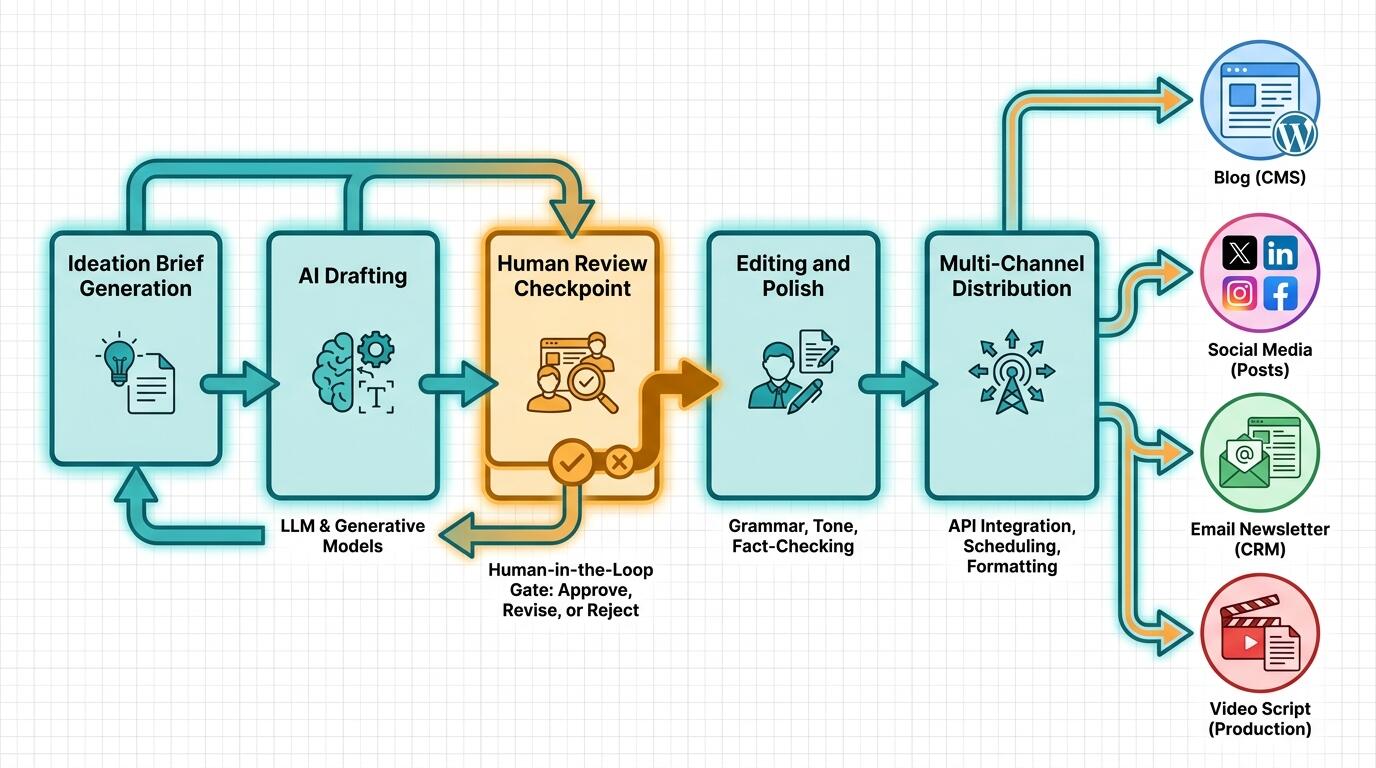
ALT: AI content workflow architecture diagram illustrating automated drafting, human review checkpoints, and multi-channel distribution pipeline for creator tools in 2026
Advanced Considerations: Edge Cases, Misconceptions, and Strategic Tradeoffs
Handling High-Stakes and Regulated Content
AI creator tools are not a universal solution. For content that carries legal, medical, or financial weight, the risk profile of AI-generated output is fundamentally different. In these contexts, AI is best used for structural scaffolding and research synthesis — not final copy. The human review burden doesn't decrease; it shifts. Teams that don't account for this end up with workflows that are fast but legally or reputationally exposed.
The "More Tools = Better Output" Misconception
A pattern we consistently see in teams new to AI-assisted workflows: tool proliferation. They adopt a writing assistant, a separate SEO tool, an image generator, a scheduling platform, and a repurposing tool — and then spend more time managing integrations than creating content. The discipline of a lean stack is underrated. Two or three well-integrated tools with clear ownership of each workflow stage will outperform six loosely connected ones every time.
AI Creator Tools vs. AI-Native Products
There's an important distinction between using AI creator tools to improve your content workflow and building AI as a native capability into your product. The former is an operational efficiency play; the latter is a product architecture decision. Both matter, but they require different thinking. Teams that conflate them often under-invest in one or over-engineer the other. Knowing which problem you're solving keeps your investment calibrated.
Cost Modeling at Scale
The economics of AI creator tools look different at different volumes. At low volume, subscription tools are almost always the right choice — the cost is predictable and the setup overhead is minimal. As volume scales, the per-unit cost of subscription tools can exceed the amortized cost of a custom pipeline. This crossover point is worth modeling explicitly before you commit to a long-term tooling strategy.
Common Questions
Q1: How do I measure the ROI of AI creator tools in a content workflow?
ROI measurement for AI content tools should focus on three dimensions: time saved per content piece, quality consistency (measured by revision cycles and editorial rejection rates), and output volume relative to team size. Avoid measuring only raw volume — a flood of mediocre content is not a win. The most reliable signal is whether your team is spending more time on high-judgment creative work and less on mechanical production tasks. Track this qualitatively through team retrospectives as well as quantitatively.
Q2: Are AI-generated content workflows reliable enough for enterprise-scale production?
Enterprise reliability depends heavily on workflow design, not just tool quality. AI creator tools at the enterprise level require structured prompt management, version-controlled style guides, and defined human review gates. Teams that treat AI tools as plug-and-play solutions at enterprise scale consistently encounter quality drift and brand consistency issues. With proper instrumentation and governance, AI-assisted workflows are production-reliable — but they require the same engineering discipline as any other production system.
Q3: What is the typical timeline and cost to implement an AI-assisted content workflow?
A lean AI content workflow — covering drafting, editing assistance, and basic repurposing — can typically be operational within a few weeks for a small team using existing platforms. The investment is primarily in workflow design and prompt engineering, not tooling cost. More sophisticated custom pipelines require engineering resources and a longer build cycle. Cost scales with customization depth and output volume; most teams find that starting with a subscription-based stack and migrating to custom infrastructure only when volume justifies it is the most cost-effective path.
The Bottom Line
The shift in AI creator tools from novelty to infrastructure is complete. In 2026, the question isn't whether to integrate AI into your content workflow — it's how to do it with enough architectural discipline to get compounding returns rather than compounding technical debt.
Three things matter most:
First, treat workflow design as a first-class engineering problem. The tools are only as good as the system you build around them. Brief quality, style guide encoding, and feedback loop instrumentation determine your output ceiling.
Second, keep humans in the loop at strategic points. Automation without oversight is a quality risk at scale. The efficiency gains are real, but they require governance to be sustainable.
Third, match your tooling architecture to your current stage. A lean, well-integrated stack beats a sprawling one at every scale. Model your costs explicitly and migrate to more custom infrastructure only when the economics justify it.
The teams winning with AI content workflows aren't the ones with the most tools — they're the ones who've made AI a native, disciplined part of how they build and ship.
Want to go deeper on building AI-native products that actually ship? Visit Darius to explore hands-on insights, real-world AI product breakdowns, and frameworks from an Engineering Director who has designed and launched production AI systems. Whether you're an engineer leveling up or a leader shaping your team's AI strategy, Darius has the perspective to help you move from idea to deployment.
References
- getblend.com. "12 Best AI Tools to Use for Content Creation in 2026".
https://www.getblend.com/blog/10-best-ai-tools-to-use-for-content-creation/ - Simular AI. "The 7 Best Automated Content Creation Tools in 2026".
https://www.simular.ai/alternatives/automated-content-creation - YouTube. "Top 5 AI Tools For Content Creators in 2026".
https://www.youtube.com/watch?v=te5V-24r6CA
Note: Standards and tool capabilities may be updated; please check the latest official documentation or consult professional advisors before making tooling decisions.