Agents vs Plain Workflows: A Comparison for This Quarter's Builders
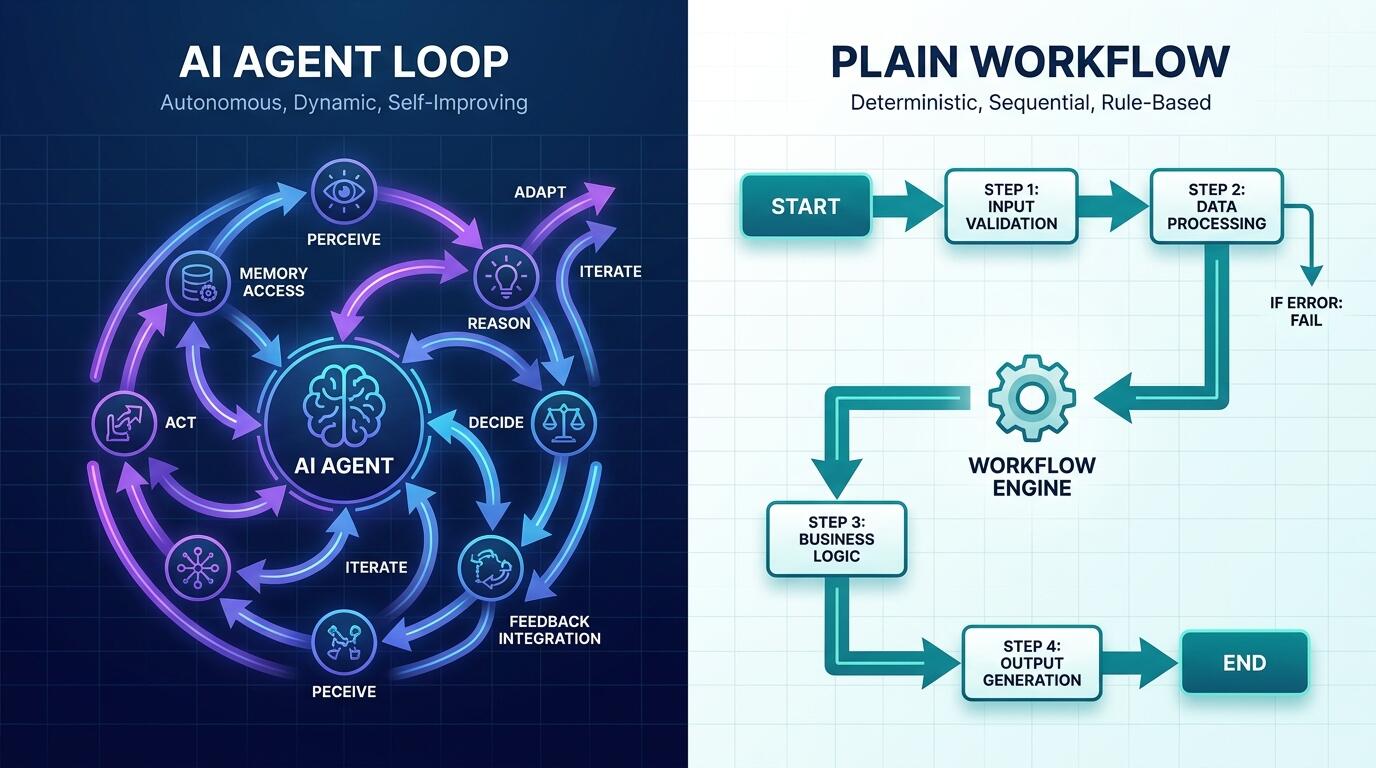
ALT: AI agents vs plain workflows comparison guide for product builders and engineers this quarter
Agents or Plain Workflows: How to Make the Right Call for What You're Building Right Now
You've just scoped out a new AI feature. The temptation is real: reach for an agent framework because it sounds more powerful, more future-proof, more impressive in a demo. A pattern we consistently see in our work with AI product builders is that teams over-architect early and pay for it in production — runaway costs, unpredictable latency, and debugging sessions that feel like interrogating a black box. Equally, teams that stick rigidly to plain workflows miss the window where a bit of autonomous reasoning would have saved weeks of hand-coded branching logic.
The honest verdict: neither AI agents nor plain workflows are universally superior. The right choice depends on task structure, tolerance for non-determinism, latency constraints, and how much operational overhead your team can sustain. This article compares both approaches across the dimensions that actually matter in production, so you can ship the right architecture this quarter — not the trendy one.
Evaluation Criteria: What Actually Matters in Production
The comparison between AI agents and plain workflows should be judged on dimensions that surface real costs and risks, not just capability demos.
Determinism and predictability. A system is only as reliable as its worst-case behavior. Determinism measures how consistently a system produces the same output given the same input. For regulated, audited, or customer-facing pipelines, unpredictable outputs are a liability — not a feature.
Operational complexity. This covers the infrastructure, tooling, and engineering hours required to deploy, monitor, and maintain a system. Complex architectures compound toil: every new capability added to an agent can introduce a new failure mode. Teams that underestimate this dimension routinely ship systems they can't debug in production.
Latency and cost profile. LLM calls are expensive and slow relative to deterministic code. Agents that chain multiple model calls per request multiply both dimensions. Understanding whether your use case can absorb that overhead — or whether users will notice — is a prerequisite to any architecture decision.
Adaptability to novel inputs. Some tasks have a fixed, enumerable set of inputs. Others require reasoning over inputs that weren't anticipated at design time. This dimension measures how gracefully a system handles edge cases without requiring code changes.
Debuggability and observability. When something goes wrong in production — and it will — how quickly can you isolate the cause? Plain workflows are generally traceable step by step. Agent systems, where the model is making routing and tool-selection decisions, require purpose-built observability tooling and careful prompt logging.
Development velocity. How long does it take to go from requirement to working system? This cuts both ways: plain workflows can be faster to build for well-defined tasks, while agents can compress weeks of conditional logic into a few well-crafted tool definitions — for the right problem class.
The Contenders
AI Agents: Autonomous Reasoning Systems
An AI agent is a system in which a language model autonomously decides what actions to take — including which tools to call, in what order, and how to interpret intermediate results — to accomplish a goal specified by the user or an upstream system. Agent frameworks such as LangGraph, AutoGen, and OpenAI's Assistants API provide scaffolding for this loop: the model reasons, acts, observes, and iterates until it reaches a stopping condition or hits a resource limit.
Agents shine in tasks that are genuinely open-ended: research synthesis across variable source sets, code generation that requires iterative testing, or multi-step customer workflows where the branching logic is too complex to enumerate. The agent pipeline behind a daily AI briefing — covering retrieval, verification, and publication — is a concrete example of where autonomous orchestration handles variable inputs that a fixed workflow would struggle to enumerate in advance.
The risks are significant and often underestimated. Agent systems are harder to test exhaustively because the action space is large. Tool-call errors can cascade. Prompt injection from external content (web pages, user-supplied documents) is a real attack surface. And without tight resource limits — maximum steps, maximum cost per run, timeout thresholds — agents can spin indefinitely, burning tokens and budget. In our experience, teams that deploy agents without these guardrails in place are operating on borrowed time.
Plain Workflows: Deterministic Orchestration
A plain workflow is a deterministic, graph-structured pipeline in which each step's behavior is fully specified at design time. The pipeline might invoke LLM calls — for classification, summarization, or generation — but the routing logic, step sequence, and error handling are code, not model decisions. Tools like Prefect, Airflow, n8n, and custom DAG implementations all fall into this category.
Plain workflows are the workhorse of production AI systems. When you know the input schema, the required transformations, and the acceptable output format, a workflow gives you reliability, traceability, and predictable cost. Every execution leaves a full audit trail. Failures surface at a specific, named step. Latency is bounded and measurable.
The limitation is brittleness at the edges. A workflow built to handle ten document types will fail silently or noisily on an eleventh. Extending coverage requires code changes, QA cycles, and deployment. For tasks where the input space is genuinely bounded, this is an acceptable trade-off. For tasks where it isn't, teams often find themselves in an endless cycle of exception handling — adding conditional branches until the workflow is as complex as an agent, but without the reasoning flexibility.
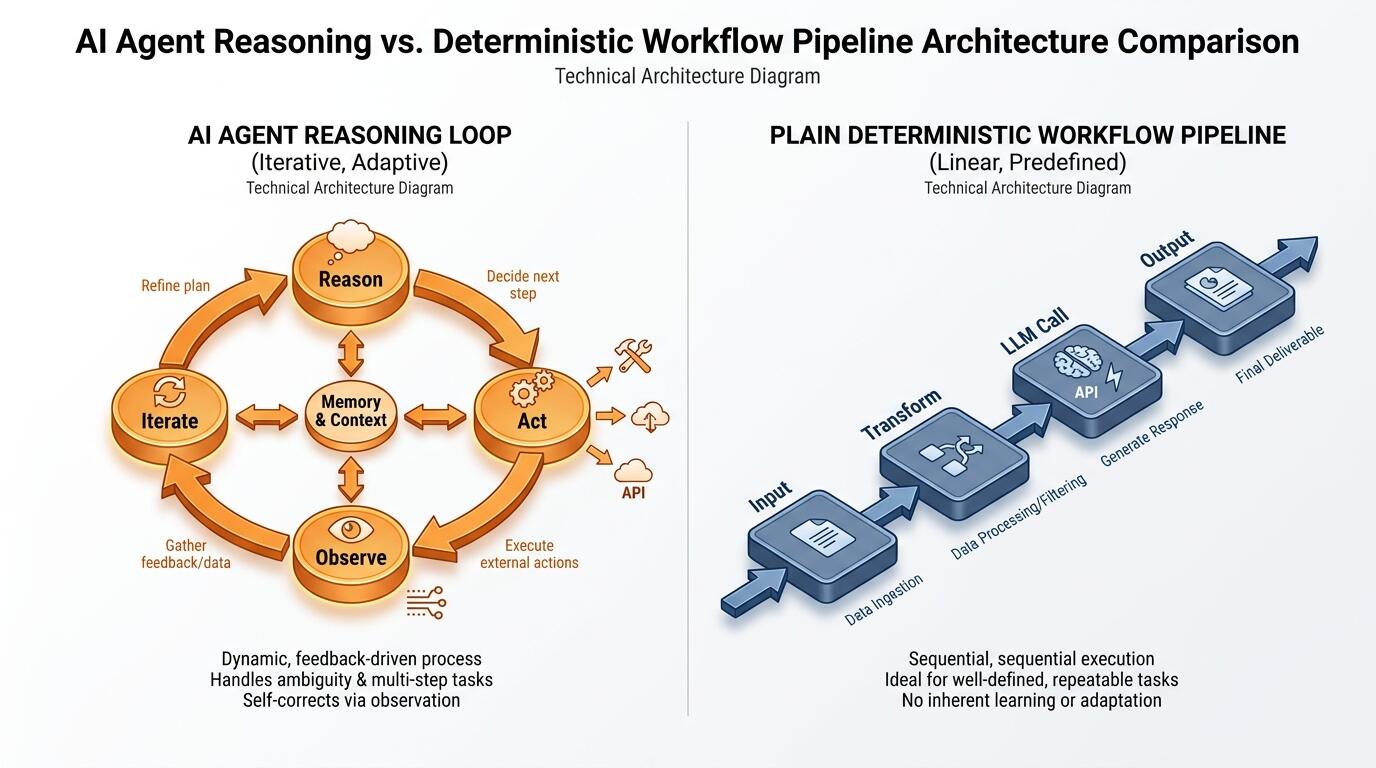
ALT: Side-by-side diagram of AI agent reasoning loop versus plain deterministic workflow pipeline for engineering teams evaluating AI architecture options this quarter
Head-to-Head Comparison
| Criterion | AI Agents | Plain Workflows |
|---|---|---|
| Determinism | Low — model decisions introduce variance | High — behavior fully specified in code |
| Operational complexity | High — requires observability tooling, guardrails, prompt versioning | Moderate — standard pipeline monitoring applies |
| Latency per request | High and variable — multiple LLM calls per run | Lower and bounded — LLM calls are isolated, predictable |
| Cost profile | High and variable — token usage scales with reasoning depth | Controlled and predictable — cost per run is estimable |
| Adaptability to novel inputs | High — model can reason over unseen input types | Low — novel inputs require code changes |
| Debuggability | Harder — requires trace logging, step replay, prompt inspection | Easier — failures localize to a named step |
| Development velocity (well-defined task) | Slower — agent design requires careful tool definition and prompt engineering | Faster — deterministic logic is straightforward to implement |
| Development velocity (open-ended task) | Faster — avoids enumerating all branches | Slower — branching logic grows without bound |
| Compliance and auditability | Harder — non-deterministic paths complicate audit trails | Easier — full execution trace available by default |
The table makes the trade-off structure visible: agents trade determinism and debuggability for adaptability. Plain workflows trade flexibility for reliability. Neither axis is inherently superior — the question is which trade-off matches your task's actual requirements.
For teams evaluating where to invest engineering time this quarter, the most common mistake we observe is treating "agent" as a capability upgrade to any existing workflow. It isn't. Wrapping a well-understood, bounded task in an agent framework adds operational overhead without adding meaningful capability. The latency and cost increase is real; the adaptability gain is theoretical if your input space is already enumerable.
Conversely, teams that avoid agents entirely because of perceived complexity sometimes build plain workflows of extraordinary fragility — dozens of conditional branches that encode implicit knowledge about edge cases, with no graceful degradation when a new edge case appears. For tasks where the branching logic is genuinely open-ended, the engineering cost of maintaining that conditional sprawl often exceeds the overhead of operating a well-scoped agent.
The inflection point, in practice, is roughly this: if you can write a finite, reviewable specification of every valid input type and every required output, a plain workflow is almost always the right call. If you cannot — if the task requires the system to reason about inputs it hasn't seen — an agent becomes worth the operational investment.
Which Should You Choose? Scenario Recommendations
If your task has a fixed, enumerable input schema — choose a plain workflow. Document processing pipelines, structured data extraction, classification against a known taxonomy, and report generation with a defined template are all cases where a workflow delivers reliability at lower cost. The engineering investment goes into well-tested transforms and robust error handling, not prompt engineering and tool definition. As a bonus, compliance and audit requirements are far easier to satisfy.
If your task requires multi-step reasoning over variable or unanticipated inputs — evaluate agents carefully. Customer support triage that must handle arbitrarily varied queries, research assistants that synthesize across variable source sets, or code generation tools that require iterative test-run feedback are all cases where agent autonomy pays dividends. The key qualifier is "evaluate carefully": before committing, define your guardrails (max steps, max cost per run, fallback behavior), instrument your traces, and run adversarial tests against prompt injection. For further guidance on building these checks into your pipeline, see where an AI drafting pipeline fails and the checks that catch it.
If you're under time pressure and the task is well-understood — default to a plain workflow. Speed-to-ship is a real constraint, and agents introduce non-trivial design and testing overhead. A workflow you can deploy and monitor confidently this week beats an agent architecture you're still debugging next month. The principles behind shipping fast without sacrificing product quality apply directly here: pick the simplest architecture that solves the problem, instrument it well, and iterate.
If your team lacks observability tooling for LLM systems — do not deploy agents yet. Operating an agent system without trace logging, step-level cost attribution, and anomaly alerting is genuinely risky. You will not know when something goes wrong until it's expensive. Build or adopt the observability layer first.
Pros and cons at a glance:
Plain workflows: reliable, auditable, cost-predictable, debuggable; limited to enumerable input spaces, brittle at novel edges, can accumulate conditional sprawl.
AI agents: adaptable, capable of handling novel inputs, can replace large bodies of conditional logic; variable cost and latency, harder to debug, require guardrails and observability investment, compliance-complicated.
People Also Ask
Q1: How do I know if my use case actually needs an AI agent?
An AI agent is worth the overhead when your task requires reasoning over inputs you cannot fully enumerate at design time — for example, open-ended user queries, variable document structures, or multi-step workflows where the next action depends on intermediate results. If you can write a complete, finite specification of every valid input and required output, a plain workflow will be more reliable, cheaper, and easier to maintain. When in doubt, build the workflow first and instrument where it breaks.
Q2: Are plain workflows suitable for production AI products in 2025 and beyond?
Plain workflows are the backbone of most production AI systems today. They handle classification, extraction, summarization, and generation tasks reliably when the input space is bounded. The assumption that agents are the "next step up" from workflows is a common misconception — they are a different architectural choice for a different problem class. Well-structured deterministic workflows are not a stepping stone to agents; for many tasks, they remain the correct final architecture indefinitely.
Q3: How much more does it cost to run an agent system versus a plain workflow for the same task?
Cost depends heavily on how many LLM calls the agent makes per task and the models it uses. A plain workflow with a single LLM call per request has predictable, bounded token cost. An agent that chains multiple calls — reasoning, tool selection, observation, re-reasoning — multiplies that cost by the number of iterations. In practice, poorly bounded agents can cost an order of magnitude more per request than an equivalent workflow. Setting hard limits on maximum steps and using cheaper models for intermediate reasoning steps are the two most effective mitigations.
Summary
The choice between AI agents and plain workflows is not a question of which technology is more advanced — it is a question of which architecture matches the structure of your actual task. Three points should anchor your decision:
First, determinism is a feature for most production tasks. If your input space is enumerable, a plain workflow's predictability, auditability, and lower cost profile are genuine advantages, not limitations.
Second, agents are the right call for genuinely open-ended reasoning tasks — but only when you have the observability, guardrails, and operational investment to run them safely. Deploying agents without these safeguards is not a velocity gain; it is deferred risk.
Third, start with the simpler architecture. A workflow that ships and runs reliably creates far more value than an agent system still in debugging. Complexity should be introduced only when the evidence — from production failures or enumerable branching limits — clearly justifies it.
Your next step: audit the AI feature or pipeline you're currently scoping. Can you write a complete input-output specification? If yes, build a workflow. If not, define your agent's guardrails before writing a single prompt.
If you're building AI products and don't want to waste time filtering signal from noise, subscribe to the Darius newsletter — each issue surfaces the AI developments that actually matter, with first-hand source links and production-grounded analysis to help you turn model releases, papers, and policy changes into concrete product decisions.
References & Further Reading
- Workflowbuilder.io. "Best AI agent frameworks in 2026: a comparison for developers and teams".
https://www.workflowbuilder.io/blog/best-ai-agent-frameworks - Sketricgen.ai. "What Is an AI Workflow Builder? How to Choose in 2026".
https://www.sketricgen.ai/blog/what-is-ai-workflow-builder - Tom Firth. "LinkedIn post on OpenAI's workflow builder versus agent framing".
https://www.linkedin.com/posts/tdfirth_openais-workflow-builder-sorry-agent-activity-7381694081007079424-xUIH - IEEE. "IEEE Standards and Publications on Autonomous Systems and AI".
https://www.ieee.org/
Note: Standards and frameworks evolve rapidly in this space; verify the current state of any referenced tool or specification against its official documentation before making architectural commitments.