Agile vs. Waterfall in 2026: Which Methodology Actually Fits Your Team
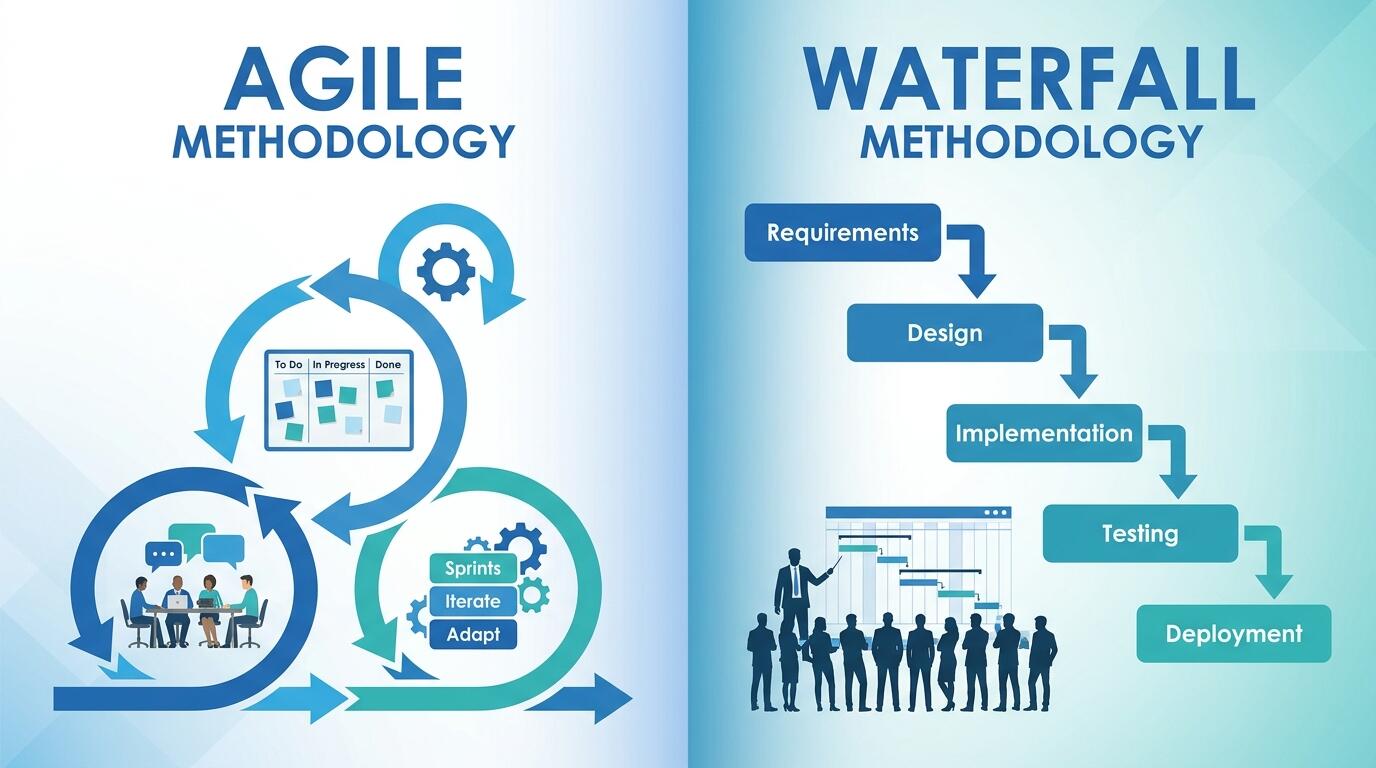
ALT: Agile vs Waterfall methodology comparison for engineering teams in 2026 project planning
Agile vs. Waterfall in 2026: Which Project Management Methodology Actually Fits Your Team?
Key Conclusion: In 2026, neither Agile nor Waterfall is universally superior — the right methodology depends on your team's size, product uncertainty, regulatory context, and delivery cadence. Agile remains the default for iterative, fast-moving product teams, while Waterfall retains clear advantages in regulated industries and fixed-scope infrastructure projects. Most experienced teams end up blending both, using structured planning phases with iterative execution cycles to ship production-ready systems without losing control.
Choosing between Agile and Waterfall is one of the most consequential — and frequently misunderstood — decisions a technical team can make. This comparison evaluates both methodologies across the dimensions that actually matter to engineering leaders: team structure, product uncertainty, regulatory requirements, delivery speed, and long-term maintainability. The goal is to give you a clear, opinionated framework for making the right call for your specific context, not a textbook survey of abstract principles.
The Evaluation Criteria That Actually Matter for Engineering Teams
The right criteria for comparing Agile and Waterfall are not the ones most textbooks emphasize — they are the ones that separate projects that ship from projects that stall.
Requirements stability is the first dimension. How well-defined are your requirements at the outset? If you are building a payment gateway integration with a fixed specification document, requirements are unlikely to shift mid-stream. If you are building an AI-powered product where user behavior will reshape the feature set after launch, requirements are inherently emergent. Methodology choice must match this reality.
Team coordination overhead matters enormously in 2026, when distributed and hybrid teams are the norm rather than the exception. Agile's ceremony-heavy iterations (standups, sprint reviews, retrospectives) can create coordination drag for small, co-located teams. Waterfall's phase-gate model reduces meeting overhead but can leave teams blindsided when late-stage integration reveals misaligned assumptions.
Regulatory and compliance exposure is non-negotiable for certain industries. Healthcare, finance, aerospace, and defense often require documented traceability from requirements through testing — a structure that maps naturally to Waterfall's sequential phases. Agile's flexibility can create audit trail gaps that become costly compliance failures.
Feedback loop speed determines how quickly a team can course-correct. In markets where competitive pressure or user behavior shifts rapidly, short feedback loops are survival-critical. The ability to ship, measure, and adjust in weeks rather than months is often the deciding factor between products that find product-market fit and those that don't.
Cost of late-stage change reflects the economic reality of each model. Waterfall front-loads design and planning investment, making late changes expensive. Agile distributes change costs across the lifecycle, making early pivots cheap but creating ongoing planning overhead. Understanding your actual cost structure — not the theoretical one — determines which model's trade-offs you can afford.
Team experience and discipline is the underrated criterion. Agile done poorly is chaos with standups. Waterfall done poorly is bureaucracy with Gantt charts. The sophistication of your team in executing whichever framework you choose matters as much as the framework itself.
The Contenders: Understanding Each Methodology on Its Own Terms
Agile: Iterative Delivery Built for Uncertainty
Agile is a software development philosophy, codified in the Agile Manifesto (published in 2001 by a group of seventeen practitioners), that prioritizes individuals and interactions over processes and tools, working software over comprehensive documentation, customer collaboration over contract negotiation, and responding to change over following a plan. In practice, Agile manifests through frameworks like Scrum, Kanban, SAFe, and XP, each of which implements the core principles with varying ceremony and structure.
In a typical Agile implementation, work is organized into time-boxed iterations — commonly called sprints — lasting one to four weeks. At the end of each sprint, a potentially shippable product increment is delivered, reviewed, and used to inform the next planning cycle. Requirements live in a prioritized backlog managed by a product owner, and the team pulls work in a sequence determined by business value rather than a predetermined schedule.
Agile's headline advantage is adaptability. A pattern consistently seen in fast-moving product teams is that the most valuable features at launch were not the ones planned six months earlier — they emerged from early user feedback and competitive shifts that no upfront specification could have anticipated. Agile's short cycles create the organizational muscle to capitalize on those insights rather than being locked into a plan that no longer reflects reality.
The pitfalls of Agile are real and underappreciated. Without strong product ownership and architectural discipline, Agile backlogs devolve into feature soup — an undifferentiated queue of requests with no coherent system vision. Technical debt accumulates when "working software" is interpreted as "software that passes the demo" rather than software built to production standards. Teams that skip architecture design in favor of sprint velocity frequently arrive at a point where the codebase cannot support the features the business needs — a pattern that is expensive and demoralizing to unwind.
Waterfall: Sequential Execution Built for Certainty
Waterfall is a linear, sequential software development model in which each project phase — requirements, design, implementation, testing, and deployment — must be completed and signed off before the next phase begins. The model derives its name from the visual metaphor of progress flowing downward through stages, with no upstream return permitted once a phase closes.
Waterfall was the dominant approach to software development from the 1970s through the early 2000s, and it remains the right choice in contexts where requirements are stable, regulatory traceability is mandatory, or large teams with specialized roles must coordinate across long timelines. Infrastructure projects, embedded systems, defense contracting, and regulated medical device software are environments where Waterfall's structured documentation and phase-gate approval process provide genuine value.
The strength of Waterfall is predictability. When scope, budget, and timeline can be defined with high confidence upfront, Waterfall's sequential model produces the most auditable, traceable record of how a system was built and why decisions were made. For a team building a financial reporting system against a fixed regulatory deadline, this predictability is not a nice-to-have — it is a contractual requirement.
The risks are equally clear. Requirements almost always evolve. A Waterfall project that reaches the testing phase only to discover that core assumptions have shifted faces a painful choice: absorb expensive rework or ship a product that no longer meets user needs. In a 2026 market moving at the pace that AI capabilities are enabling, the risk of a twelve-month Waterfall cycle producing a specification-accurate but market-irrelevant product is higher than it has ever been.
Head-to-Head Comparison Across Key Criteria
| Criterion | Agile | Waterfall |
|---|---|---|
| Requirements stability | Designed for evolving requirements | Requires stable, well-defined requirements upfront |
| Team coordination overhead | High ceremony (standups, retros, sprint planning) | Lower ongoing ceremony; heavier upfront planning |
| Regulatory compliance fit | Requires deliberate effort to maintain audit trails | Natural fit for documented, phase-gated traceability |
| Feedback loop speed | Short cycles (weeks); frequent course correction | Long cycles (months); late-stage discovery |
| Cost of late-stage change | Low-to-moderate; changes absorbed in backlog | High; rework requires revisiting upstream phases |
| Scalability to large teams | Challenging without a scaling framework (SAFe, LeSS) | Better native support for large, specialized teams |
| AI/ML product development fit | Strong; handles uncertainty and iteration well | Weak for core ML; better for surrounding infrastructure |
| Team discipline required | High; chaos risk without strong ownership | High; rigidity risk without change management |
The table above makes one thing immediately apparent: no single methodology wins across all criteria. The choice is fundamentally about which trade-offs your team and product context can absorb.
For teams building AI-powered or data-intensive products, Agile's tolerance for evolving requirements is particularly valuable. Machine learning systems are defined as much by the data they encounter and the behaviors they exhibit in production as by any upfront specification. Locking an ML system design into a Waterfall plan at month one, then discovering six months later that the data distribution assumptions were wrong, is a failure mode that Agile's iterative approach is specifically designed to prevent. Teams serious about shipping scalable ML systems should also consider how their delivery framework interacts with their machine learning pipeline architecture — methodology and infrastructure must reinforce each other.
Waterfall, by contrast, retains genuine relevance for the scaffolding around AI systems: the integrations, the compliance layers, the data governance frameworks, and the operational infrastructure that surrounds a model. These components often have stable, documentable requirements and benefit from the traceability that Waterfall's phase-gate model provides.
The most honest interpretation of the comparison table is that it argues for thoughtful hybridization rather than ideological commitment to either model. According to Atlassian, one of the most widely referenced authorities on software development practice, teams that understand both methodologies deeply are better positioned to adopt the right tool for each layer of their system rather than forcing every problem through a single methodological lens.
Which Methodology Should You Choose? Scenario Recommendations
Picking a methodology is not a one-time decision — it is a context-specific judgment that should be revisited as your team, product, and market evolve. Here is how to map your situation to the right choice.
If you are a startup building a net-new AI product with high uncertainty, choose Agile. Your biggest risk is building the wrong thing, not building it inefficiently. Short sprints, frequent user feedback, and a lightweight backlog process will let you course-correct before you've committed months of engineering capacity to a direction that doesn't work. Pair this with strong architectural discipline — Agile is not a license to skip design — or you will trade early flexibility for late-stage rigidity.
If you are delivering a system integration or infrastructure project with a fixed specification and a compliance deadline, choose Waterfall. The predictability and documentation trail Waterfall provides are genuine assets in this context. Define requirements exhaustively upfront, invest in thorough design review before coding begins, and treat the phase gates as the risk-reduction mechanism they are meant to be.
If you are a growth-stage company scaling an existing product, choose a hybrid model. Use Agile for feature development and user-facing iteration, and apply Waterfall-style planning to platform migrations, security upgrades, and regulatory compliance work. The discipline of maintaining separate cadences for different types of work pays dividends in both velocity and stability.
If you are managing a distributed engineering team across multiple time zones, apply Agile selectively. Synchronous ceremony is expensive across time zones. Teams working in this context often benefit from asynchronous-first Agile adaptations: written sprint updates, async backlog refinement, and documented architectural decision records that replace verbal alignment. For founders navigating the challenge of maintaining team cohesion across geographies, the structural principles for lean AI system design in early-stage environments apply equally to process architecture as to technical architecture.
If you are in a regulated industry (healthcare, finance, aerospace), default to Waterfall with Agile sprints inside phases. This hybrid — sometimes called "Water-Scrum-Fall" — allows iterative development within each phase while preserving the documented, auditable structure that regulators require. It is not perfect, but it is significantly better than either pure model applied dogmatically to a regulated context.
Pros and cons at a glance:
Agile strengths: rapid feedback, change tolerance, high team morale from visible progress, natural fit for emergent AI products.
Agile weaknesses: documentation gaps, technical debt risk, requires strong product ownership, ceremony overhead at scale.
Waterfall strengths: predictability, audit trail, clear phase boundaries, strong fit for large and specialized teams.
Waterfall weaknesses: late discovery of misaligned requirements, inflexibility, high cost of change, poor fit for uncertain product spaces.
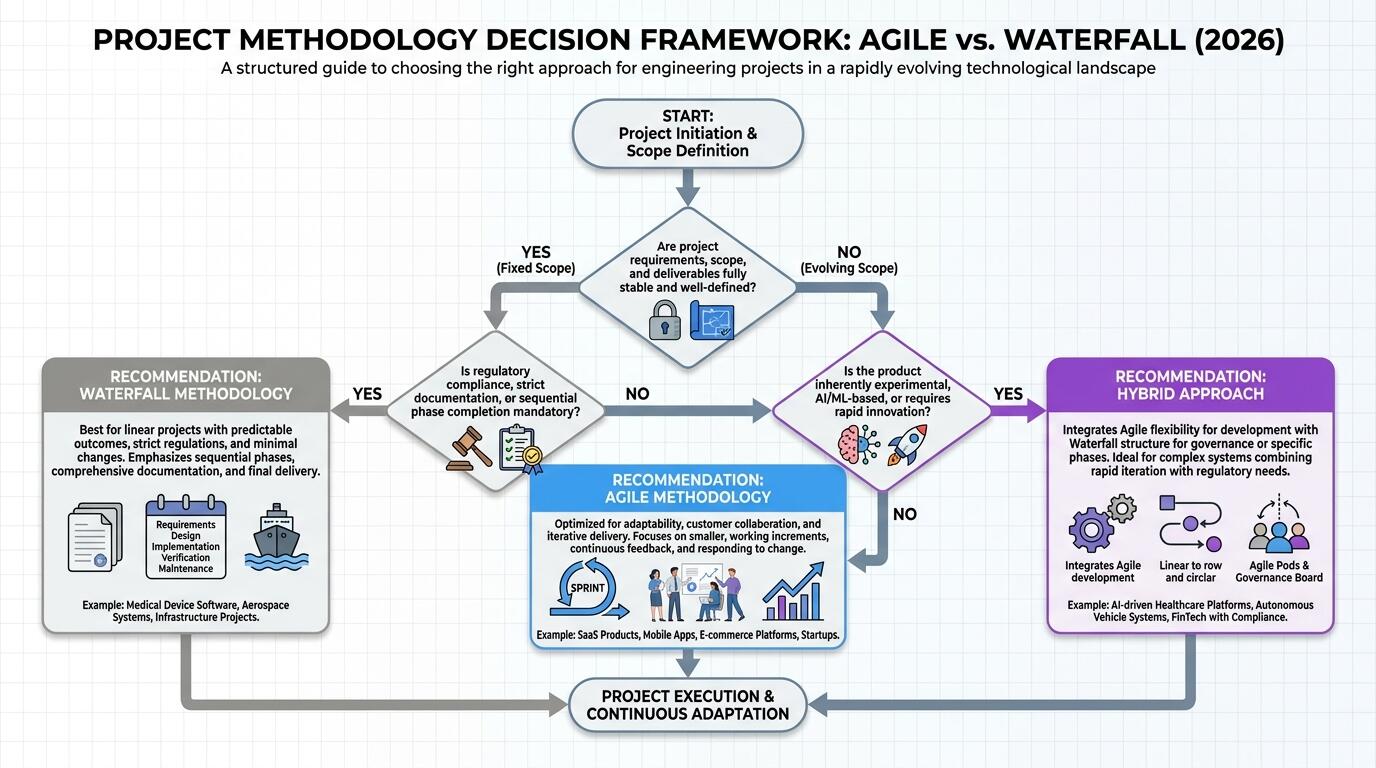
ALT: Decision framework diagram showing when to choose Agile vs Waterfall for engineering and AI product teams in 2026
People Also Ask
Q1: How do you decide between Agile and Waterfall for a software project?
The decision hinges on requirements stability and feedback loop requirements. If your requirements are well-defined, unlikely to change, and tied to compliance documentation, Waterfall is typically the right starting point. If your product involves significant uncertainty — user behavior, data quality, market fit, or evolving AI capabilities — Agile's iterative cycles allow you to discover and respond to that uncertainty rather than being locked into assumptions made before development began. Most teams benefit from a hybrid approach that applies each model where its strengths are most relevant.
Q2: Is Waterfall still relevant for software development in 2026?
Waterfall remains genuinely relevant in specific contexts: regulated industries, fixed-scope infrastructure projects, large-scale system integrations with stable specifications, and government or defense contracting environments. The claim that Waterfall is obsolete reflects a narrow view of software development that underestimates the diversity of contexts in which teams operate. Per the Project Management Institute, a significant portion of projects worldwide still use predictive (Waterfall-style) methodologies, particularly in industries where contractual traceability is a requirement rather than a choice. The question is not whether Waterfall is outdated, but whether it fits your specific context.
Q3: How long does it take to transition a team from Waterfall to Agile?
A meaningful transition — one that goes beyond vocabulary change to actual process change — typically takes several quarters of consistent effort. The timeline depends on team size, organizational culture, existing tooling, and management support. Surface-level Agile adoption (renaming phases "sprints" without changing planning or feedback cycles) can happen quickly but delivers little value. Genuine adoption requires new habits around backlog management, continuous delivery infrastructure, and stakeholder communication. Teams that rush the transition without building the underlying engineering practices — automated testing, continuous integration, incremental deployment — frequently find that Agile ceremonies add overhead without delivering the flexibility the methodology promises.
Wrapping Up
The Agile vs. Waterfall debate in 2026 is less about picking a winner and more about developing the judgment to apply the right model — or the right blend of models — to the specific conditions your team faces. The teams that ship consistently are rarely the ones that follow a methodology dogmatically; they are the ones that understand why each approach exists and make deliberate trade-off decisions accordingly.
Key Takeaways:
- Requirements stability is the single most important factor in methodology selection — match your process to your uncertainty, not to an industry trend.
- Agile's flexibility is only valuable when paired with architectural discipline; without it, iterative development becomes iterative debt accumulation.
- Waterfall's predictability is a genuine asset in regulated, fixed-scope, or large-team contexts — do not discard it because it is unfashionable.
- Most mature engineering organizations use a hybrid model, applying iterative cycles within structured planning phases rather than choosing one approach exclusively.
- The quality of execution matters more than the methodology chosen — a disciplined Waterfall team outperforms an undisciplined Agile team every time.
The next step is honest context assessment: map your product's uncertainty level, your team's coordination needs, and your compliance obligations against the criteria outlined here. Then commit to a model, instrument it, and adjust based on what you observe — which, incidentally, is itself an Agile principle worth applying regardless of which methodology you choose.
Ready to think through the right engineering approach for your specific product? Visit the Darius website to explore technical insights, real project examples, and expert guidance on AI architecture, systems design, and full-stack engineering.
References & Further Reading
- Atlassian. "Agile vs. Waterfall Project Management Methodology".
https://www.atlassian.com/agile/project-management/project-management-intro - Rock.so. "Agile vs Waterfall: Why Most Agencies Use Both (2026 Guide)".
https://www.rock.so/blog/agile-vs-waterfall - Monday.com. "Agile vs Waterfall vs Scrum: The Complete Guide For 2026".
https://monday.com/blog/rnd/agile-vs-waterfall-vs-scrum/ - Project Management Institute. "Project Management Body of Knowledge and Standards".
https://www.pmi.org/
Note: Standards and methodology guides may be updated; please check the latest official documents or consult qualified project management and engineering advisors for guidance specific to your context.