Agile Implementation Best Practices for Engineering Teams This Year
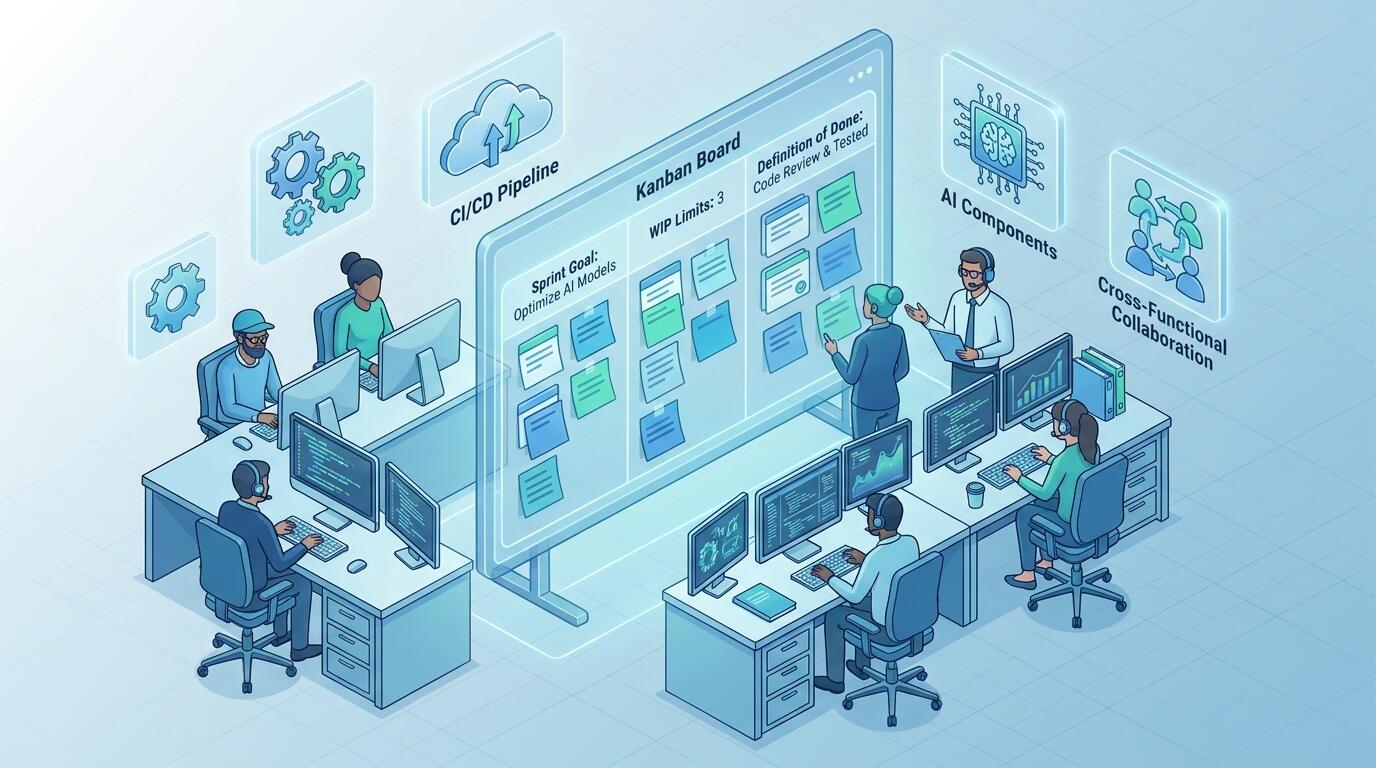
ALT: Agile implementation best practices for engineering teams working on AI and full-stack product delivery
What Does Strong Agile Implementation Actually Look Like for Engineering Teams Today?
Agile is a software development philosophy built around iterative delivery, cross-functional collaboration, and continuous improvement — the idea that working software delivered frequently is more valuable than a comprehensive plan delivered late. Most engineering teams claim to run Agile. Far fewer actually practice it in a way that accelerates delivery, reduces rework, and produces shippable software consistently.
The question most technical leaders are wrestling with right now isn't "should we use Agile?" — that debate is settled. The real question is: what does disciplined Agile implementation look like for a modern engineering team, particularly one building AI-powered systems or complex full-stack products under real delivery pressure?
This list draws from hands-on patterns observed across engineering engagements — teams at different stages, building different things, but running into the same failure modes when their Agile practice is thin. The items below are selected not for theoretical completeness, but because each one has a direct, measurable impact on shipping velocity and product quality. Use this list as a diagnostic and a roadmap: audit your current practice against each item, identify where the gaps are, and apply the practices in order of where your team is most dysfunctional.
The Practices: Agile Implementation That Actually Ships Products
Start Every Sprint with an Unambiguous Definition of Done
A Definition of Done (DoD) is a shared, explicit checklist that every team member agrees must be satisfied before any piece of work is considered complete. It is the single most underrated practice in Agile implementation. Without a DoD, "done" becomes a negotiation that plays out differently in every sprint, and technical debt quietly accumulates beneath the surface of apparent progress.
In practice, a useful DoD covers more than just passing tests. It includes code review completion, documentation updates, deployment to a staging environment, and — for teams building AI components — validation that model outputs meet a defined quality threshold. According to the Agile Alliance, teams that codify and consistently enforce a DoD ship fewer defects and experience significantly fewer regressions in production.
Best for: Teams moving from ad-hoc delivery toward consistent, releasable increments — especially useful when product and engineering frequently disagree on whether something is truly finished.
Watch out: A DoD that is too broad becomes a bottleneck. Start narrow, covering only the non-negotiables, and expand it iteratively as the team matures.
Invest in Proper Backlog Refinement — It Is Not Optional
Backlog refinement is the practice of continuously reviewing, estimating, and reprioritizing the product backlog so that upcoming sprint work is well-understood before the sprint starts. Many teams treat refinement as optional or collapse it into sprint planning. This is one of the most common failure modes we see: teams enter sprint planning with vague tickets, and then spend the first two days of the sprint clarifying requirements instead of building.
Effective refinement means stories are broken down to a size the team can complete in a single sprint, acceptance criteria are explicit, and dependencies are surfaced before they become blockers. For teams building machine learning features, refinement sessions should also address data availability and model interface contracts — details that are easy to miss and expensive to discover mid-sprint. As outlined by Aha!, backlog health is a direct predictor of sprint predictability.
Best for: Teams suffering from scope creep, mid-sprint requirement changes, or consistently failing to meet sprint goals.
Watch out: Refinement can become a second planning session that eats into development time. Time-box it — typically no more than ten percent of the team's weekly capacity.
Hold Retrospectives That Produce Actual Process Changes
A retrospective is a structured meeting held at the end of each sprint where the team reflects on what went well, what didn't, and what specific action they will take to improve. The key word is "specific." A retrospective that produces only vague sentiments — "we should communicate better" — is theater. A retrospective that produces a concrete, assigned action — "we will add a blocker field to all tickets starting next sprint, owned by the tech lead" — is a genuine improvement mechanism.
A pattern we consistently see in high-functioning teams is that retrospectives are treated with the same seriousness as product reviews. The output is a single, prioritized action item that gets tracked. Teams that run retrospectives well compound their improvements over time; teams that skip them or phone them in plateau quickly. According to monday.com's research on Agile best practices, teams that conduct regular retrospectives demonstrate measurably higher rates of process improvement and team satisfaction.
Best for: Teams that feel stuck at a ceiling of delivery performance and need a structured mechanism to identify and address the real constraints.
Watch out: Retrospectives can devolve into complaint sessions if facilitated poorly. Rotate facilitators and use a clear format — Start/Stop/Continue is a reliable default.
Make Sprint Goals the Organizing Principle of Every Sprint
A sprint goal is a single, concise statement that describes the value the team intends to deliver in a given sprint. It is distinct from the sprint backlog — the list of individual tasks — and serves as the guiding constraint when priorities shift mid-sprint (which they always do). Most teams maintain a sprint backlog. Far fewer articulate a sprint goal that the whole team and stakeholders actually understand.
Without a sprint goal, every item in the backlog feels equally important, and the team has no principled basis for deciding what to drop when something unexpected takes time away. With a clear sprint goal, the team can make fast, autonomous decisions: "does this new request serve the sprint goal? If not, it goes to the backlog." This autonomy is what separates teams that ship from teams that are perpetually catching up. The Scrum Guide, maintained by Scrum.org, explicitly identifies the sprint goal as one of the three artifacts that create transparency and enable empirical decision-making.
Best for: Teams where mid-sprint scope changes are frequent and disruptive, or where stakeholders regularly pull engineers away from planned work.
Watch out: Sprint goals only work if leadership respects them. If a sprint goal can be overridden at any moment by an urgent request, the practice loses credibility. Escalation paths need to be agreed upon in advance.
Treat Continuous Integration as an Engineering Standard, Not a Nice-to-Have
Continuous Integration (CI) is the practice of merging every developer's working copy to a shared mainline branch several times a day, with automated tests running on each merge. CI eliminates the "integration hell" that happens when long-lived feature branches are merged late — a problem that scales badly as teams grow and becomes catastrophic when multiple AI components with diverging data dependencies are combined at the last minute.
For teams building scalable systems, CI is not just a workflow preference — it is the technical foundation that makes iterative delivery feasible. Without it, the feedback loop between writing code and knowing whether it works correctly extends from minutes to days. A well-structured CI pipeline that catches regressions early is the infrastructure equivalent of a good sprint cadence: it creates a reliable rhythm that the whole team can build on. This is especially relevant if your team is building machine learning pipelines that need to scale past the prototype stage — CI discipline is what separates exploratory notebooks from production-ready systems.
Best for: Teams with more than two engineers, or any team where multiple components need to integrate reliably across a sprint.
Watch out: CI only prevents problems if test coverage is meaningful. A CI pipeline running weak tests gives false confidence. Invest in test quality alongside pipeline setup.
Limit Work in Progress — Aggressively
Work in Progress (WIP) limits are constraints on how many tasks a team or individual can actively work on simultaneously. The principle comes from Lean manufacturing and is formalized in the Kanban method: limiting WIP increases flow, reduces context-switching, and surfaces bottlenecks that multitasking hides. In Agile engineering teams, high WIP is one of the clearest signals that the team is optimizing for looking busy rather than delivering value.
A common pattern we see: an engineer has five tickets "in progress" at the same time, none of them moving to done. Lowering WIP limits forces clarity — is the real problem a dependency on another team? A blocked API? An unclear requirement? WIP limits expose the true constraints, which is uncomfortable but necessary. According to nextagile.ai's analysis of Agile best practices for high-performing teams, organizations that implement WIP limits consistently report faster cycle times and higher delivery predictability.
Best for: Teams where tickets spend days or weeks "in progress" without reaching done, or where engineers are pulled across multiple priorities simultaneously.
Watch out: Setting WIP limits too low can cause engineers to sit idle waiting for review. Calibrate limits based on actual observed throughput, not aspirational targets.
Build in Technical Debt Sprints or Dedicated Capacity
Technical debt is the accumulated cost of shortcuts, deferred refactoring, and suboptimal design decisions made under delivery pressure. Every engineering team accumulates it. Teams that ignore it eventually find that delivery speed degrades — what once took a day now takes a week because the codebase has become fragile. Addressing technical debt is not a luxury; it is a prerequisite for sustaining Agile velocity beyond the early sprints of a product.
The most practical approach is to allocate a defined percentage of each sprint's capacity — or a dedicated sprint per quarter — to debt reduction, refactoring, and architectural improvement. This keeps the codebase in a state where new features can be added without disproportionate risk. For teams working on AI and full-stack products, this is especially relevant: as models evolve and infrastructure scales, architectural decisions made at the prototype stage often need to be revisited. If you're working through how to structure these decisions early, exploring AI system design on a lean budget can help prioritize which shortcuts are acceptable and which will compound quickly.
Best for: Teams that have been shipping fast for six or more months and are starting to feel the drag of accumulated shortcuts.
Watch out: Teams can use "tech debt" as cover for over-engineering. Keep debt work tied to specific, demonstrable delivery friction — not abstract ideals of clean code.
Use Metrics That Reflect Delivery Health, Not Developer Activity
Meaningful Agile metrics measure the team's ability to deliver value reliably — cycle time, lead time, deployment frequency, and change failure rate. These are the metrics that matter. What does not matter, and actively damages team culture, is tracking individual developer output through proxy metrics like lines of code, number of commits, or story points per person.
The four DORA metrics — Deployment Frequency, Lead Time for Changes, Change Failure Rate, and Time to Restore Service — were developed by the DevOps Research and Assessment program and provide an evidence-based framework for assessing engineering delivery health. Teams that track and act on these metrics identify systemic problems (slow review cycles, inadequate testing, fragile deployments) rather than blaming individuals for symptoms. Measuring the right things creates psychological safety, which is itself a prerequisite for the honest communication Agile depends on.
Best for: Engineering leaders who want to have data-driven conversations with business stakeholders about team capacity and delivery risk.
Watch out: Metrics can be gamed. Use them as conversation starters and trend indicators, not as targets to be optimized in isolation.
Create Cross-Functional Teams — Not Handoff Chains
A cross-functional team is one where all the skills needed to take a feature from idea to production exist within the team itself — design, engineering, QA, and for AI products, data science or ML engineering. Agile fails when teams are organized around functional silos — front-end, back-end, QA, DevOps — because features must be handed off between groups, each with their own queue and priority system.
In our work with engineering organizations, the shift from siloed functional teams to cross-functional product teams consistently produces the most dramatic improvements in delivery speed and accountability. When a single team owns an outcome end-to-end, there is no ambiguity about who is responsible, and no handoff queue to drain before work can move forward. This structure is particularly important for teams building AI-powered features, where the interaction between model behavior and user-facing product decisions requires tight, fast feedback loops across disciplines.
Best for: Organizations currently running separate front-end, back-end, and QA teams with a waterfall-style handoff model dressed up in Agile ceremonies.
Watch out: Cross-functional teams require T-shaped engineers — people with depth in one area and working knowledge across others. This takes time and deliberate investment in skill development.
A Quick Look at All Nine Practices
| Practice | Best For | Key Strength | Limitation |
|---|---|---|---|
| Definition of Done | Teams with ambiguous completion criteria | Eliminates "done but not really done" | Too broad a DoD becomes a bottleneck |
| Backlog Refinement | Teams entering sprints with vague tickets | Prevents mid-sprint requirement churn | Can consume excessive planning time |
| Real Retrospectives | Plateaued delivery performance | Compounds improvements over time | Devolves into complaints without facilitation |
| Sprint Goals | Teams disrupted by mid-sprint changes | Enables fast autonomous decisions | Requires leadership buy-in to be respected |
| Continuous Integration | Multi-engineer teams or complex integrations | Shortens feedback loops dramatically | Weak tests give false confidence |
| WIP Limits | Teams with chronic multitasking | Surfaces real blockers and bottlenecks | Too low = idle time; calibrate carefully |
| Technical Debt Capacity | Teams experiencing delivery drag | Sustains velocity long-term | Can be misused as over-engineering cover |
| Delivery Health Metrics | Leaders seeking data-driven conversations | Evidence-based team assessment | Metrics can be gamed if used as targets |
| Cross-Functional Teams | Siloed organizations with handoff bottlenecks | End-to-end ownership and accountability | Requires T-shaped engineers to function |
How to Choose Which Practices to Prioritize First
The most common misconception about Agile implementation is that it requires adopting everything at once. It doesn't. Agile is itself an iterative approach — you should apply that principle to how you adopt Agile practices.
Start by diagnosing your team's most painful constraint. If tickets routinely sit "in progress" for days without moving to done, prioritize WIP limits and the Definition of Done before anything else. If sprint planning meetings run long and produce confusion, backlog refinement and sprint goals will give you the most immediate relief. If your codebase is slowing you down, technical debt allocation is the lever to pull.
For teams that are earlier in their Agile journey — perhaps moving from a more waterfall-style delivery model — the sequence that tends to work best in practice is: establish a Definition of Done, implement CI, then introduce sprint goals and retrospectives. These four form a stable foundation. The remaining practices build on top.
For more mature teams that already have ceremonies in place but are struggling to scale, cross-functional team structure and delivery health metrics are the highest-leverage interventions. Structural changes take longer to implement but produce durable improvements in throughput and accountability.
A common misconception worth addressing directly: Agile ceremonies are not the same as Agile. Daily standups, sprint planning, and retrospectives are rituals that serve the underlying principles — transparency, inspection, and adaptation. A team can run every ceremony flawlessly and still fail to deliver if the underlying engineering practices (CI, WIP management, clear DoDs) are absent. Ceremonies without engineering discipline is theater.
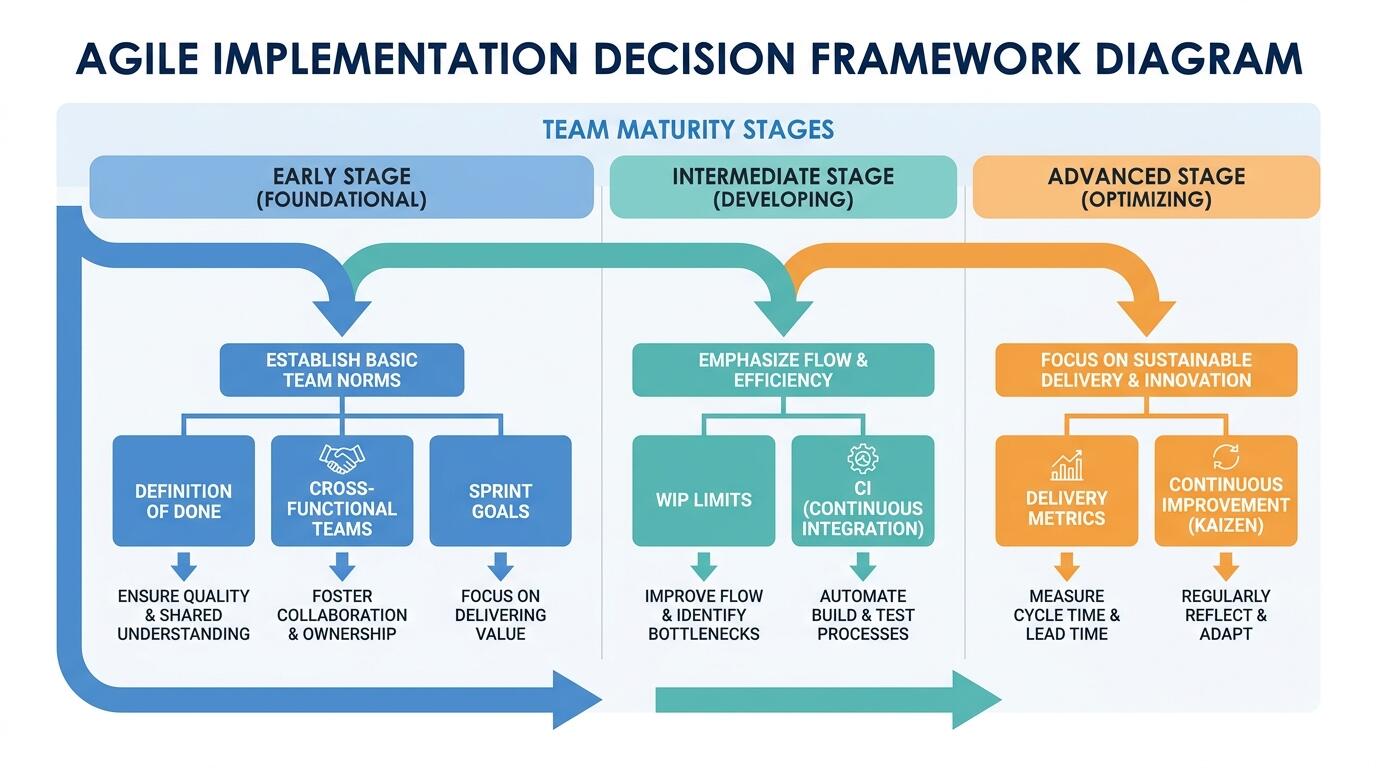
ALT: Decision framework for selecting the right Agile implementation practices for engineering teams at different maturity stages building AI-powered and full-stack products
Common Questions
Q1: How long does it take to see results from improved Agile practices?
Most teams observe measurable improvements in sprint predictability within two to four sprint cycles after implementing a clear Definition of Done and consistent backlog refinement. Structural changes — like reorganizing into cross-functional teams — take longer, often one to two quarters, before the benefits are fully realized. Improvement is a compound effect: small, consistent changes stack up over time rather than producing immediate step-change results.
Q2: Are Agile practices compatible with AI and machine learning development?
Agile practices are not only compatible with AI development — they are increasingly necessary for it. AI projects carry inherent uncertainty around model performance and data quality, which makes iterative delivery and fast feedback loops especially valuable. The key adaptation is ensuring that the Definition of Done explicitly addresses model evaluation criteria, and that backlog refinement accounts for data dependencies. Teams building AI features need tighter collaboration between engineers and data scientists, which cross-functional team structures directly support.
Q3: How much time should a team spend on Agile ceremonies each sprint?
A well-run two-week sprint should require no more than eight to ten hours total across all ceremonies — sprint planning, daily standups, sprint review, and retrospective. Refinement adds another two to three hours across the sprint. If your ceremonies are consuming significantly more time than this, the problem is usually poorly prepared backlog items or meetings that lack a clear facilitator and agenda. Time-boxing each ceremony strictly and preparing materials in advance recovers this time quickly.
The Bottom Line
Agile implementation for engineering teams is not about which framework you adopt — it is about which practices you execute with discipline. The teams that ship consistently and improve over time are not necessarily the ones running the most sophisticated process; they are the ones with a clear Definition of Done, a healthy backlog, retrospectives that produce real change, and engineering fundamentals like CI and WIP management in place.
Key Takeaways:
- A Definition of Done and continuous integration are the non-negotiable foundation — everything else builds on them.
- Sprint goals give teams the autonomy to handle mid-sprint disruption without losing alignment.
- Retrospectives compound: small, consistent process improvements accumulate into significant velocity gains over months.
- WIP limits and delivery metrics expose systemic problems that individual effort alone cannot fix.
- Cross-functional team structure is the highest-leverage structural change available to most engineering organizations, but it requires investment in people and takes time to yield results.
The next step is a team audit: take each practice in this list, rate your current implementation honestly on a simple three-point scale (not in place, partially in place, consistently practiced), and pick the single weakest area to address in the next sprint. That is how Agile improvement actually works — one deliberate, time-boxed experiment at a time.
Visit Darius to explore technical insights, real project case studies, and proven approaches to engineering leadership and AI architecture. If you're working to move faster from idea to shipped product, get in touch — this is exactly the work we do.
Sources & Further Reading
- Aha!. "Agile Best Practices: A Guide For PMs And Engineers".
https://www.aha.io/roadmapping/guide/agile/best-practices - monday.com. "Agile Best Practices: Strategies for High-Performing Teams".
https://monday.com/blog/rnd/agile-best-practices/ - NextAgile. "Top 15 Agile Best Practices Guide For Building Highly Effective Teams".
https://nextagile.ai/blogs/agile/agile-best-practices/ - Agile Alliance. "Agile Glossary and Terminology".
https://www.agilealliance.org/ - Scrum.org. "The Scrum Guide".
https://www.scrum.org/
Note: Standards and frameworks may be updated; please check the latest official documents or consult professional advisors for current guidance.