The Agent Pipeline for Marketers: What a Daily AI Briefing Can Teach Your Team
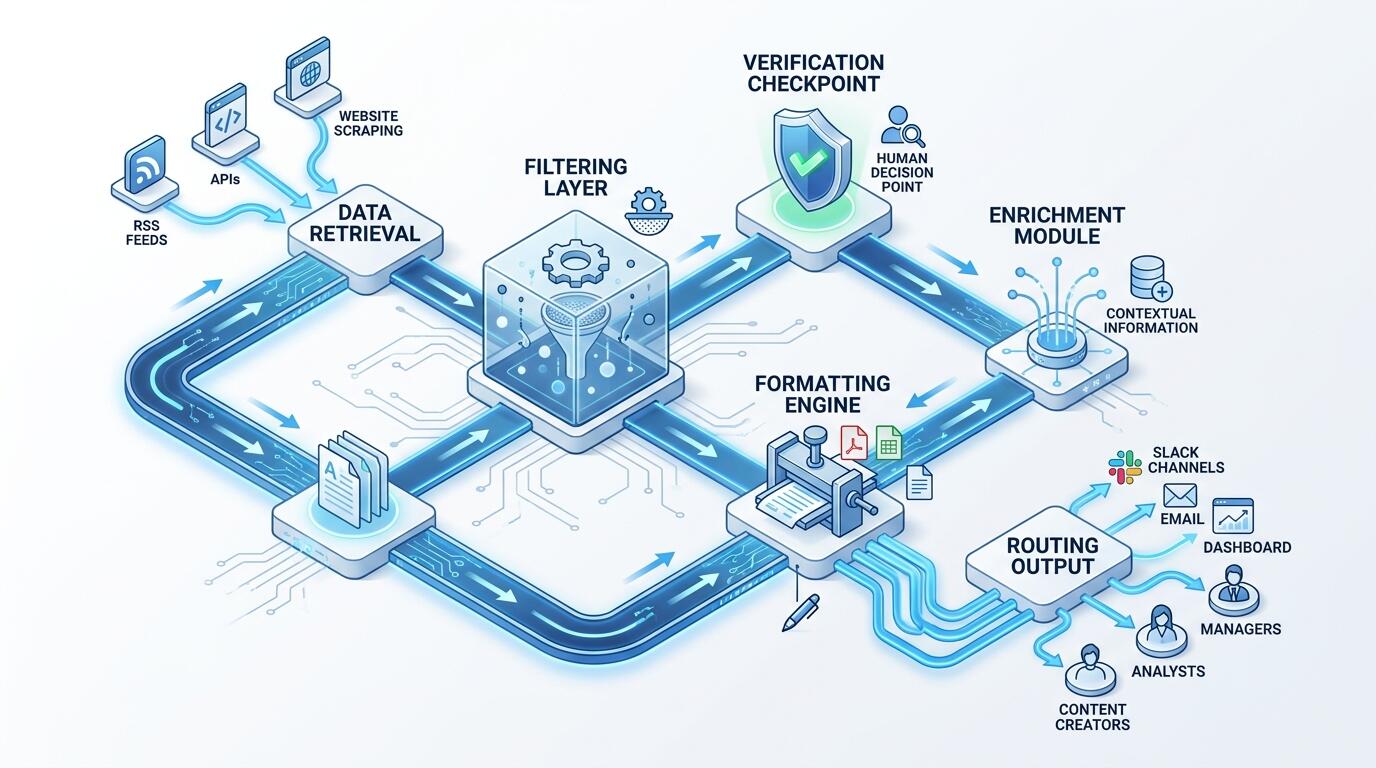
ALT: AI agent pipeline diagram showing how a daily briefing system teaches marketing teams to work smarter
What a Daily AI Briefing Can Show Marketing Teams About Building Agent Pipelines
Your marketing team spends an hour each morning skimming newsletters, Slack digests, and Twitter threads, trying to figure out what actually matters. By the time they've formed a consensus on a topic, a competitor has already shipped a response. The uncomfortable truth is that this information bottleneck is not a people problem — it is a pipeline problem. A well-designed agent pipeline solves it the same way a well-designed daily AI briefing solves it: by making retrieval, filtering, summarization, and routing happen automatically, leaving humans to make decisions rather than gather facts.
This article draws from the operational patterns we see when running a structured AI briefing system at production scale. The core argument is that every design decision embedded in a daily AI briefing — what to fetch, how to verify it, how to format it for action — is a direct analog of the design decisions your marketing team needs to make when adopting agent-driven workflows. The briefing is not just a product; it is a working reference architecture.
Who This Is For — and When It Applies
Applicable Scenarios:
- Marketing or growth teams that consume large volumes of AI-related information daily and struggle to translate it into action before the news cycle moves on
- Engineering or technical leads responsible for standing up internal agent pipelines and looking for a concrete use case to prototype against
- Independent developers building AI-powered content or research tools who want to stress-test their pipeline logic against a real editorial workflow
Not Applicable/Cautions:
- Teams that do not yet have a structured process for information intake at all — an agent pipeline will automate chaos into faster chaos; fix the process first
- Organizations where the primary bottleneck is creative execution rather than information processing — agent pipelines help with the former only indirectly
The Real Problem: Information Latency Is a Product Risk
Marketing teams that build or support AI products face a specific version of a general problem: the domain they are tracking changes faster than any human curation workflow can keep pace with. Model releases, API deprecations, new competitor features, and regulatory signals arrive continuously. Missing a relevant signal for even a day can mean shipping a positioning message that is already stale.
The conventional response is to hire more content analysts or subscribe to more aggregators. A pattern we consistently see is that adding more human readers to the funnel does not reduce latency — it increases it, because now there is coordination overhead on top of reading overhead. The information does not move faster; the team just gets more tired.
Agent pipelines address this at the architecture level. The idea is to decompose the information-to-decision journey into discrete, automatable stages — retrieval, filtering, enrichment, verification, formatting, routing — and then assign each stage to a machine rather than a person. Humans enter the pipeline at the judgment layer, not the gathering layer.
A daily AI briefing is, structurally, exactly this pipeline made visible. Each issue of a briefing like Darius is the output of a retrieval-and-filter pass over hundreds of sources, a verification step to confirm first-hand sourcing, an enrichment step that adds practitioner context, and a formatting step that makes each item immediately actionable. Understanding how that briefing is assembled gives a marketing team a concrete mental model for building their own agent workflows.
For a detailed breakdown of how that retrieval-to-publication pipeline actually works in production, the full technical report on the AI briefing agent pipeline covers each stage with implementation specifics.
Building the Pipeline: A Three-Step Quick Start
Three Steps Your Team Can Implement This Week
Step 1: Define Your Signal Taxonomy Before You Touch Any Tooling
Before any agent fetches a single URL, your team needs to define what "relevant" means with enough precision that a machine can act on it. This means creating a written taxonomy of signal types — competitor moves, model capability changes, regulatory updates, customer use-case examples — and for each type, specifying the source categories, recency requirements, and disqualifying characteristics. Expect to spend a focused two-hour session on this. Teams that skip it end up with agents that surface everything, which is worse than surfacing nothing because it trains readers to ignore the output.
Step 2: Build a Minimum Viable Retrieval-and-Filter Loop
With a taxonomy in hand, wire up a simple retrieval loop: pull from your highest-signal sources (RSS feeds, API endpoints, curated URLs), run each item through a classification pass against your taxonomy, and discard anything that does not meet threshold. Do not try to also summarize, enrich, or format in this first loop — separation of concerns matters here. A common failure mode is collapsing retrieval and enrichment into one step, which makes it impossible to debug when the output quality degrades.
Step 3: Add a Verification and Routing Layer Before Human Review
Once your retrieval loop is stable, add a verification pass that checks each item for a traceable first-hand source, and a routing step that assigns each item to the correct team member or Slack channel based on signal type. Only after this layer should a human see the output. The goal is that by the time a marketer reads the digest, every item is already categorized, sourced, and tagged for action — no triage required. This step is where most teams underinvest, and it is the step that determines whether the pipeline earns trust or gets abandoned.
Comparing Approaches to Marketing Agent Pipelines
Marketing teams typically have three practical approaches when adopting agent-driven information workflows. Each has a different cost structure, time-to-value, and maintenance burden.
| Comparison Dimension | Native Platform Agents | Custom-Built Pipeline | Structured Briefing Subscription |
|---|---|---|---|
| Setup time | Low (days) | High (weeks to months) | Near-zero |
| Customization depth | Limited to platform features | Full control | Depends on editorial scope |
| Source coverage | Platform-specific | Configurable | Curated by editorial team |
| Verification quality | Variable, often weak | Depends on implementation | Enforced editorially |
| Ongoing maintenance burden | Handled by vendor | High | None for subscriber |
| Practitioner context | None | None unless built in | Core value-add |
| Appropriate team size | Any | Engineering capacity required | Any |
The most common pitfall we see is teams defaulting to native platform agents — tools that aggregate news within a single vendor's ecosystem — because setup is fast, without realizing that source coverage is structurally limited. The agent only sees what the platform surfaces, which is rarely where the highest-signal information lives.
Monday.com's AI Daily Briefer agent is a representative example of the native platform category: it is fast to deploy and useful for pipeline-specific data, but it does not reach the broader external signal landscape that marketing teams covering AI need to monitor. Writer's analysis of agent pipelines for content teams makes a similar point: the agent's value ceiling is set by the quality of its retrieval layer, not its summarization capability.
Why the Briefing Format Is a Useful Reference Architecture
A daily AI briefing that is built and run by practitioners — rather than assembled by an editorial team with a news background — encodes a specific set of design decisions that map directly onto agent pipeline architecture. Breaking them down makes the parallel explicit.
Retrieval scope is a bounded problem, not a maximization problem. A briefing that attempts to cover everything produces nothing useful. The same is true of an agent pipeline: the first engineering mistake is building the widest possible retrieval net and expecting downstream filters to compensate. In practice, source selection is the highest-leverage decision in the pipeline, and it should be made deliberately, not by default.
Filtering is a policy, not a feature. In a briefing, the editorial rule set — what qualifies as worth including — is written down, tested against edge cases, and revised when it produces bad outputs. Agent pipelines need the same thing: a documented filtering policy that an agent can follow consistently. Teams that treat filtering as an implicit judgment call end up with agents whose behavior drifts as underlying model behavior changes. The process of writing editorial rules that an agent can actually follow is a learnable discipline — it is not fundamentally different from writing a specification.
Verification is the step that determines whether the output earns trust. A briefing that surfaces a claim without a traceable first-hand source trains its readers not to trust the briefing. An agent pipeline that routes unverified information to a decision-maker trains that decision-maker to override the pipeline. Both failure modes are fatal. The verification layer is not optional, and it cannot be delegated entirely to a language model — some form of source-traceability check needs to be structural.
Formatting is a communication decision. The way each briefing item is structured — signal, source, practitioner interpretation, implied action — is a deliberate choice about how information should flow from the pipeline to the human. Agent pipelines that output raw summaries without a formatting convention put the cognitive burden back on the reader and reduce the pipeline's value. Defining an output schema is as important as defining an input schema.
Routing determines whether the output reaches the right person at the right time. A briefing that lands in an inbox at 3 AM local time, or goes to a general list when it should go to a specific team, fails at the last step. Agent pipelines face the same routing problem: who receives what, in what channel, at what cadence. Getting this wrong is the single most common reason a well-built pipeline gets abandoned — the output exists but does not integrate into actual work patterns.
Advanced Considerations: Where Pipelines Break Under Real Conditions
Agent pipelines for marketing teams fail in predictable ways. Recognizing the failure modes in advance is more useful than debugging them after they've eroded team trust.
The cold-start verification problem is the most acute. When a pipeline is first deployed, there is no historical baseline for what good output looks like. Teams tend to over-trust early output because the novelty of automation suppresses critical evaluation. The correct posture is the opposite: run the pipeline in parallel with your existing human process for the first few weeks, and audit every divergence. The divergences are your calibration data.
Model version drift is a silent killer. If your filtering or enrichment steps rely on a language model, any change to that model's behavior — even a minor version update — can shift your pipeline's output quality without any explicit change on your end. Build evaluation benchmarks against a fixed sample of inputs and run them on a scheduled basis, not just when you suspect something is wrong. For a broader look at how to assess AI tooling before committing, the framework for evaluating AI development tools before signing a contract applies directly to pipeline component selection.
The "good enough to ship, bad enough to mislead" zone is where most pipelines stall. Output quality is high enough that the team does not abandon the pipeline, but low enough that it occasionally surfaces wrong or misleading information. This is more dangerous than obviously bad output, because it degrades trust slowly and inconsistently. Build explicit escalation paths: when an item's confidence or source quality falls below a defined threshold, route it for human review rather than letting it pass through.
Misconception: more sources means better coverage. A pattern we see repeatedly is teams expanding source lists as a response to quality complaints, when the actual problem is filtering policy. More sources without better filtering produces more noise. Audit your filtering layer first.
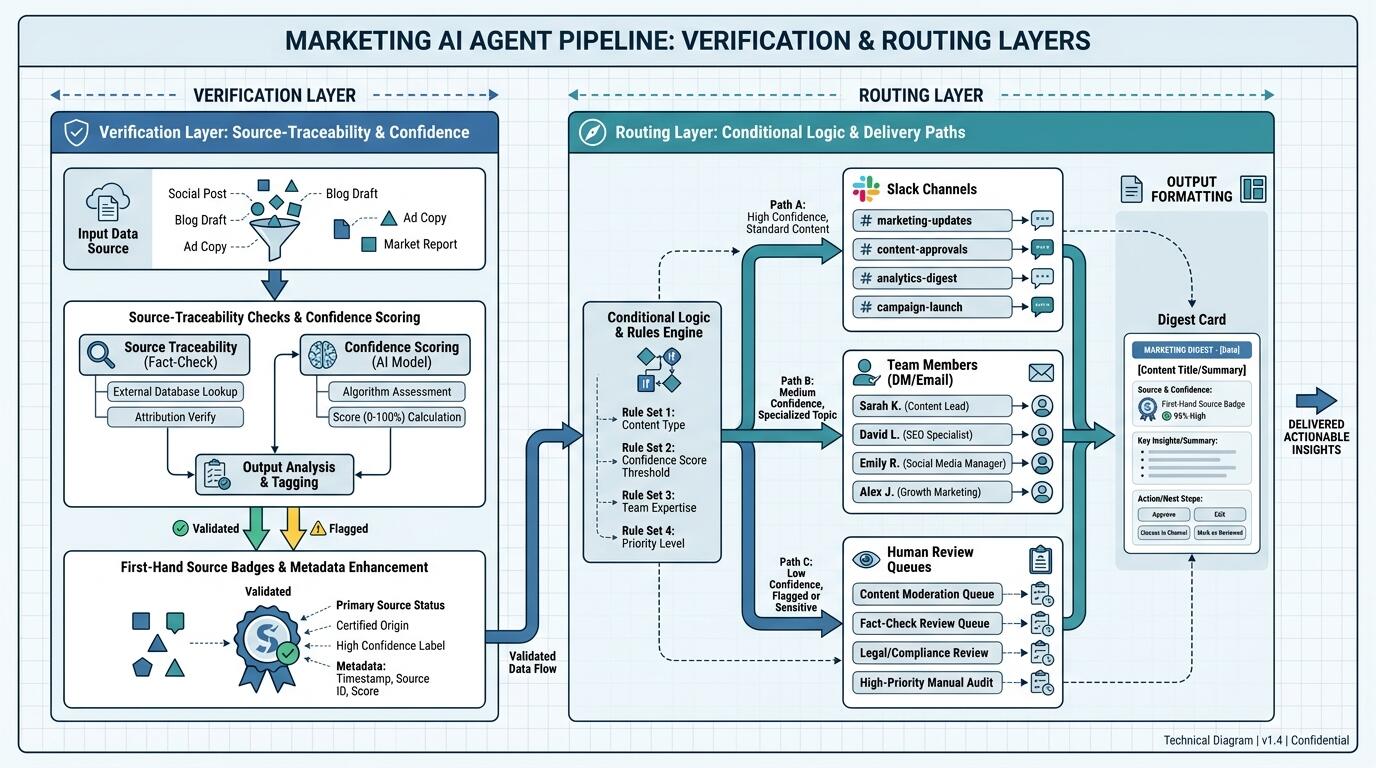
ALT: Diagram showing verification and routing layers in a marketing-focused AI agent pipeline with source attribution and output formatting steps
Common Questions
Q1: How do you decide which sources to include in a marketing agent pipeline?
Source selection should follow your signal taxonomy, not your familiarity with certain publications. Start by listing the five to ten sources that have historically generated the most actionable decisions for your team, confirm that each can be programmatically accessed (RSS, API, or structured URL), and begin there. Expand the source list only after you have evidence that your filtering layer handles the initial set well. Adding sources before the pipeline is stable is a common way to introduce noise that degrades trust in the entire system.
Q2: Is a pre-built AI briefing subscription a substitute for building an internal agent pipeline?
They serve different functions. A practitioner-curated briefing like a structured daily AI newsletter gives your team high-quality, verified signal with practitioner context, at near-zero operational cost. An internal pipeline gives you the ability to monitor sources specific to your own product, competitive landscape, or customer base. The most effective setups we see use both: a curated external briefing for broad domain awareness, and a lightweight internal pipeline for company-specific signals. Starting with a briefing subscription is a faster way to calibrate what good pipeline output looks like before you build.
Q3: How long does it take for a marketing team to operationalize an agent pipeline from scratch?
Realistic timelines depend heavily on engineering capacity and the clarity of the team's signal taxonomy. A minimum viable pipeline — retrieval, basic filtering, formatted digest, routed to Slack — can be running in one to two focused sprints if an engineer owns it and the taxonomy is pre-defined. The harder work is the calibration period afterward, typically several weeks of running the pipeline alongside existing workflows and adjusting filtering thresholds and routing rules. Teams that try to build and deploy simultaneously without a calibration phase almost always end up with a pipeline that gets ignored.
The Bottom Line
The agent pipeline behind a daily AI briefing is not a niche engineering artifact — it is a working blueprint for how marketing teams can handle information at the speed the AI landscape actually moves.
Three things to take away: First, the design decisions embedded in a high-quality briefing — retrieval scope, filtering policy, verification layer, output format, routing — are the same decisions you need to make when building a marketing agent pipeline, and you can use the briefing as a concrete reference. Second, the most common failure modes are not technical; they are process failures — skipping taxonomy definition, collapsing pipeline stages, and over-trusting early output. Third, starting with a practitioner-curated briefing subscription is the fastest way to calibrate your team's sense of what good pipeline output looks like before you invest in building your own.
The practical next step is to spend thirty minutes mapping your current information workflow against the pipeline stages described here — retrieval, filtering, verification, formatting, routing — and identify which stage has the highest human cost. That is where to start building.
If you are building AI products and want to skip the noise and get straight to the signals that actually matter, subscribe to the Darius briefing at Darius — each issue delivers five to ten curated items with first-hand sources and practitioner interpretation from an engineering director running three production AI products.
References & Further Reading
- monday.com. "AI Daily Briefer agent".
https://monday.com/w/ai-templates/ai-agents/daily-briefer-agent - Writer. "This AI agent analyzes and reports on your key pipeline trends".
https://writer.com/blog/ai-agent-key-pipeline-trends/ - AI Daily Brief. "How to Build Team Agents".
https://aidailybrief.ai/e/2026-09-29
Note: Agent tooling and platform capabilities evolve rapidly. Verify current feature sets and API availability directly with the relevant providers before making implementation decisions.