Why Agent Autonomy Is the Wrong Question for Most Teams This Quarter

ALT: Engineering team debating AI agent autonomy versus reliability in a production environment sprint planning session
The Autonomy Debate Is Costing Teams Their Actual Roadmap
Most AI teams we follow right now are having the same internal argument: should the agent handle this step on its own, or does it need a human in the loop? The question feels strategic. It is, in practice, a distraction — at least for where most teams actually are in their development cycle.
The deeper issue is that framing the conversation around agent autonomy assumes you have already solved the harder prerequisites: reliable task decomposition, observable intermediate states, recoverable failure modes, and consistent output contracts. A pattern we consistently see is teams spending significant engineering cycles debating the degree of autonomy they want to grant an agent before they have meaningful data on how the agent behaves under normal operating conditions. That sequencing problem is costing quarters, not days.
This piece is about why the autonomy question is premature for most teams right now, what the more productive questions are, and how to reframe your near-term roadmap around problems you can actually close this quarter.
How the Autonomy Framing Took Hold — and Why It Stuck
The current obsession with agent autonomy is a direct product of the large language model capability curve of recent years. As foundation models moved from pattern completion to multi-step reasoning, researchers and product teams began imagining agents that could execute long-horizon tasks with minimal supervision. Prominent research from academic institutions including Stanford and MIT, along with papers published through venues like the Association for the Advancement of Artificial Intelligence (AAAI), explored agents operating over extended task sequences — and those papers filtered into engineering discourse faster than the accompanying caveats did.
The resulting narrative — that the goal of AI product development is to maximize agent autonomy — became widely accepted in ways that were never entirely warranted. The research explored what was possible under controlled conditions with human evaluators providing quality signals. Production environments offer neither.
The enterprise software industry's familiarity with automation reinforced this. Automation is generally understood as "remove the human from the loop." AI agents got mapped onto that mental model, and autonomy became the implied optimization target. The more autonomous, the better — or so the thinking went.
By the time agentic frameworks like LangChain, AutoGPT derivatives, and various orchestration layers became widely available, teams had a ready supply of tools designed to maximize what an agent could do without intervention. The tooling shaped the conversation. If the framework is built to support tool-calling chains, multi-agent delegation, and long-context memory, the natural design question becomes: how much can we let it run on its own?
That question is not inherently wrong. It is wrong right now for most teams, because the prerequisite layer — what we might call the reliability substrate — is not in place to make the autonomy question answerable in a useful way.
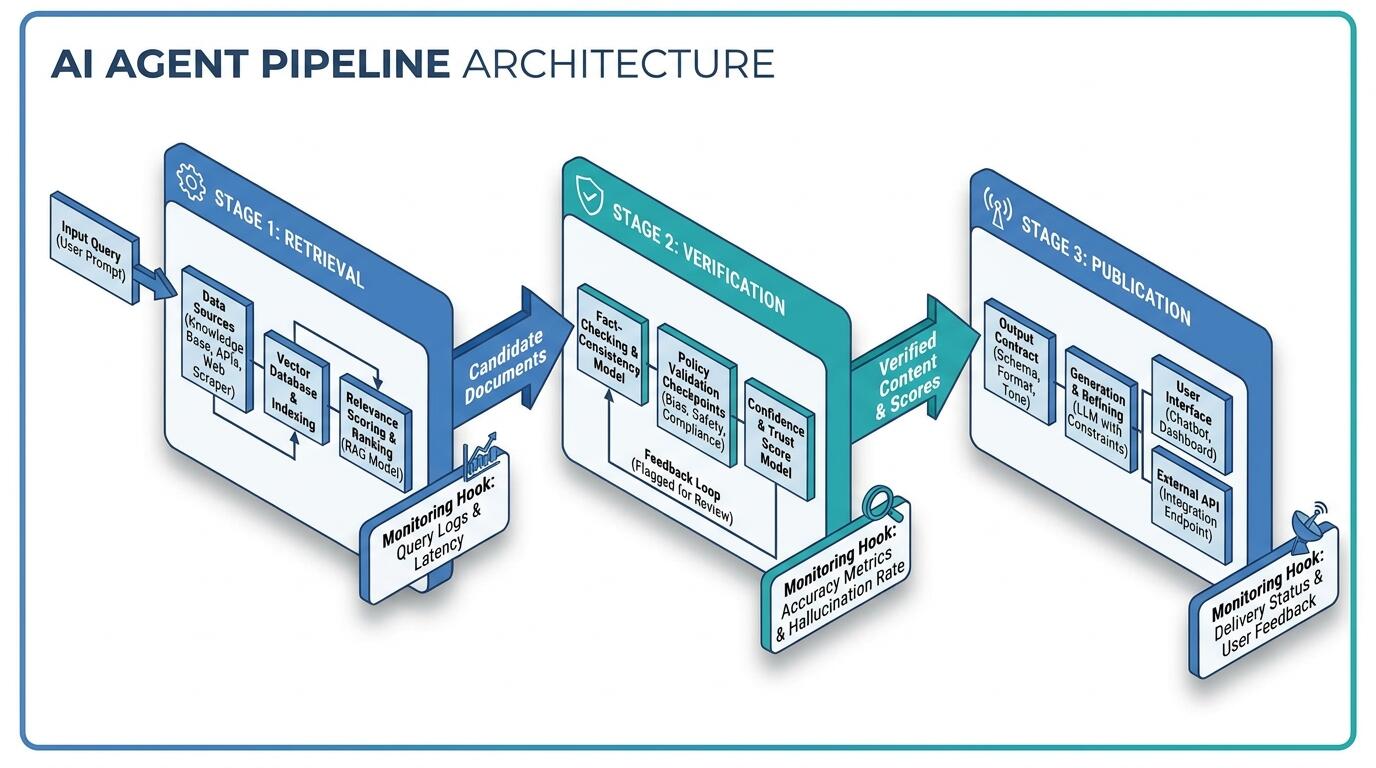
ALT: AI agent pipeline architecture diagram illustrating retrieval, verification, and publication stages relevant to production AI systems and agent reliability
Why Autonomy Is the Wrong Optimization Target This Quarter
The real problem is not that autonomy is a bad goal. It is that autonomy is an output of a well-functioning system, not an input to one. Treating it as a design objective before the system is well-functioning produces agents that are autonomous in ways you have not accounted for — which is not autonomy, it is drift.
Observability Comes Before Autonomy
Agent observability — the capacity to know what an agent did, why it made a particular tool call, and what intermediate state it is operating from — is the actual foundational capability that enables everything else. In our work tracking AI teams in production, the most common failure mode is not that teams gave agents too much autonomy. It is that they had no reliable way to know what the agent was doing in the middle of a task chain.
Without observability, autonomy decisions are made on faith. You set a policy ("the agent handles steps 1 through 4 without review") based on early testing, and then you have no mechanism to detect when that policy is producing bad outputs in edge cases that did not appear in your test distribution. The autonomy level you set becomes a liability the moment your production traffic diverges from your test data — which it always does.
Failure Recovery Is Harder Than It Looks in Orchestrated Workflows
Failure recovery in agentic systems is a distinct engineering challenge from failure recovery in conventional software. When a deterministic function fails, it fails cleanly. When an LLM-based step in an agent chain produces an output that is subtly wrong rather than obviously broken, downstream steps consume that error and propagate it. By the time the failure surfaces to a user or a monitoring alert, the causal chain is several layers deep.
Teams that have not built structured recovery mechanisms — checkpointing intermediate states, defining explicit failure contracts per step, building rollback paths — should not be designing for high autonomy. The higher the autonomy, the longer the chain of unmonitored decisions before a failure surfaces. For teams where we see this clearly, the right move this quarter is to shorten and instrument the chains, not extend them.
Output Contracts Are Not a Nice-to-Have
An output contract is a formal specification of what a given agent step is expected to produce — its schema, its confidence bounds, its acceptable failure modes. Most teams we observe are running agents without explicit output contracts. Steps hand off to the next step in whatever format the model happened to generate, with validation happening only at the terminal output.
This is fine for prototypes. In production, it means that changes to the underlying model — a model update, a prompt change, a context window adjustment — can break the chain in ways that are invisible until they hit users. Output contracts create testable seams. They allow you to verify that each step in the chain is functioning correctly, independently, before you wire them together. Without them, increasing autonomy just means more surface area for invisible failures.
Trust Calibration Takes Longer Than Most Teams Budget
Trust calibration — the iterative process of learning which tasks the agent performs reliably enough to run unsupervised — requires a meaningful volume of production runs across a representative distribution of inputs. Teams that have been running agents for a few weeks on constrained workflows have not collected enough signal to make informed autonomy decisions on broader task classes.
This is not a failure of the team. It is a product of how agentic systems behave in production. The tail of the input distribution — the edge cases, the unusual user phrasings, the inputs that combine in ways the system designer did not anticipate — takes time to surface. Pushing autonomy higher before you have seen enough of the tail is a bet against the house.
Examining Competing Approaches to the Autonomy Question
Teams across the AI product landscape are taking meaningfully different positions on how to handle agent autonomy, and those differences have observable trade-offs.
| Perspective / Approach | Strengths | Trade-offs | Best Fit |
|---|---|---|---|
| Maximize autonomy early | Faster UX iteration, lower operational cost if it works, useful for discovering capability limits | High blast radius when failures occur, poor observability, hard to debug in production | Research environments, low-stakes consumer products with easy rollback |
| Human-in-the-loop by default | High reliability, clear accountability, safer for regulated domains | Slower, higher operational cost, does not scale without automation layer | Enterprise, regulated industries, early-stage production with novel task types |
| Autonomy-by-step (per-step trust calibration) | Granular control, testable, allows incremental expansion of autonomy | Requires robust observability tooling, more complex to orchestrate | Teams with mature monitoring, mid-stage production systems |
| Full human review of agent output | Maximum quality control, clear audit trail | Does not leverage agent capability, bottlenecks at human review bandwidth | Initial deployment, high-stakes one-off tasks, auditable workflows |
The per-step trust calibration approach — which we consider the most defensible for teams currently in production — requires exactly the observability and output contract infrastructure described above. It is not the easiest path. It is the one that makes the autonomy question answerable instead of aspirational.
For teams building pipelines where retrieval, verification, and publication are distinct stages, understanding how each step behaves independently is essential. The agent pipeline architecture behind a production AI briefing offers a concrete case study in how to instrument those stages for reliability before pushing autonomy higher.
A related consideration that matters for this quarter specifically: teams deciding between building their own orchestration infrastructure and buying a managed layer are effectively also deciding how much of the reliability substrate comes pre-built. The build vs. buy decision for AI infrastructure has significant implications for how quickly you can reach a state where autonomy decisions are empirically grounded rather than speculative.
Where This Is Heading and What to Prioritize Now
The autonomy question will eventually be the right question. As reliability substrates mature — better native observability in LLM APIs, more standardized output validation middleware, better tooling for distributional shift detection — teams will have the data they need to make autonomy decisions that are grounded rather than optimistic.
The direction of model development from major labs also points toward agents that are better at expressing uncertainty, requesting clarification, and surfacing their own reasoning — capabilities that make autonomy safer by making agent behavior more predictable. IEEE working groups and AI safety researchers have increasingly emphasized structured verification and interpretability as prerequisites for deploying autonomous systems in consequential contexts, a perspective that aligns with the operational experience of teams running AI products in production.
For this quarter specifically, the most high-leverage priorities are:
- Instrument every step in your existing agent chains. Know what is happening between input and output.
- Write explicit output contracts for each step. Make each stage testable in isolation.
- Define what a recoverable failure looks like for each task class your agents handle.
- Map the input distribution your agents have actually seen versus what they will see in expanded deployment.
- Set autonomy levels based on observed reliability data per task class, not on general model capability claims.
Teams that do this work this quarter will be positioned to expand autonomy in a principled way next quarter. Teams that skip it in favor of designing for high autonomy now will spend next quarter debugging cascading failures they cannot easily trace.
The more immediate goal — shipping reliably without sacrificing output quality — is achievable this quarter for teams willing to make the sequencing trade-off. Nail reliability and observability first. The autonomy expansion follows naturally from that foundation.
People Also Ask
How does agent observability differ from standard application monitoring?
Agent observability goes beyond traditional logging because the relevant signals are not just system events but intermediate reasoning states — what context the agent used, which tool calls it made and in what sequence, and how it synthesized intermediate outputs. Standard application monitoring tracks whether a service returned successfully. Agent observability tracks whether the agent's decision-making process produced a semantically correct intermediate state. Teams building agentic systems need both layers, and the agent-specific layer requires explicit instrumentation at each step in the task chain.
Are there AI task types where high autonomy is already appropriate this quarter?
High autonomy is defensible right now for narrowly scoped, low-stakes, reversible tasks with well-understood input distributions — for example, formatting transformations, classification against a fixed taxonomy, or summarization within a tightly constrained domain. The key conditions are: the failure mode is detectable and recoverable, the task inputs are well-characterized from prior production runs, and output quality can be validated programmatically. For broad, multi-step, high-stakes, or novel task classes, high autonomy remains premature without a mature reliability substrate in place.
How long does it typically take to reach a state where autonomy decisions are empirically grounded?
The timeline depends on task complexity, production traffic volume, and monitoring maturity. For a narrowly defined, well-instrumented task running at meaningful production volume, enough signal to make calibrated per-step autonomy decisions can accumulate over several weeks to a few months. For broader or less common task types, it takes longer because the tail of the input distribution surfaces slowly. The practical implication is that teams should not expect to complete trust calibration in a single sprint — it is an ongoing process, not a one-time milestone.
Summary
The agent autonomy debate is not wrong in principle, but it is the wrong focal point for most engineering teams this quarter. The core argument, stated plainly: autonomy is a property of a well-functioning system, not a design lever you pull before the system is functioning well.
Key Takeaways:
- Agent autonomy is an output of reliable, observable systems — not a starting design objective.
- Observability, output contracts, and failure recovery are the prerequisites that make autonomy decisions empirically defensible.
- Trust calibration takes real production volume to develop; most teams have not yet collected enough signal to expand autonomy safely.
- Per-step trust calibration — setting autonomy levels based on observed reliability per task class — is the most defensible approach for teams currently in production.
- The highest-leverage work this quarter is instrumentation and reliability infrastructure, not autonomy expansion.
The teams that close this quarter in a strong position will be the ones that treated observability and reliability as the actual product work, and deferred the autonomy expansion until they had the data to support it. That sequencing discipline is unglamorous. It is also what separates teams that consistently ship reliable AI products from teams that are perpetually firefighting.
If you are building AI products and want a practitioner's perspective delivered efficiently each week, subscribe to the Darius bilingual AI briefing — written by an engineering director who runs AI products in production and reads every source so you don't have to. Visit Darius to explore the newsletter, topic pages, and engineering blog.
References
- Association for the Advancement of Artificial Intelligence (AAAI). "Proceedings on Autonomous Agent Research and Multi-Step Reasoning Systems".
https://www.aaai.org/ - IEEE. "Standards and Working Groups on AI System Reliability, Verification, and Autonomous Decision-Making".
https://www.ieee.org/ - Stanford University Human-Centered AI Institute (HAI). "Research on Large Language Model Agents and Human-AI Collaboration".
https://hai.stanford.edu/ - MIT Computer Science and Artificial Intelligence Laboratory (CSAIL). "Research Publications on AI Agent Architectures and Failure Modes".
https://www.csail.mit.edu/ - National Institute of Standards and Technology (NIST). "AI Risk Management Framework and Guidelines for AI System Trustworthiness".
https://www.nist.gov/
Note: Standards and frameworks may be updated; please check the latest official documents or consult professional advisors for current guidance.