Advanced Tactics for Running Multiple Production Services Alone
ALT: Engineer managing multiple production AI services alone with advanced operational tactics and monitoring dashboards
Running Multiple Production Services Alone Is Possible — If You Architect for It
Can a single engineer realistically operate several production services without burning out or shipping broken software? Yes — but only if operational resilience is designed into the system from the start, not bolted on after the first 3 a.m. incident. The core conclusion is straightforward: solo operators succeed not because they work harder, but because they ruthlessly minimize the blast radius of every decision and automate everything that does not require genuine human judgment.
This article draws on the lived experience of running three production AI products simultaneously — each with real users, real data, and real infrastructure bills. The patterns here are not theoretical; they are what actually held things together when a deployment went sideways at midnight and there was no on-call rotation to call. If you are building or operating AI products as a small team or a one-person engineering department, the tactics below are the ones worth reaching for first.
Who Should Read This — and Who Should Probably Not
Applicable Scenarios:
- Solo engineers or two-person teams operating multiple live services with actual user traffic
- Technical founders who ship and maintain their own infrastructure in parallel with product work
- AI product builders running autonomous pipelines (data ingestion, model inference, content generation) that must stay up without a dedicated SRE team
- Engineers at small companies where "on-call" means your personal phone
Not Applicable/Cautions:
- Teams with dedicated SRE or platform engineering headcount — your leverage comes from specialization, not generalization
- Projects still in pre-production or prototyping phases, where the overhead of robust operational scaffolding is premature
- Regulated industries (healthcare, finance) where compliance mandates multi-person review on every change — solo operation introduces approval-chain risks that tooling cannot fully mitigate
The Structural Problem With Solo Production Operations
The central challenge of running multiple production services alone is not technical skill — it is attention bandwidth. Any experienced engineer can debug a failing service; the hard part is debugging it while a second service is degrading and a third is waiting for a scheduled deployment. Attention is the scarce resource, and every operational decision should be evaluated by how much of it the decision will consume going forward.
The industry has broadly moved toward platform engineering and internal developer platforms precisely because the cost of context-switching across services compounds faster than most teams expect. Studies and practitioner reports from the site reliability engineering community consistently show that unplanned work — the fires that interrupt planned work — is the primary driver of engineer burnout in small infrastructure teams. For a solo operator, unplanned work does not get distributed; it lands entirely on one person.
The good news is that the same trend pushing teams toward automation — the rise of AI-assisted tooling, event-driven infrastructure, and observable-by-default cloud primitives — also dramatically lowers the floor for what a single engineer can sustainably operate. Understanding how to use those primitives deliberately is the entire game.
Understanding the trade-offs involved is also relevant to the broader build vs. buy decision for AI infrastructure, where the operational burden of self-managed services is often underweighted relative to the upfront cost savings.
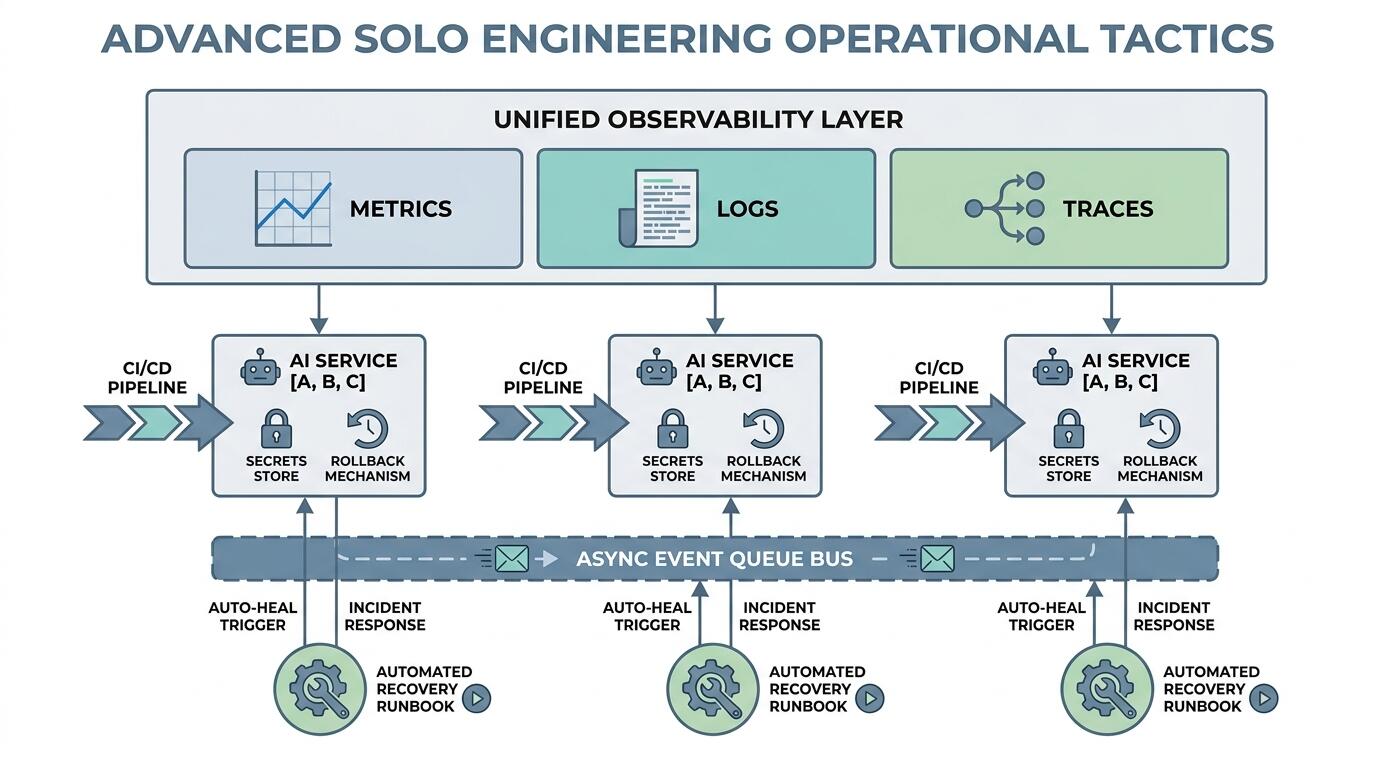
ALT: Diagram illustrating advanced tactics for solo engineers managing multiple production AI services with automated monitoring and isolated deployment pipelines
Advanced Tactics for Running Multiple Production Services Alone
Three-Step Foundation Before You Add a Second Service
Step 1: Establish a Unified Observability Layer
Before operating two services in parallel, centralize logs, metrics, and traces into a single pane of glass. This does not mean buying an expensive APM suite — it means choosing one place where you will look first when something breaks, and making sure every service emits enough signal to make that look useful. Pick a stack (Grafana + Loki + Prometheus is a common self-hostable choice; managed options from cloud providers work equally well) and enforce it as a hard constraint before launching service number two. Time investment: roughly a focused weekend for a greenfield setup, longer if retrofitting legacy services.
Step 2: Define an Explicit Failure Budget Per Service
A failure budget is a concrete, pre-negotiated answer to the question "how much degradation is acceptable before I drop everything and fix this?" Without it, every alert feels equally urgent, which is cognitively paralyzing when you are operating alone. Set a target availability or error rate per service, document it somewhere visible, and build your alerting thresholds around it. The budget does not need to be precise — the act of writing it down forces clarity about what actually matters.
Step 3: Automate the Recovery Path, Not Just the Detection
Detection without remediation just means you get paged faster. For each common failure mode — a crashed process, a full disk, a failing upstream API — write a runbook, then automate as many runbook steps as are safe to automate. Many solo operators stop at alerting and never build the recovery automation, which means every incident still requires full human attention. Invest the upfront time to make the most frequent incidents self-healing. The payoff compounds with every subsequent occurrence.
Comparing Operational Approaches for Solo Multi-Service Environments
The three dominant strategies for a solo operator managing multiple production services each carry meaningful trade-offs. Understanding them side by side helps you allocate your limited operational investment correctly.
| Comparison Dimension | Fully Managed Cloud Services | Self-Hosted with Automation | Hybrid (Managed Data Plane, Self-Hosted Control Plane) |
|---|---|---|---|
| Operational overhead | Lowest — vendor handles patching, scaling, and much of the failure recovery | Highest — you own the full stack and all failure modes | Medium — you manage logic, vendor manages compute/storage |
| Blast radius per incident | Contained by vendor SLA; failures are usually invisible to you | Potentially high; a misconfiguration can cascade across all services | Partially contained; vendor failures affect data plane but not your logic |
| Cost predictability | Higher at scale; pricing surprises are common at traffic spikes | More predictable; you control the underlying resources | Variable; depends on how cleanly the boundary between planes is drawn |
| Debugging depth | Limited; vendor abstractions obscure root causes | Full access; you can instrument everything | Mixed; deep visibility into control plane, limited into data plane |
| Suitable solo operator profile | Engineers who want to focus on product, not infrastructure | Engineers with strong SRE/DevOps backgrounds who value control | Engineers building AI pipelines where model hosting is managed but orchestration is custom |
The honest observation from operating across all three modes: fully managed services look cheapest in attention cost until the first time something fails in a way the vendor does not surface clearly. Self-hosted setups look cheapest in dollars until you account for the time cost of maintaining them. The hybrid approach is often the right answer for AI product builders, because model inference and vector storage are commoditizing rapidly while the orchestration and product logic around them is where your actual differentiation lives.
Detailed Tactical Patterns That Actually Hold Up in Production
Isolate services at the deployment boundary, not just the code boundary.
Code-level isolation — separate repositories, separate packages — is necessary but not sufficient. What actually prevents a bad deployment in service A from affecting service B is deployment pipeline isolation: separate CI/CD pipelines, separate secrets stores, and separate rollback mechanisms. A pattern that works well in practice is treating each service as if it were operated by a different team that happens to share the same laptop. This mental model prevents the temptation to share deployment state across services for convenience, which is the most common source of cross-service blast radius.
Use feature flags as a first-class operational tool, not just a product tool.
Feature flags are typically framed as a product management primitive — a way to run A/B tests or gate beta features. For solo operators, they are equally valuable as an operational kill switch. Any behavior that is expensive to roll back — a new model call, a changed data schema, a third-party integration — should be behind a flag. This lets you disable a problematic behavior in seconds without a full deployment, which is the difference between a five-minute incident and a forty-minute one when you are operating alone.
Build for async-first architecture wherever latency requirements allow.
Synchronous service dependencies are the fastest path to cascading failures. When service A calls service B synchronously and B is slow, A's users feel it immediately. For solo operators, the cure is designing communication between services to be asynchronous wherever the use case allows — event queues, webhooks, scheduled jobs. This does not just improve resilience; it also decouples your operational attention. A backed-up queue is a slower-moving problem than a broken synchronous dependency, which gives you time to respond thoughtfully rather than reactively.
Schedule regular "operational audits" as calendar commitments, not intentions.
One of the most reliable patterns from running multiple live products is the value of a weekly thirty-minute slot dedicated to reviewing the health of all services together — not responding to alerts, but proactively looking for signals that have been trending in the wrong direction. Slowly increasing error rates, growing queue depths, disk usage creeping upward — these never trigger alerts until they become crises. Catching them in the audit window prevents a class of incidents entirely. The discipline required is simply treating the audit as a non-negotiable calendar item, not something to do "when there's time."
Maintain a living incident log, even for solo operations.
Writing a brief post-mortem for every significant incident — even one that affects only you — is disproportionately valuable over time. The log reveals patterns: which service generates the most operational noise, which failure modes recur, which automation investments would have the highest leverage. Without the log, each incident feels unique. With it, you start to see that three different-looking incidents were actually the same root cause. This is the foundation for making the system progressively easier to operate rather than fighting the same fires indefinitely.
The same discipline of structured, documented decision-making applies to AI pipeline operations. Building systems that can catch failures before they surface to users requires the same combination of observable signals and documented runbooks described here.
Advanced Edge Cases and Common Misconceptions
The "just add more monitoring" trap. A common misconception is that operational pain decreases linearly with the number of alerts and dashboards. In practice, alert fatigue is real and dangerous — a solo operator who receives forty alerts a day will start ignoring them, including the ones that matter. The advanced tactic is aggressive alert pruning: regularly audit your alerting rules and delete any alert that has not led to a meaningful action in the past month. More signal is not better; calibrated signal is.
The temptation to consolidate services to reduce complexity. When operating multiple services feels overwhelming, the instinct is to merge them — fewer moving parts, simpler mental model. This is sometimes correct, but often it just shifts the complexity inside a single service, making it harder to isolate failures and harder to deploy changes safely. Before consolidating, ask whether the operational burden is coming from the service boundary itself or from insufficient automation and observability within each service. Usually it is the latter.
Dependency version drift across services. When you are moving fast across multiple codebases, it is easy for shared dependencies — runtime versions, common libraries, authentication SDKs — to drift apart across services. This creates a class of bugs that are genuinely difficult to diagnose because they only appear when services interact. A practical mitigation is a shared dependency manifest (a simple document or a monorepo convention) that defines the canonical version of high-impact shared dependencies and gets reviewed whenever a service updates one.
The role of AI tooling in reducing solo operator overhead. AI-assisted code review, automated changelog generation, and LLM-based runbook drafting are increasingly practical for small teams. The important caveat is that these tools reduce the cost of producing artifacts — documentation, tests, runbooks — but they do not replace the judgment required to know which artifacts to produce and when. Used well, they are a genuine force multiplier for a solo operator. Used poorly, they generate confident-sounding output that obscures rather than clarifies the actual system state. The discipline required is the same as with any other operational tool: define exactly what problem you are using it to solve before you reach for it. For teams building AI pipelines, understanding how to ship quickly without sacrificing production quality is directly relevant to this balance.
Frequently Asked Questions
Q1: How do you decide which services to automate first when operating alone?
Prioritize automation by incident frequency multiplied by time-to-resolve, not by severity alone. A low-severity incident that happens three times a week and takes thirty minutes each time costs more total attention than a high-severity incident that happens once a quarter. Build a simple log of incidents over four to six weeks, sort by cumulative time cost, and automate from the top of that list. This approach consistently surfaces surprising winners — often mundane operational tasks that feel routine but consume significant aggregate attention.
Q2: Is it sustainable to run more than two production services entirely alone?
It is sustainable, with the right architectural constraints, but the marginal cost of each additional service is not linear — it is closer to exponential if services share operational failure modes. Three services are roughly manageable with strong automation and observability. Beyond that, the pattern that tends to work is consolidating shared operational concerns (logging, alerting, deployment pipelines) into a platform layer that all services use uniformly, so adding a new service does not add proportional operational overhead. The ceiling depends heavily on how stable and self-healing the existing services are.
Q3: How much upfront time does building proper operational scaffolding take?
The honest answer is that a solid observability layer, automated recovery for the top five failure modes, and a basic incident log structure typically requires two to four focused weeks of engineering time for a greenfield set of services. The investment feels expensive in the short term but pays back quickly — most practitioners who have done this report that the first major incident that resolves automatically, without waking them up, makes the investment feel obviously correct in retrospect. The scaffolding also compounds: each new service added to an existing operational framework costs a fraction of what the first one cost.
Key Takeaways
Running multiple production services alone is an architecture problem before it is an operational one — the structural decisions you make about service isolation, observability, and async communication determine how sustainable solo operation actually is.
Unified observability is the highest-leverage first investment. A single place to look when something breaks eliminates the most expensive part of any incident: orienting yourself across multiple systems simultaneously.
Alert fatigue is as dangerous as insufficient alerting. Prune alerts aggressively and keep only those that reliably lead to meaningful action.
Async-first service communication reduces both blast radius and the urgency of incidents, giving solo operators the response time they need to act thoughtfully rather than reactively.
Documented failure budgets and a living incident log transform individual incidents into a compounding knowledge base — the foundation for making the system progressively easier to operate over time.
The next step is honest: pick the one service in your current stack that generates the most unplanned work, and spend the next two weeks building automated recovery for its top three failure modes. That single intervention will free more operational attention than almost any other investment of equivalent time.
If you are building AI products and want practitioner-level signal on what is actually working in production — not editorial summaries, but first-hand engineering perspective — subscribe to the Darius bilingual AI newsletter. Each issue covers five to ten AI developments anchored to primary sources, with real-world context from someone running production AI systems with real users, real data, and real infrastructure bills.
Sources & Citations
- CoderLegion. "Lessons I Learned from Managing Production Servers Alone".
https://coderlegion.com/29602/lessons-i-learned-from-managing-production-servers-alone - LinkedIn Top Content. "Tips for Improving Production Processes".
https://www.linkedin.com/top-content/productivity/manufacturing-improvement-techniques/tips-for-improving-production-processes/ - SAP Community. "Example of a multi-level production run (finite scheduling)".
https://community.sap.com/t5/supply-chain-management-q-a/example-of-a-multi-level-production-run-finite-scheduling/qaq-p/10976792 - IEEE. Site Reliability Engineering and DevOps Standards and Best Practices.
https://www.ieee.org/ - CNCF (Cloud Native Computing Foundation). Cloud Native Operational Maturity and Observability Guidance.
https://www.cncf.io/
Note: Standards and best practices in site reliability engineering evolve continuously. Consult the latest official documentation from relevant standards bodies and your platform vendors for current guidance.