Gemini 4 Carbon opens to all developers, DeepMind uses agents to formally verify Signal's code, Anthropic launches its IPO roadshow
Today's thread: Google ships its strongest model at its mainstream price and uses it to cut formal verification, long too costly for most, to four weeks. Meanwhile the layer that runs agents is getting cheaper: two NVIDIA open-source projects snapshot and restore idle sessions and inference replicas, while AWS and Hugging Face turn search, retrieval and classification into smaller off-the-shelf parts.
Carbon is available through the paid Gemini API tier in Google AI Studio and Gemini for business at the same introductory price as Gemini 4 Argon ($2 per million input tokens, $10 per million output); after the introductory period ends on November 30, 2026 it will cost $4 and $20.
Google positions Argon as the default for most coding and knowledge work, and Carbon for the hardest tasks such as multi-step coding and debugging or open-ended research, where it spends more tokens than Argon exploring and verifying.
Google says Carbon ranks first on CursorBench 4.0, Perplexity's WANDR and Zapier's AutomationBench at more than 2x lower cost per task than the next best external model; it also launched the Multimodal Knowledge Agent (MKA) benchmark with Artificial Analysis, where Carbon ranks second at more than 6x lower average cost per task than the top model.
Google Antigravity previews /swarm, which turns one prompt into a coordinated team of agents; GitHub Copilot added Carbon the same day for Pro+, Max, Business and Enterprise users, billed at provider list price.
Builder's takeThe window before November 30 is the cheap one. I would put Carbon into our evals now, run only the long tasks our default model keeps failing, log cost per task, then recompute at the $4 / $20 price from December before deciding to keep it. Same approach as the Fable 5.2 item on 11-10: leave the default tier alone and route only the hard tasks up.
AlphaProof Code is a multi-LLM agentic framework: researchers work with models to turn Signal's security goals into formal specifications, each reviewed by a human expert, and agents then prove autonomously that the implementation meets them.
The agents generated over six million lines of Lean and audited their own proofs, flagging about 1% of the codebase for human review; Lean checks the rest automatically.
The proofs cover the compiled code that runs on devices, not just the protocol design; the process took four weeks, work DeepMind says historically takes expert teams years.
To check it can tell good code from bad, the team reintroduced two real, previously fixed bugs into an isolated copy, and both times the system produced a machine-checked proof that the buggy version was insecure.
Builder's takeFor most product teams this is not a tool for tomorrow, but the split of humans writing specs, agents writing proofs and a machine checking them is worth learning now. I would try having a coding agent write Lean or property tests for a small, high-stakes module like auth or billing, with humans reviewing only the spec. Read with Microsoft's PDD-Kit on 11-06, agents are lowering the bar for formal verification.
The proposed offering is 825,000,000 shares of Class A common stock: 801,351,354 offered by Anthropic and 23,648,646 by certain existing stockholders, whose proceeds do not go to the company.
The expected price range is $70.00 to $78.00 per share, and underwriters get a 30-day option to buy up to 123,750,000 more shares.
Anthropic has applied to list on the Nasdaq Global Select Market under the symbol "ANT"; Goldman Sachs and Morgan Stanley provide the prospectus, and the registration statement is not yet effective.
Builder's takeFor teams building on Claude, the listing changes nothing in the API, but it means pricing, model retirements and usage policies will be disclosed more formally from here. I would read the product and risk sections of the prospectus, and use the moment to confirm our model routing can switch between Claude and Gemini rather than betting on one vendor.
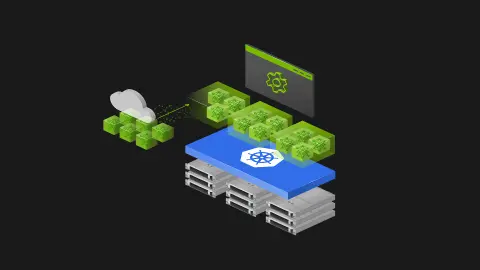
Agent Substrate is an open-source, zero-trust runtime for sandboxed agents, now donated to the CNCF Sandbox; it multiplexes many sessions over a small pool of warm Kubernetes worker Pods, at what NVIDIA says is 10x the density of standard containers.
When a session goes idle it is snapshotted out of its gVisor or microVM sandbox, memory and filesystem included, and its worker is freed; the next request restores it onto any free worker without going through the API server, scheduler or kubelet.
It targets three workloads: coding assistants alternating between model calls and repository work, bursty reinforcement learning environments, and short-lived GPU sandboxes for compiling and benchmarking.
Upstream additions include request parking, which queues a turn when every worker is busy instead of returning an error, and integration with NVIDIA Dynamo, whose router uses session identity and KV cache location to keep related calls on workers that already hold the context.
Builder's takeTeams running their own agent platform usually face a choice between one warm Pod per session, which is expensive, and on-demand Pods, which cold-start on every step. If your sessions look like "run 10 ms, wait minutes", I would load-test Agent Substrate on a staging cluster for density and restore latency before building more of our own session pool. Next to AWS Nitro Sandboxes on 11-09, both isolation and density are becoming standard parts.
Snapshot is an open-source checkpoint and restore system for GPU workloads on Kubernetes; it captures a fully initialized workload's CPU and GPU memory and restores it on nodes with the same GPU model and driver.
In tested configurations restores take 3.6 to 42.7 seconds, 8x to 36x faster than cold starts that take minutes; creating a checkpoint takes 15 seconds to 5.5 minutes, and checkpoint plus restore is shorter than a single cold start in every configuration.
It supports vLLM, SGLang and TensorRT-LLM, plus multi-GPU setups with tensor, data and expert parallelism, with checkpoints up to 1 TB across eight GPUs for large MoE models.
One upstream contributor cut GLM-5.3 Pod readiness from about 8 minutes to 31 seconds on NVIDIA HGX B300.
Builder's takeFor teams self-hosting open models, the biggest cost is often the GPUs kept warm for peaks. With cold starts down from minutes to under a minute, scaling idle replicas to zero becomes realistic. I would start with batch-style services that tolerate tens of seconds of delay, and check whether the same-GPU-model-and-driver constraint fits our fleet.
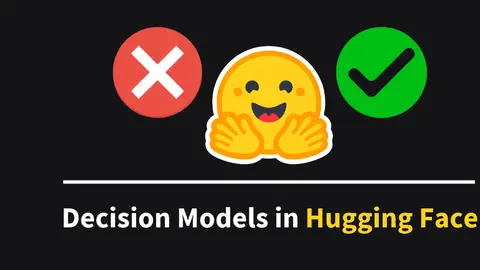
A decision model's interface is state plus questions plus allowed answers, returning decisions plus probabilities; instead of generating token by token, it scores answers the application already understands.
It defines three primitives: Choice (a probability distribution over options), Score (a rating on an ordered scale) and Noul (the probability of a yes/no answer).
Transformers adds DecisionPipeline, AutoModelForDecision and DecisionConfig, with fine-tuning through the Trainer API; llama.cpp can serve GGUF decision models through the same interface, and the Hub has a new decision-model tag.
The goal is a shared interface without a shared implementation: models can be built on encoders such as ModernBERT or on larger generative backbones.
Builder's takeOur products make many calls like "who should handle this request" or "which role does this resume fit", mostly by asking a large model for JSON and parsing it. Resume screening in Smart Interview and file classification in AI Cloud Drive are good first tests for a decision model: check accuracy holds, then measure latency and cost per call, and use the probabilities directly as thresholds for human review.
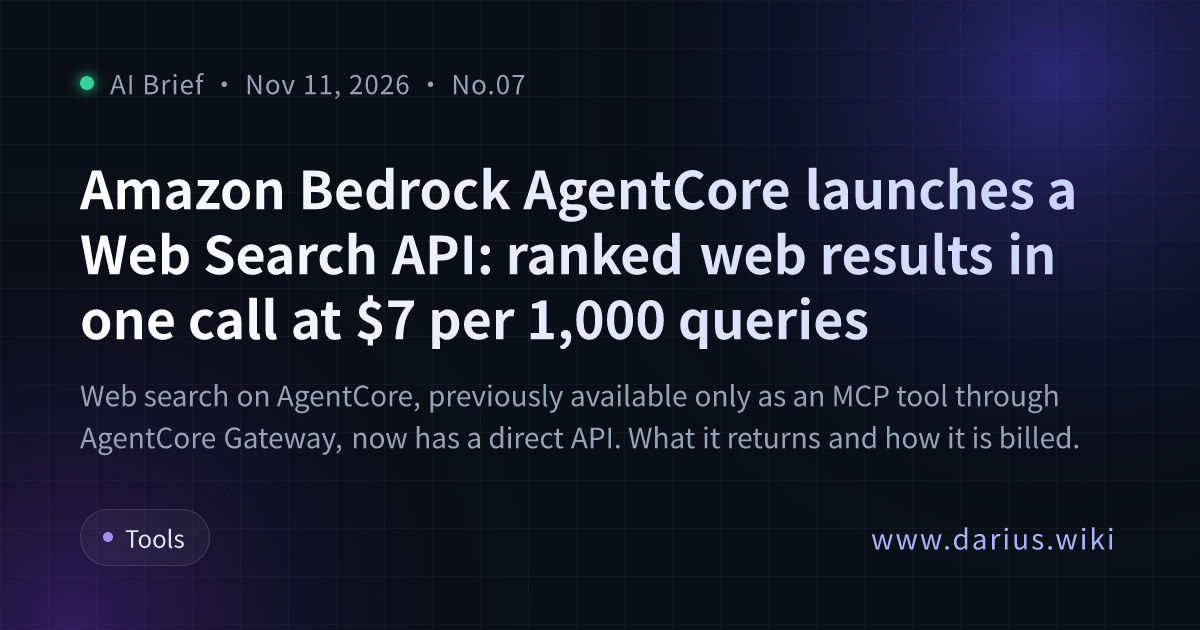
The new InvokeWebSearch API is generally available, letting applications, custom agent loops and data pipelines search without creating any resources, with results from the Amazon-operated web index.
Each result includes a text extract and, when available, the title, URL and publication time; requests can be filtered by domain and publication time.
Calls are authorized with IAM, can come from a VPC through AWS PrivateLink, and can be logged as CloudTrail data events.
It costs $7 per 1,000 queries, the same as through AgentCore Gateway with no gateway charges, in US East (N. Virginia and Ohio), US West (Oregon), Sydney, Tokyo and Ireland.
Builder's takeThe domain and publication-time filters are the useful part: a content pipeline that checks sources, like PandaClaws, can restrict searches to official sites and the last 72 hours. I would compare hit rate against our current search on the same query set, then price it by queries per task. At $7 per 1,000 it costs far more than DeepSeek's $0.75 from 10-17, so it pays off only if you need IAM and in-VPC calls.
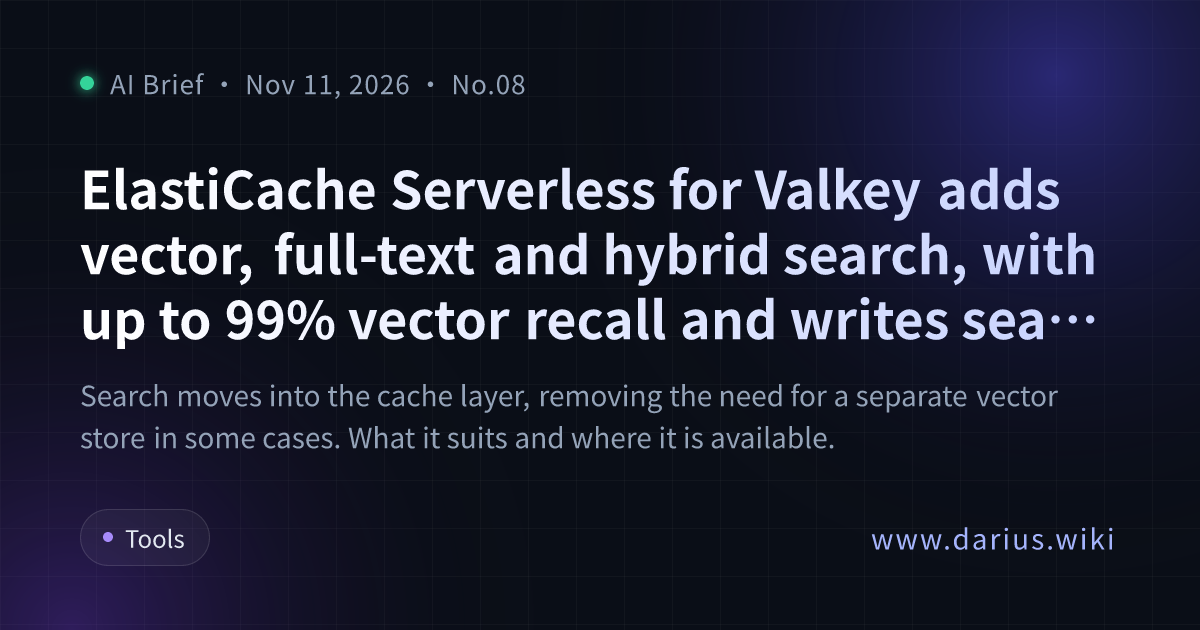
ElastiCache Serverless for Valkey adds vector, full-text and hybrid search plus server-side aggregations, combining search types in one query with tunable recall.
AWS cites latency as low as microseconds, up to 99% recall for vector search and billions of queries per day; updates become searchable within microseconds of a write completing.
AWS suggests giving each agent, session or task its own datastore for memory and context retrieval, ready in seconds and billed only for usage.
It is available in all commercial AWS Regions, GovCloud (US) and the European Sovereign Cloud, on ElastiCache version 9 for Valkey.
Builder's takeFor something like AI Cloud Drive, where a file must be searchable right after upload, write-to-search latency matters more than the recall figure. I would not move the main index, but I would try this kind of usage-billed store for agents' short-term memory and session context, one per task and thrown away after, leaving the main vector store for long-lived data.
Starting December 8, 2026, GitHub will turn off Dependabot alerts on most repositories with no activity in the past year; existing alerts are archived, not deleted, and can be restored at any time.
Any push turns alerts back on automatically and restores the archived alerts, restarting the one-year clock; alerts can also be re-enabled manually.
GitHub says vulnerability discovery and alert volume are growing quickly, and the change keeps Dependabot fast and reliable for actively developed repositories.
It applies to all plans on github.com and to GitHub Enterprise Cloud with data residency, not to GitHub Enterprise Server.
Builder's take"Inactive" does not mean "unused": many teams have internal SDKs or deploy-script repos untouched for a year that production still depends on. Before December 8 I would list those and either re-enable alerts or confirm they are archived and no longer referenced. With models like Carbon and GPT-6 Cyber finding bugs faster, alerts will only grow; do not let old repos you still rely on drop out of sight.
Gemini Robotics 2.5 is DeepMind's most capable vision-language-action model so far; across 200 tasks it achieves 30% to 100% higher success than previous baselines, depending on task type, and completes tasks 20% to 30% faster.
With Apptronik and Mercedes-Benz, Apollo 2 humanoids performed automotive kitting on production lines in Kecskemét, Hungary, and Sindelfingen, Germany, with a 96% success rate in the proof of concept.
Inference-time safety guidance raised safe task completion by 33% around obstacles and by 43% around nearby people.
DeepMind also released an open-source robotics jailbreak benchmark with hundreds of disguised unsafe prompts; Gemini 4 Argon reaches 99.5% jailbreak resistance, up from 82% for the previous baseline, Gemini Robotics ER 2.
Builder's takeWe do not build hardware, but two things are worth noting. "Real workplace plus a stated success rate" is becoming the standard for launches, and we should report agent capabilities to customers the same way. And jailbreak benchmarks now cover physical actions, so any agent that triggers real-world actions should have a test set of disguised requests.
Researched and drafted with AI assistance; editorial standards and views set by Darius.
Every Monday, the week in AI in one email
Every Monday morning: the 6 AI stories that mattered most in the past seven days, with my take, in your inbox.
Your email is only used to send the weekly and is never shared. Every email has a one-click unsubscribe link. See the latest issue →