Claude Code hooks can fail closed, Anthropic commits $150M to the Genesis Mission, Google open-sources AQuA and ML Drift
Today's thread is planning for failure: Claude Code makes guard hooks block by default when they break, Copilot review quota and triggers move under organizational control, and Google uses one agent to audit another in production. Once agents are in production, quality depends not just on the model but on how the defaults for failure, billing and checks are set.
Command and HTTP hooks get onFailure: "block": a hook that can't start, times out or exits with an unexpected code blocks the action instead of letting it through.
Every Claude apps gateway upstream can take an optional models list, so only those models are sent there, on failover too; cloud upstreams such as Bedrock, Vertex and Foundry support timeouts.upstream_ttfb_ms to cap how long a stream may take to start before it fails over or returns a 502.
Program Status Protocol (OSC 7501) support lets terminals that implement it show whether Claude Code is working, waiting on you or done.
A new CLAUDE_CODE_RETRY_WATCHDOG_MAX_WAIT_MS limits how long unattended retry mode waits out 429 and 529 errors.
Builder's takeFail closed is the default a safety hook should have: a guard that lets everything through when it crashes is no guard. I'd switch hooks that block deletions or production config pushes to block, and add health checks for the hooks themselves so a broken one doesn't stall the whole team.
Announced at a summit hosted by the White House Office of Science and Technology Policy: $150 million over three years for the federal Genesis Mission, which uses AI to speed up scientific discovery.
The funding expands Claude to more than 15 agencies in the mission, including NASA, the National Institutes of Health and the National Science Foundation.
Over three years it will provide Claude, Claude Code and API credits to several hundred Genesis Mission research projects, and partner with agencies and national labs on priorities such as fusion energy and quantum computing.
It will also offer training, onboarding and technical support to scientists on the projects, and help newly joined agencies launch their first projects.
Builder's takeFor product builders, the point isn't the amount but that Claude Code is being handed out as standard kit for scientists. Read with the $100M deployment-engineer program from 10-05, Anthropic is paying for adoption capacity; products for professional users can borrow the approach and design training and onboarding as part of the product.
With the worktrees feature flag on in trusted local projects, Codex can create and list managed Git worktrees.
Tasks can be pinned in the agent Command Center with p; custom Responses-compatible model providers can configure live web access and remote compaction.
Linux sandbox fixes: startup with multiple denied files, rejecting writable sandbox-construction executables, and ripgrep config no longer weakening deny-glob masks.
Retryable Responses and WebSocket failures honor server Retry-After advice; apply_patch preserves existing CRLF line endings.
Builder's takeLetting the agent manage worktrees means parallel tasks in one repo become normal. I'd try it in one repo first and agree on naming and cleanup rules for worktrees; the ripgrep fix is also a reminder to test sandbox rules with real commands periodically, not just read the config.
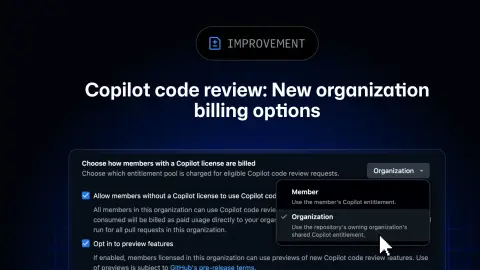
The new setting has two options: Member (default) bills reviews to the member's own Copilot entitlement, and the review fails if that quota is exhausted; Organization bills the organization that owns the repository.
Organization billing requires AI Credits paid usage to be enabled and supports an optional budget; it lives under organization settings, Copilot > Policies.
A new control, Only allow Copilot code review to be triggered by authorized users, stops Copilot licenses from outside the organization or enterprise, such as personal licenses, from requesting reviews.
When an owner turns it on at the organization level, repository admins can't turn it off.
Builder's takeUnder the default, a review fails once a member runs out of quota, which is a risk for teams that make review a required check. I'd switch to organization billing with a budget and turn on the authorized-trigger control; read with the review API from 10-05, review is turning from a personal tool into an organizational process cost that someone has to own.
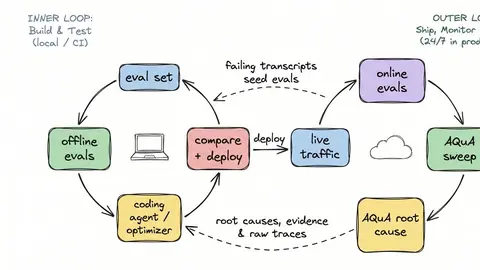
AQuA (Ambient Quality Agent) is an open-source reference implementation in the google/adk-recipes repository; it runs in your own Google Cloud project on a schedule, after each deployment or on demand, sampling up to 1,000 sessions per run.
It works in five stages: sample, review against a nine-point checklist, cluster, verify clusters against full transcripts, and track insights across runs; it never sits in the request path, changes the agent or opens pull requests itself.
In a travel-concierge example, 32 sessions produced 42 findings in 9 clusters; the verifier rejected 3, leaving 6 issues, and after two one-line prompt fixes full-session passes rose from 5/32 to 13/32.
Cost: $0.70 for a 96-session single-agent sweep and $3.76 for a 32-session multi-agent sweep, about $0.12 per session.
Builder's takeThe step I value most is verification: have the model find issues, then check them against the raw transcripts to drop false positives, the same reason I insist on primary sources. Conversational products like AI Interview can copy this: sample a few dozen real sessions after each release for a few dollars, far cheaper than waiting for complaints.
ML Drift is the core GPU acceleration engine in LiteRT and is also available as a standalone library, under Apache 2.0 on GitHub.
It supports OpenGL ES, OpenCL, Metal and WebGPU, covering Android and iOS, plus Windows and Linux via WebGPU and macOS via Metal (desktop in preview).
Stage-aware optimizations switch kernels between prefill and decode for edge LLMs; Gemma benchmarks show up to 12% lower memory overhead than other frameworks, and YouTube Shorts saw up to 40% lower average frame latency.
The legacy TFLite GPU delegate gets no new features, and the LiteRT accelerator is fully backward compatible with existing models.
Builder's takePaired with EmbeddingGemma 2 from 10-07, on-device semantic search now has both the model and the engine. Products like AI Cloud Drive can trial local embedding on the web via WebGPU and keep privacy-sensitive files on the user's device; projects still on the TFLite GPU delegate should schedule a migration.
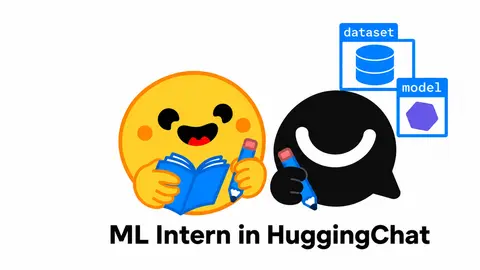
ML-Intern plans the work, asks for a budget before spending, runs small tests before full jobs, then trains, evaluates and publishes models on Hugging Face hardware.
Each task starts with a zero-dollar budget and needs your permission before paid jobs; you use it by turning on ML-intern mode in HuggingChat.
In one example, Citrus Doctor fine-tuned Qwen3.5-2B for citrus plant problems, raising accuracy on 335 test photos from 14.9% to 52.8% for about $1.90.
The author built six projects in a few days for about $103 in total; the models, datasets and Spaces are public under the ML-Intern-lab organization.
Builder's takeStart at zero budget and ask before spending is a design every agent that touches money should copy. For small teams, a specialized small model now costs a few dollars per experiment; I'd try it on fixed tasks such as content moderation or tagging first, then compare cost against calling a large model.
Ai2's clusters range from 88 to 1024 GPUs and serve about 150 researchers, with demand running 2-3x supply.
Managers now set GPU time budgets enforced by a hierarchical fair-share scheduler: a declared minimum runtime is protected from preemption and charged to the budget, while unbudgeted time is free but preemptible.
Occupancy held at 98% before and after; over a 30-day test, teams received 98% of their owed GPU hours, with 13 of 15 allocations at 95% or more.
Debug-job p90 queue wait fell from 2 hours to 30 seconds, and human-in-the-loop repairs dropped by 74%.
Builder's takeThere's no released code, but the idea transfers directly: swap priority for budgets and grabbing resources gets a cost. When a team shares GPUs for inference or fine-tuning, I'd set budgets per project and keep a fast lane for debug jobs, which beats endlessly tuning priorities.
Researched and drafted with AI assistance; editorial standards and views set by Darius.
Every Monday, the week in AI in one email
Every Monday morning: the 6 AI stories that mattered most in the past seven days, with my take, in your inbox.
Your email is only used to send the weekly and is never shared. Every email has a one-click unsubscribe link. See the latest issue →