Translation as an Engineering Problem, Not a Post-Processing Step
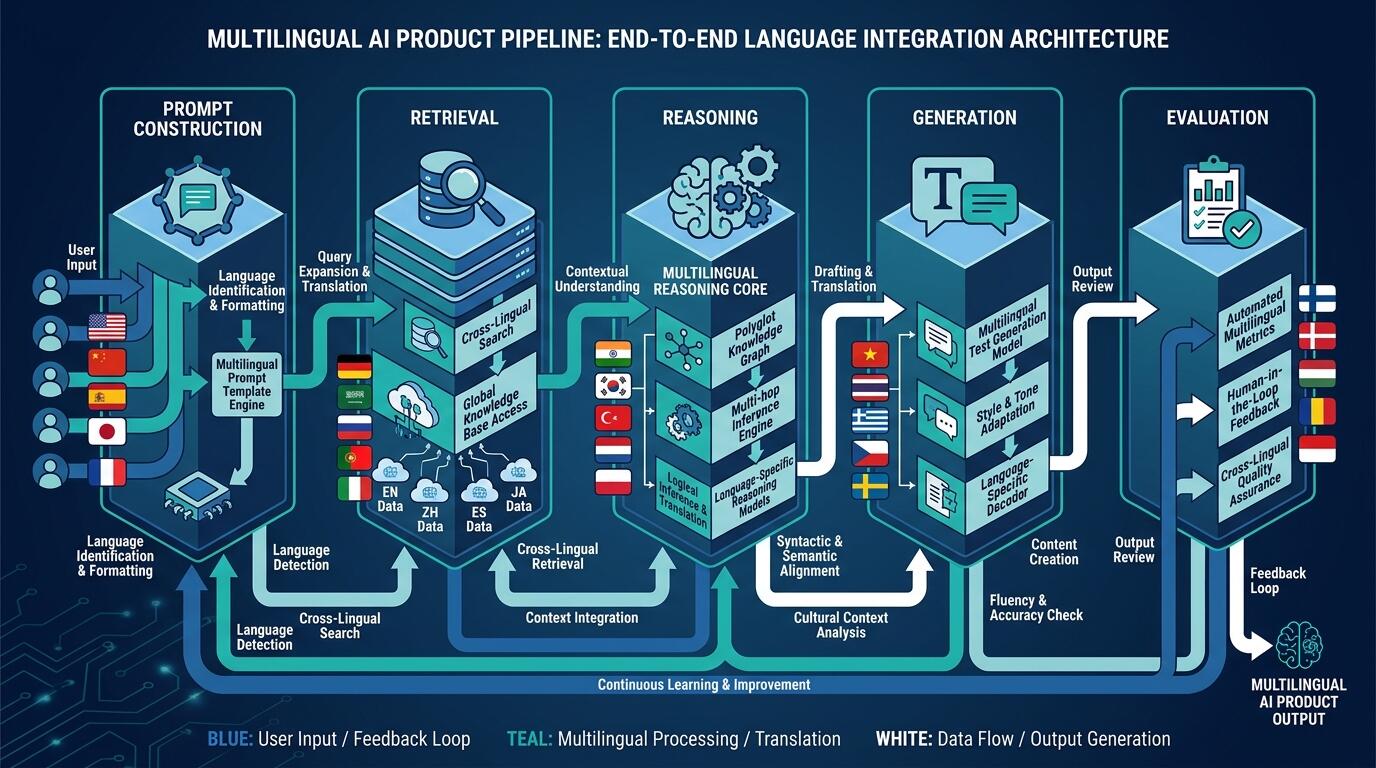
ALT: Engineering-first multilingual AI product pipeline showing translation integrated at the system architecture level
Why Translation Is an Engineering Problem, Not a Post-Processing Step
You finish building your AI product. The core model works. The API is stable. The evaluation suite passes. Then someone asks: "Can we make this available in Japanese and Portuguese?" The instinct — almost universal in teams we've seen operate this way — is to treat that as a content task. Hand it to a localization team, wire in a third-party translation API at the output layer, ship. Done.
That instinct is wrong, and it costs teams in ways that compound quietly over months. Translation, when treated as post-processing, becomes a reliability problem dressed up as a language problem.
The comparison this article makes is not between translation vendors or MT engines. It is between two fundamentally different architectural postures: treating translation as a downstream cosmetic step versus building language handling directly into the product's engineering design. The criteria for the comparison are system reliability, evaluation coverage, latency and cost at scale, and long-term maintainability. Each of these hits engineers and technical leads where decisions actually matter — in production, not in demos.
The Evaluation Criteria That Actually Matter in Production
Framing translation as an engineering problem means judging it by engineering standards. These are the dimensions that determine whether a multilingual AI product holds up under real load.
System reliability across languages. A product is only as reliable as its worst-performing language path. When translation is bolted on at the end, failures in that layer produce outputs that look valid to the system but are meaningless or harmful to the user. The system has no visibility into the degradation. Reliability here means the entire inference-to-output chain behaves consistently, not just the parts you instrumented.
Evaluation coverage. Most teams have robust evals for their primary language and thin or no evals for secondary ones. If translation is a post-processing step, the translated output exists outside your evaluation loop. You cannot measure what you do not test, and you cannot fix what you cannot measure. Evaluation coverage is the criterion that separates teams who discover multilingual failures in production from those who catch them in staging.
Latency and cost at scale. Adding a synchronous translation API call on every request is an architectural tax. At low volume it is invisible. At scale it compounds — added p99 latency, per-character API costs, additional failure modes requiring retry logic. Engineering translation into the architecture allows for smarter decisions: caching, batching, model-native multilingual output, or hybrid approaches. Post-processing forecloses most of these options by the time you realize you need them.
Long-term maintainability. Products change. Prompts evolve, system behavior shifts, new features get added. When translation lives at the edge, every change to the core system requires a separate audit of the translation layer. When language handling is a first-class concern in the design, changes propagate with the system rather than against it.
Team ownership and accountability. Post-processing translation often exists in a no-man's-land — not owned by the ML team, not owned by the product team, sometimes contracted out entirely. In a pattern we consistently see, this means bugs in the translation path get triaged to no one. Engineering-first translation requires assigning clear ownership, which by itself reduces incident response time.
The Two Architectural Postures
The Post-Processing Approach: Translation as Output Transform
The post-processing approach is a system where a model generates output in a primary language — almost always English — and a separate translation layer converts that output before it reaches the user. This is the default architecture for most teams who add multilingual support after the initial build.
It works, in the narrow sense that it produces text in the target language. In practice it surfaces several structural problems.
The model generating the primary output has no awareness of the translation step. It may produce idioms, abbreviations, cultural references, or domain-specific phrasings that are well within the English training distribution but create ambiguity or error in translation. The translation system receives these as opaque strings with no context about the intent, the domain, or the constraints of the original prompt. As noted in research on translation process challenges — particularly in contexts where source material carries implicit domain assumptions — this context gap is a primary driver of translation quality failures. (Refer to "Problems Arising in The Translation Process," published via inlibrary.uz, for a detailed taxonomy of these process-level failure modes.)
Post-processing translation also creates a two-system evaluation problem. Your evals cover the primary-language output. The translation quality requires a separate, usually manual, review process. In the teams operating this way that we've observed, that manual review is either absent, infrequent, or performed by people who lack the domain expertise to catch subtle degradation. The result is a quality gap that widens over time as the core model evolves.
The Engineering-First Approach: Language as a System Property
The engineering-first approach treats target language as a parameter that influences the system from the point of prompt construction, not as a transform applied to the final output. This does not necessarily mean running a single multilingual model end-to-end (though that is one implementation path). It means that every component in the pipeline — retrieval, reasoning, generation, formatting — is designed with language handling as a first-class requirement.
Concretely, this might mean: prompts are constructed in the target language when the model supports it; retrieved context is filtered or ranked by language relevance; output structure is adapted to typographic and grammatical conventions of the target locale; and evaluation suites include test cases in each supported language.
The distinction is architectural, not just technological. It is not about which translation API you use. It is about where in the system language decisions are made and who owns them.
This posture is more expensive to build initially. It requires multilingual evaluation infrastructure, prompt engineering across languages, and deliberate decisions about which languages each component supports. It pays back that investment in reliability and in the elimination of the silent failure modes that plague post-processing architectures.
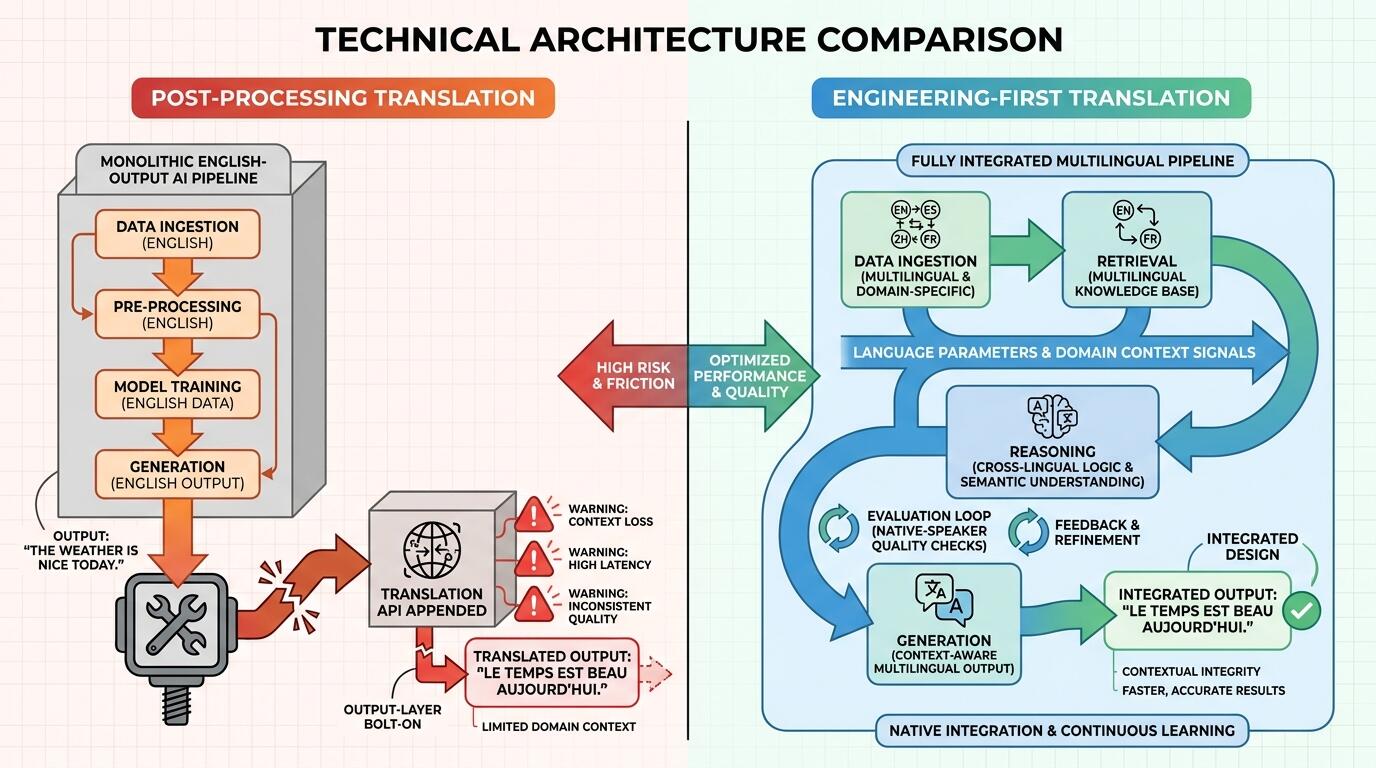
ALT: Side-by-side architecture diagram showing post-processing translation bolt-on versus engineering-first multilingual pipeline with language-aware retrieval and evaluation
Head-to-Head Comparison: Post-Processing vs. Engineering-First Translation
| Criterion | Post-Processing Translation | Engineering-First Translation |
|---|---|---|
| System reliability | Failures invisible to primary eval loop | Language failures caught within instrumented pipeline |
| Evaluation coverage | Primary language only; secondary langs manual or absent | Eval suites designed across supported languages |
| Latency at scale | Synchronous API hop on every request; compounds at p99 | Caching, batching, or native multilingual output feasible |
| Cost at scale | Per-request translation API charges layer on compute cost | Architectural decisions can reduce per-request translation cost |
| Maintainability | Each core change requires separate translation-layer audit | Language handling evolves with the system |
| Team ownership | Often ungoverned; lives between teams | Requires explicit ownership assignment |
| Build complexity | Low upfront; high remediation cost later | Higher upfront; lower long-term operational burden |
| Domain fidelity | Context-free translation of final output | Domain context available to language-handling components |
The table exposes the core asymmetry: post-processing translation transfers costs from the build phase to the operational phase, where they are harder to attribute and slower to address. Engineering-first translation front-loads complexity in exchange for systemic reliability.
The domain fidelity row deserves particular emphasis. AI products that operate in specialized domains — medical, legal, financial, technical — depend on consistent terminology. Research on translation quality assessment, including work published by the LT3 language technology group at Ghent University, frames quality as a composite of multiple sub-dimensions that must be evaluated independently rather than as a single aggregate score. A post-processing layer that receives only the final output string has no access to the domain signals needed to maintain that sub-dimensional quality consistently.
The build complexity row is frequently where the post-processing decision gets made. Engineering leaders under delivery pressure choose the low-upfront option. The remediation cost, however, is not speculative — it arrives consistently, and it arrives at the worst time: after your multilingual user base has grown large enough to make the problem visible but before you have the engineering capacity to redesign the pipeline.
For teams thinking through the build-versus-buy dimension of this decision, revisiting the build vs. buy framework for AI infrastructure is worth the time before committing to a specific translation architecture.
Which Architectural Posture Should You Choose?
If your product is in early validation with a single primary market, the post-processing approach is defensible as a temporary measure — but only if you treat it as explicitly temporary and document the constraint. Wire the translation layer in a way that can be replaced. Do not build product logic that depends on the translation API's specific behavior or output format.
If you are preparing to scale to three or more languages, engineering-first translation is the correct path regardless of current timeline pressure. The remediation cost of retrofitting language handling into a post-processing architecture at scale is structurally high. Per the pattern we consistently see, teams that delay this decision past the scale inflection point spend disproportionate engineering cycles on what amounts to architectural debt collection.
If your product operates in a specialized or regulated domain, post-processing translation is a risk you should formally evaluate before accepting. Terminology drift across languages in medical or legal contexts is not a UX issue — it is a liability issue. The engineering-first approach, where terminology handling is a component of the pipeline rather than an afterthought, provides the control surface needed to manage this.
If your team lacks multilingual engineering capacity today, the honest answer is not to adopt post-processing translation and assume it will hold. The answer is to scope the multilingual surface area to what you can actually evaluate and maintain, then expand deliberately. A narrow, well-evaluated set of supported languages is a better product than a wide, unmonitored one.
If you are building a product where the primary competitive differentiator is output quality, engineering-first translation is not optional. The quality floor of post-processing translation will eventually become the quality ceiling of your product in secondary language markets. That ceiling is set by a third-party API's general-purpose translation model, not by your domain expertise.
The tradeoffs in summary: post-processing translation offers low build complexity and fast time-to-market with high operational risk, poor evaluation coverage, and compounding latency and cost at scale. Engineering-first translation requires a higher upfront investment in pipeline design and evaluation infrastructure, and returns systemic reliability, maintainable quality, and architectural optionality as the product evolves. For teams serious about shipping AI products that hold up in production — rather than just in demos — that tradeoff has a clear answer.
For teams asking how to move fast on this without sacrificing quality, the engineering discipline of shipping quickly without quality degradation applies directly to translation architecture decisions.
People Also Ask
Q1: How should engineering teams integrate translation into an AI product pipeline?
Translation should be treated as a system property — not a final output transform. Engineering-first integration means the target language is a known parameter at the point of prompt construction, retrieval filtering is language-aware, and evaluation suites include test cases in each supported language. The key structural requirement is that the translation decision layer has access to domain context, not just the finished output string. Teams that instrument only primary-language outputs will miss failures in the translated paths entirely.
Q2: Is post-processing translation ever acceptable for production AI products?
Post-processing translation is acceptable as a time-bounded trade-off during early validation, provided the team treats it explicitly as temporary and builds the translation layer as a replaceable component rather than a permanent fixture. It becomes problematic at scale, in regulated domains, or when the product's quality proposition depends on consistent output across languages. The key question is not whether post-processing translation works — it does, narrowly — but whether the team has the evaluation infrastructure to detect when it stops working.
Q3: How much does it cost to retrofit engineering-first translation into an existing post-processing architecture?
Retrofit cost scales with how deeply the primary-language assumption is embedded in the existing system. In pipelines where prompts, retrieval, and formatting components all assume English output, retrofitting language handling typically touches every major component. Teams that have deferred this decision past a meaningful scale inflection point routinely find that the retrofit effort is comparable to a substantial re-architecture. The earlier the engineering-first posture is adopted, the lower the cumulative cost — both in engineering time and in quality incidents that occurred in the interim.
The Bottom Line
Translation is not a localization problem — it is a system reliability problem. The architectural decision to treat language handling as a downstream output transform versus a first-class system property determines whether your multilingual product is actually reliable or just superficially functional.
Three points that should drive the decision for engineering leaders:
First, post-processing translation systematically removes the translated output from your evaluation loop. You cannot catch what you cannot see, and quality failures in secondary languages are effectively invisible until they reach users.
Second, the cost asymmetry is real. Low build complexity in the post-processing approach does not mean low total cost — it means the cost is deferred to operations, where it arrives as user complaints, incident response, and eventually re-architecture under pressure.
Third, the engineering-first posture is not perfection — it is a disciplined choice to make language handling observable, testable, and maintainable as the product evolves. That discipline is the same discipline that separates AI products that hold up in production from those that fail quietly after launch.
If you are building or operating an AI product with multilingual requirements, the right time to make this architectural decision is before the product scales, not after. The audit cost of honest engineering design is always lower than the remediation cost of silent production failures.
If you found this analysis useful, subscribe to the Darius bilingual AI briefing — each issue selects high-signal AI developments with first-hand source citations and practical interpretation from real production systems, helping you cut through noise and turn news into actionable engineering judgment. Visit the Darius website to explore the full archive and join engineers building at the frontier.
Sources
- Inlibrary.uz. "Problems Arising in The Translation Process."
https://inlibrary.uz/index.php/eijmrms/article/download/61284/61762/77274 - LT3, Ghent University. "Quality as the Sum of Its Parts: A Two-Step Approach for the Identification of Translation Quality Sub-dimensions."
https://lt3.ugent.be/publications/quality-as-the-sum-of-its-parts-a-two-step-appro-2/ - IEEE. Institute of Electrical and Electronics Engineers — Standards and Technical Resources on Software Systems Engineering.
https://www.ieee.org/ - ISO. International Organization for Standardization — Language and Translation Quality Standards (including ISO 17100 and related).
https://www.iso.org/ - ACL Anthology. Association for Computational Linguistics — Research Publications on Machine Translation, Multilingual NLP, and Evaluation Methodology.
https://aclanthology.org/
Note: Standards and research publications may be updated; please check the latest official documents or consult professional advisors for current guidance.