Running Technical Reviews That Speed Teams Up Instead of Slowing Them Down

ALT: Engineering director running a technical review session that accelerates team velocity and system quality
Why Most Technical Reviews Kill Momentum — and How to Fix That
The central question every engineering leader eventually faces is this: how do you maintain rigorous technical standards without turning every review into a bottleneck that drains your team's energy and slows your delivery cadence? The answer is that well-structured technical reviews — design reviews, architecture critiques, code walkthroughs — should function as acceleration mechanisms, not gatekeeping rituals. When designed with intentionality, they surface blockers early, align teams on direction before costly work is done, and build the shared mental model that lets engineers move faster with less coordination overhead.
In practice, most organizations get this backwards. Reviews are scheduled as bureaucratic checkpoints after decisions are already locked in. Feedback arrives too late to change anything meaningful, so it generates friction without generating value. The result is a process that everyone resents and most people work around — which is the worst possible outcome. This article breaks down what effective technical reviews actually look like, when to use them, and how to structure them so they compound your team's velocity rather than tax it.
When Technical Reviews Add Value — and When They Don't
Applicable Scenarios:
- Teams planning a new system component or significant architectural change where early misalignment would be expensive to unwind
- Cross-functional collaborations where multiple engineers, product managers, or external stakeholders need a shared technical understanding before parallel work begins
- High-stakes integrations — particularly AI pipeline architectures, data system designs, or distributed service boundaries — where downstream decisions are difficult to reverse
- Onboarding senior engineers or contractors who need to absorb existing architectural context and contribute meaningfully from the start
Not Applicable / Cautions:
- Routine implementation work within already-agreed boundaries; reviews at this granularity create noise without signal
- Teams that are already heavily aligned and working at high trust — mandatory reviews here add ceremony without value and can erode autonomy
- Post-hoc reviews used as approval theater after all real decisions have been made; these generate resentment and produce feedback with no realistic path to action
The Real Cost of Reviews That Slow Teams Down
Technical reviews have a poor reputation in many engineering organizations, and that reputation is earned. A pattern that consistently appears in teams struggling with velocity is that reviews are treated as events rather than processes — discrete meetings scheduled at arbitrary points in the development timeline, often with unclear ownership and even less clear outcomes.
The organizational research community has documented this problem at scale. According to the Pragmatic Engineer newsletter, teams that invest in deliberate slow-down moments — structured review and alignment practices — consistently outpace teams that optimize purely for uninterrupted execution speed. The reasoning is straightforward: the cost of misalignment compounds geometrically. A week of unreviewed work heading in the wrong architectural direction can require a month of rework. A thirty-minute design review that catches that misalignment early is not an interruption — it is a force multiplier.
The challenge is that badly run reviews are genuinely harmful. They consume calendar bandwidth, they generate low-signal feedback, and they communicate to engineers that their time is not valued. Understanding what distinguishes an accelerating review from a decelerating one requires looking at the mechanics: who is in the room, what is the artifact being reviewed, what decisions are actually on the table, and what happens after.
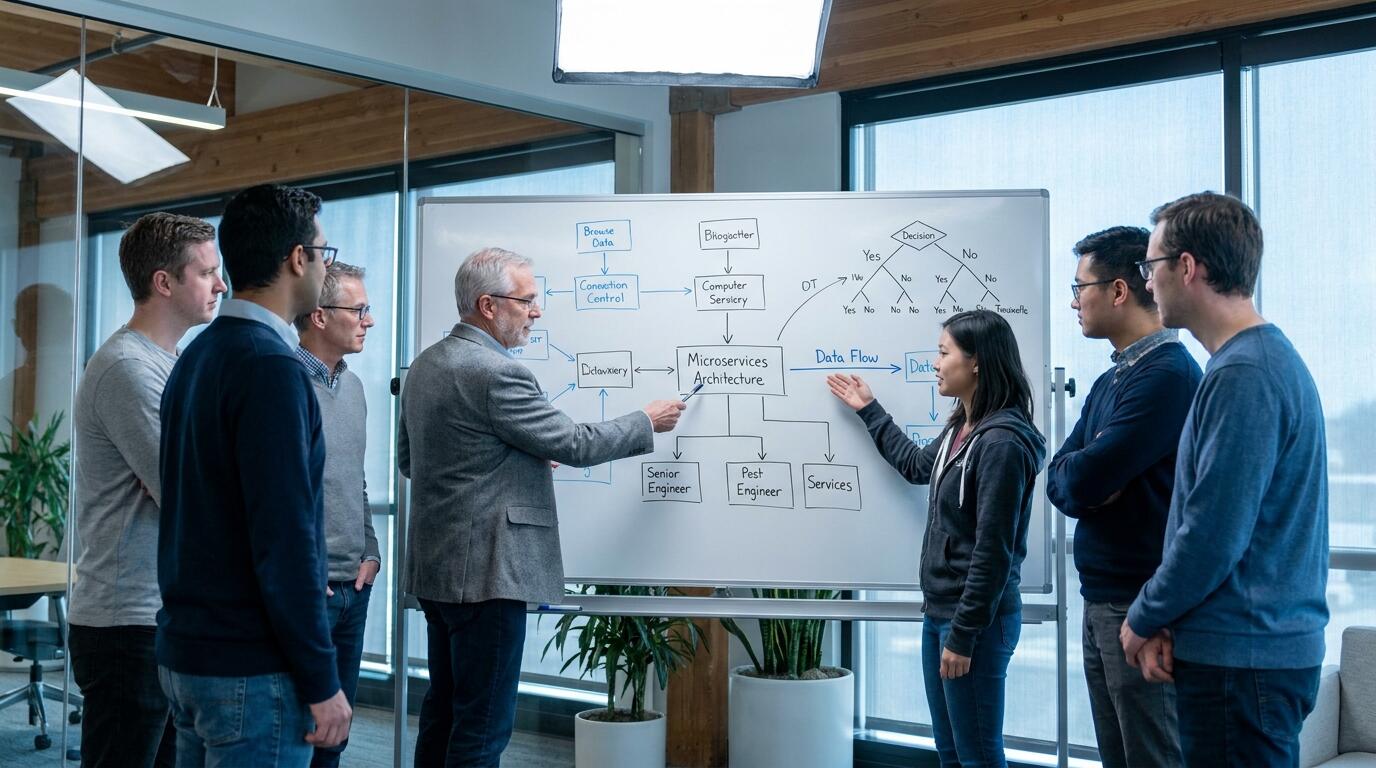
ALT: Team conducting a structured architecture review session to align on system design decisions and accelerate engineering delivery
Effective technical reviews are not about catching mistakes after the fact. They are about compressing the feedback loop so that engineers get directional alignment before they build, not after. For teams working on AI architecture or complex systems design, where architectural choices have long tails of consequence, this compression is especially valuable. If you are curious about what that engagement model looks like in practice, the article on what to expect when starting an AI architecture engagement covers the structural elements that make senior technical collaboration productive from day one.
Running Reviews That Actually Accelerate Delivery
Three Steps to Structuring a High-Value Technical Review
Step 1: Define the decision surface before anyone enters the room
The single most impactful change a team can make is to establish, in writing, what decisions the review is meant to produce — not just what topics it will cover. Before scheduling a review, the author of the proposal should document: what is being decided, what the viable alternatives are, what tradeoffs have already been evaluated, and what input is needed from reviewers specifically. This pre-work shifts the review from a presentation into a structured decision session. Budget roughly thirty minutes for the proposal author to complete this framing before the review is scheduled.
Step 2: Curate the reviewer list by decision, not by seniority
Every person in a review room has a cost: their time, their attention, and the social dynamics their presence introduces. The right reviewer list is determined by who holds relevant context or who will be meaningfully affected by the outcome — not by org chart position. A principal engineer whose system will integrate with the proposed design belongs in the room. A senior director who has no direct dependency does not, unless their domain expertise is specifically needed for a decision on the table. Keep the core reviewer set small; invite others asynchronously to read the artifact and submit written feedback.
Step 3: Establish a decision record and a follow-through mechanism
Reviews that produce no durable artifact are reviews that will be re-litigated. At the close of every review, document the decisions made, the reasoning behind them, the alternatives that were considered and rejected, and any open questions with assigned owners and deadlines. This record — whether it lives in a design doc, an RFC, a Notion page, or a Confluence space — becomes the canonical reference that prevents future meetings from reopening settled questions. Assign one person to own this artifact before the meeting ends.
Comparing Review Formats: Choosing the Right Structure for the Work
Different stages of development call for different review formats. Applying a heavyweight architecture review to a small implementation decision wastes everyone's time; applying a lightweight async comment thread to a foundational system design decision creates risk. The table below maps common review formats to their appropriate use cases.
| Comparison Dimension | Async Document Review | Synchronous Design Review | Lightweight Tech Spike Review |
|---|---|---|---|
| Best for | Settled proposals needing stakeholder alignment | Ambiguous decisions requiring live discussion | Experimental or exploratory work with low commitment |
| Typical scope | Well-defined architectural proposals | Novel system designs, cross-team integrations | Prototypes, proof-of-concept evaluations |
| Time investment | Low (author) / flexible (reviewers) | Moderate to high for all participants | Low for all participants |
| Decision quality | High when proposal is well-prepared | Highest for genuinely contested decisions | Appropriate for exploratory conclusions |
| Risk of misuse | Becomes a rubber-stamp exercise | Becomes a meeting for its own sake | Decisions made too informally, lost in chat |
| Ideal team size | Any | Four to eight active participants | Two to four |
The format that teams most consistently mis-select is the synchronous design review. It is the default choice even when an async document review would produce equivalent or better outcomes at a fraction of the coordination cost. A useful heuristic: if the proposal author can write a clear recommendation with supporting rationale that reviewers can evaluate independently, choose async. Reserve synchronous reviews for proposals where the decision genuinely depends on interactive exploration of tradeoffs that cannot be resolved in writing.
The Mechanics of a High-Signal Review Session
Framing the artifact correctly is where most reviews succeed or fail before anyone speaks. A design document that presents a single recommendation as a fait accompli invites passive acceptance rather than genuine critique. A document that surfaces two or three concrete alternatives with explicit tradeoff analysis invites exactly the kind of engaged review that produces good decisions. The author's job is not to present a finished answer — it is to make the decision space legible so that reviewers can contribute meaningfully.
Structured critique replaces the default dynamic of a few dominant voices filling the silence while others disengage. A simple facilitation pattern that works in practice: before open discussion begins, ask every reviewer to write down their one most important concern or question independently, then surface those in round-robin order. This produces a broader input set, prevents groupthink, and ensures that quieter engineers — often the ones with the most precise domain knowledge — contribute their perspective before the room's social dynamics consolidate around an early consensus.
Time-boxing discussion is a discipline, not a restriction. Experienced reviewers know that the most productive part of a review is usually the first twenty minutes of focused critique, before the conversation drifts into implementation speculation or tangential problem-solving. Setting explicit time limits on each discussion topic — with a designated facilitator who enforces them — keeps the session directed and respects everyone's calendar.
Handling unresolved questions without stalling the decision is a skill that distinguishes senior engineering leaders from less experienced ones. Not every open question needs to be resolved before a design can move forward. A pattern that consistently proves effective is the explicit "parking lot" — a designated section of the review artifact where open questions are documented with an owner and a resolution deadline. This allows the review to close on the decisions that are ready while keeping accountability for remaining uncertainties visible.
For teams building AI-powered systems, machine learning pipeline architecture introduces a specific class of review challenge: the interdependencies between data ingestion, model training, serving infrastructure, and monitoring create a decision surface that is wide and deeply interconnected. Reviews for these systems benefit from a structured decomposition — reviewing each layer of the pipeline against explicit quality criteria rather than treating the system as a monolithic proposal. The article on building machine learning pipelines that scale past prototype stage describes the architectural patterns that matter most when these systems need to hold up under production load.
Advanced Considerations: Edge Cases and Common Misconceptions
When the team resists the process. A review process that engineers treat as overhead is a signal, not a culture problem. The correct diagnosis is almost always that previous reviews produced low-value outcomes — feedback that arrived too late, decisions that were re-litigated anyway, or sessions that ran long and resolved nothing. The fix is not mandate; it is demonstration. One well-run review that visibly prevents a costly mistake does more to build buy-in than any amount of process documentation.
The "senior presence" fallacy. A common misconception is that technical reviews derive their authority from the seniority of the people in the room. In practice, the most valuable reviews are often those where the reviewers are the engineers who will actually work with the system being designed — the ones who understand its operational context most precisely. Seniority confers pattern recognition, but proximity confers specificity. Both matter; neither substitutes for the other.
Reviews are not the same as approvals. Organizations that conflate review with sign-off create a perverse incentive: engineers learn to delay reviews until their design is locked, because changing course after a formal approval is socially costly. Effective review culture explicitly separates the review function (generating quality input) from the approval function (organizational go-ahead). Reviews should happen early and often, with low formality. Approvals, where they are necessary, should be a lightweight final confirmation, not a high-stakes gauntlet.
Over-reviewing is a real failure mode. According to LinkedIn commentary from practitioners in high-growth engineering organizations, the fastest teams are not those that move fastest in isolation — they are those that identify and eliminate unnecessary coordination overhead while preserving the deliberate checkpoints that actually matter. Every review added to a workflow has an opportunity cost. The discipline of periodically auditing your review practices — asking which reviews have consistently produced high-signal outcomes and which have become ritual — is as important as establishing the practices in the first place.
People Also Ask
Q1: How often should a team run technical design reviews?
Review frequency should be proportional to decision risk and system complexity, not tied to a fixed calendar cadence. High-stakes architectural decisions — particularly those introducing new system boundaries, data dependencies, or AI model integrations — warrant a dedicated review before work begins. Routine implementation within established patterns often needs only lightweight async review or none at all. A useful default: any decision that would be expensive or time-consuming to reverse warrants a structured review. Lower-stakes work does not.
Q2: Are technical reviews necessary for small teams or early-stage startups?
Technical reviews are valuable at any team size, but the format should match the context. A three-person founding team does not need formal RFC processes or structured review committees. What it does need is a lightweight habit of shared visibility into consequential technical decisions — a short written summary of options considered and the reasoning behind the choice made. This habit compounds in value as the team grows, because it creates a decision history that prevents the organization from repeatedly re-litigating the same questions.
Q3: What is the most common reason technical reviews slow teams down rather than helping them?
The most common reason technical reviews slow teams down is that they are scheduled too late, after significant work is already complete and decisions are effectively locked. At that stage, substantive feedback generates conflict rather than value, because accepting it means discarding completed work. The fix is to shift reviews earlier in the development process — during design and framing, before implementation begins — where feedback can be incorporated without friction. Early, frequent, lightweight reviews consistently outperform infrequent, heavyweight, late-stage reviews.
Key Takeaways
- Technical reviews become acceleration tools when they are positioned early in the development process, before significant work is committed, not after.
- The artifact and the decision surface matter more than the meeting itself — a well-prepared design document with explicit alternatives and tradeoff analysis is the foundation of a productive review.
- Reviewer selection should be driven by decision relevance and domain proximity, not organizational seniority or political inclusion.
- Synchronous reviews should be reserved for genuinely contested or ambiguous decisions; async document reviews handle the majority of architectural alignment needs at lower cost.
- A durable decision record — capturing what was decided, why, and what was rejected — is the output that prevents re-litigation and preserves organizational learning.
The next step is to audit one review your team runs regularly and ask a direct question: did the last three instances of this review change a decision or improve a design in a meaningful way? If the answer is uncertain, the format probably needs a redesign — and that redesign is worth prioritizing.
Ready to build technical practices that ship real products? Visit the Darius website to explore technical insights, real project case studies, and senior AI architecture expertise — or reach out directly if you are navigating a complex system design decision and need a partner who takes ideas from zero to shipped.
References & Further Reading
- The Pragmatic Engineer. "Slow down to speed up: so much has changed in 6 months'".
https://newsletter.pragmaticengineer.com/p/slow-down-to-speed-up - LinkedIn Engineering Practitioners. "The fastest teams don't move fast."
https://www.linkedin.com/posts/thatandream_the-fastest-teams-dont-move-fast-they-avoid-activity-7366835309432553472-jfol - IEEE. Institute of Electrical and Electronics Engineers — standards and practices for software engineering and systems design.
https://www.ieee.org/ - ACM. Association for Computing Machinery — peer-reviewed research on software engineering, systems design, and technical leadership practices.
https://www.acm.org/
Note: Standards and best practices in software engineering evolve continuously. Consult the latest official publications from relevant standards bodies and professional organizations for current guidance.