What Mechanical and Structural Consulting Teams Can Still Teach Software Engineers

ALT: Mechanical structural consulting principles applied to software engineering systems design architecture
When Two Engineering Worlds Collide: What Software Builders Can Learn from Structural and Mechanical Consulting
Can software engineering borrow meaningful lessons from mechanical and structural consulting disciplines? The honest answer is yes — and the gap in cross-disciplinary exchange has cost software teams more than most of them realize.
Software engineering and structural or mechanical consulting are commonly treated as entirely separate professions. One builds load-bearing bridges and precision machinery; the other ships APIs, distributed systems, and AI pipelines. But the comparison criteria that matter — rigor in failure analysis, constraint-first design thinking, documentation discipline, accountability structures, and formal review processes — reveal striking parallels. Examining both worlds against these criteria exposes patterns that software teams consistently undervalue, and correcting that blind spot can be the difference between a system that quietly degrades and one that holds.
What the Comparison Is Actually Judged On: Six Criteria That Define Engineering Discipline
The six criteria used throughout this comparison are not abstract. They represent real points of failure observed in software projects where teams shipped confidently until something broke in production.
Failure mode analysis is the practice of systematically enumerating how a system can fail before it does. In mechanical engineering, this is formalized in methods such as Failure Mode and Effects Analysis (FMEA), a structured process recognized by standards bodies including ISO and the Society of Automotive Engineers. Software teams rarely apply anything comparable upstream of deployment.
Constraint-first design means establishing the boundaries of a problem — load limits, tolerances, material properties, regulatory envelopes — before proposing solutions. In software, the equivalent is defining performance budgets, SLA envelopes, data consistency requirements, and security boundaries before writing a line of code. A pattern consistently seen in consulting engagements is that software teams skip this step and pay for it during scaling.
Documentation discipline covers the completeness, traceability, and longevity of design records. Structural engineers are legally required to maintain documentation that can be audited decades later. Software documentation is often an afterthought, written after the fact if at all.
Formal review and sign-off refers to the mandatory review gates that structural and mechanical projects pass through — peer review, independent checking, regulatory approval — where a qualified engineer stamps a design and accepts professional liability. Software peer review exists in the form of code review, but the accountability weight is rarely comparable.
Tolerance and margin thinking is the habit of designing not to the edge of what works, but to a margin beyond it. Structural engineers size beams to carry multiples of the expected load. Software engineers frequently size systems to just beyond the current load, with minimal headroom.
Lifecycle cost awareness means accounting for operational, maintenance, and decommissioning costs at design time, not just build cost. This criterion matters because choices made during architecture disproportionately determine long-term system cost.
The Two Disciplines Under the Microscope
Mechanical and Structural Consulting: Accountability Baked Into Practice
Mechanical and structural consulting is a licensed, regulated engineering discipline in most jurisdictions. Practitioners are trained to think in terms of physical failure — not hypothetical failure, but specific, enumerated modes with quantified consequences. A structural engineer designing a floor system does not ask "what if this fails?" as an afterthought. They ask it first, formally, with documented analysis.
The consulting model in this domain typically involves an independent engineer — not the builder — reviewing and approving designs before construction begins. This separation of design and verification is not bureaucratic overhead. It is a deliberate mechanism for catching errors before they become catastrophic. According to the principles codified by bodies such as the American Society of Civil Engineers (ASCE) and the International Organization for Standardization (ISO), formal independent review is a quality control baseline, not a premium option.
Structural consulting also operates under a culture of conservative margin. When a structural engineer specifies a safety factor, they are encoding institutional memory about what happens when calculations are slightly wrong, materials are slightly variable, and loads are slightly unexpected — simultaneously. Software systems live in the same compounding uncertainty, but the discipline of margin is far less embedded in software culture.
The constraint documentation that structural and mechanical consultants produce — drawings, specifications, load calculations, material certifications — is designed to be read and understood by someone who was not present during design. This is not a minor detail. It is what makes the work transferable, auditable, and defensible.
Software Engineering: Speed-Optimized, Failure-Penalized Later
Software engineering, as a discipline, has made extraordinary progress in tooling, methodology, and delivery speed. The modern software development lifecycle encompasses requirements analysis, design, implementation, testing, deployment, and maintenance — a structure that parallels engineering disciplines more closely than many practitioners acknowledge. But in practice, the culture of software delivery is heavily weighted toward iteration speed, often at the explicit expense of upfront constraint definition and formal failure analysis.
According to the Software Engineering Institute (SEI) at Carnegie Mellon University, many software quality failures trace back to architectural decisions made early without sufficient analysis of failure scenarios, load conditions, and operational constraints. The SEI's work on software architecture and quality attributes makes this case with considerable documentation — yet the behaviors it identifies as risk factors remain common in production engineering teams.
The code review process that software teams use is a genuine strength — collaborative, fast, and increasingly well-tooled. But it is not equivalent to the independent structural check. The reviewer is typically a peer on the same team with the same assumptions, working context, and deadlines. The structural equivalent of that scenario — having the same firm that designed a bridge also verify it — would not be acceptable.
Software engineering also has a complicated relationship with documentation. As the foundational definition of software makes clear, software is instructions and data — entirely intangible — which may contribute to a cultural tendency to treat its documentation as similarly optional. That tendency produces systems that cannot be safely modified, extended, or handed over without significant risk.
Head-to-Head Comparison: Where Each Discipline Leads and Where It Lags
| Criterion | Mechanical / Structural Consulting | Software Engineering |
|---|---|---|
| Failure mode analysis | Formal, documented, upstream (FMEA, FTA common) | Inconsistent; often post-incident rather than pre-design |
| Constraint-first design | Core practice; constraints define the design envelope | Frequently deferred; constraints discovered during delivery |
| Documentation discipline | Legally mandated, long-lived, independently readable | Variable; often incomplete, team-specific, perishable |
| Formal review and sign-off | Independent verification standard; professional liability attached | Peer code review common; independent architectural review rare |
| Tolerance and margin thinking | Safety factors standard; conservative margins institutionalized | Systems sized close to current load; margin added reactively |
| Lifecycle cost awareness | Considered at design phase; operational costs modeled upfront | Build cost dominates; operational and maintenance costs often underestimated |
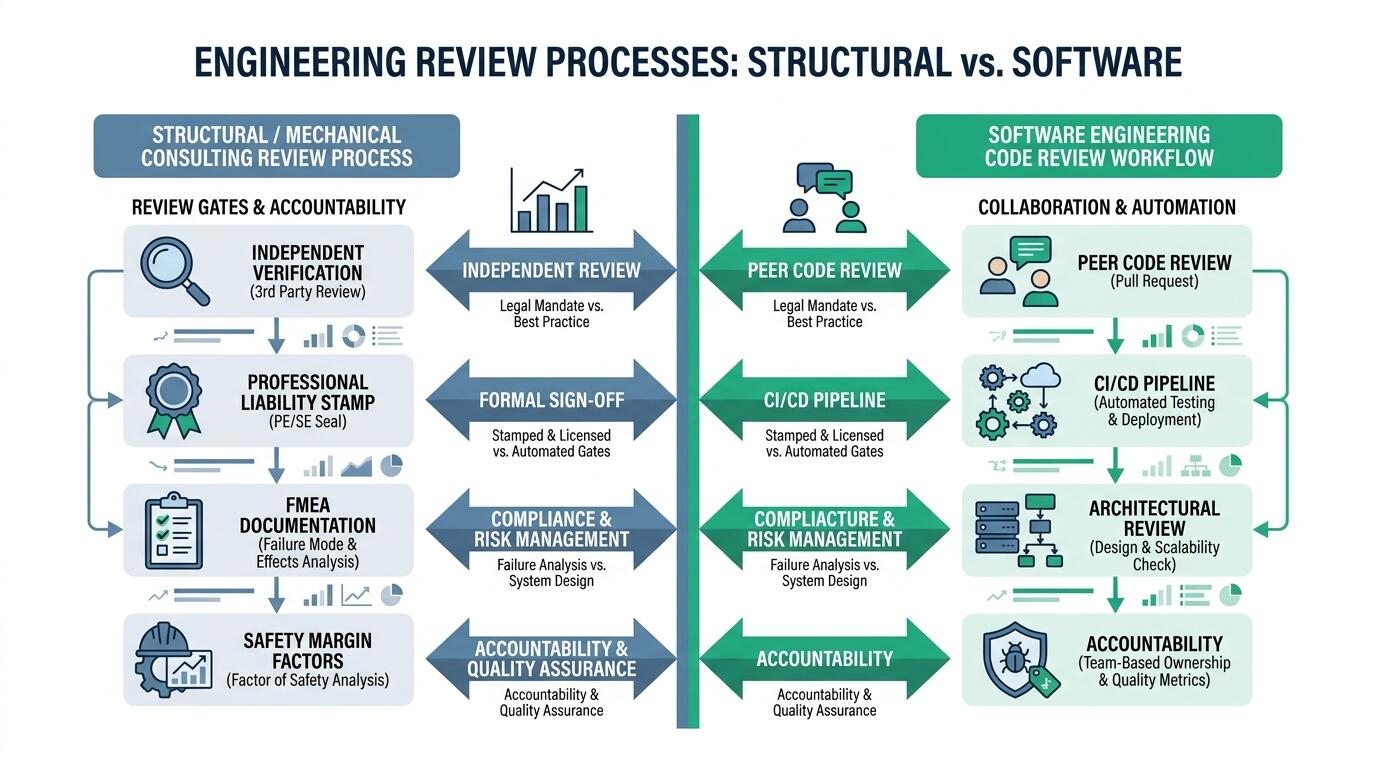
ALT: Side-by-side engineering discipline comparison showing structural consulting review gates versus software engineering code review and architectural accountability structures
The most consequential gap visible in this table is the failure mode analysis row. Structural and mechanical engineers enumerate failure scenarios as a precondition to design approval. Software engineers typically enumerate failure scenarios after an incident has surfaced them. This inversion — reactive rather than proactive failure thinking — is one of the most persistent and expensive patterns in software delivery. In work with clients navigating complex system redesigns, the discovery that a failure mode was never formally documented is almost always accompanied by the discovery that it was also never mitigated.
The margin and tolerance gap is equally significant, though less visible until systems encounter peak load conditions. A structural engineer who specifies a beam to carry exactly its expected load has not done their job. The equivalent software system — sized exactly to current traffic with no headroom — is not unusual. When that system meets an unexpected traffic spike, or when a dependency degrades response time, the absence of margin converts a manageable situation into a production incident.
The documentation discipline gap deserves particular attention for teams building AI systems. AI architectures involve data pipelines, model versioning, inference infrastructure, and evolving feature logic that interact in ways that are genuinely difficult to reconstruct from code alone. If the design rationale is not documented at the time of design, it is often lost. Teams that want to build AI systems with long operational lifespans — rather than systems that must be rebuilt from scratch at each major change — need documentation practices much closer to the structural consulting standard than to the typical software team's.
Which Approach Should You Adopt? Matching Structural Discipline to Software Context
If you are building a high-availability AI system or a platform with strict uptime requirements, the structural consulting model of failure mode analysis and formal constraint documentation is directly applicable. Before the first component is chosen or the first service boundary is drawn, produce a written enumeration of failure modes, their likelihood, their consequences, and the mitigations that will be built in. This is not a theoretical exercise. It is the kind of upfront thinking that separates systems that hold from systems that require emergency architectural surgery six months after launch. When starting an AI architecture engagement, establishing these constraints before touching implementation is a non-negotiable practice — readers evaluating that kind of engagement can find a detailed breakdown of what that process looks like at what to expect when starting an AI architecture engagement.
If you are a startup moving fast and cannot afford to slow down for structural-grade process, the right answer is not to abandon structural thinking — it is to apply it selectively to the parts of your system where failure is most costly. Adopt margin thinking on your data layer, where corruption or loss is expensive to recover from. Apply formal constraint documentation to your API contracts, where undocumented behavior becomes a cross-team coordination tax. Use independent review for your security and authentication design, where peer review by teammates with the same assumptions is a weak control.
If you are a product manager or engineering director overseeing a system that has grown organically, the structural consulting analogy that applies most directly is the structural audit — a formal review of an existing structure to determine its load capacity, identify deterioration, and document the current state. The software equivalent is an architectural review that treats the existing system as a structure to be understood, not a codebase to be blamed. Teams that run these reviews with the rigor of a structural audit — documenting what exists, analyzing failure modes, and specifying remediation — consistently produce more actionable outcomes than teams that treat the review as a code quality discussion.
If you are evaluating whether to build custom AI infrastructure or use managed services, the constraint-first design discipline from structural consulting applies directly: define your load requirements, your latency tolerances, your data residency constraints, and your operational team's capabilities before evaluating options. Teams that skip this step and select infrastructure based on feature lists rather than constraint fit tend to discover the mismatch in production. The decision framework for that kind of evaluation is explored in depth in revisiting the build vs. buy framework for AI infrastructure.
Pros and cons summary for integrating structural consulting practices into software:
- Failure mode analysis: high value, low ongoing cost, requires upfront time investment and team discipline to sustain
- Formal constraint documentation: high value for complex or long-lived systems, can be lightweight for short-lived or experimental work
- Independent review gates: high value for security-critical and high-availability systems, adds process overhead that must be budgeted
- Margin and tolerance thinking: consistently undervalued, low cost to implement at design time, very high cost to retrofit
Frequently Asked Questions FAQ
Q1: How do software teams practically implement failure mode analysis without structural engineering training?
Failure Mode and Effects Analysis (FMEA) is a structured process, not a licensed specialty — software teams can adopt it without formal mechanical engineering training. The process involves listing system components, identifying how each can fail, assessing the impact and likelihood of each failure, and documenting mitigations. Starting with critical data paths or external dependencies typically produces the highest return. According to the Software Engineering Institute, systematic pre-deployment failure analysis significantly reduces incident frequency and recovery cost in complex software systems.
Q2: Are the documentation standards used in structural consulting realistic for fast-moving software teams?
Full structural-grade documentation is not realistic for every software team — nor is it necessary. The principle worth adopting is that design rationale should be captured at decision time, not reconstructed later. A short architecture decision record (ADR) written when a key choice is made is far more valuable than a comprehensive document written after the fact. For AI systems specifically, documenting model selection rationale, data pipeline assumptions, and inference constraint decisions at design time materially reduces the cost of future changes.
Q3: How much time does adopting constraint-first design thinking typically add to a software project?
Constraint-first design is not a separate phase that adds calendar time — it is a reordering of work that tends to prevent late-stage rework, which is significantly more expensive. In practice, explicitly defining performance budgets, consistency requirements, and dependency tolerance before architecture selection can require one to two focused working sessions for a typical mid-complexity system. The structural consulting analogy holds: the cost of specifying load requirements before designing a beam is trivial compared to the cost of discovering the beam is undersized after construction.
Final Thoughts
The lesson from mechanical and structural consulting is not that software engineering needs to become slower or more bureaucratic. The lesson is that certain practices — upstream failure analysis, constraint-first design, margin thinking, and traceable documentation — became standard in physical engineering disciplines because their absence caused systems to fail in ways that were expensive, dangerous, and preventable. Software systems fail in ways that are equally expensive and preventable.
Three points are worth holding:
First, the disciplines that structural and mechanical consultants practice most rigorously are precisely the disciplines that software teams most frequently defer — and the deferral is where most production incidents are born.
Second, adopting structural discipline does not require adopting structural process overhead. Lightweight versions of FMEA, architecture decision records, and constraint documentation carry most of the value at a fraction of the process cost.
Third, the teams and practitioners who consistently ship reliable, long-lived systems are the ones who have, often without labeling it as such, internalized structural engineering instincts. The approach at Darius is built on exactly this kind of practitioner-first thinking — treating software architecture with the rigor that physical engineering applies to structures that cannot fail.
The next step is straightforward: pick one practice from this comparison — failure mode documentation, explicit margin budgeting, or constraint-first scoping — and apply it to your next design session. The difference in outcomes is measurable within a single project cycle.
Explore the portfolio and see the thinking behind shipped, live products at darius.wiki — whether you are architecting an AI system, navigating a complex product build, or evaluating what a practitioner-first engagement actually looks like.
Sources
- Software Engineering Institute (SEI), Carnegie Mellon University. "Software Engineering Institute."
https://www.sei.cmu.edu/ - IBM Think. "What Is Software Development?"
https://www.ibm.com/think/topics/software-development - Wikipedia. "Software."
https://en.wikipedia.org/wiki/Software - International Organization for Standardization (ISO). "ISO Standards."
https://www.iso.org/
Note: Standards may be updated; please check the latest official documents or consult professional advisors.