Why Retrieval Quality Degrades in Production (and How to Catch It Early)

ALT: Engineer diagnosing retrieval quality degradation in a production RAG system pipeline
Why Production Retrieval Systems Quietly Break — and What to Do About It
Retrieval-Augmented Generation (RAG) — a system architecture where a language model generates answers by first retrieving relevant documents from a knowledge base — is now a standard pattern in production AI systems. Teams spend weeks tuning chunk sizes, embedding models, and similarity thresholds in staging, then ship with confidence. A few weeks later, answer quality has quietly dropped. Users notice before the metrics do.
This guide is for engineers and technical leads who have already shipped a retrieval system and are starting to notice the cracks: inconsistent answers, increased hallucination, or vague user complaints that are hard to pin to a root cause. What follows is a practitioner's account of why retrieval quality degrades over time in production — and the concrete early-warning systems you can build to catch it before it becomes a support incident.
Before You Start: Prerequisites and What You Need in Place
Retrieval quality monitoring is not a one-time tuning exercise. It is an ongoing operational discipline, and you need a baseline before you can detect drift.
Before working through the steps below, you should have a retrieval pipeline already running in production. That means an embedding model encoding user queries and documents, a vector store (such as Pinecone, Weaviate, Qdrant, or pgvector) serving similarity searches, and some form of generation layer consuming the retrieved context. You should also have at least a minimal logging layer capturing query inputs and retrieved document IDs — if you have nothing logged, there is nothing to analyze.
On the knowledge side, you need to understand the rough shape of your corpus: how frequently documents are added or updated, who controls that process, and whether any metadata (timestamps, source tags, category labels) is available. Corpus metadata becomes critical later when diagnosing the cause of degradation.
Checklist before starting:
- A production retrieval pipeline with query and retrieval logs
- Access to the vector store's metadata and, ideally, the raw document store
- A defined set of representative queries (even a small set of manually curated test questions is sufficient to start)
- Basic monitoring infrastructure — any system that can accept metric writes and alert on threshold breaches
- A human evaluator or lightweight LLM-based evaluation script to judge retrieval relevance
The time investment to instrument the early-warning system described here scales with your existing infrastructure. Teams with structured logs and a metrics stack can move quickly. Teams starting from scratch should plan for meaningful engineering time before the monitoring layer is operational.
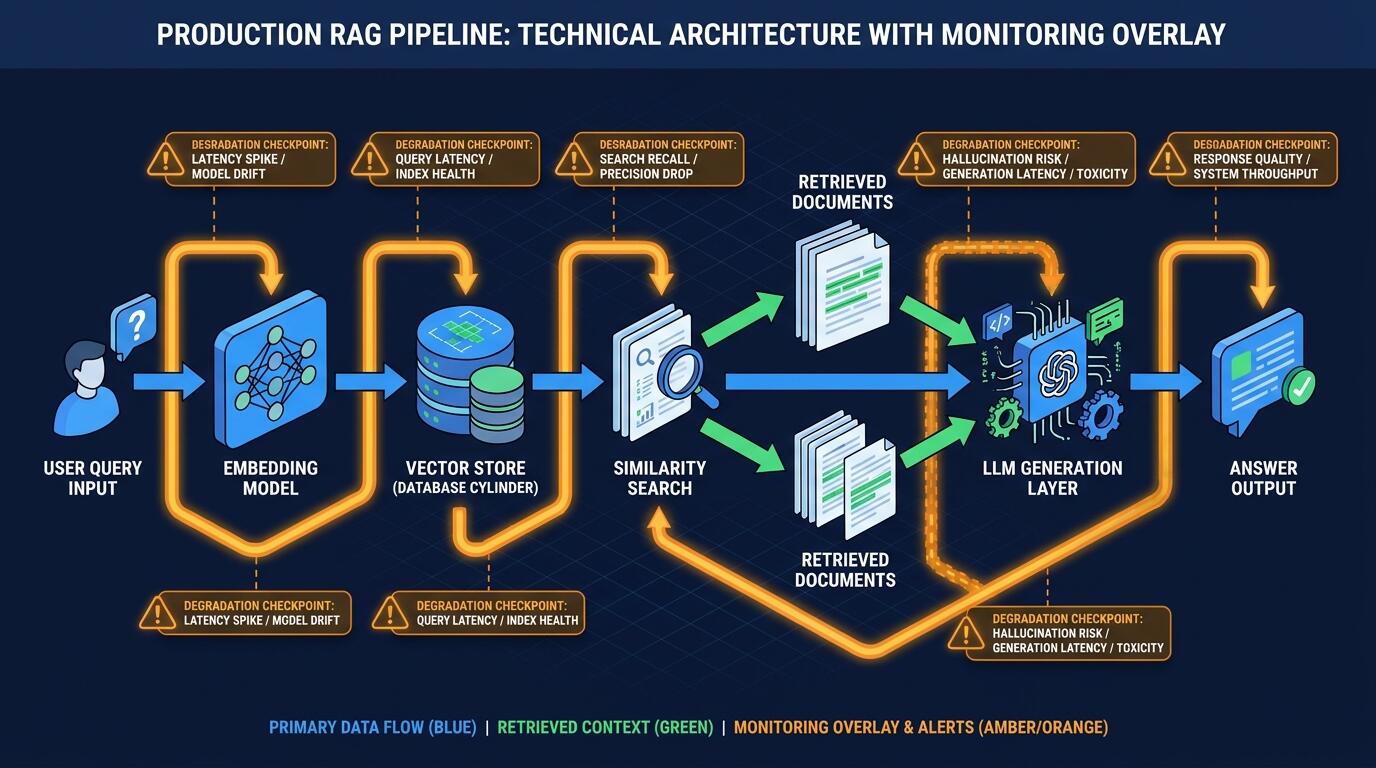
ALT: Diagram of a production RAG pipeline with embedding model, vector store, and retrieval quality monitoring layer highlighting points of degradation
A Step-by-Step System for Catching Retrieval Degradation Early
Step 1: Establish a Retrieval Quality Baseline Before Anything Else
The single most common mistake teams make is skipping the baseline. Without a documented baseline, "degradation" is just a feeling — you cannot know whether retrieval quality has fallen without knowing where it started.
Immediately after your system goes live (or right now, if you skipped this step), run a curated set of representative queries through your pipeline and record the retrieved documents for each. Have a human or an LLM-as-judge label each retrieval result as relevant or not relevant. Store these labeled results with a timestamp. This becomes your ground truth snapshot.
The query set does not need to be large. A curated set of queries that covers your primary use cases — including edge cases and queries that were previously tricky — is more valuable than a large random sample. What matters is that the set is stable: the same queries, run repeatedly over time, so you can detect changes.
Tip: Stratify your baseline queries by topic or document category if your corpus is heterogeneous. A single aggregate relevance score will mask degradation that affects only one subset of your data.
Step 2: Log Retrieval Signals Continuously, Not Just Answers
Most teams log the final LLM output for quality review. Few log the intermediate retrieval step — the actual documents returned, their similarity scores, and their metadata. This gap makes root cause analysis nearly impossible.
Instrument your retrieval layer to log, for every query: the top-k retrieved document IDs, their similarity scores, the query embedding vector (or a hash of it, if storage is a concern), and any available document metadata such as creation date or source tag. Store this alongside the query text and a timestamp.
With this data, you can detect early signals of drift that never surface in output logs: similarity scores trending lower over time (meaning the corpus and queries are growing further apart in embedding space), retrieved document age skewing older (meaning new content is not being embedded and indexed), or certain document IDs dominating retrievals in a way that suggests an indexing anomaly.
Tip: A rolling histogram of similarity scores for the top-1 retrieved result is one of the cheapest and most informative signals you can track. If the median score starts declining, something has changed — either in the queries, the corpus, or the embedding model.
Step 3: Detect the Four Root Causes of Retrieval Degradation
Retrieval quality degrades for four distinct reasons, and the fix is different for each. Treating them as a single problem leads to wasted effort.
The first cause is corpus staleness: your knowledge base has not been updated to reflect new information, but user queries now reference that new information. Retrieved documents are technically relevant to the old query distribution but not to current user intent. The diagnostic signal is a growing mismatch between query timestamps and the creation dates of retrieved documents.
The second cause is query distribution shift: the kinds of questions users ask have evolved since you tuned the system. Your embedding model and chunking strategy were optimized for an earlier query distribution. The diagnostic signal is declining similarity scores without any change to the corpus or embedding model.
The third cause is embedding model drift or replacement: if you have updated your embedding model — even a minor version update — embeddings generated before and after the update are not directly comparable. Mixing old and new embeddings in the same vector store causes retrieval to degrade silently, often for the documents indexed under the old model. The diagnostic signal is a bimodal distribution in similarity scores, where some documents retrieve well and others retrieve poorly with no obvious topical pattern.
The fourth cause is corpus contamination or indexing errors: duplicate documents, malformed chunks, or incorrectly processed files corrupt the vector index in ways that are hard to detect from query logs alone. The diagnostic signal is anomalous retrieval patterns — the same narrow set of documents appearing as top results across a wide range of semantically unrelated queries.
Tip: Before investing in a new embedding model or retuning hyperparameters, explicitly rule out corpus and indexing issues. A contaminated index will defeat any amount of model tuning.
Step 4: Build a Lightweight Canary Evaluation Loop
A canary evaluation loop is a scheduled process that automatically runs your baseline query set against the live production system and compares the results to your stored baseline. Think of it as a smoke test for retrieval quality, running continuously.
The implementation does not need to be complex. A scheduled job — daily or more frequently for high-traffic systems — runs the baseline queries, retrieves the top-k documents, and computes a similarity score against the baseline retrievals. You can measure this as Jaccard similarity between the retrieved document ID sets, or as cosine similarity between the current and baseline retrieved document embeddings if you want a more semantically sensitive metric.
When the canary score drops below a defined threshold, it fires an alert. The alert does not mean the system is broken — it means something has changed and a human should investigate. The canary loop converts a vague feeling of degradation into a trackable, actionable signal.
In our work building and operating AI pipelines, the canary loop is consistently the highest-leverage monitoring addition a team can make after shipping. It catches corpus drift, indexing errors, and embedding model inconsistencies before user complaints accumulate. For a deeper look at how retrieval sits within a larger automated pipeline, the agent pipeline behind a daily AI briefing covers retrieval, verification, and publication in an end-to-end production context.
Tip: Store canary run results with timestamps and build a trend chart. A single score drop is noise; a trend line is a signal.
Step 5: Add Human-in-the-Loop Spot Checks on a Cadence
Automated metrics catch what you instrumented. They miss what you did not anticipate. A regular manual spot-check cadence catches the surprises.
Set a recurring task — weekly or biweekly — where a team member manually reviews a random sample of production queries and their retrieved documents. The evaluation question is simple: given this query, would a knowledgeable user consider these retrieved documents genuinely useful? Yes, partially, or no.
Track the proportion of "yes" judgments over time. This is a qualitative signal, but it is grounded in actual user intent rather than a proxy metric. It also surfaces failure modes that automated systems miss: retrieved documents that are technically similar but practically useless because they are too generic, too dated, or from the wrong source.
Tip: Route the most common user queries — those appearing most frequently in your logs — through spot checks first. High-frequency queries failing silently cause disproportionate user impact.
Step 6: Instrument Downstream Quality as a Lagging Confirmation Signal
Retrieval quality ultimately matters because of what it does to generation quality. Downstream signals — LLM output quality scores, user feedback, citation accuracy — are lagging indicators, but they provide confirmation that a retrieval problem is actually affecting users.
If you have any form of user feedback (thumbs up/down, follow-up questions that indicate confusion, or session abandonment patterns), track it alongside your retrieval metrics. A correlation between a drop in your canary retrieval score and an uptick in negative feedback is strong evidence that the retrieval degradation is real and user-facing, not just a metric artifact.
For teams running LLM-as-judge evaluation on outputs, tag each judged output with the similarity score of the top retrieved document. This lets you analyze whether low-relevance retrievals systematically produce lower-quality outputs — a relationship that validates your retrieval metrics as meaningful proxies.
Tip: Be careful not to treat downstream metrics as your primary retrieval signal. They are too slow and too noisy for early detection. Use them to confirm what your retrieval-layer metrics already surfaced.
Step 7: Define a Remediation Playbook for Each Failure Mode
Detection without remediation is just a better view of the problem. For each of the four root causes identified in Step 3, have a defined response before you need it.
For corpus staleness: establish a document refresh schedule and automate re-embedding and re-indexing of updated documents. If your corpus update cadence is longer than your query freshness requirement, that mismatch is a product decision that needs to be made explicitly.
For query distribution shift: schedule a periodic re-evaluation of your chunking strategy and embedding model against the current query distribution. The baseline queries from Step 1 should be augmented with new representative queries from production logs on a regular cadence.
For embedding model drift: enforce strict version pinning on your embedding model and treat any model update as a full re-indexing event. Never mix embeddings from different model versions in the same vector store without explicit namespace separation.
For corpus contamination: build a corpus audit script that flags duplicate document IDs, anomalously short or long chunks, and documents with missing metadata. Run it as part of your indexing pipeline, not as a reactive investigation tool.
Tip: Document the remediation playbook in your team's runbook alongside the alert definitions. The engineer who receives the 3am alert should not have to figure out the playbook from first principles.
Common Mistakes and Troubleshooting
| Symptom | Likely Cause | How to Fix |
|---|---|---|
| Retrieval scores look fine but answer quality has dropped | Query distribution has shifted; top-k documents are technically similar but no longer relevant to actual user intent | Augment baseline query set with recent production queries; re-evaluate relevance labels against current user intent |
| Canary scores are volatile and hard to interpret | Baseline query set is too small or too diverse; single aggregate score masks category-level variance | Stratify canary evaluation by topic; track per-category scores separately |
| New documents are not appearing in retrieval results | Indexing pipeline is broken or lagging; new documents are not being embedded and written to the vector store | Add indexing pipeline monitoring with lag metrics; alert on index freshness falling behind corpus update cadence |
| Same small set of documents appears for most queries | Corpus contamination or duplicate embeddings pulling retrieval toward a narrow set | Run corpus audit; deduplicate document IDs; check for malformed embeddings producing anomalously high similarity with the query distribution |
| Bimodal similarity score distribution | Embedding model version mismatch — old and new embeddings coexist in the same index | Identify documents indexed under the old model; re-embed and re-index under the current model version; enforce version pinning going forward |
| Manual spot checks fail but automated metrics look healthy | Automated metrics are measuring the wrong thing — similarity without relevance | Incorporate relevance labels into canary evaluation, not just similarity scores |
Pro Tips for Better Retrieval Quality in Production
Version your embedding model as strictly as you version your application code. In practice, most teams treat the embedding model as a static dependency and update it opportunistically. Every embedding model update is a silent breaking change to your vector store unless you re-index everything under the new model. Treat model updates like database migrations: planned, tested, and rolled back if they regress retrieval quality.
Use metadata filters as a retrieval quality lever, not just a relevance filter. If your corpus has reliable date or source metadata, filtering retrieved documents by recency or source type can meaningfully improve precision without touching the embedding model or chunk strategy. A pattern we consistently see: teams that use metadata filters strategically maintain retrieval quality through corpus growth much better than those relying on similarity scores alone.
Build your canary query set from production logs, not just intuition. The queries you think are representative often are not. Mining production logs for the most frequent query patterns, the queries that generated the most follow-up questions, and the queries that historically produced poor retrievals gives you a far more operationally grounded baseline than a manually curated set alone.
Treat retrieval evaluation as a first-class engineering concern, not a QA afterthought. A pattern we consistently see in teams that struggle with production retrieval quality is that evaluation was added after the system shipped, as a reactive measure. Teams that instrument retrieval quality from day one — including canary loops, logging, and spot-check cadences — catch problems earlier and spend far less time on reactive incident investigation. This principle applies whether you are building an internal tool or a customer-facing product; the guidance in shipping fast without sacrificing product quality applies directly to retrieval pipeline operations.
Do not confuse high similarity scores with high relevance. This is the most persistent misconception in RAG systems. A similarity score measures how close two vectors are in embedding space — it does not measure whether a document actually answers the user's question. A document can score very high similarity to a query while being practically useless as context. This is why human-in-the-loop spot checks and downstream quality signals are necessary complements to automated similarity metrics.
Frequently Asked Questions FAQ
Q1: How do I know if retrieval degradation or generation quality is causing my system's answers to worsen?
Isolate the layers: log retrieved documents separately from generated answers and evaluate each independently. If retrieved documents are relevant but generated answers are poor, the problem is in the generation layer — prompt, model, or context window handling. If retrieved documents are irrelevant or stale, the problem is in retrieval. Running a canary evaluation loop that scores retrieval independently of generation is the fastest way to answer this question cleanly.
Q2: Is re-indexing the entire corpus always required when the embedding model is updated?
Yes, in almost every case. Embeddings from different model versions occupy different positions in vector space, so comparing a new-model query embedding against old-model document embeddings produces unreliable similarity scores. Partial re-indexing — updating only new or recently modified documents — is only safe if you maintain strict namespace separation between old and new embeddings and route queries accordingly. The cleanest approach is a full re-index on any model version change.
Q3: How much engineering effort does a basic retrieval monitoring system require to build and maintain?
For teams with existing log infrastructure and a metrics stack, an initial canary loop and retrieval logging layer can be built in a matter of days. The ongoing maintenance cost is low if the system is well-instrumented from the start — primarily the time to review alerts and conduct scheduled spot checks. The larger investment is usually in the baseline query set curation and establishing the human review cadence, both of which are process costs rather than engineering costs.
Final Thoughts
Retrieval quality degradation in production is not a one-time problem you solve at launch — it is an ongoing operational reality that every team building on RAG architectures will encounter. The good news is that it is detectable and manageable with the right instrumentation in place.
The three core points to carry forward: first, a documented baseline is non-negotiable — without it, degradation is invisible. Second, the four root causes of retrieval degradation (corpus staleness, query shift, embedding model drift, and corpus contamination) have distinct diagnostic signals and distinct fixes; treating them as a single problem wastes effort. Third, early detection through canary loops and regular spot checks is far cheaper than reactive incident response after users have already noticed.
The next concrete steps: if you do not have a baseline, create one this week using your current production system and a curated set of representative queries. If you have a baseline but no canary loop, build the simplest version — a scheduled job, a comparison metric, and a threshold alert. If you have both, audit your remediation playbook to ensure every alert type maps to a defined response.
The teams that maintain reliable retrieval quality over time are not the ones with the best embedding models at launch. They are the ones that built monitoring and response processes before they needed them.
If this guide surfaces useful patterns for your work, subscribe to Darius — a bilingual briefing written by practitioners actively building AI products, with five to ten curated signals per issue drawn from primary sources and annotated with production-grounded context. Whether you are selecting tools, tuning a pipeline, or scaling infrastructure, Darius filters the noise and surfaces what actually matters.
Sources
- Association for Computing Machinery (ACM). "Research and Practice in Information Retrieval Systems".
https://www.acm.org/ - Institute of Electrical and Electronics Engineers (IEEE). "Standards and Publications on Information Retrieval and Machine Learning Systems".
https://www.ieee.org/ - arXiv (Cornell University). "Preprint Research on Retrieval-Augmented Generation and Embedding Model Evaluation".
https://arxiv.org/
Note: Standards and research in this area evolve rapidly; always consult the latest official publications and verify findings against your specific production environment.