Reporting Structures That Actually Work for Product Development Teams
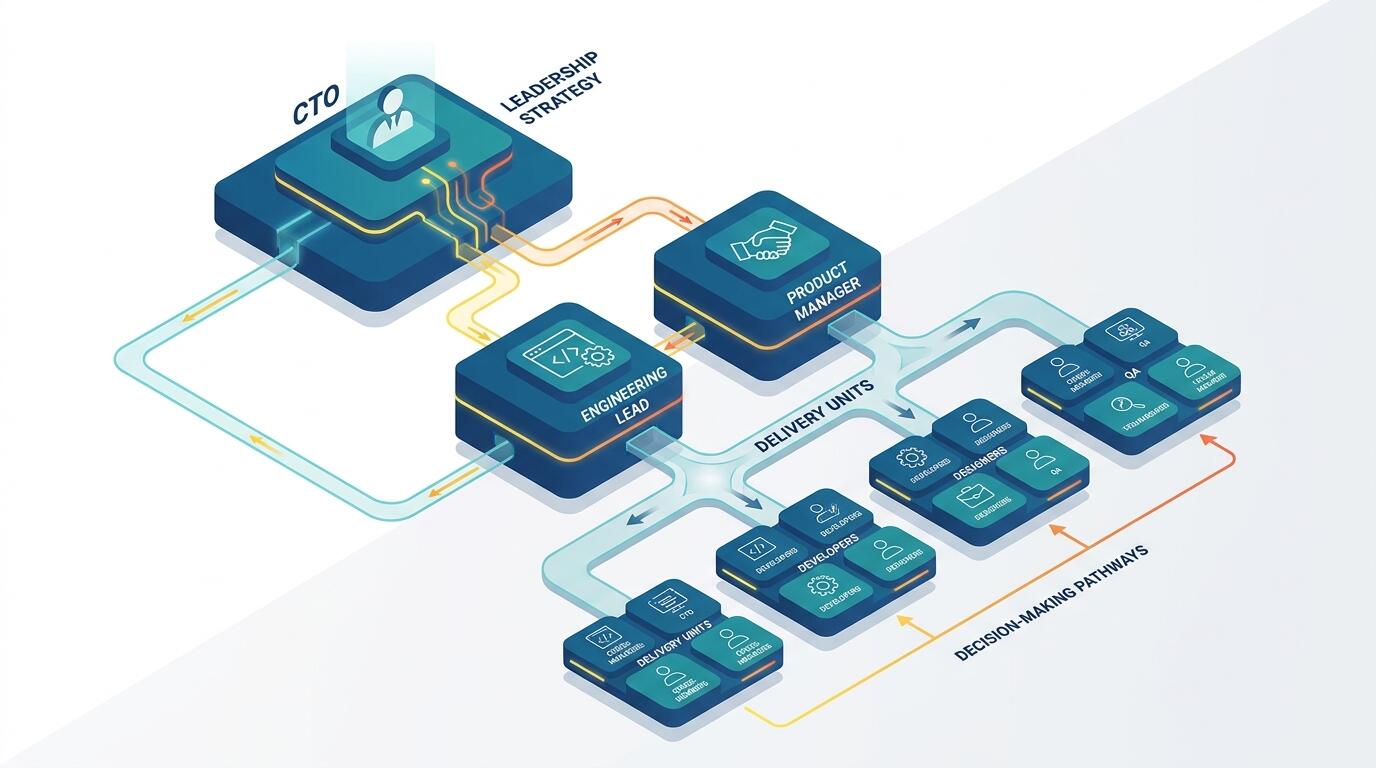
ALT: Effective reporting structures for product development teams bridging engineering and leadership
Why Most Product Development Reporting Structures Break Down Before Launch
Reporting structures for product development teams are the invisible scaffolding that either holds a build together or quietly causes it to collapse. A well-designed reporting structure aligns decision-making authority with technical reality, keeps context flowing between layers, and ensures that the people closest to the work can surface blockers before they become crises. A poorly designed one creates bottlenecks, diffuses accountability, and produces exactly the kind of misalignment that kills otherwise promising products.
In our work with engineering and product organizations, a pattern emerges consistently: teams that struggle to ship are rarely short on talent. More often, they are operating inside a reporting hierarchy that was either inherited from a previous company's playbook or assembled reactively as headcount grew. The structure was never designed for how this particular team builds. Understanding how to design — or redesign — a reporting structure that actually supports product delivery is one of the highest-leverage decisions a technical leader can make.
When This Guidance Applies to Your Team
Applicable Scenarios:
- Engineering teams that have grown beyond a handful of people and are experiencing coordination friction, unclear ownership, or delayed decisions
- Startups transitioning from a founder-led technical structure to a more formalized engineering organization while still needing to move fast
- Product development teams building AI-powered or complex software products where technical dependencies cut across multiple domains
Not Applicable/Cautions:
- Pure research teams or skunkworks initiatives where exploration is the goal and shipping cadence is deliberately undefined
- Organizations undergoing a major restructuring driven by M&A or executive mandate, where the reporting structure is constrained by external factors outside the team's control
The Hidden Cost of Getting Reporting Wrong in Product Development
Reporting structures are a form of organizational architecture, and like software architecture, they encode assumptions about how work flows and where decisions should be made. When those assumptions no longer match reality — because the product has grown, the team has scaled, or the technical complexity has increased — the structure starts generating friction rather than eliminating it.
The most common symptom is the "too many cooks" problem: a decision that should take an afternoon takes three weeks because it requires sign-off from five stakeholders who each have partial context. Another familiar failure mode is the "orphaned concern" — a critical issue that lives in the gap between two teams, where neither reporting chain owns it clearly enough to act. Both of these are structural problems masquerading as people problems or process problems.
According to the Project Management Institute (PMI), organizational structure is one of the key environmental factors influencing project outcomes, particularly in complex, cross-functional product development contexts. The implication for engineering leaders is straightforward: before blaming the sprint process or the ticket backlog, examine whether the reporting hierarchy is creating the conditions for coordination failure.
For teams building AI-powered products specifically, this pressure is amplified. AI systems have unusual cross-disciplinary dependencies — data engineering, model development, infrastructure, and product logic all need to be tightly coordinated — and a reporting structure that was designed for a conventional software team will struggle to accommodate them. If you are thinking through how an AI engagement is structured from the start, understanding what to expect when you start an AI architecture engagement is a useful reference point before locking in any organizational design.
Designing Reporting Structures That Serve Product Delivery
Three Steps to Audit and Redesign Your Current Structure
Step 1: Map Where Decisions Actually Get Made
Before proposing any changes, spend time documenting how decisions currently flow — not how the org chart says they should flow, but how they actually do. Interview team leads, product managers, and individual contributors. Ask them where they go when they need a call made quickly. The gap between the formal hierarchy and the informal decision-making map is almost always where the real structural dysfunction lives. This audit can typically be completed in a focused week of conversations and observation.
Step 2: Identify the Accountability Gaps and Overlaps
With the decision map in hand, look for two things: areas where no single person can make a call without escalating, and areas where multiple people believe they own the same domain. Accountability gaps slow you down; accountability overlaps create political friction and inconsistent direction. Document both explicitly. These are the inflection points your new structure needs to resolve. Give yourself another focused week to produce a clear written inventory of gaps and overlaps before moving to solutions.
Step 3: Redesign Around Product Delivery Units, Not Functional Silos
The most effective reporting structures for product development teams organize people around outcomes — a working feature, a shipped module, a customer-facing capability — rather than around technical disciplines alone. This does not mean eliminating functional expertise; it means ensuring that the people who need to coordinate to ship something are close enough in the reporting structure that they can make decisions without excessive escalation. Sketch the new structure, run it past senior engineers and PMs for a gut-check, then pilot it on one delivery unit before rolling out broadly.
Comparing Common Reporting Models for Product Teams
Different reporting models carry different tradeoffs. The right choice depends on team size, product complexity, and how tightly coupled your technical domains are.
| Comparison Dimension | Functional Structure | Cross-Functional (Product) Teams | Matrix Structure |
|---|---|---|---|
| Decision-making speed | Slower — escalation paths are longer | Faster — decisions stay within the team | Moderate — depends on how clearly authority is defined |
| Technical depth | High — specialists report to specialist managers | Variable — depends on embedded expertise | High, but requires strong functional leads |
| Coordination overhead | High across teams | Low within teams, higher at team boundaries | High — dual reporting creates ambiguity |
| Best fit | Deep R&D or platform work | Fast-moving product delivery | Large organizations with shared services |
| Risk of accountability gaps | High at cross-team interfaces | Low within teams | High if authority lines are unclear |
| Scalability | Scales with clear functional ownership | Scales well up to medium team sizes | Scales with strong governance |
The cross-functional model — often called a product team or squad structure — consistently performs best for teams focused on shipping. It keeps the engineering lead, product manager, and domain specialists in the same accountability unit, which eliminates the most common sources of coordination delay. However, it requires deliberate investment in technical standards and shared infrastructure, because teams operating with high autonomy will otherwise diverge in ways that create platform-level debt.
How Authority, Proximity, and Context Shape Effective Hierarchies
Authority must live where context lives. The most reliable predictor of a good decision is whether the decision-maker has full context. Reporting structures that push authority to people who are too far from the work — organizationally or informationally — consistently produce slower, lower-quality decisions. This sounds obvious, but a surprising number of engineering organizations are structured so that the people with the most decision-making authority are the ones with the least direct visibility into day-to-day technical reality.
The practical fix is to be deliberate about what decisions require escalation and what decisions should be made at the team level by default. Documenting this — some organizations use a simple decision rights framework, referenced by researchers at MIT Sloan Management Review as a key lever for organizational effectiveness — prevents the drift toward over-escalation that naturally occurs when teams lack explicit guidance.
Proximity to the product matters as much as proximity to the org chart. In product development, the most dangerous coordination failures tend to happen between teams that are close on the org chart but distant in their understanding of each other's work. A useful structural heuristic: any two people who need to make joint decisions more than once a week should report to the same immediate lead, or at minimum should have a shared lead no more than one level up. When that condition is not met, coordination becomes a political negotiation rather than a technical conversation.
Context transfer is a structural responsibility, not a communication skill. When a team member moves from one reporting structure to another — during a reorg, a product pivot, or a growth phase — they carry context with them that may not be visible to their new lead. Effective reporting structures build context transfer into the handoff: documented decision history, explicit onboarding into the team's technical and product assumptions, and a deliberate ramp period before full ownership is assumed. This is particularly relevant for teams validating a new product idea and then spinning up a delivery team to build it — the learning from the validation phase needs to be structurally preserved, not left in informal notes.
The engineering director role is a structural lever, not just a seniority tier. In organizations that ship consistently, the Engineering Director or equivalent role functions as the connective tissue between product strategy and technical execution. This person is close enough to the technical work to catch architectural drift early, and senior enough to influence resourcing and priority decisions before they create downstream problems. When this role is missing or too thinly staffed, the gap shows up as a flood of escalations to the CTO or VP of Engineering — people who are operating at a level of abstraction that makes fast, well-informed technical decisions difficult.
Advanced Considerations for Scaling and Restructuring
Reorgs often solve the wrong problem. A common pattern we observe: a team hits a shipping bottleneck, leadership responds with a structural reorganization, and within a quarter the same bottleneck re-emerges in a slightly different form. This happens when the reorg addresses reporting lines without addressing the underlying decision rights or information flow problems. Before restructuring, verify that you have diagnosed the root cause correctly — sometimes the fix is a clearer RACI matrix or a revised escalation policy, not a wholesale change to who reports to whom.
Remote and distributed teams require more structural explicitness, not less. A reporting structure that works adequately in a co-located environment will often fail in a distributed one, because the informal coordination mechanisms — hallway conversations, visible body language, spontaneous whiteboard sessions — are no longer available. Distributed product teams need more explicit documentation of decision rights, more deliberately structured communication rhythms, and clearer ownership boundaries than their in-person counterparts.
A common misconception: flat is always better. The appeal of flat organizational structures is real — they reduce hierarchy overhead and can accelerate certain kinds of decision-making. But for product development teams working on complex systems, very flat structures often just relocate the coordination problem rather than solving it. When there is no clear reporting hierarchy, informal power structures fill the vacuum, and those are typically less fair and less predictable than formal ones. The goal is not the flattest possible structure; it is the most effective one for the work at hand.
Reporting structure and technical architecture should mirror each other. Conway's Law — articulated by computer scientist Melvin Conway and widely cited in software engineering literature — states that organizations design systems that mirror their own communication structure. This means that if your reporting structure is siloed, your system architecture will tend to be siloed too, often in ways that create integration headaches down the line. When designing or revisiting your reporting structure, it is worth asking explicitly whether the organizational design is compatible with the technical architecture you are trying to build. Teams working on scalable ML systems, for example, benefit from reading about how to build machine learning pipelines that scale past prototype stage, since the architectural decisions and the team structure decisions are deeply intertwined.
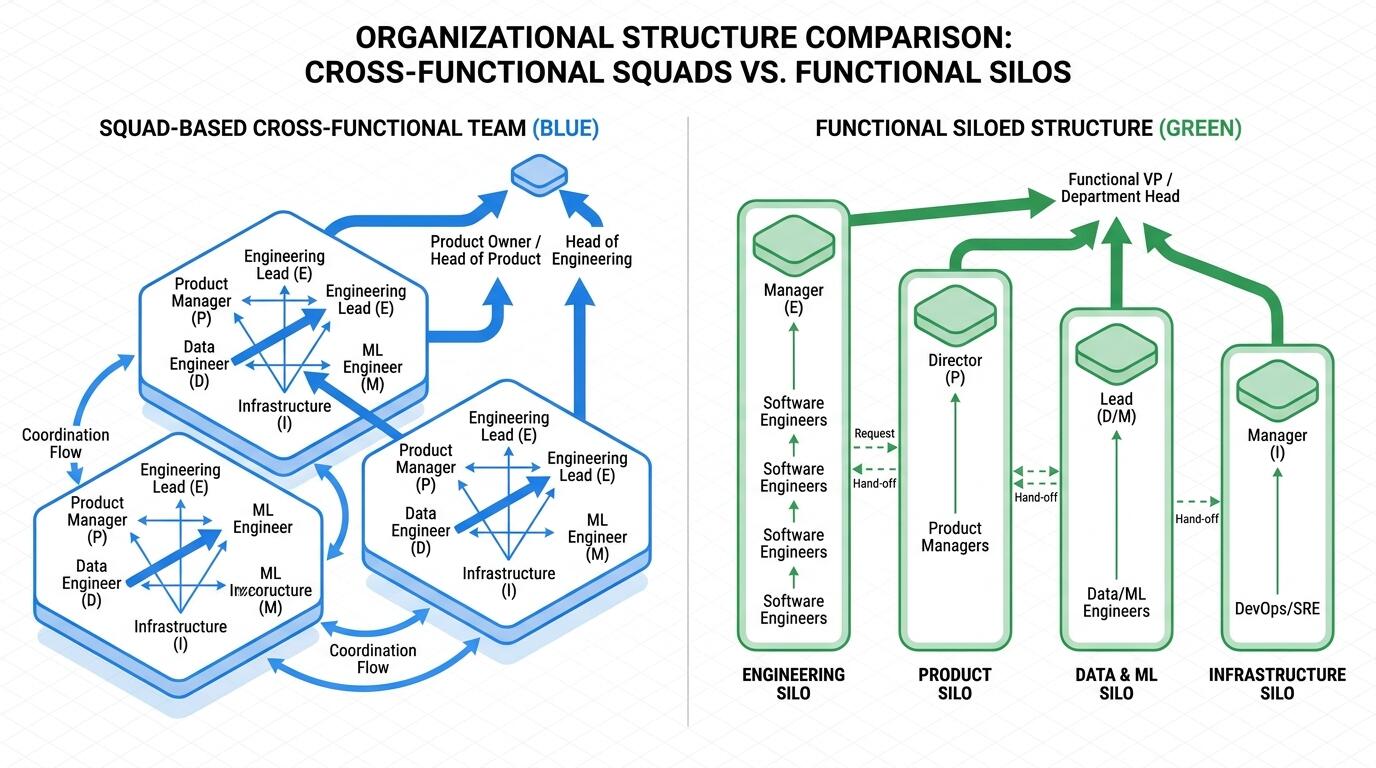
ALT: Diagram illustrating cross-functional product team reporting structures aligned for effective delivery and AI development
Questions & Answers
Q1: How do you decide who the engineering lead should report to in a product team?
The engineering lead in a product team should report to whoever owns the product outcome, not to a centralized engineering function — unless that centralized function is itself accountable for the product outcome. The key test is whether the engineering lead and their reporting manager share enough context to make resourcing and priority decisions together without a long escalation chain. When those two people are organizationally distant, decision speed suffers predictably. In practice, this often means the engineering lead reports to a VP of Product or a General Manager for that product area.
Q2: Is a matrix reporting structure ever the right choice for a startup?
A matrix structure is rarely the right choice for an early-stage startup. Matrix structures require strong governance and well-defined authority at every node to function well — conditions that early-stage teams almost never have. The dual reporting lines that define a matrix introduce ambiguity about who to prioritize, which tends to paralyze individuals rather than empower them. Startups are better served by a leaner, clearer structure: one lead per person, explicit product ownership, and a small number of well-defined escalation paths.
Q3: How long does it typically take to feel the benefit of a reporting structure change?
The positive effects of a well-designed reporting structure change are rarely immediate. Teams need time to adjust to new authority boundaries, rebuild trust with new leads, and develop new coordination rhythms. In practice, teams typically begin to feel the benefit within one to two quarters, with the most visible improvements showing up in decision speed and cross-team coordination quality. If you see no improvement after two quarters, revisit whether the structural change actually addressed the root cause or just moved the problem.
Summary
Effective reporting structures for product development teams are not a one-size-fits-all solution — they are a design decision that should be made as deliberately as any architectural decision in the product itself.
Key Takeaways:
- Reporting structures encode decision-making assumptions; when those assumptions no longer match the team's reality, coordination failures follow.
- The most effective model for product delivery teams organizes people around outcomes, not functional disciplines — keeping decision authority close to the people with the most context.
- A structure audit should start by mapping where decisions actually get made, not where the org chart says they should be made.
- Authority, proximity, and context transfer are the three structural levers that most directly affect shipping velocity.
- Conway's Law means your org structure and your technical architecture are not independent — designing one without considering the other creates avoidable systemic risk.
- Reorgs that change reporting lines without changing decision rights often reproduce the original problem in a new form.
The next step is to conduct an honest audit of how decisions currently flow in your team, document the gaps and overlaps in accountability, and design a reporting structure that puts authority where context actually lives.
If you are ready to bring clearer structure and sharper technical leadership to your product development team, visit Darius to explore the work, read practical insights on engineering and AI architecture, and get in touch about how he can help you design and ship your next product with confidence.
Sources & Further Reading
- Project Management Institute. "A Guide to the Project Management Body of Knowledge (PMBOK Guide)".
https://www.pmi.org/ - IEEE. "IEEE Standards on Systems and Software Engineering".
https://www.ieee.org/ - MIT Sloan Management Review. "Organizational Decision Rights and Structural Effectiveness".
https://sloanreview.mit.edu/
Note: Standards and organizational research may be updated; please check the latest official documents or consult professional advisors.