Handling Production Incidents Without a Formal On-Call Rotation in 2026
ALT: Engineering team managing production incidents without a formal on-call rotation in 2026
Building a Resilient Incident Response System When You Don't Have a Formal On-Call Rotation
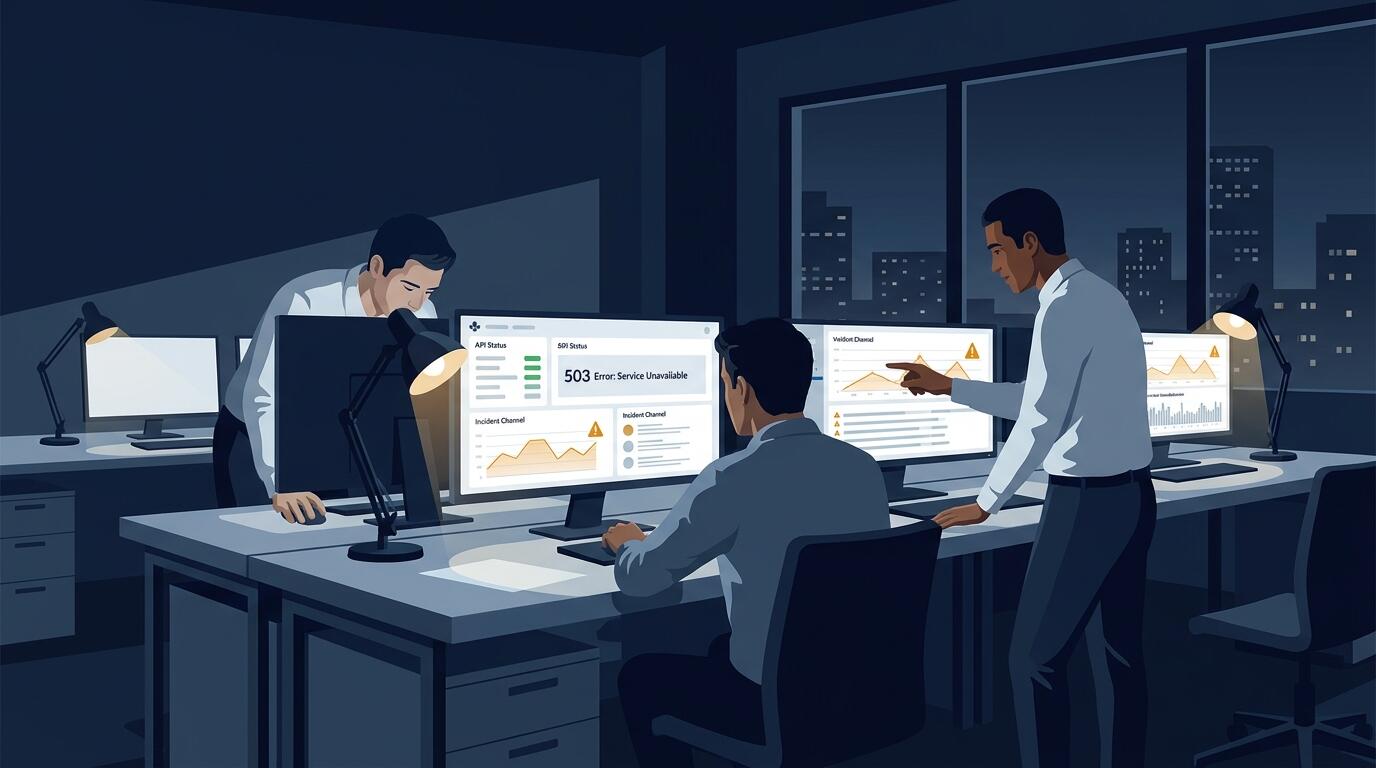
Your staging environment is clean, your CI/CD pipeline is green, and then — at 11:47 PM — a customer flags that your core API is returning 503s. You have no PagerDuty policy configured, no escalation tree, and no designated engineer whose phone is supposed to ring. What you do have is a team of capable people, a production system that matters, and no formal process for handling this exact moment. This scenario is far more common than most engineering blogs acknowledge, especially among early-stage startups and lean engineering teams in 2026.
This guide is for founders, engineering directors, and technical leads who are shipping real products without the organizational scaffolding of a dedicated on-call rotation. It is not about pretending the problem does not exist — it is about building a lightweight, sustainable, and genuinely effective incident response capability for the team you actually have, not the enterprise SRE org you might build someday.
Before You Start: Prerequisites and Preparation for Informal Incident Management
Handling production incidents without a formal on-call rotation is achievable, but it is not a zero-preparation exercise. Before establishing any process, you need to be honest about a few fundamentals that will determine whether your approach holds up under real pressure.
The first prerequisite is clarity about your system's blast radius. You need to understand, at least qualitatively, which failures are catastrophic (complete data loss, full service unavailability affecting paying customers), which are degraded (partial functionality, elevated error rates), and which are cosmetic (broken image, minor UI bug). Without this classification, every alert feels equally urgent, and your team burns out responding to noise.
The second prerequisite is a shared communication channel that everyone actually monitors. In most lean teams, this is a dedicated Slack channel or similar. Critically, it must be distinct from your general engineering channel — incident signal should not compete with pull request notifications.
The third prerequisite is documented runbooks for your highest-probability failure modes. These do not need to be elaborate. A runbook for a common failure can be a three-step list in a shared Notion page or internal wiki. The goal is to eliminate the cognitive load of diagnosing under pressure.
The fourth prerequisite is at least one observability tool emitting meaningful signals — logs, metrics, or traces that give you real visibility into what is broken and why. Blind incident response is the most expensive kind.
Finally, you need explicit team buy-in. Even informal incident handling carries implicit expectations about availability and response. These expectations must be named, discussed, and agreed upon — not assumed.
Prerequisites checklist before starting:
- Incident severity classification framework (even a simple three-tier model)
- A dedicated incident communication channel, separate from general engineering noise
- Basic runbooks for your top three to five most likely failure modes
- At least one observability layer providing logs, metrics, or traces
- Explicit team agreement on informal availability expectations and escalation paths
- A postmortem or incident retrospective template, however lightweight
Step-by-Step: Building Production Incident Handling Without a Formal Rotation
Step 1: Define Severity Tiers Before an Incident Happens
The single most important thing you can do before your first incident is define what kinds of failures require what kinds of response — and do it when no one is under pressure. Severity classification is the foundation of proportionate incident response.
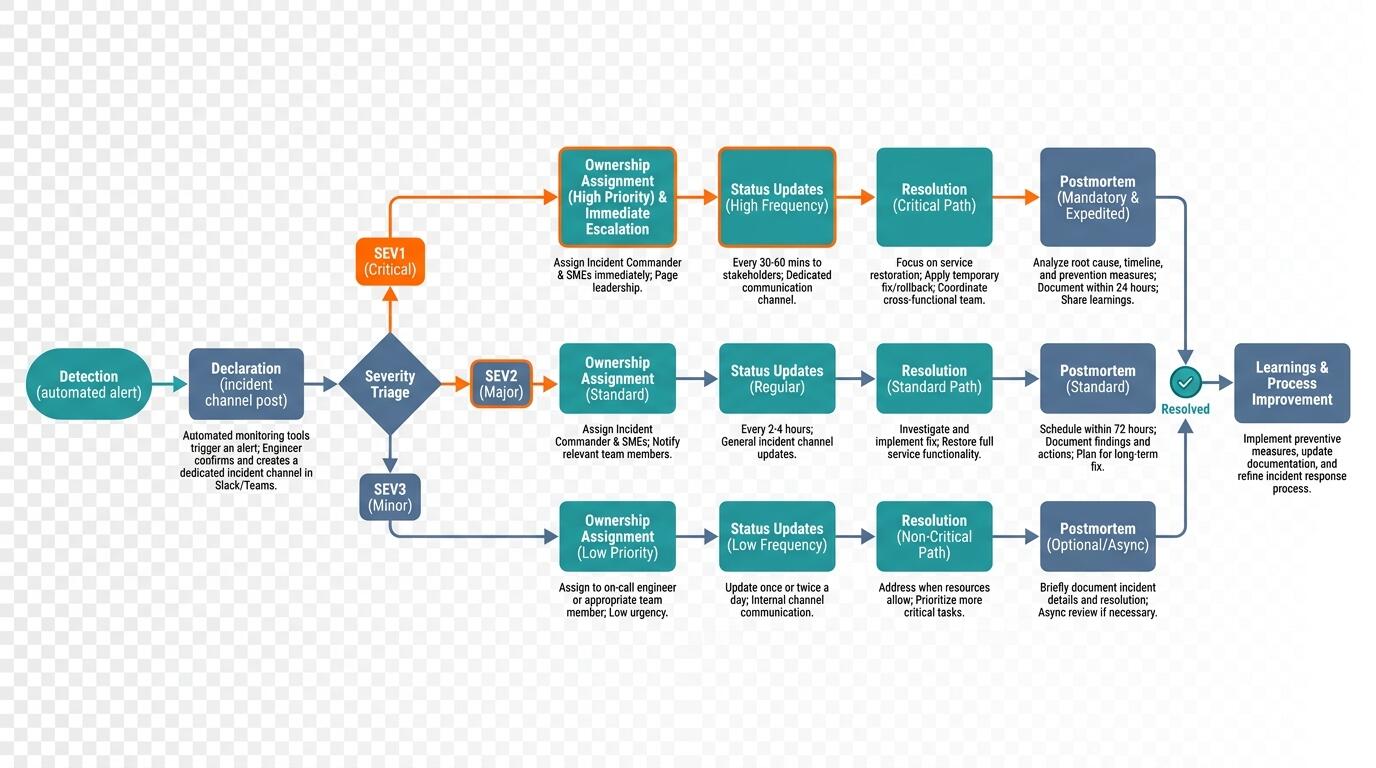
A practical three-tier model works well for most small and mid-sized teams. Severity 1 covers complete or near-complete service outages affecting core customer workflows. These warrant immediate response regardless of time of day. Severity 2 covers significant degradation — elevated error rates, major feature failures — that affects a meaningful portion of users but the service is still partially functional. Severity 3 covers minor issues, cosmetic defects, or failures affecting only a small segment of users where a next-business-day resolution is acceptable.
The key discipline here is to resist the temptation to classify everything as Severity 1. In a pattern consistently observed when working with early-stage engineering teams, alert fatigue from over-classification is one of the primary reasons informal incident processes collapse. Engineers stop responding promptly because every alert has cried wolf.
Tip: Write your severity definitions down and share them with your entire team, including non-engineers. When a customer success manager is deciding whether to escalate at 2 AM, they need to know what qualifies as a genuine emergency.
Step 2: Establish a Clear Incident Ownership Model
Without a formal rotation, you need an alternative ownership model — something that answers the question "whose problem is this right now?" clearly and without ambiguity.
The two most effective informal models are area ownership and primary-secondary pairing. In area ownership, each engineer is the default responder for the systems they built and know best. This works well in small teams where ownership boundaries are clear and the bus factor risk is managed through documentation. In primary-secondary pairing, you designate a loose informal lead for each sprint or week — not a formal on-call, but someone who has agreed to be the first point of contact for that window. According to incident.io, even lightweight rotation structures significantly reduce the "bystander effect" where everyone assumes someone else is handling it.
Neither model requires formal tooling to implement. A shared calendar entry, a pinned Slack message, or a simple weekly note in your team standup is sufficient to establish who is primary this week.
Tip: Make ownership visible without making it burdensome. Rotate the loose primary role frequently enough that no one individual bears a disproportionate load over time.
Step 3: Build a Lightweight Incident Communication Protocol
When an incident occurs, the communication structure is often more valuable than the technical tooling. A clear communication protocol eliminates the two most common failure modes of informal incident handling: nobody knows who is working on it, and nobody knows what has been tried.
A minimal incident communication protocol for teams without a formal rotation includes three components. First, a trigger declaration: any engineer who identifies a potential Severity 1 or 2 issue posts a brief, structured message to the incident channel immediately — something as simple as "Potential incident: API latency spiking, investigating." Second, a status cadence: the incident owner posts a brief status update at a fixed interval (every fifteen or thirty minutes) until the incident is resolved, even if the update is just "still investigating, no change." Third, a resolution and next-steps note: when the immediate issue is resolved, the incident owner posts a short summary of what happened, what fixed it, and whether a follow-up action item is needed.
This protocol requires no dedicated tooling. It can run entirely in Slack, Discord, or any team messaging platform. Its value is that it keeps context synchronized for anyone who joins the incident thread late, and it creates an automatic record for your postmortem.
Tip: Create a Slack channel message template or pinned format for incident declarations so the structure is consistent. Consistent structure makes it easy to scan the channel history later and reconstruct a timeline.
Step 4: Automate the Detection Layer So Humans Are Notified, Not Expected to Notice
One of the most dangerous failure modes in informal incident response is relying on a human to notice something is wrong. Production systems fail in ways that are not always immediately visible to end users or engineers who are not actively looking at dashboards.
Effective automated detection for lean teams does not require a complex observability stack. At a minimum, you want uptime monitoring with alerting (services like UptimeRobot or equivalent provide this at low cost), error rate monitoring tied to a threshold alert, and latency or response time monitoring for your critical endpoints. Per Xurrent's on-call rotations guide, automated alerting is a prerequisite for any incident management approach — formal or informal — because it removes the dependency on a human being actively watching for problems.
The alert routing for informal teams is simpler than a formal rotation because there is no escalation tree to configure. Route critical alerts to your incident channel and to the personal notification channel of whoever is the informal primary for that period. Keep alert volume low and signal quality high — alert fatigue in informal teams is particularly dangerous because there is no institutional mechanism to force response.
Tip: Audit your alert thresholds every few months. Alerts that fire frequently but never require action are destroying your team's signal-to-noise ratio. Delete or raise those thresholds without mercy.
Step 5: Create Runbooks for Your Top Failure Modes
A runbook is a documented procedure for diagnosing and resolving a specific class of incident. Runbooks are the most undervalued tool in the informal incident response toolkit, because they allow any competent engineer on your team to handle an incident that would otherwise require the one engineer who built that specific component.
You do not need runbooks for every conceivable failure. Start with the three to five failure modes you have already experienced or that your architecture makes most likely. For an API service, this might include database connection pool exhaustion, a downstream third-party API failure, or a memory leak causing container restarts. For each of these, write a simple document covering: how to confirm this is actually the issue, the steps to mitigate or resolve it, and when to escalate beyond the runbook.
In practice, the act of writing a runbook often reveals gaps in your system's observability or recovery tooling — places where you realize you do not actually have a clean way to perform a step you assumed was straightforward. This is valuable information to discover before 2 AM, not during.
As you ship fast without sacrificing product quality, runbooks should grow alongside your system. Each incident postmortem should include a question: does this failure mode now warrant a runbook, or does an existing runbook need updating?
Tip: Store runbooks where engineers can find them under pressure — ideally linked from your incident channel's pinned resources. A runbook in a Confluence space that nobody navigates to is as useful as no runbook.
Step 6: Conduct Lightweight Postmortems on Every Significant Incident
A postmortem is a structured retrospective conducted after an incident to understand what happened, why it happened, and what changes will prevent or reduce the impact of similar incidents in the future. Postmortems are the mechanism by which informal incident response improves over time — without them, you are stuck in a reactive loop.
The key word for informal teams is "lightweight." A postmortem does not need to be a ninety-minute meeting with a formal facilitator and a written report reviewed by leadership. For most incidents on lean teams, a postmortem can be a fifteen-minute async discussion in a shared document with four sections: timeline of events, root cause analysis, contributing factors, and action items with owners and target dates.
Blameless postmortem culture — the principle, documented by organizations like Google's Site Reliability Engineering group, that postmortems focus on system failures rather than individual fault — is particularly important for informal teams where there is no organizational buffer between an incident and the individual who was responsible. Without explicit blamelessness, engineers will avoid surfacing incidents, and your incident data becomes unreliable.
Tip: Assign a specific owner and a specific due date to every action item that comes out of a postmortem. Action items without owners are aspirations, not commitments.
Step 7: Establish Explicit Boundaries Around Informal Availability
This step is the one most informal incident processes skip, and it is the reason many of them fail or cause team burnout within months. If you are handling incidents without a formal on-call rotation, you must be explicit about what your informal availability expectations actually are — and those expectations must be sustainable and consented to.
Runframe's on-call rotation guide emphasizes that even informal availability expectations, left unspoken, tend to expand to fill all available time. Engineers in informal systems often feel implicitly expected to be available at all times because there is no formal boundary saying otherwise. This is a direct path to burnout and attrition, which is a worse outcome for your production reliability than any individual incident.
The practical fix is a brief, explicit team conversation: what is the actual expectation for response time outside business hours for a Severity 1 incident? Is it thirty minutes? An hour? Is there a specific window — say, 8 PM to 8 AM — where only true emergencies warrant waking someone? Document this agreement, share it with stakeholders who might generate incident escalations, and revisit it periodically.
As your system and team grow, this is also the natural trigger point to evaluate whether you need to formalize your rotation. Understanding what a more structured technical engagement looks like can help you decide when the informal model has reached its natural limits.
Tip: Make the availability agreement visible to everyone, including your product and customer success teams. When they understand what the actual commitment is, they can set appropriate expectations with customers and avoid unnecessary escalations.
Common Mistakes and Troubleshooting in Informal Incident Response
| Symptom | Likely Cause | How to Fix |
|---|---|---|
| Nobody responds to incidents in the shared channel | Bystander effect — no clear ownership | Implement a loose primary-secondary model; ensure one named person is responsible each week |
| Every alert gets treated as a critical emergency | No severity classification framework | Define and document a three-tier severity model; train the team and stakeholders to apply it |
| The same incidents keep recurring | No postmortem process or action items without owners | Conduct lightweight postmortems; assign every action item a specific owner and due date |
| Engineers are burning out from informal expectations | Implicit availability expectations have expanded beyond sustainable limits | Hold an explicit team conversation to document and agree on realistic off-hours response expectations |
| Runbooks exist but nobody uses them | Runbooks are hard to find under pressure | Link runbooks from your incident channel's pinned resources and from monitoring alert messages |
| Incidents take too long to resolve | Alerts are firing but context is missing | Improve alert message content to include relevant context; link to runbooks directly in the alert payload |
ALT: Lightweight production incident handling workflow for engineering teams without a formal on-call rotation in 2026
Pro Tips for Better Results in Informal Incident Management
Treat your observability stack as a first-class product investment, not a nice-to-have. In informal incident response, the observability layer is doing work that a formal on-call rotation would otherwise distribute across multiple people and tooling layers. If your logs are sparse, your metrics are coarse, and your traces are nonexistent, your engineers are flying blind during incidents. Invest in this layer early and treat it with the same care you give your product features.
Build incident muscle memory through deliberate practice. Gameday exercises — intentionally triggering known failure modes in a non-production or staging environment and running your informal incident process against them — are one of the highest-leverage investments a lean team can make. You discover gaps in your runbooks, communication protocols, and escalation paths before a real incident surfaces them at the worst possible moment.
Use incident data to prioritize reliability investments. Every incident your team handles is data about where your system is fragile. Track incidents, even informally, and review patterns quarterly. A recurring class of incidents is a strong signal that a reliability investment — better retry logic, a circuit breaker, improved connection pool management — will pay higher dividends than most new features. This kind of data-driven prioritization is something to consider when evaluating build-vs-buy decisions for your infrastructure.
Normalize declaring incidents early, not late. A common misconception is that declaring an incident is an admission that something serious has happened. The more accurate framing is that declaring an incident is the act of activating your response process. Early declaration means more eyes on the problem sooner, better communication with stakeholders, and a cleaner timeline for the postmortem. Engineers who wait until they are certain something is wrong before declaring are delaying the response unnecessarily.
Revisit your informal process as your system complexity grows. An informal incident process that works well for a three-engineer team handling a single-service product will not scale unmodified to a twelve-engineer team running a distributed AI-powered platform. The process that got you here is not necessarily the process that will serve you at the next stage. Build in a periodic review — quarterly or at major team growth milestones — to assess whether your informal model is still fit for purpose.
Questions & Answers
Q1: How do you decide when to move from an informal incident process to a formal on-call rotation?
The informal model has reached its limits when any of three signals appear consistently: engineers are reporting burnout from unpredictable off-hours interruptions, incidents are going unaddressed for extended periods because ownership is unclear, or your customer SLA commitments are being breached with regularity. At that point, a formal rotation with clear escalation policies is not bureaucratic overhead — it is a reliability investment that protects both your product and your team.
Q2: Is it possible to handle production incidents sustainably without any on-call tooling at all?
For small teams and early-stage products, yes — with the right communication protocols and observability in place. The critical dependencies are automated alerting (so humans are not expected to notice failures themselves) and a clear ownership model (so the bystander effect does not delay response). According to published guidance from incident management platforms, even minimal tooling dramatically improves response consistency compared to purely ad hoc approaches. The tooling complexity should scale with the team and system complexity.
Q3: How much time does setting up a lightweight incident process typically take?
The initial setup — severity classification, communication protocols, a handful of runbooks, and basic automated alerting — is achievable within a few focused working sessions for most small teams. The ongoing investment is in postmortems and runbook maintenance after each significant incident. The process itself is not the time commitment; the discipline of consistently applying and improving it is where the sustained effort lies. Think of it as a recurring investment rather than a one-time project.
Wrapping Up
Handling production incidents without a formal on-call rotation is not a gap to be embarrassed about — it is the operational reality for most lean engineering teams in 2026, and it is entirely manageable with the right structure. The key is building that structure deliberately, before the next incident, rather than improvising under pressure.
Key Takeaways:
- Define severity tiers before an incident happens; classification is the foundation of proportionate response.
- Establish explicit (not implicit) ownership for each period, even if it is informal and lightweight.
- A clear communication protocol — declare, update, resolve — is often more valuable than any tooling investment.
- Automate detection so humans are notified rather than expected to notice failures.
- Runbooks and blameless postmortems are the mechanism by which your informal process improves over time.
- Explicitly document and agree on off-hours availability expectations to protect your team from burnout.
The next step is straightforward: take one hour this week to run your team through a tabletop exercise against your most likely failure mode. Walk through who gets notified, who declares the incident, what the runbook says, and how the resolution gets communicated. You will discover at least one gap — and discovering it in a tabletop is orders of magnitude cheaper than discovering it at midnight with a customer watching.
If you are building or scaling a production system and want experienced architecture and engineering guidance on reliability, systems design, or AI-powered product development, explore the portfolio and technical insights at Darius — a resource for founders and engineering leaders who are ready to ship real products with confidence.
References & Further Reading
- incident.io. "On-call scheduling strategies: Rotation models that actually work."
https://incident.io/blog/on-call-scheduling-rotation-models - Runframe. "On-Call Rotation Guide: Schedule Templates, Handoffs & Best Practices."
https://runframe.io/blog/on-call-rotation-guide - Xurrent. "On-Call Rotations and Schedules: A Guide for 2026."
https://www.xurrent.com/blog/on-call-rotations-and-schedules-guide - IEEE. "IEEE Standards — Software and Systems Engineering."
https://www.ieee.org/
Note: Standards and industry guidance may be updated; verify the latest official documents or consult professional advisors for current best practice.