Prioritizing AI Features: A Framework for This Quarter's Engineering Roadmap

ALT: Engineering leader reviewing AI feature prioritization framework on a quarterly roadmap planning board
Prioritizing AI Features: A Framework for This Quarter's Engineering Roadmap
Picture a planning meeting three weeks before quarter-end: the product team wants a customer-facing chatbot, the platform team wants an internal RAG-powered search tool, and leadership wants "something with AI" in the release notes before the next board update. Everyone has a reason their feature should ship first, and nobody has a shared method for deciding. Prioritizing AI features requires a repeatable framework that weighs technical feasibility, business impact, and data readiness together, rather than relying on whoever argues loudest in the roadmap review.
This topic deserves fresh scrutiny now because AI feature requests have stopped being rare, exploratory bets and have become a recurring line item on nearly every engineering roadmap. Teams that once evaluated one AI initiative a year are now fielding a dozen candidate features a quarter, and the cost of picking wrong — in engineering hours, in stalled trust from stakeholders, in models that never leave staging — has grown proportionally.
The Current Landscape of AI Roadmap Planning
AI feature prioritization today sits at the intersection of two colliding pressures: accelerating stakeholder demand and unevenly distributed technical readiness. AI feature prioritization is the structured process of ranking candidate AI capabilities on an engineering roadmap based on measurable criteria such as feasibility, data availability, and business value, rather than intuition or seniority of the requester. Most engineering organizations did not inherit a mature version of this process; they built it in real time as generative AI moved from research demo to product requirement in a very short span.
A pattern we consistently see across engineering organizations is that the first wave of AI roadmap items gets approved on enthusiasm rather than evidence. Leadership hears about a competitor's AI feature, a sales team requests parity, and the item lands on the roadmap without anyone asking whether the underlying data pipeline, model infrastructure, or evaluation process actually exists to support it. This is not a criticism of any single team — it reflects how quickly the market moved and how few organizations had a prioritization playbook ready when the demand surged.
The broader industry context reinforces this. According to insights shared through GetDX's discussion on prioritization as code, engineering organizations are increasingly trying to encode prioritization logic explicitly — turning what used to be tribal knowledge and gut instinct into something closer to a repeatable, inspectable system, particularly for platform and AI-adjacent work. This shift matters because AI features carry a different risk profile than typical feature work: a mis-scoped AI feature does not just slip a deadline, it can produce outputs that are subtly wrong, erode user trust, or require an entirely different technical approach once real usage data arrives.
There is also a structural difference between AI roadmap items and traditional software features that the current landscape has not fully absorbed. Traditional features tend to have deterministic acceptance criteria — the button works or it does not. AI features often require iterative evaluation, human review loops, and ongoing monitoring even after "launch," which means the roadmap conversation cannot stop at "when will this ship." It has to include "how will we know if this is working, and what happens when it drifts."
Frameworks addressing this gap have begun to circulate more widely. One example is the CAFE framework for AI product success, discussed on LinkedIn, which organizes AI roadmap decisions around clusters of readiness — a useful signal that the industry is converging on structured, multi-factor evaluation rather than single-metric ranking. Similarly, practitioner writing on Medium exploring AI prioritization frameworks has emphasized starting with "where to invest first" rather than "what would be impressive to ship first," a subtle but important reframing for teams building this quarter's plan.
The net effect is that engineering leaders now need a framework that does three things simultaneously: filters out AI feature requests that sound compelling but lack technical or data foundation, ranks the remaining candidates against real business priorities, and builds in checkpoints for the ongoing evaluation that AI features uniquely require. The rest of this article breaks down how to build that framework and apply it to a live quarterly roadmap.
The Mechanism Behind Effective AI Feature Prioritization
Effective prioritization works by scoring each candidate AI feature against a consistent set of independent factors before it ever reaches a roadmap slot. This mechanism matters because it separates the decision from the personalities in the room and replaces it with criteria that can be revisited when new information — like a data quality issue or a shift in user demand — comes in. Below are the core factors that drive a defensible prioritization outcome.
Feasibility and Data Readiness
Feasibility determines whether a proposed AI feature can actually be built with the data, infrastructure, and model capability available this quarter, not in some hypothetical future state. A feature that depends on high-quality structured data your organization does not yet collect should be scored differently than one that can be built on data already flowing through production systems. In our work building AI-native products, the single most common reason a promising AI feature stalls mid-quarter is that the data readiness assumption made during planning turns out to be wrong once engineers start integration.
Teams that skip this step tend to discover the gap only after committing engineering weeks to the effort. A practical mechanism here is a lightweight readiness audit: before a feature enters the roadmap, someone technical actually inspects the data source, checks for volume and quality, and confirms the model or retrieval approach that will be used. This is the same discipline described in comparisons between AI prototypes and production-ready AI systems, where a demo that works on curated examples often breaks down against messy, real-world inputs.
Business Impact and User Value
Business impact measures how much a given AI feature moves a metric leadership actually cares about — retention, conversion, support cost reduction, or measurable time saved for users. Not every AI feature that is technically interesting delivers proportional value, and part of the prioritization mechanism is forcing a plain-language statement of expected impact before the feature is greenlit. A feature that automates a rarely-used workflow may be technically elegant but deliver far less value than a duller feature that touches every user session.
This factor also requires distinguishing between novelty value and durable value. An AI chatbot that generates initial excitement but does not reduce support ticket volume or improve resolution time has short-lived business impact. Grounding this conversation in specific, named outcomes — not just "AI-powered" as a marketing line — keeps the roadmap honest about what each feature is actually expected to achieve.
Time-to-Value and Iteration Cost
Time-to-value captures how quickly a feature can move from committed roadmap item to something real users are interacting with, and how expensive it will be to iterate once feedback starts arriving. AI features frequently need multiple iteration cycles based on real usage patterns, unlike traditional features that might ship once and stabilize. A framework that only scores initial build cost, without accounting for the ongoing tuning and evaluation cost, will systematically underestimate the true cost of AI work.
This is closely tied to a broader engineering philosophy: smaller, faster releases that generate real feedback loops tend to outperform large, slow-moving efforts planned entirely upfront. This is the same reasoning behind the guidance in why shipping beats planning — a bias toward action that applies directly to how AI features should be scoped and sequenced on a quarterly roadmap.
Risk, Governance, and Monitoring Overhead
Risk and governance overhead reflects the ongoing operational burden a feature introduces once it is live, including monitoring for model drift, handling edge cases, and maintaining human review processes where required. Some AI features carry meaningfully higher governance overhead than others — a customer-facing generative feature typically requires more oversight than an internal recommendation engine, for instance. This factor should be scored explicitly rather than assumed to be uniform across all AI work, because underestimating it is one of the most common reasons AI features consume disproportionate engineering time after launch.
Evidence and Comparing Prioritization Approaches
Different organizations lean toward different prioritization philosophies, and the evidence suggests no single approach dominates — the right choice depends on organizational maturity, data infrastructure, and how much tolerance there is for iteration after launch. A pattern we consistently observe is that teams new to AI feature development often default to impact-first prioritization, chasing the biggest headline outcome, while more mature AI teams shift toward feasibility-first prioritization once they have been burned by at least one stalled project.
Qualitatively, engineering organizations that adopt a structured, multi-factor scoring approach report fewer stalled AI initiatives and clearer stakeholder alignment during roadmap reviews, compared with organizations that prioritize based on stakeholder seniority or market hype. This is not a claim of precise measured improvement, but a directional pattern visible across teams that move from ad hoc to structured prioritization.
The table below contrasts three common prioritization philosophies engineering teams apply to AI roadmap decisions this quarter.
| Perspective / Approach | Strengths | Trade-offs | Best Fit |
|---|---|---|---|
| Feasibility-first (data and infrastructure readiness drive ranking) | Reduces stalled projects; grounded in what can actually be built now | May deprioritize high-impact ideas that need infrastructure investment first | Teams with uneven data maturity across product areas |
| Impact-first (business metric potential drives ranking) | Keeps roadmap tied to measurable business outcomes; easier to justify to leadership | Risk of greenlighting features the team cannot yet deliver reliably | Organizations under pressure to show clear ROI quickly |
| Balanced scoring (weighted combination of feasibility, impact, time-to-value, and governance risk) | Produces a defensible, repeatable ranking; adaptable as new information arrives | Requires more upfront setup and discipline to maintain scoring consistency | Engineering leaders managing a multi-team AI roadmap across a full quarter |
In practice, a pattern we consistently see is that engineering leaders start with impact-first thinking because it aligns with how business stakeholders talk about priorities, then evolve toward balanced scoring once they need to defend roadmap decisions across multiple competing teams. The Medium-published framework on AI prioritization makes a similar observation, noting that teams often need to explicitly ask "where should we invest first" before they can move past instinct-driven roadmap debates.
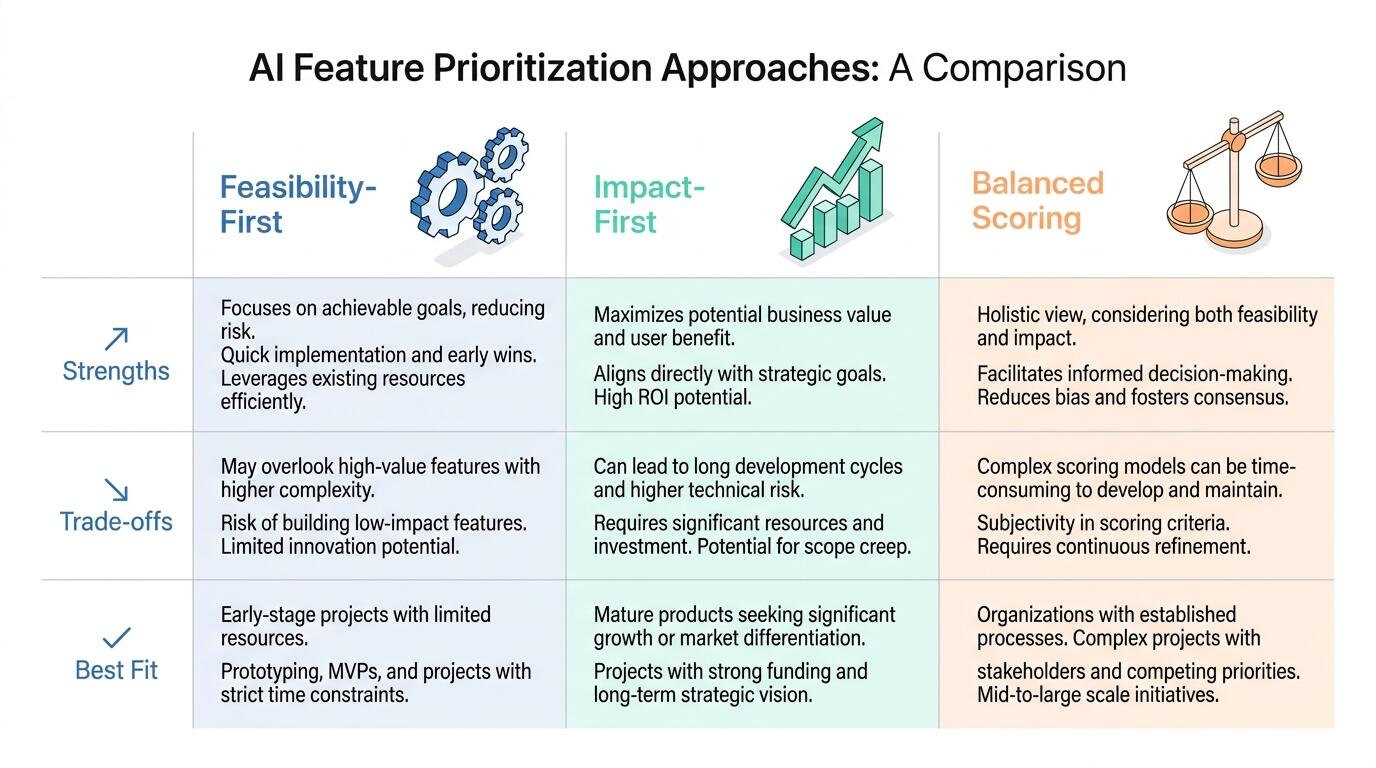
ALT: Comparison table showing feasibility-first, impact-first, and balanced AI feature prioritization approaches for engineering teams
What This Means for the Quarter Ahead
The direction of travel is clear: AI feature prioritization is moving from an informal, opinion-driven exercise toward a documented, revisitable framework that engineering leaders can defend in front of stakeholders and revisit as facts change. Teams that build this discipline now will spend less time relitigating roadmap decisions mid-quarter and more time actually shipping.
For readers building this quarter's roadmap, a few concrete actions follow directly from the analysis above. Score every candidate AI feature against feasibility, business impact, time-to-value, and governance overhead before it earns a roadmap slot — not after. Insist that "feasible" means confirmed by someone who has actually looked at the data and infrastructure, not assumed by whoever wrote the proposal. Build in checkpoints partway through the quarter to reassess features against real usage signals rather than treating the initial ranking as fixed for the full quarter.
It is also worth noting that AI adoption pressure is not evenly distributed across industries or company sizes, and roadmap prioritization frameworks should account for that context. Reports on AI adoption trends among SME leaders illustrate how smaller organizations face distinct constraints on data infrastructure and engineering bandwidth compared to larger enterprises, which should influence how aggressively a team scores feasibility for ambitious AI features.
Finally, the organizations that get the most value from this quarter's AI roadmap are the ones treating prioritization as an ongoing discipline rather than a one-time planning exercise. A framework applied once at the start of the quarter and never revisited is only marginally better than no framework at all — the real value comes from using it as a living tool throughout the quarter as new data and user feedback arrive.
Questions & Answers
Q1: How should engineering teams score feasibility for a new AI feature request?
Feasibility scoring should start with a direct technical audit of available data quality, volume, and existing model or retrieval infrastructure, not a stakeholder's assumption. A team member with hands-on technical knowledge should confirm whether the required data pipeline exists in production before the feature is added to the roadmap. This single step prevents the majority of AI features from stalling mid-quarter due to unmet infrastructure assumptions.
Q2: Is impact-first prioritization ever the wrong approach for AI roadmap planning?
Impact-first prioritization can be risky when it greenlights features the engineering team cannot yet reliably deliver, since it focuses on potential business value without weighing feasibility or data readiness. It works best for organizations under pressure to demonstrate quick ROI, but should be paired with a feasibility check to avoid committing to features that stall during build. A balanced scoring approach mitigates this risk for most quarterly roadmaps.
Q3: How often should an AI feature prioritization framework be revisited during a quarter?
An AI feature prioritization framework should be revisited at meaningful checkpoints throughout the quarter, not only at the start, because AI features often require iteration based on real usage data and evolving governance needs. Many engineering teams build in a mid-quarter review specifically to reassess rankings against actual feasibility and impact signals observed since launch planning began. This ongoing reassessment is a core part of the mechanism, not an optional add-on.
Summary
Prioritizing AI features for this quarter's engineering roadmap comes down to three consistent principles: score candidates against feasibility and data readiness before business excitement takes over, weigh business impact in concrete terms rather than novelty, and build in ongoing checkpoints because AI features require iteration long after their initial launch. Teams that treat this as a one-time planning exercise tend to relitigate the same roadmap debates every quarter, while teams that treat it as a living framework build lasting clarity across engineering and product stakeholders.
The next step is practical, not theoretical: take your current list of proposed AI features, run each one through a feasibility and impact audit before your next planning meeting, and set a mid-quarter checkpoint now rather than waiting until priorities have already drifted. Teams that have gone through this exercise once rarely go back to prioritizing by instinct alone.
Ready to see how AI-native products are built in practice? Visit Darius at the Darius website to explore hands-on AI tools like the AI Cloud Drive, AI Mock Interview Platform, and AI Creator Cockpit, and learn how to design AI as a core capability rather than an afterthought. Join Darius's journey to build smarter, production-ready AI products today.
Sources & Citations
- GetDX. "Prioritization as code: An AI-supported framework for platform engineering".
https://getdx.com/podcast/prioritzation-as-code-ai-supported-framework-for-platform-engineering/ - LinkedIn. "AI Roadmap Framework: CAFE for Product Success".
https://www.linkedin.com/posts/tript_productmanagement-ai-productstrategy-activity-7448069555689660416-2Kvs - Medium. "The AI Prioritization Framework: How to Know Where to Invest First".
https://medium.com/@contact.jitendra07/the-ai-prioritization-framework-how-to-know-where-to-invest-first-a7544220cd4b - Institute of Electrical and Electronics Engineers (IEEE).
https://www.ieee.org/ - International Organization for Standardization (ISO).
https://www.iso.org/
Note: Standards may be updated; please check the latest official documents or consult professional advisors.