Outsourced Development vs. In-House Teams: What Actually Ships Faster
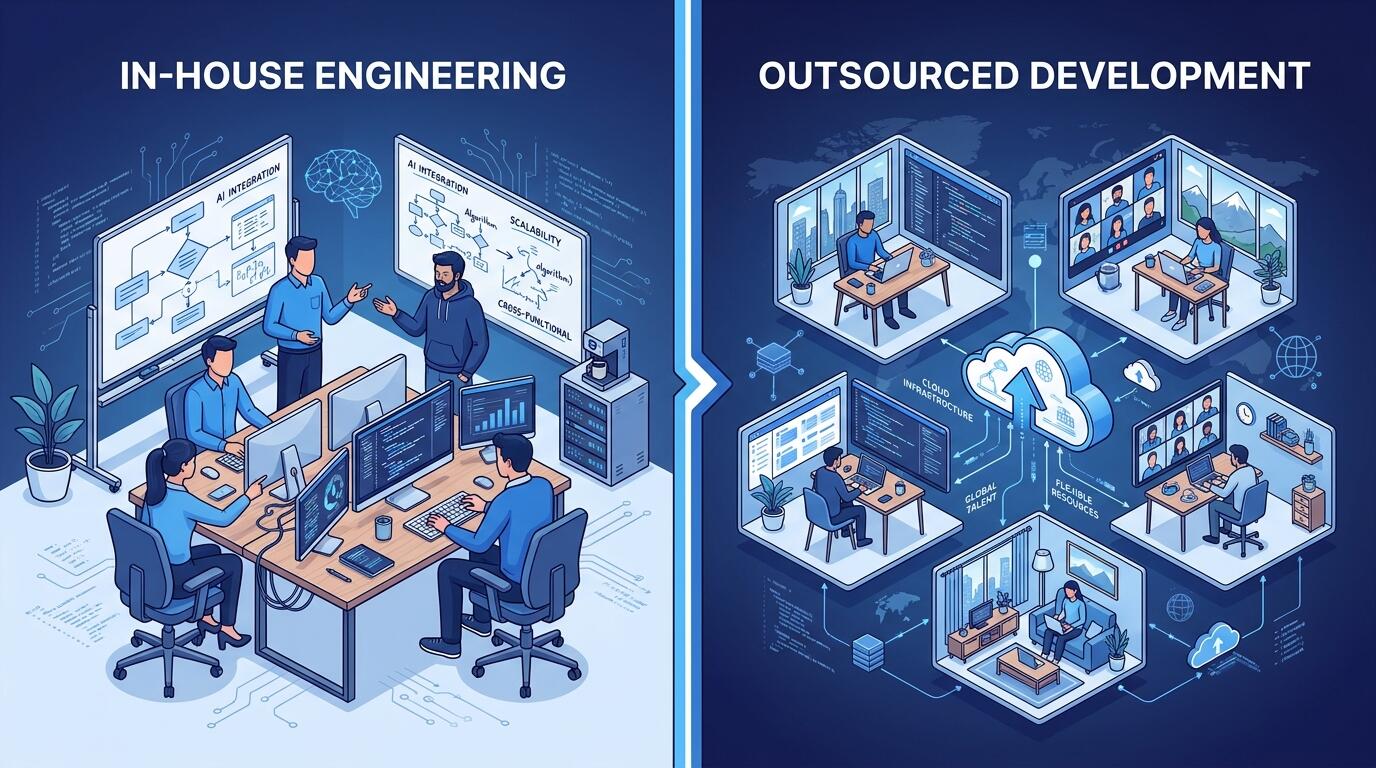
ALT: Outsourced development vs in-house teams comparison for faster software shipping and AI product delivery
Outsourced Development vs. In-House Teams: Which Model Actually Ships Faster?
Imagine you're a founder with a funded idea and a six-month runway. You've got a product concept, a target market, and mounting pressure to launch. The decision sitting in front of you — whether to hire a dedicated in-house engineering team or engage an external development partner — is one of the most consequential choices you'll make before a single line of code is written. Make the wrong call, and you spend your runway on onboarding, misalignment, and rework rather than shipping.
This comparison evaluates outsourced development and in-house team building across the dimensions that actually determine velocity: time to first deployment, knowledge continuity, cost structure, team alignment, and long-term scalability. The goal is to give technical founders, CTOs, and product leaders a clear, honest framework for choosing the model that fits their specific stage, risk profile, and product complexity — not a generic answer that sounds decisive but helps no one.
The Criteria That Actually Determine Shipping Speed
Speed is not a single metric. What shipping faster really means depends on where you measure it, and a pattern consistently observed in product engineering is that most teams conflate "starting fast" with "finishing fast." They're different animals.
The following six criteria determine which development model genuinely accelerates time to a live, production-ready product:
Time to productive output. How quickly does the team go from zero to writing useful, reviewable code? This includes hiring or contracting lag, onboarding, tooling setup, and environment configuration. Days lost here compound directly against your runway.
Alignment with product intent. Engineers who deeply understand the "why" behind features make better tradeoffs under pressure. Misaligned teams produce technically correct work that misses the product mark, requiring costly revision cycles.
Knowledge retention and continuity. Teams that accumulate context over time ship faster on iteration two than on iteration one. Models that reset institutional knowledge — through contractor churn or high turnover — pay a re-onboarding tax on every cycle.
Cost efficiency relative to output. Cheaper by the hour is not cheaper if the hourly rate buys confusion. Total cost of delivery — inclusive of management overhead, revision cycles, and coordination friction — is the relevant figure.
Scalability of the model itself. Can you scale the team up or down as product needs shift? Rigidity in either direction creates bottlenecks that slow shipping.
Quality and production-readiness. A feature that ships but immediately breaks in production hasn't really shipped. Code quality, test coverage, and deployment reliability all factor into whether something is truly live.
These six dimensions form the basis of the head-to-head evaluation below.
The Contenders
In-House Engineering Teams: Control at a Price
An in-house engineering team is a group of full-time employees hired directly by the company, integrated into its culture, reporting structure, and day-to-day operations. For many scaling organizations, in-house teams represent the gold standard: engineers who live and breathe the product, attend standups, debate roadmap decisions, and accumulate deep institutional knowledge over months and years.
The headline characteristic of an in-house team is alignment. When engineers sit inside the organization — whether physically or embedded in daily culture remotely — they develop an intuition for what the product needs that external teams rarely replicate. This alignment pays dividends in speed on the second, third, and fourth product iterations, even if the first one is slower.
The cost and time profile, however, is significant. Recruiting senior engineers in competitive markets takes time — often measured in months, not weeks. Onboarding an engineer to the point where they produce high-quality, context-aware code takes additional time. Benefits, equity, tooling, and management overhead add to the total cost. For an early-stage company with a short runway or a company testing a new product vertical, the in-house model carries real risk of burning capital before anything ships.
Outsourced Development: Speed with Tradeoffs
Outsourced development is a model in which product or feature work is delegated to an external team — typically a software agency, a specialist consultancy, or a freelance contractor network — rather than built by employees. According to analysis by Classic Informatics on when to outsource vs. build in-house, outsourcing tends to deliver faster initial velocity, particularly for well-scoped, technically defined projects.
The outsourced model's primary advantage is time to productive output. A capable external team can be engaged, briefed, and writing production code within days rather than months. For founders who need to validate a hypothesis quickly or deliver a working prototype to investors, this speed advantage is real and material.
The tradeoffs are equally real. External teams work from specifications, not intuition. When requirements are ambiguous — as they almost always are in early product development — the specification gap produces rework. Communication latency across time zones, handoff friction, and the lack of shared organizational context can erode velocity gains surprisingly fast. Knowledge continuity is the most chronic problem: contractors who depart take hard-won context with them, and replacement ramp-up is expensive.
Hybrid and Embedded Models: The Third Path
A hybrid model is an approach where a product organization uses a combination of in-house technical leadership — typically an Engineering Director, CTO, or Lead Architect — paired with external execution capacity. The internal leader owns architecture decisions, product alignment, and quality standards; the external team executes against clearly defined, well-scoped work.
In practice observed from working with product teams at various stages, the hybrid model often outperforms both pure alternatives on overall delivery speed. It captures the alignment advantage of in-house leadership while preserving the staffing flexibility and time-to-start advantage of external teams. The key dependency is the quality of the technical leadership layer: weak internal direction amplifies rather than corrects the inherent risks of outsourcing.
Head-to-Head Comparison: Shipping Speed Across All Criteria
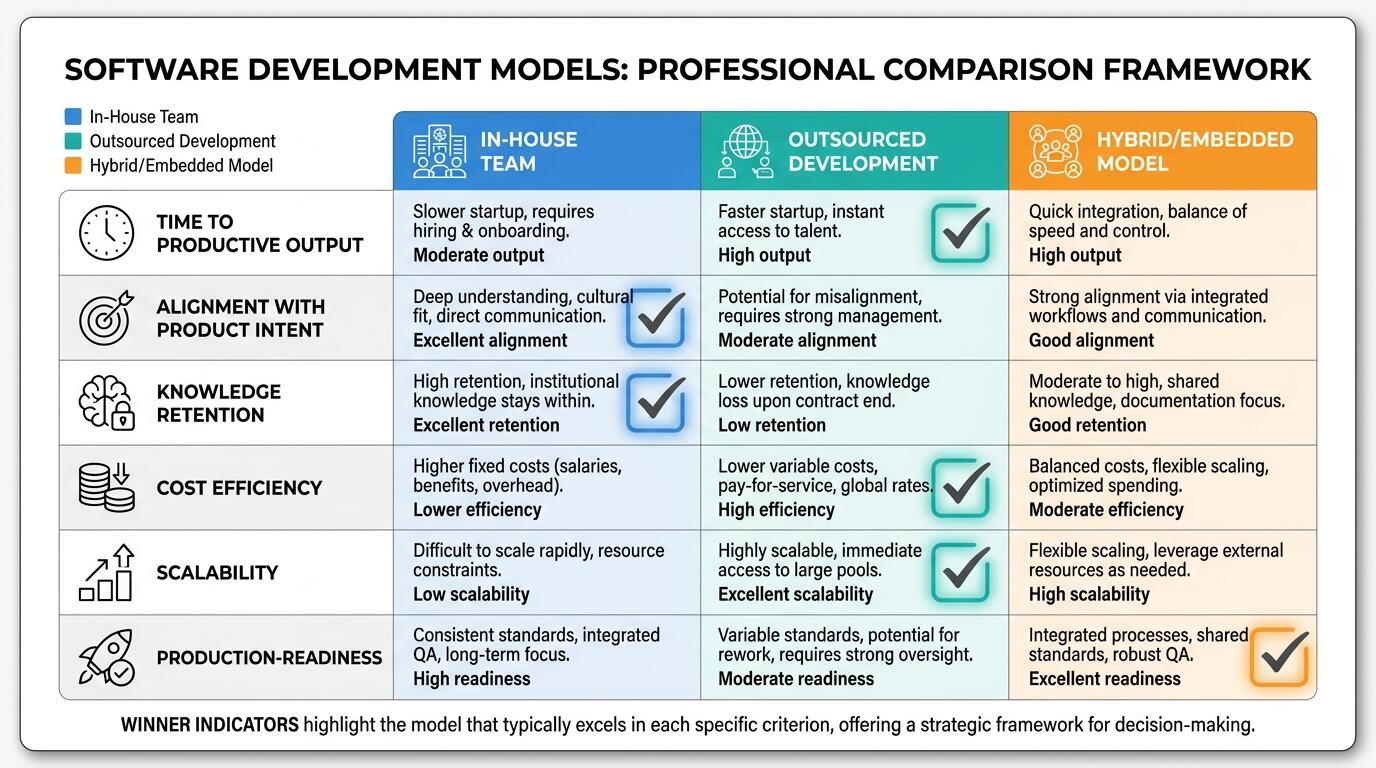
| Criterion | In-House Team | Outsourced Development | Hybrid / Embedded Model |
|---|---|---|---|
| Time to productive output | Slow (weeks to months for hiring and onboarding) | Fast (days to weeks if vendor is pre-qualified) | Fast to medium (depends on internal lead availability) |
| Alignment with product intent | High (deep organizational context) | Low to medium (specification-dependent) | High (internal lead carries context) |
| Knowledge retention | High (accumulates over time) | Low (resets with contractor churn) | Medium to high (retained by internal lead) |
| Cost efficiency relative to output | High long-term, expensive short-term | Lower upfront, variable based on rework | Balanced; overhead is managed by lead |
| Scalability | Rigid (slow to scale up or down) | Flexible (can surge or contract quickly) | Flexible within lead's management capacity |
| Production-readiness and quality | High when team is experienced | Variable (depends heavily on vendor selection) | High when lead enforces standards |
The table reveals a consistent pattern: no single model dominates across all six criteria. In-house teams win decisively on alignment and long-term knowledge retention, but lose on initial velocity and short-term cost efficiency. Outsourced teams invert that profile — they start fast but struggle to maintain quality and continuity without strong internal oversight.
The hybrid model consistently occupies the middle row: it doesn't lose badly on any criterion, and it wins on the dimensions most critical to early-stage and growth-stage shipping — alignment, quality, and flexibility — when paired with experienced technical leadership. According to research by Boldare on in-house vs. outsourcing efficiency, the efficiency gap between models narrows significantly when organizations invest in clear architectural direction and communication infrastructure regardless of which model they choose.
The practical implication is this: the variable that matters most to actual shipping speed is not which model you choose in the abstract — it is whether the people making architecture and product decisions have enough context and authority to make them quickly and correctly. A well-led outsourced team ships faster than a poorly led in-house team, every time. Similarly, if you're in the early stages of validating your product idea with real customers before building, the model you choose for execution should match the fidelity of feedback you actually need — outsourcing works well for prototypes, in-house scales better for iterative post-validation development.
ALT: Comparison framework chart showing in-house team vs outsourced development vs hybrid model for shipping AI and full-stack products faster
Which Should You Choose? Scenario Recommendations
The right development model is not universal — it is a function of your current stage, your technical leadership capacity, and the complexity of what you're building. Here is how to map your situation to the best option.
If you are pre-product and need to validate a hypothesis fast, outsourcing is almost always the right first move. You do not yet need the institutional knowledge that in-house teams accumulate — you need working software in front of users, fast. Engage a reputable external team for a time-boxed, well-scoped first build. Set clear success criteria before you start, and resist scope creep.
If you are post-validation and iterating rapidly on a live product, in-house becomes increasingly attractive. The product now has enough defined behavior that institutional knowledge pays compounding returns. The cost of alignment failures — which increase with outsourced teams as product complexity grows — starts to outweigh the cost of slower hiring.
If you have a clear product vision but limited internal technical leadership, the hybrid model is typically the fastest path to a production-ready system. Engaging an experienced Engineering Director or AI Architect to own architecture and oversee external execution bridges the alignment gap without requiring you to build a full in-house team before you're ready. This is particularly relevant for AI-powered products, where architecture decisions made early — around data pipelines, model integration, inference infrastructure — are difficult and expensive to reverse. For teams building at this intersection, understanding how to build machine learning pipelines that scale past prototype stage before you hand off execution to any team is essential groundwork.
If you are scaling a product with established product-market fit, invest in building the in-house team. At this stage, velocity is less about starting fast and more about consistent, high-quality iteration. External teams become a tool for supplementing specific capability gaps — not for driving core product development.
Pros and cons summary:
In-house teams offer strong long-term alignment, knowledge continuity, and quality consistency — but they are slow and expensive to stand up, and carry significant sunk cost risk if the product direction changes.
Outsourced development offers immediate velocity and cost flexibility — but produces knowledge fragility, requires strong specification quality, and generates rework risk in ambiguous product contexts.
Hybrid models offer the most balanced risk profile for most early and growth-stage teams — but their effectiveness depends critically on the quality of the internal technical leadership layer.
Frequently Asked Questions FAQ
Q1: How do I know if my project is too complex for outsourcing?
Outsourcing handles well-scoped, technically defined work efficiently. A project becomes too complex for a pure outsourced model when requirements are highly ambiguous, when architecture decisions require deep product context to make correctly, or when the system integrates multiple AI/ML components where tradeoffs are non-obvious. According to analysis by instinctools on in-house vs. outsourcing software development, the clearer and more complete the specification, the more reliably an external team can execute without expensive revision cycles. When specifications require constant interpretation, in-house or hybrid leadership becomes essential.
Q2: Is the hybrid model practical for a startup with limited budget?
The hybrid model is practical for budget-constrained startups when framed correctly. The internal technical leadership role — an Engineering Director or Architect — does not need to be a full-time hire at early stage; it can be engaged as a fractional or consulting arrangement. This approach captures the alignment and quality benefits of senior internal oversight while keeping total headcount cost manageable. The hybrid model's cost efficiency comes from reducing the rework and misalignment costs that unmanaged outsourcing typically generates.
Q3: How much faster does outsourcing actually start compared to hiring in-house?
Engaging a pre-qualified outsourced team typically compresses initial start time from the weeks or months required for engineering hiring and onboarding down to days or a few weeks. However, this lead time advantage is highly dependent on vendor selection quality and specification clarity. Early velocity gains from outsourcing can be partially or fully offset by rework cycles, particularly in the first one or two sprint cycles when alignment is being established. The net shipping speed advantage of outsourcing is greatest for clearly defined, bounded first builds — not for open-ended, iterative product development.
Wrapping Up
The question of outsourced development vs. in-house teams is ultimately not answered by a universal preference — it is answered by an honest read of your current situation.
Three points deserve emphasis as you make this decision. First, shipping speed is a function of alignment quality, not headcount model. A well-directed team in any configuration outperforms a poorly directed one. Second, the hybrid model — internal technical leadership paired with external execution — is consistently underutilized by early-stage teams and consistently effective when implemented with experienced leadership. Third, the cost of making the wrong model choice is not just financial; it is the time and credibility cost of not shipping, or shipping the wrong thing.
The practical next step is to map your current situation against the scenario framework above. Identify whether your bottleneck is initial velocity, product alignment, or long-term knowledge continuity — and choose the model that addresses the bottleneck you actually have, not the one that sounds most credible to stakeholders.
If your product involves AI architecture, complex systems design, or a full-stack build where the gap between strategy and execution has been the persistent obstacle, the model that bridges that gap is worth examining carefully before you default to either extreme.
Explore the work, projects, and engineering expertise at the Darius website — and see how end-to-end product thinking, from AI architecture to live deployment, can accelerate your next build. Whether you're an early-stage founder or a scaling team ready to ship, reach out and start the conversation.
References
- Classic Informatics. "In-House vs Outsourcing Software Development".
https://www.classicinformatics.com/blog/when-to-outsource-software-development-vs-in-house - Boldare. "In-house vs. Outsourcing: Comparing Efficiency for 2025".
https://www.boldare.com/blog/in-house-vs-outsourcing-efficiency-2025/ - instinctools. "In-House vs Outsourcing Software Development".
https://www.instinctools.com/blog/in-house-vs-outsourcing-software-development/ - IEEE (Institute of Electrical and Electronics Engineers). Software Engineering Standards and Publications.
https://www.ieee.org/