Open Weights vs. API: How to Decide for a Production Feature
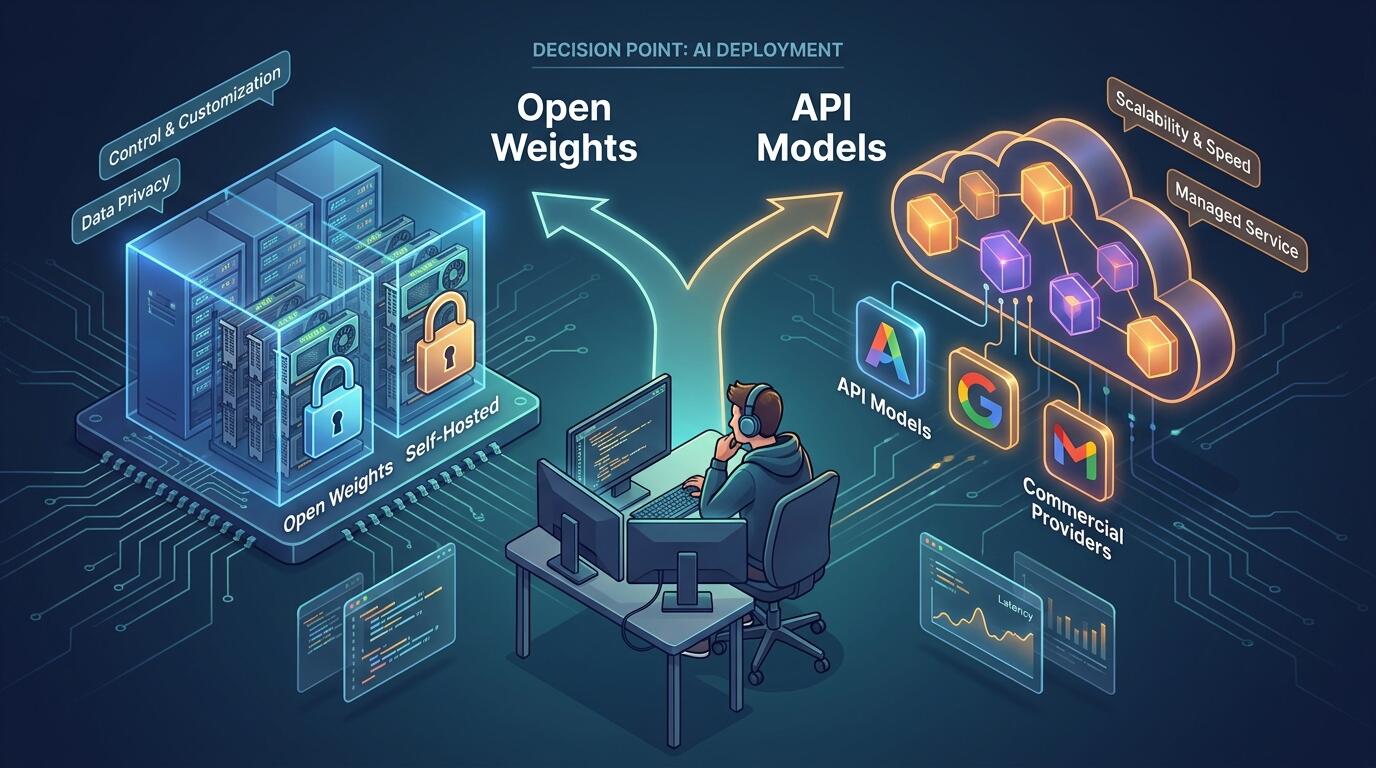
ALT: Engineer choosing between open weights and API models for a production AI feature deployment
How to Choose Between Open Weights and API Models for a Production AI Feature
The question I hear most often from engineers and product leads who are building AI-powered features is not "which model is best?" — it is "should we self-host an open-weights model or call a commercial API?" The answer shapes infrastructure costs, latency budgets, data privacy posture, and your team's operational load for months or years ahead. This guide walks through that decision systematically, from first principles to production-ready checklist, for engineers and technical leads who need a defensible answer before sprint planning, not after the first incident.
Before You Start: Prerequisites and Preparation
Making this call well requires more than a quick benchmark comparison. Before you sit down with your team to debate Llama versus GPT-4o, you need clear visibility into a handful of upstream inputs — otherwise you are optimizing for the wrong variable.
First, you need a defined feature scope. "We want to use AI" is not a feature. You need to know what input the model receives, what output the product consumes, what latency the user-facing surface tolerates, and roughly how many requests per day you expect at steady state and at peak.
Second, you need your data classification policy in writing. If your legal or security team has not ruled on whether user data can leave your infrastructure boundary, this decision is not yours to make alone. Find out now, not after you have integrated an external API.
Third, you need a realistic picture of your infrastructure team's capacity. Running an open-weights model in production is an MLOps problem, not just a model problem. If your team has never operated a GPU inference cluster, the ramp-up cost is real and should be priced into the comparison.
Fourth, you need at least a rough cost model — not a precise forecast, but a directional sense of request volume, acceptable cost per call, and whether your organization has existing cloud credits or reserved capacity.
Checklist before starting:
- Feature input/output spec is written down and agreed upon by at least one PM and one engineer
- Data residency and privacy requirements have been confirmed with legal or security
- Infrastructure team capacity for GPU operations has been assessed honestly
- Rough request volume estimate (current and projected) is available
- Budget ceiling or cost-per-query target exists, even informally
- Latency requirement is defined (e.g., acceptable p95 response time for the user surface)
The Decision Framework: Step by Step
This framework is the one I apply when evaluating a new AI feature for the products I operate. It is not a flowchart you execute once — it is a series of filters, each of which can terminate the decision early if the answer is unambiguous.
Step 1: Apply the Data Sovereignty Filter First
Before evaluating any model capability or cost, ask whether your data can legally and contractually leave your infrastructure. Open-weights models — that is, models whose weights are publicly released and can be run on your own hardware — give you complete data residency by default, because inference happens inside your own environment. Commercial API providers, by contrast, process your prompts on their infrastructure, which introduces questions around data retention, jurisdiction, and sub-processor agreements.
If your feature handles health records, financial data, or any category your legal team classifies as sensitive, the API path may be blocked regardless of how convenient it is. I have seen teams spend weeks evaluating API providers only to discover that their enterprise agreement prohibited sending that data class to a third party. Run this filter first and save yourself the wasted cycles.
Tip: Get the data classification answer in writing before the next step. "We think it should be fine" is not a clearance.
Step 2: Assess Your Latency and Throughput Requirements
Once data sovereignty is resolved, the second filter is latency. Open-weights inference is only fast if you have appropriately sized hardware. A 70-billion-parameter model running on a single underpowered GPU will produce worse latency than a well-optimized API endpoint with global edge routing.
Characterize your latency budget precisely. For a synchronous user-facing feature — a chat assistant, an autocomplete field, an inline rewrite tool — users typically notice degradation beyond a few hundred milliseconds for the first token. For an asynchronous background feature — document summarization triggered by a webhook, a batch classification job — throughput matters more than per-request latency, and you have more flexibility.
Commercial APIs are generally easier to achieve predictable low latency on at low-to-moderate traffic volumes, because the provider has already invested in inference optimization. At high volumes, self-hosted open-weights models can achieve lower per-token latency with the right hardware configuration, but reaching that point requires investment in quantization, batching strategy, and hardware tuning.
Tip: Benchmark both paths against your actual prompt distribution, not a toy example. A prompt that is three tokens long behaves very differently in a batching system than a prompt that is two thousand tokens.
Step 3: Build a Total Cost of Ownership Model
Cost comparison between open weights and API is frequently misframed. Engineers often compare only the per-token API price against the model download cost (zero), which makes open weights look free. It is not.
The total cost of running an open-weights model in production includes: GPU instance costs (including idle time during low-traffic periods), engineering time to set up and maintain the inference stack, monitoring and alerting infrastructure, model update cycles when a new version is released, and the opportunity cost of the engineering capacity that is now committed to MLOps rather than product work.
API costs, by contrast, are per-call and scale linearly with usage, which makes them predictable and easy to audit. At low-to-moderate volumes, API pricing is often cheaper in total-cost-of-ownership terms once you account for the engineering overhead of self-hosting. The crossover point — where self-hosting becomes cheaper — depends heavily on your traffic volume and team efficiency. In my experience operating multiple AI products, that crossover arrives later than most engineers initially expect.
For a rigorous treatment of this build-versus-buy tradeoff in the broader AI infrastructure context, the analysis in Build vs. Buy for AI Infrastructure: Revisiting the Framework for Late 2026 is directly applicable and worth reading alongside this guide.
Tip: Model the cost at three traffic scenarios: current baseline, 5x growth, and 20x growth. The right answer often differs across these scenarios.
Step 4: Evaluate Customization and Control Requirements
Some features genuinely require a level of model customization that commercial APIs cannot provide. If your use case requires fine-tuning on proprietary domain data, injecting custom vocabulary into the tokenizer, modifying inference behavior at the architecture level, or shipping model weights as part of an on-device application, open weights are the only viable path.
Commercial APIs increasingly offer fine-tuning endpoints, and a pattern I consistently see is that teams reach for fine-tuning before they have exhausted prompt engineering and retrieval-augmented generation — both of which work inside an API boundary without requiring self-hosting. Before deciding that customization forces you to open weights, confirm that the customization you need is architectural (requiring weight access) rather than behavioral (achievable through prompting or retrieval).
Tip: Write down the specific customization requirement and ask whether it needs weight access or just output control. Many "we need to fine-tune" requirements dissolve when restated precisely.
Step 5: Evaluate Operational Maturity Requirements
Operating an open-weights model in production is an ongoing commitment. You need to handle model updates, monitor for quality degradation over time, manage hardware failures, and maintain the inference stack as dependencies evolve. This is meaningful operational overhead that your team absorbs permanently — it does not go away after launch.
Commercial APIs offload most of this to the provider. You still need to monitor output quality and handle API version deprecations, but the infrastructure layer is managed. For teams that are already stretched across product work, the operational simplicity of the API path has real compounding value.
I have written about how infrastructure choices affect the ability to ship fast without sacrificing product quality — the friction of maintaining a self-hosted inference stack is exactly the kind of hidden drag that slows release cadence months after the initial deployment.
Tip: Ask your team how many production incidents they are already managing. Adding GPU infrastructure management to an already loaded on-call rotation is a decision, not a default.
Step 6: Evaluate Vendor Risk and Model Availability
Commercial APIs introduce vendor dependency. If the provider changes pricing, deprecates a model version, or experiences an outage, your feature is directly affected. This risk is real and has materialized for teams that built tightly around a specific API model only to find it deprecated on short notice.
Open-weights models shift this risk profile. The model weights you downloaded will continue to run on your infrastructure regardless of what the original developer does commercially. This makes the open-weights path more resilient to vendor discontinuity, though it introduces its own risks: the community around a particular open model can fragment, fine-tuned variants can diverge, and you bear the full cost of migrating when a better architecture is released.
Tip: For any API-dependent feature, maintain a lightweight abstraction layer that lets you swap the underlying model without rewriting the feature. This applies equally to managing open-weights model version upgrades.
Step 7: Make the Decision and Document the Reasoning
After running through the filters above, you should have a defensible answer. Document it. Write down which filters you applied, what the answer was at each filter, and what assumptions the decision depends on. This documentation is valuable for two reasons: it helps reviewers evaluate your decision, and it gives you a clear trigger for revisiting when circumstances change (traffic grows, a new open model is released, your team hires MLOps engineers).
The decision is rarely permanent. A feature that correctly starts on a commercial API at low traffic volume may migrate to open-weights self-hosting when volume justifies the infrastructure investment. Plan for that migration path from the beginning, even if you do not execute it yet.
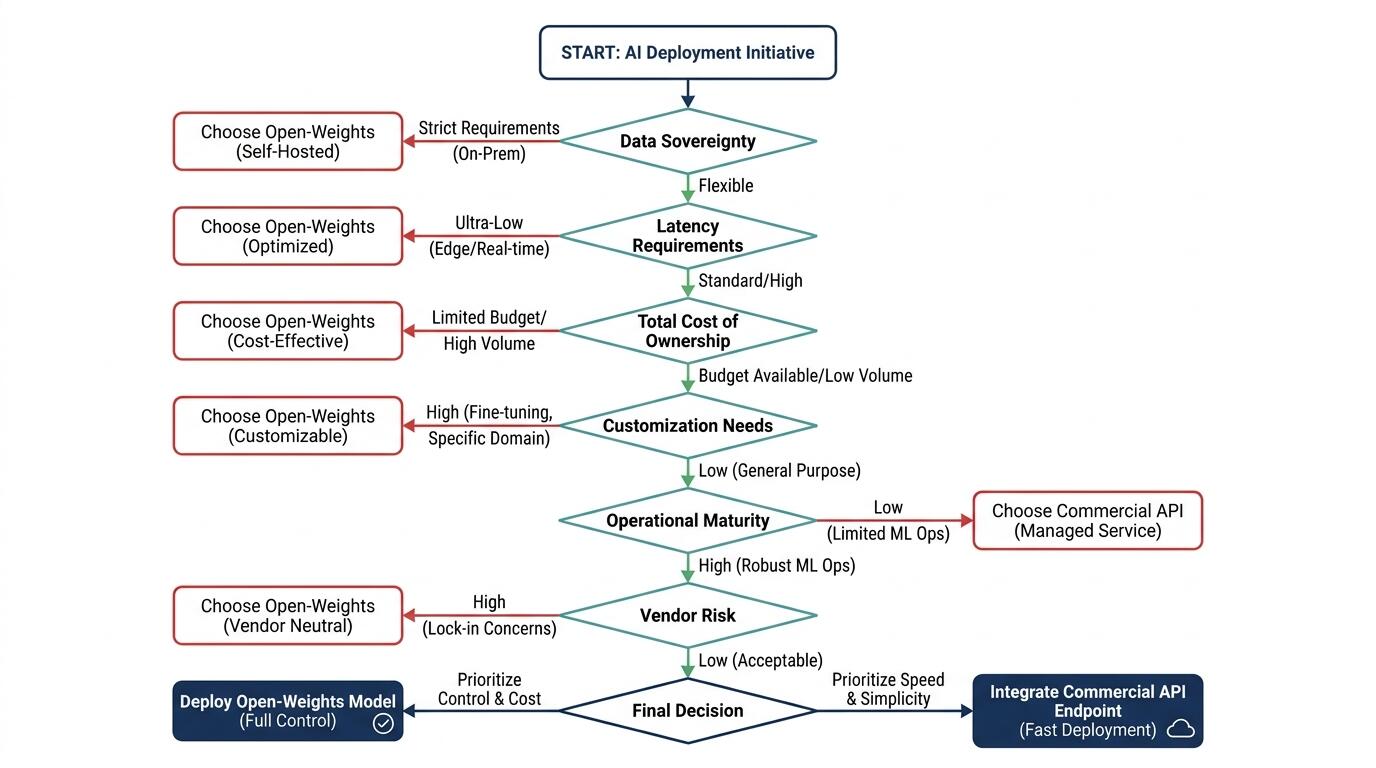
ALT: Flowchart showing decision steps for choosing between open weights and API for production AI feature deployment
Common Mistakes and Troubleshooting
| Symptom | Likely Cause | How to Fix |
|---|---|---|
| Open-weights inference latency is much worse than expected in production | Model is undersized for the hardware, or batching configuration is not tuned for the traffic pattern | Profile actual GPU utilization and prompt length distribution; adjust batching parameters or upgrade hardware |
| API costs are much higher than the initial estimate | Request volume grew faster than projected, or average prompt length is larger than the benchmark used for estimation | Implement prompt caching where the API supports it; audit prompt construction to eliminate redundant context tokens |
| Fine-tuning via the API did not produce the behavioral change needed | The required customization is architectural, not behavioral — fine-tuning on the output layer cannot change the model's knowledge representation fundamentally | Evaluate whether an open-weights model with full fine-tuning access is required, or whether retrieval-augmented generation can provide the domain knowledge instead |
| Team is unable to maintain the self-hosted inference stack alongside product work | Operational overhead of GPU infrastructure was underestimated at the outset | Consider a managed inference platform that abstracts the hardware layer while still running open-weights models; evaluate whether migration to an API is warranted |
| Data privacy review blocked the API integration after engineering was completed | Data classification was not done before the technical decision was made | Establish a mandatory data review gate before any model evaluation begins; this is a process fix, not a technical one |
Pro Tips for Better Results
Abstract the model behind an interface from day one. Whether you are calling an API or running local inference, write your feature code against a thin adapter interface that can be swapped. This protects you from vendor lock-in on the API side and from model version churn on the open-weights side. The cost of this abstraction at implementation time is low; the cost of retrofitting it later is high.
Treat quantized open-weights models as a serious option. A quantized version of a strong open-weights model — one where the weight precision has been reduced to lower memory and compute requirements — can achieve quality that rivals much larger models in many production tasks. Teams that dismiss open weights because of hardware cost are often benchmarking against full-precision versions of very large models, rather than quantized variants optimized for inference efficiency.
Monitor API model version deprecations proactively. Commercial API providers routinely sunset model versions, sometimes on timelines shorter than a feature's development cycle. Subscribe to provider changelogs, set calendar reminders at the midpoint of stated deprecation windows, and keep your model version pinnable in configuration rather than hardcoded.
Do not conflate "open source" with "open weights." Open source means the training code and data are public. Open weights means only the model weights are released. Most widely used "open" models — including several prominent large language models — are open-weights but not fully open source. This distinction matters when evaluating license terms for commercial use, modification rights, and redistribution. Read the specific model license, not just the general "open" framing.
A common misconception: Many engineers assume that switching from an API to self-hosted open weights is a straightforward cost-saving move at scale. In practice, the operational complexity introduced by self-hosting — monitoring, hardware management, model update cycles — consumes a significant portion of the predicted cost savings. The math works, but usually later and more narrowly than the initial estimate suggests.
Questions & Answers
Q1: How do I evaluate whether an open-weights model is good enough to replace an API model for my specific use case?
Benchmarking on public leaderboards is a starting point, but it is not sufficient. You need to evaluate on your actual prompt distribution and judge output quality against your feature's acceptance criteria. Build a small evaluation dataset of representative inputs and use it to compare both options on the metrics that matter for your feature — accuracy, format adherence, refusal rate, latency. Quality on your task is what matters, not general benchmark rankings. This applies equally when deciding between different commercial API providers.
Q2: Are open-weights models safe to use for commercial production features?
Open-weights models are commercially viable, but you must review the specific license for each model. Some are released under permissive licenses with no commercial restrictions. Others carry conditions on commercial use, redistribution, or use in certain application categories. The model card and accompanying license file are the authoritative sources — do not rely on informal summaries. Additionally, responsibility for content safety and output monitoring shifts entirely to you when you self-host, whereas API providers typically apply their own safety layers.
Q3: How long does it typically take to go from evaluating an open-weights model to running it in production?
The timeline depends heavily on your team's existing infrastructure capability and the complexity of your inference requirements. For a team with some MLOps experience deploying to an existing cloud environment, a straightforward inference setup can reach a production-ready state in a matter of weeks. For teams without prior GPU infrastructure experience, the same scope can take considerably longer once you account for hardware provisioning, serving stack configuration, monitoring, and load testing. Factor in the evaluation phase, which itself requires meaningful time to build representative test sets and interpret results rigorously.
Wrapping Up
Choosing between open-weights models and commercial API endpoints is a systems decision, not a model quality decision. The right answer is determined by data policy, latency requirements, total cost of ownership, customization needs, operational capacity, and vendor risk tolerance — in roughly that order of urgency.
Key Takeaways:
- Run the data sovereignty filter first. If your data cannot cross your infrastructure boundary, the API path may not be available regardless of other factors.
- Total cost of ownership for open weights includes significant ongoing engineering cost that is easy to underestimate upfront.
- Customization requirements that seem to demand open weights often resolve to prompt engineering or retrieval, which work inside an API boundary.
- Operational maturity is a real constraint. Self-hosting is a permanent commitment, not a one-time deployment task.
- Abstract the model behind an interface from the start. The decision you make today may change as traffic grows and the model landscape evolves.
Your immediate next step: take the checklist from the Prerequisites section, fill it in for your current feature, and run through the seven-step filter. Most decisions become clear by step three or four — the remaining steps are for the genuinely ambiguous cases.
If you are building AI products and want a sharper signal filter for decisions exactly like this one, the Darius bilingual AI briefing delivers five to ten curated items per issue — each with primary sources and first-hand production context, not editorial summaries. Subscribe at the Darius website and stay calibrated on what is actually changing in the AI infrastructure landscape.
References & Further Reading
- Data Studios. "How to choose the right OpenAI model and API in 2025".
https://www.datastudios.org/post/how-to-choose-the-right-openai-model-and-api-in-2025-features-pricing-endpoints-and-use-cases - Business Standard. "Proprietary vs open-weight AI".
https://www.business-standard.com/technology/artificial-intelligence/proprietary-vs-open-weight-ai-differences-cost-control-business-model-explained-126070300635_1.html - Lumeor Studio. "Open-source LLMs vs API models: honest comparison (2026)".
https://www.lumeor.studio/compare/open-source-llm-vs-api-models/ - IEEE. IEEE Standards and Technical Resources on Artificial Intelligence and Machine Learning.
https://www.ieee.org/
Note: Standards and model licenses may be updated; please check the latest official documents and provider release notes before making production decisions.