Model Strategy 101: Choosing Between Open Weights and API This Quarter
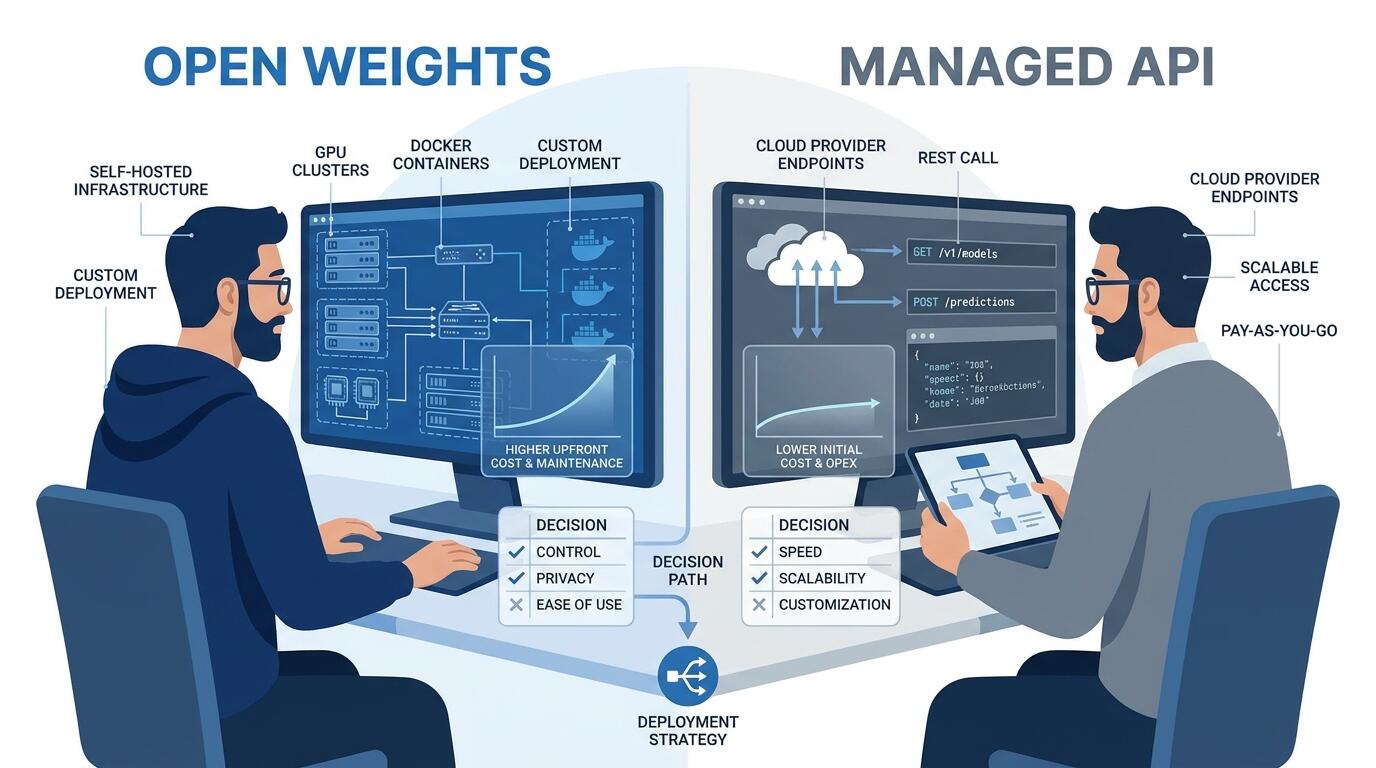
ALT: Engineer comparing open weights versus API model strategy options for AI product development this quarter
The Real Model Strategy Question Every Builder Is Facing Right Now
The question most engineering teams are actually asking this quarter is not "which model is best" but "which deployment model fits our constraints." The honest answer: open weights and API access are not competing philosophies — they are tools with different cost profiles, risk surfaces, and operational overhead, and the right choice depends on where your product sits in its lifecycle.
In our work building and operating AI products, we consistently see teams default to whichever option feels familiar rather than running the decision through a structured framework. That default is expensive in both directions — teams that reach for managed APIs too early leave significant margin on the table at scale, while teams that self-host prematurely burn engineering capacity on infrastructure that has nothing to do with their core product. This article lays out a practical decision framework for right now, when the model landscape is shifting fast and the cost-to-capability curve looks different than it did even a few quarters ago.
When This Decision Actually Matters for Your Team
Applicable Scenarios:
- You are past proof-of-concept and moving into a production workload that runs more than a few hundred requests per day
- Your use case involves sensitive data where routing through a third-party API creates compliance, contractual, or reputational risk
- Your inference cost line item has become visible on a monthly budget review, or you anticipate it will within the next two quarters
- You need deterministic behavior — repeatable outputs on fixed inputs — that a continuously updated API endpoint cannot guarantee
- You are a small team with ML engineering depth but limited DevOps bandwidth and need to decide where to spend that capacity
Not Applicable / Cautions:
- You are still in the experimental phase where iteration speed dominates every other concern — at that stage, API access is almost always right
- Your monthly inference volume is low enough that even unoptimized API pricing is cheaper than the engineering hours required to self-host and maintain
- Your team has no experience operating GPU infrastructure and has no near-term plan to build that capability — the hidden costs of self-hosting are routinely underestimated
- You are building on a frontier capability that no open-weights model currently matches, and the capability gap is the central value driver for your product
Why This Decision Is More Consequential Than It Was a Year Ago
Open-weights models are foundation models whose weights are released publicly, allowing teams to download, fine-tune, and deploy them on their own infrastructure without per-token API charges. Managed API access means consuming a hosted model through an HTTP endpoint, paying per token or per request, with no control over the underlying weights or serving infrastructure.
The decision between these two paths used to be simpler because the capability gap between open-weights and frontier closed models was wide enough that most production use cases pointed clearly toward APIs. That gap has narrowed substantially. Models like Meta's Llama series, Mistral's releases, and a growing set of specialized open models now match or exceed the performance of closed models from two or three generations ago on a broad range of tasks. Meanwhile, managed API pricing has become more competitive as providers have scaled, but inference costs at high volume still compress product margins in ways that teams often do not model carefully at the outset.
The current environment also introduces a strategic dimension that did not exist at the same intensity before: model lock-in. Building a product that depends on a single provider's API endpoint means your latency, pricing, uptime, and model behavior can change on that provider's timeline. The Build vs. Buy for AI Infrastructure framework lays out how to think about this dependency at a structural level, and the core logic applies directly here — the question is not just cost today but optionality over the next several quarters.
A pattern we consistently see across teams: the cost modeling done at the point of initial architecture almost always underestimates inference volume growth by a significant factor. Teams that start with APIs and never revisit the decision end up spending two to three times what self-hosting at modest scale would have cost. Conversely, teams that commit to self-hosting before they have a stable workload definition often spend that same money on infrastructure that serves a product shape that no longer exists three months later.
A Three-Step Framework for Making the Call This Quarter
Step 1: Run a Realistic Cost Projection at Two Volume Scenarios
Do not model current volume. Model current volume times five and current volume times twenty. Pull your last thirty days of inference logs, extract token counts per request type, and price them out against both your current API provider's rate card and the realistic infrastructure cost of running a comparable open-weights model on dedicated GPU instances. Include engineering time for setup, monitoring, and maintenance at a real hourly rate — not a hypothetical. This exercise alone eliminates roughly half the decisions teams think they need frameworks for. Budget two to four hours for this step; it will surface the crossover point where self-hosting becomes economical.
Step 2: Score Your Data and Compliance Constraints
List every category of data that will flow through model inference in your product. For each category, identify whether your data processing agreements, customer contracts, or applicable regulations — such as those maintained by regulators like the European Data Protection Board or sector-specific requirements under frameworks like HIPAA — permit routing that data through a third-party API. If you find categories where the answer is "unclear" or "no," that constraint may resolve the decision entirely in favor of self-hosting regardless of cost. Allocate one to two hours for this step; involve legal or compliance stakeholders if any category is ambiguous.
Step 3: Assess Your Team's Operational Surface
Self-hosting is not a one-time setup cost — it is an ongoing operational commitment that includes model versioning, serving infrastructure reliability, security patching, GPU capacity management, and monitoring. Audit your team's current operational load. If your on-call rotation is already stretched, adding a self-hosted inference cluster will degrade both. Rate your team's ML infrastructure depth honestly: zero to one engineers with hands-on LLM serving experience is not the same as a team that has run vLLM or TGI in production. Factor the operational cost of self-hosting into the same budget model you built in Step 1. This should take no more than an hour, but it must be honest.
Open Weights vs. Managed API: A Direct Comparison Across the Dimensions That Matter
The comparison below uses the dimensions that consistently drive decisions in production contexts. It is deliberately qualitative on cost because actual figures depend on volume, provider, instance type, and workload characteristics that vary too much for a generic number to be useful.
| Comparison Dimension | Open Weights (Self-hosted) | Managed API | Managed API with Dedicated Deployment |
|---|---|---|---|
| Marginal cost at scale | Low (infrastructure-bound, not token-bound) | High (grows linearly with token volume) | Medium (flat infrastructure + some token cost) |
| Time to first request | Days to weeks (setup, optimization) | Minutes to hours | Days (provisioning required) |
| Data privacy control | Full — data never leaves your infrastructure | Dependent on provider's DPA and subprocessors | Stronger than shared API, but data still leaves your environment |
| Model version stability | Complete — you pin the version | Dependent on provider's update policy | Generally stable per deployment contract |
| Capability ceiling | Limited to released open models | Access to frontier closed models | Access to frontier models with more predictable serving |
| Engineering overhead | High (ongoing ops, scaling, monitoring) | Near-zero (abstracted away) | Low to medium (less than self-hosting) |
| Fine-tuning control | Full — weights are yours to modify | Dependent on provider's fine-tuning API | Partial — typically limited to adapter-style tuning |
| Vendor lock-in risk | Low — portable across infrastructure | High — tied to API contract and endpoint behavior | Medium — still dependent on one provider |
Working Through the Real Trade-offs
Cost Efficiency Is Not Just About Token Price
The most common mistake in model strategy decisions is treating API pricing as the only cost variable. The real cost model has four components: inference compute (either API fees or infrastructure spend), engineering time (setup, maintenance, iteration), latency cost (measured in user experience and, in some products, in downstream task completion rates), and optionality cost (what you give up by committing to a path that is difficult to reverse). Teams that optimize only on inference compute often discover that engineering time and optionality costs dominate.
When working through this with our own products, we apply a rule of thumb: if the projected monthly API cost would fund more than forty engineering hours per month at your team's fully-loaded rate, the self-hosting conversation is worth having seriously. Below that threshold, the math rarely favors self-hosting unless data privacy is a hard constraint.
Capability Gaps Are Real but Narrowing
Open-weights models are not uniformly weaker than closed frontier models — they are weaker on specific capability frontiers, including complex multi-step reasoning, certain coding benchmarks, and tasks requiring very recent world knowledge. If your use case sits squarely on one of those frontiers, this is not a cost decision: the closed API is the right answer until open capability catches up or your use case evolves. If your use case is document processing, structured extraction, classification, summarization, or domain-specific generation with fine-tuning, the capability gap may be smaller than you think. Benchmarks published by academic institutions like Stanford's Center for Research on Foundation Models and leaderboards maintained by Hugging Face provide a reasonable starting point for capability assessment, though production performance always requires your own evaluation suite.
Hybrid Architectures Deserve More Attention
A pattern we see increasingly in mature AI products is a tiered inference architecture: open-weights models handle the high-volume, lower-complexity requests where cost efficiency matters most, while a managed API handles the low-volume, high-stakes requests that require frontier capability. This architecture requires more engineering to implement initially but produces a cost structure that scales well and a capability ceiling that stays competitive. If you are evaluating model strategy for a product that has heterogeneous request types — and most do — model this hybrid before committing to a single path. The evaluation framework for AI development tools covers how to structure this kind of comparative assessment before making a long-term infrastructure commitment.
Advanced Considerations: Edge Cases and Common Misconceptions
Misconception: Open weights means free. The infrastructure cost of running a capable open-weights model on GPU hardware is significant. At anything smaller than a few billion parameters, you can potentially run inference on CPU or consumer hardware, but production latency requirements typically push you onto GPU instances. The compute cost of running a mid-size open model at production scale can easily exceed managed API costs until you reach high enough volume — the crossover point is not at low request rates.
Misconception: APIs are always less private. Most major API providers offer data processing agreements that satisfy GDPR Article 28 requirements and have achieved relevant compliance certifications. The question is whether those agreements satisfy your specific customer contracts and whether you are comfortable with the subprocessor chain. For many B2B products, the compliance situation with a well-documented API provider is actually cleaner than a self-hosted setup where data governance processes are informal.
Edge case: Research and evaluation workloads. If a significant fraction of your inference is running evaluations, red-teaming, or prompt engineering experiments rather than serving end users, the economics look different — burst capacity from APIs is often the right call for these workloads even if self-hosting wins for production serving.
Edge case: Regulatory environments in motion. The EU AI Act and emerging sector-specific AI regulations in financial services and healthcare are actively changing what "compliant deployment" means. If your product operates in a regulated sector, build your model strategy with enough flexibility to adapt — committing entirely to a single provider's API creates a dependency that regulatory change can make costly to unwind. Following the relevant regulatory bodies directly is the only reliable way to stay current; the compliance picture is moving faster than most second-hand summaries reflect.
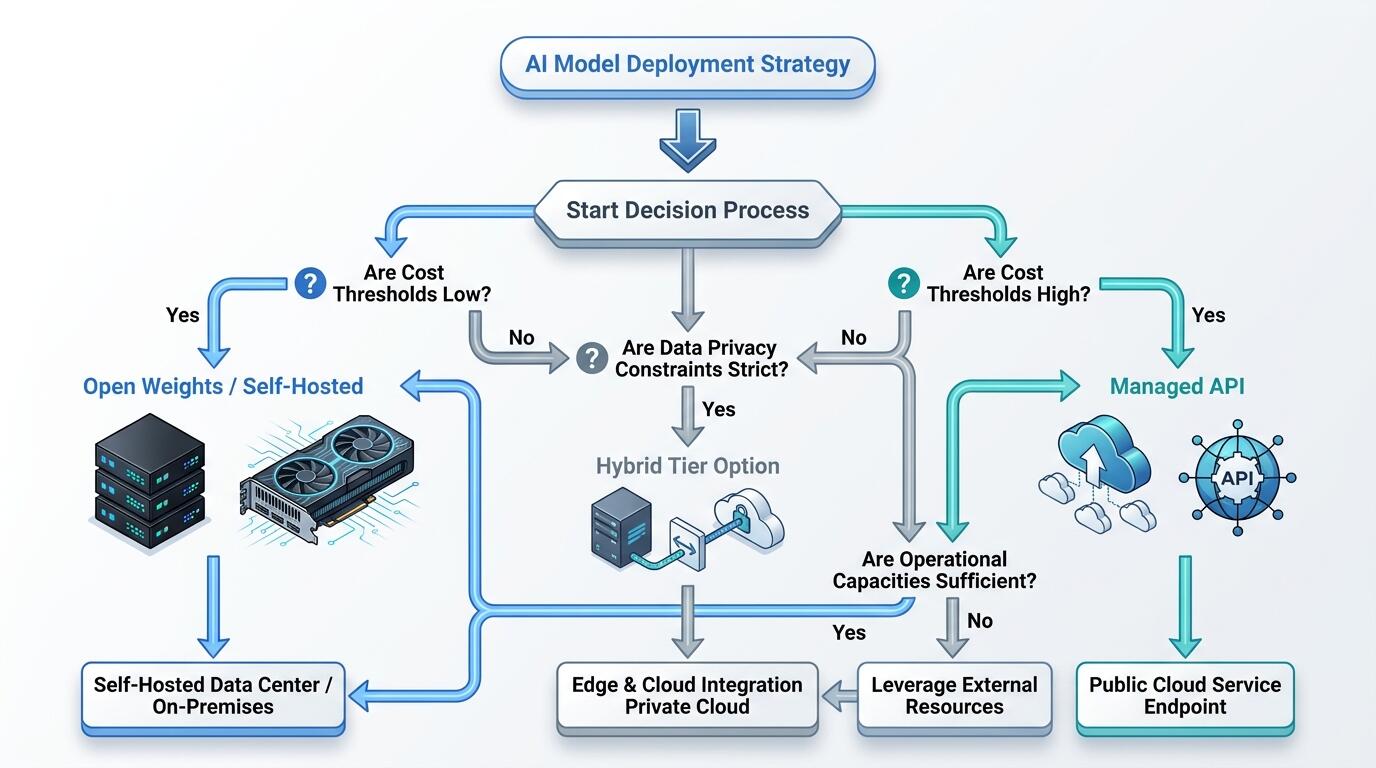
ALT: Visual decision framework comparing open weights self-hosting against managed API for AI engineers selecting model deployment strategy this quarter
Questions & Answers
Q1: How do I know when my inference volume crosses the threshold where self-hosting becomes economical?
The threshold is not a fixed number — it depends on your infrastructure cost basis, the models you are comparing, and your team's operational overhead rate. The practical approach is to build a cost model that includes fully-loaded engineering time for setup and ongoing maintenance alongside compute costs, then find the monthly request volume where total self-hosting cost falls below total API cost. For most teams using mid-size GPU instances and models in the seven to thirty billion parameter range, this crossover tends to occur at meaningful daily active usage — not at prototype or early beta scale.
Q2: Is it possible to migrate from a managed API to self-hosted open weights after a product is in production?
Migration is possible but carries real risk if your prompts and application logic are tightly coupled to a specific model's behavior. Open-weights models, even when fine-tuned to match a closed model's output format, will produce different outputs on the same inputs. Plan for a parallel evaluation period where both models serve the same requests and outputs are compared before cutover. Budget more time for this than you expect — behavior differences surface in long-tail cases that short evaluation suites miss. Building model abstraction into your application architecture from the start makes this migration significantly less costly.
Q3: How long does it typically take to stand up a production-grade open-weights inference setup from scratch?
For a team with at least one engineer who has worked with LLM serving frameworks like vLLM, Text Generation Inference, or similar tools, a basic production setup — with load balancing, basic monitoring, and autoscaling — typically takes two to four weeks. Teams without that experience should budget longer, or consider starting with a managed open-model hosting service that provides the infrastructure layer before committing to full self-hosting. The operational maturity required to run self-hosted inference reliably is often underestimated.
Key Takeaways
- The open weights versus managed API decision is fundamentally a cost-structure and operational-capacity decision, not a capability decision — start by modeling economics at realistic future volumes, not current ones.
- Data privacy and compliance constraints can resolve the decision before cost modeling is necessary; audit your data categories first when operating in regulated sectors.
- Self-hosting carries ongoing operational overhead that must be priced into the total cost model at a real engineering hourly rate — it is not "free" after setup.
- Hybrid architectures that route high-volume, lower-complexity requests to open-weights models while preserving API access for frontier-capability tasks often produce better outcomes than committing fully to one path.
- Model version stability and vendor lock-in risk are strategic costs that belong in the decision model alongside infrastructure and API fees — factor in optionality, not just price per token.
The next step is running the three-step framework above with your actual numbers. If your cost projection and operational audit point in different directions, that tension is the real conversation your team needs to have before the quarter is over.
If this framework is useful, subscribe to Darius — a bilingual briefing written by people who build AI products in production, covering the model strategy decisions, infrastructure shifts, and builder-relevant signals that actually matter, five to ten items per issue with first-hand context attached.
References
- Stanford Center for Research on Foundation Models. "Foundation Model Research and Evaluation."
https://www.stanford.edu/ - Hugging Face. "Open LLM Leaderboard and Model Hub Documentation."
https://huggingface.co/ - European Data Protection Board. "Guidelines on Data Processors and Controllers under GDPR Article 28."
https://edpb.europa.eu/ - IEEE. "Standards and Technical Publications on AI Systems Engineering and Machine Learning Infrastructure."
https://www.ieee.org/ - European Parliament. "EU Artificial Intelligence Act — Regulatory Framework Documentation."
https://www.europarl.europa.eu/
Note: Regulatory frameworks and model capability benchmarks evolve rapidly; verify against the latest official documentation before making architectural commitments.