Open Weights vs API: A Side-by-Side Comparison for Small Teams
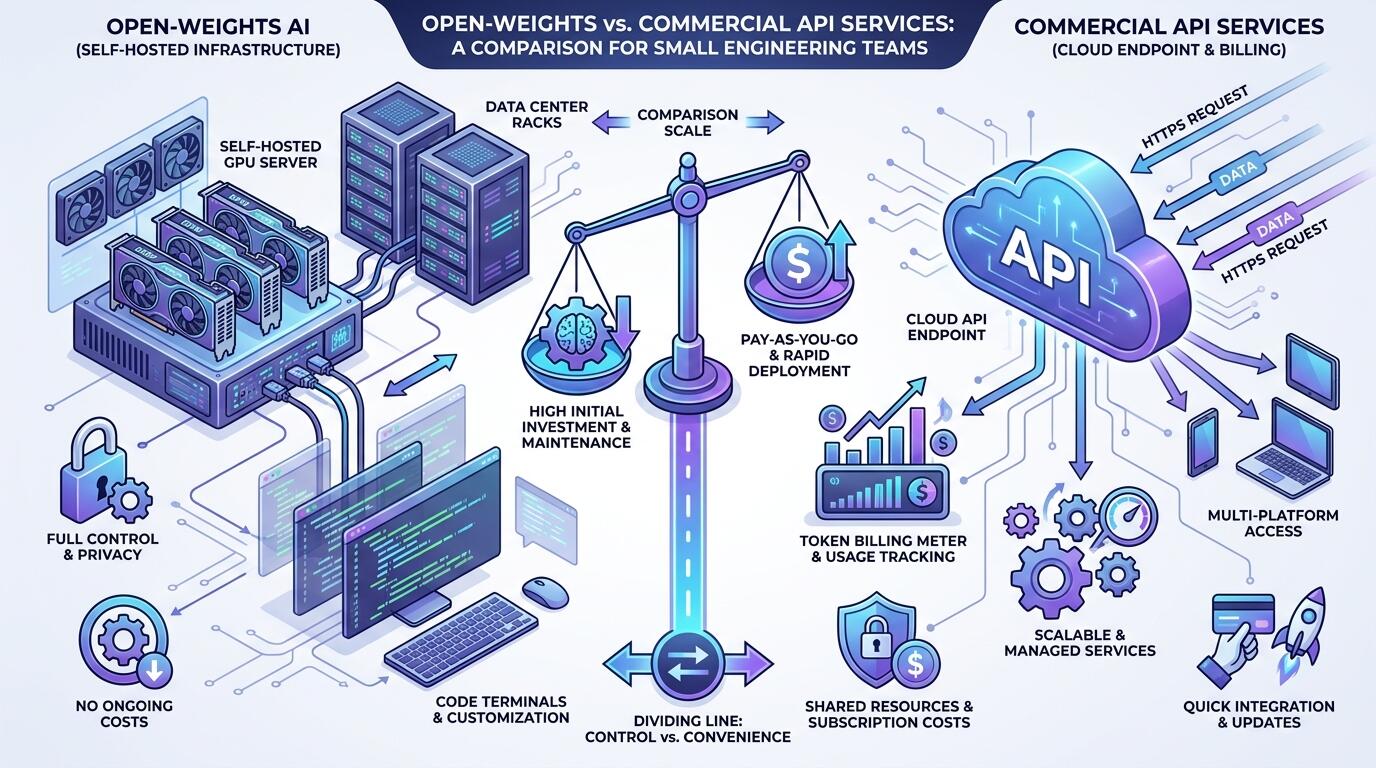
ALT: Open weights vs API models side-by-side comparison guide for small engineering teams
Open Weights or API? The Decision That Shapes Your AI Stack
You're three engineers, a product manager, and a prototype that's starting to look like a real product. Someone raises the question of which AI model to use, and suddenly the room splits: one engineer wants to self-host an open-weights model for control and cost predictability; another wants to call a commercial API to ship faster. Both positions are defensible, and that's exactly why this decision is harder than it looks.
The comparison here is between two fundamentally different approaches to integrating large language model (LLM) capabilities into your product: open-weights models (downloadable models whose parameters are publicly released) versus commercial API services (hosted inference endpoints provided by AI labs, billed per token or request). The criteria used to evaluate them are cost structure, operational complexity, latency and reliability, data privacy, customization depth, and long-term vendor risk. These are the dimensions that consistently determine whether a small team's AI integration succeeds or quietly becomes a liability.
The Criteria That Actually Matter for Small Teams
Choosing between open-weights models and commercial APIs is not a question of raw capability alone — the decision turns on operational and business realities that capability benchmarks rarely capture.
Cost structure matters because small teams have finite budgets and uneven traffic. A model with high fixed infrastructure cost can be ruinous at low scale, while per-token API pricing can surprise you at high scale. The relationship between your usage volume and the cost curve of each option is the first thing to map.
Operational complexity is the often-underestimated cost of self-hosting. Running a model in production requires GPU provisioning, version management, monitoring, scaling, and on-call responsibility. For a team of three engineers, that overhead competes directly with feature work.
Latency and reliability determine whether your product feels fast and trustworthy. API providers operate global infrastructure optimized for inference; self-hosted setups depend on the hardware and configuration you can afford.
Data privacy and compliance are non-negotiable in regulated industries. Where your data goes, who can access it, and what contracts govern that access are legal and trust concerns, not just technical ones.
Customization depth sets the ceiling on product differentiation. Fine-tuning, model merging, and custom inference pipelines are possible only when you hold the weights.
Long-term vendor risk — price changes, deprecation, API-breaking changes — affects the durability of whatever you build. Dependency on an external API is a business risk that compounds over time.
The Contenders
Open-Weights Models
An open-weights model is a neural network whose trained parameters are publicly released by its developers, allowing anyone to download, run, modify, and deploy the model on their own infrastructure. Well-known examples in the current landscape include Meta's Llama family, Mistral's open releases, and the models released under various permissive licenses by organizations such as Hugging Face. The defining characteristic is that the model runs wherever you put it — your own GPU server, a cloud VM, or a specialized inference cluster.
Open-weights models vary significantly in size and capability, measured in billions of parameters. Smaller models can run on consumer-grade hardware or even CPUs with quantization (a technique that reduces numerical precision to shrink memory requirements); larger models demand dedicated GPU infrastructure. The practical implication for small teams is that entry-level self-hosting is accessible, but production-grade self-hosting at quality levels comparable to frontier commercial models requires real investment.
The open-weights ecosystem has matured considerably. Tools such as Ollama, vLLM, and llama.cpp have simplified local and server-side deployment. Fine-tuning frameworks make it feasible for a single engineer to adapt a base model to a specific domain with a modest labeled dataset.
Commercial API Services
A commercial API service is a hosted inference endpoint operated by an AI lab, where you send prompts over HTTPS and receive model outputs, paying per token consumed or per request made. Prominent examples include OpenAI's API (GPT-4o and related models), Anthropic's Claude API, Google's Gemini API, and a growing number of smaller providers. The defining characteristic is that you never touch the model weights or the hardware running them — you consume the service as a utility.
The appeal is immediate: no infrastructure to provision, no GPUs to manage, and instant access to frontier-level capability. API providers handle uptime, scaling, and model updates. For a small team under delivery pressure, this is a substantial operational advantage. The trade-off is that you are wholly dependent on the provider's pricing decisions, uptime SLAs, data handling policies, and product roadmap.
The commercial API market has become increasingly competitive, which has generally driven prices down and improved baseline reliability. However, providers have also introduced breaking changes, deprecated model versions, and adjusted pricing tiers in ways that created real engineering work for teams caught mid-product cycle.
Head-to-Head Comparison
| Criterion | Open-Weights Models | Commercial API Services |
|---|---|---|
| Upfront cost | Hardware/cloud GPU spend required | None — pay as you go |
| Ongoing cost | Relatively predictable once infrastructure is stable | Variable; scales with usage volume |
| Operational burden | High — team owns infra, monitoring, scaling | Low — provider manages all infrastructure |
| Data privacy | Full control; data never leaves your environment | Data transmitted to provider; governed by ToS and data agreements |
| Latency | Depends on your hardware; tunable | Generally optimized, but subject to provider load |
| Frontier-level capability | Typically behind leading commercial models | Access to latest frontier models |
| Fine-tuning / customization | Full access — weights, fine-tuning, merging | Limited; some providers offer fine-tuning via API |
| Vendor lock-in risk | None — you hold the weights | Moderate to high depending on model-specific feature use |
| Compliance suitability | Strong — on-premise deployment possible | Requires due diligence on provider's compliance posture |
| Time to first prototype | Slower — setup overhead | Fast — API key and a few lines of code |
The table reveals a pattern that holds up in practice: commercial APIs front-load convenience and defer cost and risk; open-weights models front-load cost and operational work but give you progressively more leverage as you scale and specialize.
The most consequential difference for small teams is the operational burden gap. A team of two or three engineers that chooses to self-host a capable open-weights model in production is implicitly allocating some fraction of engineering capacity to infrastructure work that produces no direct user value. That's a real cost that never appears in a per-GPU-hour calculation. In our observation working on production AI products, teams routinely underestimate this cost at the start and reckon with it painfully six months in.
The second major differentiator is data privacy. For consumer applications where users share sensitive personal information — health data, financial details, private communications — the ability to guarantee that data never leaves your controlled environment is not a nice-to-have. It's often a requirement. Open-weights models deployed on your own infrastructure provide this guarantee by construction. Commercial APIs require you to trust the provider's contractual commitments, which may or may not satisfy your legal obligations depending on jurisdiction and industry.
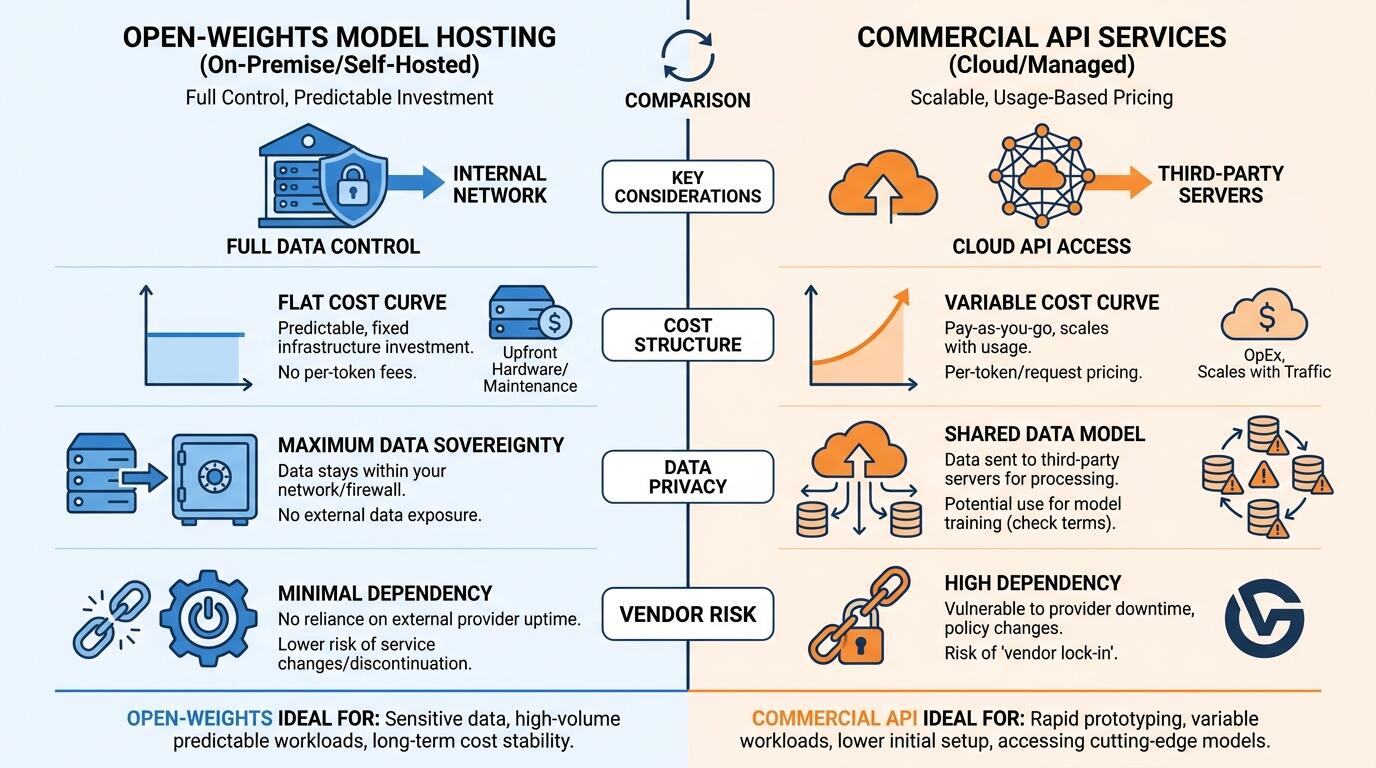
ALT: Side-by-side breakdown comparing open-weights model hosting against commercial API services on cost structure, data privacy, and vendor risk for small AI product teams
Which Should You Choose? Scenario Recommendations
The right answer depends almost entirely on your team's current constraints and the nature of the product you're building. Here are the situations we consistently see map cleanly to one option or the other.
If you need to ship a working prototype in the next few weeks, choose a commercial API. The operational overhead of self-hosting will absorb time you don't have. Validate your product concept against an API, then revisit the infrastructure decision once you have evidence of product-market fit.
If your product handles sensitive user data and you cannot accept data leaving your environment, lean toward open-weights. Even a capable smaller model running on your own infrastructure is a better starting point than building on an API whose data handling you cannot fully audit or control.
If your traffic is low and highly variable — common for early-stage products — commercial APIs are almost certainly cheaper. You pay only for what you use, with no idle GPU spend. The breakeven point where self-hosting becomes cost-competitive typically requires consistent, substantial inference volume.
If you need a highly specialized model — one that behaves in ways a general-purpose frontier model won't without extensive prompting — fine-tuning an open-weights model is often the most direct path. Fine-tuning gives you precise control over style, domain knowledge, and output format in ways that system prompts and few-shot examples can't always replicate.
If you're building in a regulated industry (healthcare, finance, legal) and compliance is a gating requirement, start with open-weights and on-premise or private-cloud deployment. This gives you the clearest path through compliance review and reduces the surface area of third-party risk.
If your team has no prior ML infrastructure experience, be honest about the learning curve. Choosing open-weights is not just a technical decision — it's a staffing decision. If nobody on the team has operated a GPU server in production, plan for that skill gap before committing.
A pattern that works well in practice: use a commercial API for the general-purpose reasoning tasks in your product, and run a smaller open-weights model locally for tasks that require data privacy or where tight latency control matters. This hybrid approach, discussed in more depth in the build vs. buy AI infrastructure framework, lets you start fast and migrate selectively as you understand your product's actual usage patterns.
The key pros and cons distilled:
Open-weights: full data control, no per-token cost at scale, deep customization, model permanence — against real operational overhead, infrastructure cost, and a capability gap relative to frontier APIs.
Commercial APIs: immediate access to frontier capability, zero infrastructure work, fast iteration — against variable cost at scale, data privacy exposure, vendor dependency, and the risk of breaking changes.
People Also Ask
Q1: How do open-weights models differ from open-source models?
Open-weights models make their trained parameters publicly available, but do not necessarily release training code, datasets, or full implementation details. Open-source models, in the strict sense defined by the Open Source Initiative, require the full release of all components under a qualifying license. In practice, many models described as "open" release only weights under custom licenses that restrict commercial use or redistribution. Teams should review the specific license of any model they plan to use in a commercial product before assuming it is freely usable.
Q2: Is it safe to send proprietary business data to a commercial API?
The safety of sending proprietary data to a commercial API depends on the provider's data processing agreements, the specific API tier you're using, and your jurisdiction's data protection requirements. Many providers offer enterprise tiers with explicit commitments not to use submitted data for model training and with stronger contractual privacy protections. For genuinely sensitive data — personally identifiable information, protected health information, or trade secrets — legal counsel should review the provider's terms before integration, and open-weights self-hosting should be considered as an alternative.
Q3: How long does it typically take to set up an open-weights model for production use?
Setup time varies significantly by team experience and infrastructure maturity. A single engineer familiar with GPU servers and containerization can stand up a basic open-weights inference endpoint in a day or two using tools like Ollama or vLLM. A production-ready deployment with monitoring, autoscaling, and reliability safeguards typically takes several weeks. Ongoing maintenance — handling model updates, infrastructure incidents, and capacity planning — is a continuous commitment, not a one-time setup cost. Teams evaluating open-weights should budget for this ongoing operational load from the start.
The Bottom Line
Three things consistently separate teams that make this decision well from those that regret it:
First, they match the deployment model to their actual constraints — not their aspirational ones. If you have two engineers and three months of runway, that is a different context than a team of eight with dedicated infrastructure experience.
Second, they treat the decision as revisable. Starting on a commercial API does not lock you in forever. A well-structured integration layer — abstracting the model call behind a thin interface — makes it feasible to migrate to open-weights later when volume justifies it. This kind of forward-compatible architecture is worth the modest upfront design effort, and it's the kind of practice covered in evaluating AI development tools before committing to a contract.
Third, they monitor costs and operational load from day one. The teams that get surprised by a large API bill or by a self-hosted GPU becoming a single point of failure are the teams that didn't instrument their usage early. Treat your AI integration like any other production dependency: measure it, set alerts, and review it regularly.
The open-weights vs. API debate has no universal answer. The right choice is the one that fits your team's size, skill set, data obligations, and product stage — and that you can revise as those factors change.
If you're actively building an AI product and want a practitioner's perspective on decisions like this one — delivered concisely, with first-hand context rather than editorial commentary — subscribe to Darius, a bilingual AI briefing written by an engineering director who runs AI products in production. Every issue covers what's actually worth your attention, with source links and real-world interpretation included.
Sources
- LinkedIn Top Content. "Open-weight AI Models for Production Use".
https://www.linkedin.com/top-content/artificial-intelligence/ai-model-development/open-weight-ai-models-for-production-use/ - Popular AI. "AI API Comparisons: Pricing, Fallbacks & Performance".
https://www.popularai.org/p/ai-api-comparisons - Miles IT. "AI API Comparison Guide: Extend your software's reach".
https://www.milesit.com/ai-api-comparison/ - IEEE. "Institute of Electrical and Electronics Engineers — Standards and Publications".
https://www.ieee.org/ - Hugging Face. "Open-Source Machine Learning and AI Community — Models, Datasets, and Infrastructure".
https://huggingface.co/
Note: Standards, licensing terms, and provider policies may be updated; verify with official documentation or qualified advisors before making production decisions.