Microservices Best Practices for Production Systems This Quarter
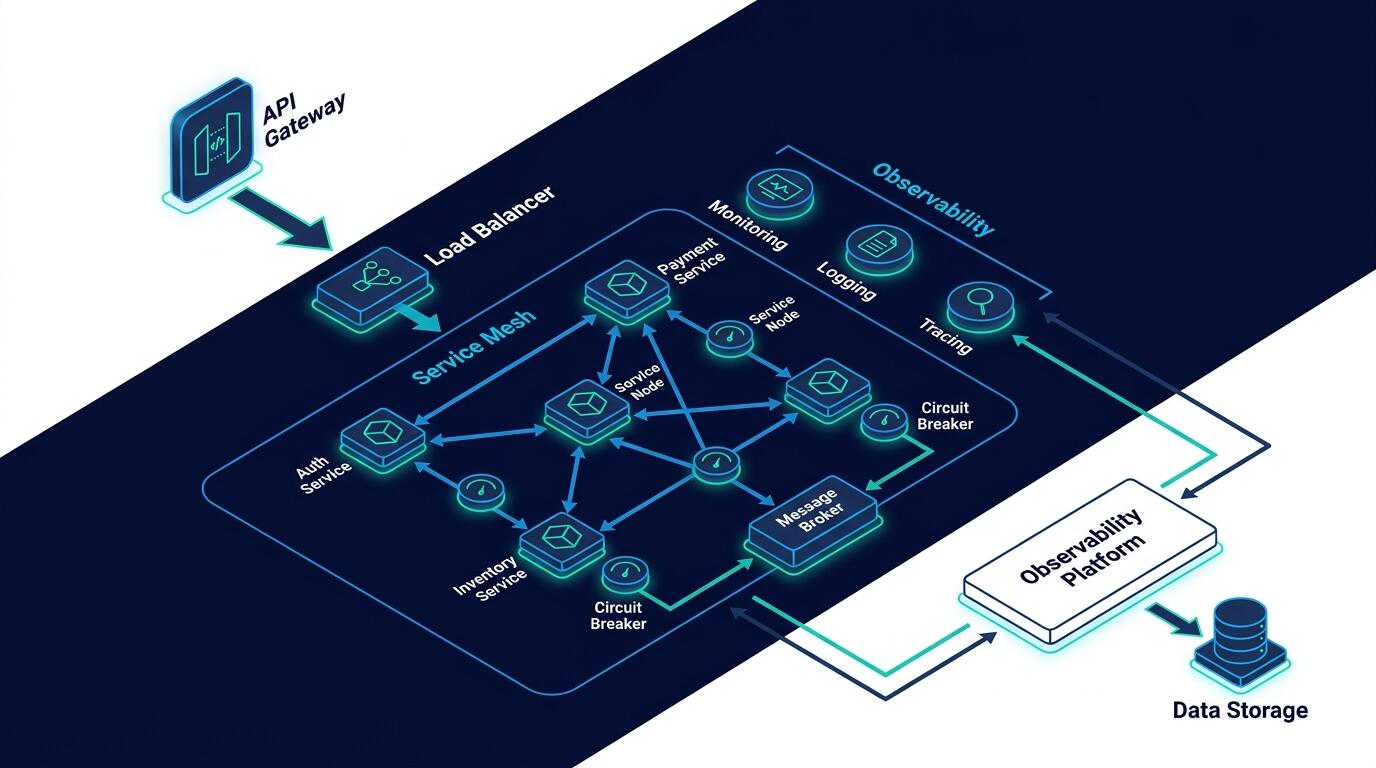
ALT: Microservices best practices for production systems architecture diagram showing service mesh and API gateway
What Separates Microservices That Scale From Those That Crumble in Production
The question most engineering teams ask at some point is deceptively simple: why does our microservices architecture keep breaking in production even though it looked solid in staging? The honest answer is that distributed systems fail in ways that monoliths rarely do, and the gap between a working demo and a resilient production system is filled with operational decisions that don't get made until something goes wrong at 2 a.m.
Microservices architecture is a design approach in which a single application is built as a collection of small, independently deployable services, each responsible for a distinct business capability and communicating over well-defined APIs. When done well, this model unlocks genuine advantages: independent scaling, faster release cycles, team autonomy, and fault isolation. When done poorly, it introduces coordination overhead, cascading failures, and debugging nightmares that make engineers nostalgic for their old monolith.
This article is a practitioner's guide to the microservices best practices that matter most for production systems right now. Each item on this list was selected because it addresses a real failure mode — patterns we consistently see derail teams who have the architectural intent right but the operational execution wrong. Whether you are designing a greenfield system or hardening an existing distributed platform, these practices offer concrete leverage. Use the list sequentially for a comprehensive review, or jump to the sections most relevant to your current pain points.
The Core Practices for Resilient, Production-Ready Microservices
Design Around Business Capabilities, Not Technical Layers
Microservices decomposition is most effective when service boundaries map to distinct business capabilities rather than technical concerns such as "data layer" or "API layer." A service that owns a complete business function — say, order fulfillment or user identity — is far more stable than one that owns a horizontal slice of the stack, because business logic changes are contained within a single service rather than rippling across multiple teams and deployments.
In practice, this means applying Domain-Driven Design (DDD) concepts — particularly the idea of bounded contexts — to draw service boundaries. A bounded context is a logical boundary within which a particular domain model applies consistently. Services defined along these lines have natural ownership, clear API contracts, and minimal cross-service coupling.
Best for: Teams building new systems from scratch, or architects breaking apart a monolith incrementally and trying to avoid "distributed monolith" anti-patterns.
Watch out: Prematurely fine-grained decomposition. Starting with too many small services before understanding the domain leads to excessive inter-service communication and operational complexity that outweighs the benefits. Start coarser and split when clear evidence demands it.
Implement the API Gateway Pattern Rigorously
An API gateway is a single entry point that handles all client requests, routing them to the appropriate downstream microservices while enforcing cross-cutting concerns such as authentication, rate limiting, request transformation, and observability. Without a well-designed gateway, these concerns leak into individual services, creating inconsistency and duplicated logic across the system.
The gateway is not merely a reverse proxy. It is a critical architectural component that enforces policies uniformly, reduces client-side complexity, and provides a stable external interface even as internal services evolve. According to industry guidance, separating external API contracts from internal service topology is one of the most impactful decisions a team can make for long-term maintainability.
Best for: Any production system with external clients — mobile apps, third-party integrations, or separate frontend applications — where consistent policy enforcement and API versioning are non-negotiable.
Watch out: Turning the gateway into a smart monolith. Logic that belongs in a domain service should not migrate into the gateway. Keep it thin: routing, authentication, rate limiting, and protocol translation only.
Treat Service-to-Service Communication as a First-Class Engineering Problem
Inter-service communication is where distributed systems earn their reputation for complexity. Teams that model each service call as a simple function call consistently encounter cascading failures, timeouts, and data consistency problems under real production load. The choice between synchronous communication (HTTP/REST, gRPC) and asynchronous messaging (event-driven, message queues) should be deliberate and documented, not incidental.
For request-response interactions where an immediate answer is needed, gRPC offers strong typing and efficient binary serialization. For workflows where services need to react to state changes without direct coupling, an event-driven approach using a message broker reduces temporal coupling and improves resilience. In a pattern we consistently see among teams scaling past a certain complexity threshold, mixing both styles — synchronous for queries, asynchronous for commands and events — yields the best operational outcomes.
Best for: Platform teams establishing communication standards, and architects reviewing a system that has grown organically and accumulated inconsistent patterns.
Watch out: Event-driven architectures introduce eventual consistency, which creates its own class of bugs — duplicate event processing, out-of-order delivery, and unclear failure recovery paths. Design for idempotency from day one.
Build Observability In, Not On
Observability is the degree to which the internal state of a system can be inferred from its external outputs. For microservices, observability is not optional — it is the primary tool for maintaining operational confidence in a system where no single person can hold the full runtime state in their head. The three pillars of observability are structured logs, distributed traces, and metrics, and all three must be present and correlated for production debugging to be tractable.
Distributed tracing — the practice of propagating a trace context (a unique identifier) through every service call in a request chain — is particularly transformative. Without it, diagnosing latency problems or errors in a multi-hop call graph requires manual log correlation across service boundaries, which is slow and error-prone. With it, a single request's journey through dozens of services is visible in a single timeline.
Instrumenting services with the OpenTelemetry standard (an open-source observability framework managed by the Cloud Native Computing Foundation) provides vendor-neutral telemetry that can be routed to any backend. This avoids vendor lock-in at the observability layer — a consideration with real long-term cost implications. If you are also working through broader infrastructure decisions, the build vs. buy framework for AI infrastructure covers adjacent trade-offs that apply directly to observability tooling selection.
Best for: Every production microservices deployment. There is no reasonable exemption for observability investment in a distributed system.
Watch out: Logging at the wrong granularity is expensive. Excessively verbose logging at INFO level in high-throughput services drives up storage and egress costs significantly. Instrument thoughtfully and set retention policies intentionally.
Apply Circuit Breakers and Graceful Degradation Everywhere
A circuit breaker is a design pattern — named by analogy to its electrical counterpart — that detects when a downstream service is failing or slow, and stops sending it requests for a defined period, allowing it to recover. Without circuit breakers, a single degraded dependency can exhaust connection pools and thread pools across the entire system, turning a localized failure into a platform-wide outage.
Graceful degradation goes one step further: when a dependency is unavailable, the calling service returns a reduced but still useful response rather than propagating an error. A product catalog service that cannot reach the recommendations engine, for example, can return results without personalization rather than failing the entire request. This is the difference between a system that wobbles and one that falls over.
Per guidance from practitioners across the industry — including resources compiled by teams at OSO and TekRecruiter — resilience patterns such as circuit breakers, retries with exponential backoff, and bulkheads are among the highest-leverage investments a team can make in a microservices platform, with measurable impact on availability metrics.
Best for: Any service that calls another service over a network. Circuit breakers are not optional in production; they are standard practice.
Watch out: Misconfigured thresholds cause circuit breakers to trip on normal transient errors, introducing unnecessary unavailability. Calibrate thresholds against your actual error rate baselines, not defaults.
Enforce Strong API Contracts and Versioning Discipline
In a microservices architecture, an API is a contract between the service producer and its consumers. Breaking changes — removing fields, changing types, altering response semantics — can silently corrupt dependent services even after successful deployments. Without explicit versioning and contract enforcement, the velocity benefit of independent deployments becomes a liability: services deploy changes that break consumers in production with no advance warning.
Schema-first design (defining the API contract in a machine-readable format such as OpenAPI or Protocol Buffers before writing implementation code) combined with automated compatibility checks in CI/CD pipelines is the most reliable way to prevent contract violations. Consumer-driven contract testing — where consumer teams define the API behavior they depend on, and those contracts are run as tests against the provider — is an even more robust approach for teams at scale.
Best for: Teams with multiple services and multiple teams, where any producer-consumer pair may not be in daily direct communication.
Watch out: Versioning strategies must be agreed on upfront. Mixing URL versioning, header versioning, and no versioning across services creates inconsistency that complicates client code and API gateway routing rules.
Automate Deployment and Manage Environments as Code
Independent deployability is one of the core promises of microservices. Fulfilling that promise requires CI/CD pipelines that can build, test, and deploy individual services without manual handoff steps. Teams that rely on manual deployments or shared deployment scripts quickly find that the operational overhead of managing many services at once negates the autonomy the architecture was meant to provide.
Infrastructure as Code (IaC) — the practice of managing infrastructure configuration in version-controlled files rather than through manual console operations — is equally important. When environments are defined as code, spinning up a new staging environment, rolling back an infrastructure change, or onboarding a new service follows a consistent, auditable process. Tools in this category include Terraform, Pulumi, and Kubernetes manifests managed via GitOps workflows.
If you want a practical perspective on shipping quickly without accumulating technical debt in the process, the piece on shipping fast without sacrificing product quality covers the discipline required to keep deployment velocity high without creating fragility.
Best for: Any team managing more than a handful of services. The automation investment pays for itself quickly in reduced deployment friction and incident recovery time.
Watch out: Full CI/CD automation requires a meaningful upfront investment in tooling and process. Teams that skip this step early often carry the cost in manual coordination overhead and delayed releases for months afterward.
Implement Fine-Grained Authorization at the Service Level
Security in a microservices system is not handled once at the perimeter and assumed safe internally. Each service must make its own authorization decisions — verifying not just that a caller is authenticated, but that the caller is authorized to perform the specific action being requested. Treating internal service-to-service calls as inherently trusted is a perimeter security model that does not survive a lateral movement attack.
Fine-grained authorization is a capability that determines, at runtime, whether a given identity is permitted to perform a given action on a given resource. Implementing it at the service level, using a dedicated policy engine or authorization library, ensures consistent enforcement and auditable access decisions across the platform. According to technical references on microservices security, including detailed guidance from OSO's engineering team, moving authorization logic out of application code and into a dedicated, testable layer is among the most impactful security improvements available to microservices teams.
Best for: Systems handling sensitive data, regulated workloads, or multi-tenant platforms where one customer's data must be strictly isolated from another's.
Watch out: Role-based access control (RBAC) alone is often insufficient for fine-grained use cases. Attribute-based access control (ABAC) or relationship-based access control (ReBAC) models provide more expressive policies but introduce more complexity to manage.
Manage Data Ownership and Avoid Shared Databases
Each microservice should own its data store exclusively, and no two services should share a database. This is one of the most frequently violated and most consequential microservices principles. Shared databases create implicit coupling between services: schema changes made for one service can break another, deployments must be coordinated, and the services effectively become a distributed monolith at the data layer.
Data ownership means a service's database is an internal implementation detail, not a shared resource. Other services access data through the service's API, not through direct database queries. This boundary enables each service to evolve its data model independently, choose the storage technology best suited to its access patterns, and scale its persistence layer without affecting others.
Best for: Teams designing systems where independent scalability and deployment are genuine requirements — which, in a microservices architecture, should be every team.
Watch out: Enforcing this principle in a brownfield (existing) system is hard. Shared databases often become shared precisely because the data access pattern that emerged was easier to implement that way. Migrating away requires deliberate strangler fig patterns and strong team discipline.
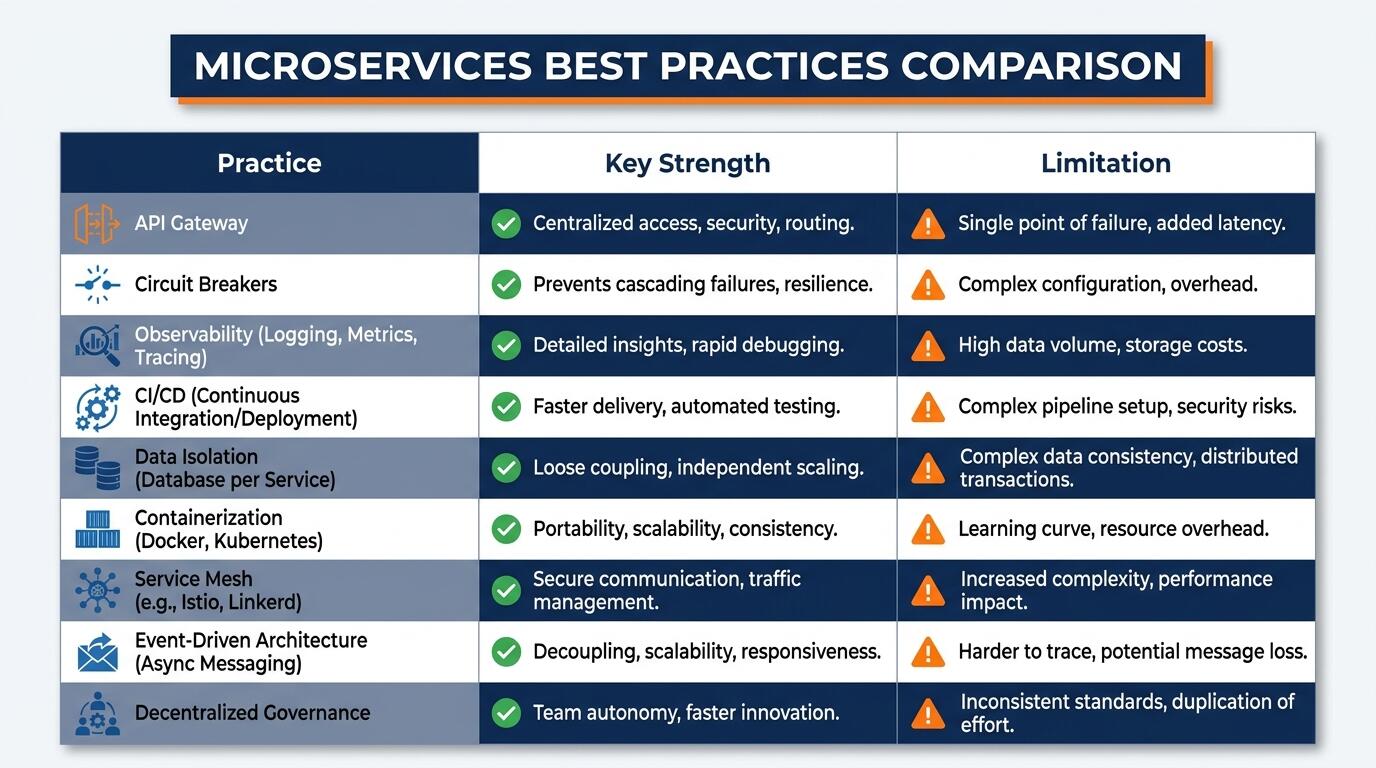
ALT: Comparison table of microservices best practices for production systems showing strengths and trade-offs for engineering teams
Quick Comparison at a Glance
The following table summarizes each practice by the context where it delivers the most value, its primary strength, and the main trade-off or limitation to account for when prioritizing implementation.
| Practice | Best For | Key Strength | Limitation |
|---|---|---|---|
| Business capability decomposition | Greenfield design, monolith decomposition | Reduces coupling, enables team autonomy | Requires deep domain understanding; premature splits backfire |
| API gateway | Systems with external clients | Uniform policy enforcement, stable external surface | Risk of gateway becoming a logic-heavy bottleneck |
| Communication strategy (sync/async) | Platform teams, architects | Resilience and scalability through decoupling | Async patterns introduce eventual consistency complexity |
| Observability (logs, traces, metrics) | All production deployments | Fast incident diagnosis, confidence in runtime behavior | High-cardinality telemetry has real cost implications |
| Circuit breakers and graceful degradation | Any service calling another service | Contains failures, preserves partial availability | Misconfigured thresholds introduce unnecessary unavailability |
| API contracts and versioning | Multi-team, multi-service environments | Prevents breaking changes from reaching production | Requires upfront tooling investment and team discipline |
| CI/CD and IaC | Teams managing multiple services | Consistent, auditable, fast deployments | Significant setup cost; requires cultural buy-in |
| Fine-grained authorization | Sensitive data, multi-tenant systems | Least-privilege enforcement at runtime | ABAC/ReBAC models are more complex to manage than RBAC |
| Isolated data ownership | Any microservices architecture | Independent evolution and scaling per service | Hard to retrofit into existing shared-database systems |
How to Choose the Right Practices to Prioritize
Applying all nine practices simultaneously is not realistic for most teams, particularly those operating under resource and timeline constraints. The right sequencing depends on where your system currently sits on the maturity curve and what failure modes are most actively hurting you.
If your system is new and pre-production, the highest-leverage starting points are business capability decomposition and API contract discipline. Getting these right before writing significant amounts of code avoids the costly refactoring that teams face when they get them wrong early.
If your system is in production but experiencing availability problems — cascading failures, timeouts, or partial outages spreading unexpectedly — prioritize circuit breakers, observability, and communication strategy. These three practices together give you the visibility to diagnose what is happening and the resilience patterns to contain it.
If your system is scaling but deployment friction is slowing the team down — releases require manual coordination, rollbacks are scary, environments drift — CI/CD automation and Infrastructure as Code are the correct investments. The ROI here is direct and measurable in reduced lead time for changes.
If you are operating in a regulated or security-sensitive environment, fine-grained authorization and data isolation cannot wait. These are not optimizations; they are table-stakes requirements.
A common misconception worth addressing directly: microservices are not inherently more scalable than a well-designed monolith. Microservices provide the architectural conditions for selective, independent scaling — but only if the other practices are in place. A microservices deployment with shared databases, no observability, and manual deployments is strictly harder to operate than a monolith, with none of the advertised benefits. The practices in this list are what make the model work, not the decomposition itself.
For teams embarking on an AI-powered product and navigating these architectural decisions, understanding what to expect from an AI architecture engagement can clarify how distributed system design and AI infrastructure decisions intersect from the start.
Frequently Asked Questions FAQ
Q1: How should a team decide whether to split a service into two separate microservices?
The clearest signal that a service should be split is when two distinct business capabilities within it have different change rates, scaling requirements, or team ownership. If one part of the service is modified frequently while the other is stable, or if one needs to scale independently from the other, decomposition is likely warranted. If the split would require a network call for every operation that previously happened in-process, pause and assess whether the operational cost justifies the separation. Domain-Driven Design's bounded context concept provides the most reliable framework for making this decision.
Q2: Are microservices appropriate for early-stage startups with small engineering teams?
Microservices are generally not the right starting architecture for a team of two to five engineers building an unvalidated product. The operational overhead — managing multiple deployment pipelines, distributed tracing, inter-service communication, and independent data stores — is significant and slows iteration when speed matters most. A well-structured monolith with clear module boundaries is faster to build, easier to debug, and straightforward to decompose later when team size and traffic warrant it. The architecture should match the current operational maturity of the team, not the anticipated complexity of a future state.
Q3: How long does it take to retrofit observability into an existing microservices system?
The timeline depends heavily on the number of services, the technology stack, and the current state of logging and instrumentation. In practice, basic structured logging and health endpoint instrumentation can be added across a modest-sized service fleet in a matter of weeks. Distributed tracing integration using a standard such as OpenTelemetry typically takes longer because trace context propagation must be threaded through every service boundary, including message brokers and background jobs. Teams that adopt a standard instrumentation library early and enforce it through shared libraries or service templates compress this timeline significantly compared to retrofitting each service independently.
Summary
Microservices architecture delivers real value — independent deployability, fault isolation, and selective scalability — but only when a set of operational and design practices are consistently applied. The nine practices covered in this article represent the difference between a distributed system that supports your team's velocity and one that impedes it.
Three points anchor the entire framework. First, service boundaries must be rooted in business domain logic, not technical layers — everything downstream, from ownership to API contracts, depends on getting this right. Second, observability and resilience patterns are not optional features to add later; they are the foundation that makes production operation tractable. Third, the practices compound: CI/CD automation enables fast, safe deployments; API contracts prevent breaking changes; circuit breakers contain failures when they do occur. Skipping any layer weakens the whole.
The practical next step is an honest assessment of which failure modes are actively affecting your system today. Start there, address the highest-impact gap first, and build the operational discipline incrementally. Distributed systems are not a destination you reach — they are a practice you maintain.
If you are working through these decisions on a platform that matters — whether a new product or an existing system you need to harden — explore the portfolio and thinking behind the work at Darius, where real shipped products and proven architectural approaches are documented in detail. If you're ready to build smarter and ship faster, reach out directly to explore how hands-on AI architecture, systems design, and full-stack engineering expertise can accelerate your next initiative.
References
- OSO. "13 Microservices Best Practices".
https://www.osohq.com/learn/microservices-best-practices - TekRecruiter. "Top 10 Microservices Architecture Best Practices for 2026".
https://www.tekrecruiter.com/post/top-10-microservices-architecture-best-practices-for-2026 - MetaProject. "Microservices Best Practices: A Practical Guide".
https://www.metaproject.pro/resources/microservices-best-practices - Cloud Native Computing Foundation. "Cloud Native Computing Foundation — Open Source, Vendor-Neutral Projects".
https://www.cncf.io - IEEE. "Institute of Electrical and Electronics Engineers — Standards and Technical Resources".
https://www.ieee.org
Note: Standards and industry guidance may be updated; please check the latest official documents or consult professional advisors for current best practices.