Microservices Architecture Best Practices for Production Systems in 2026
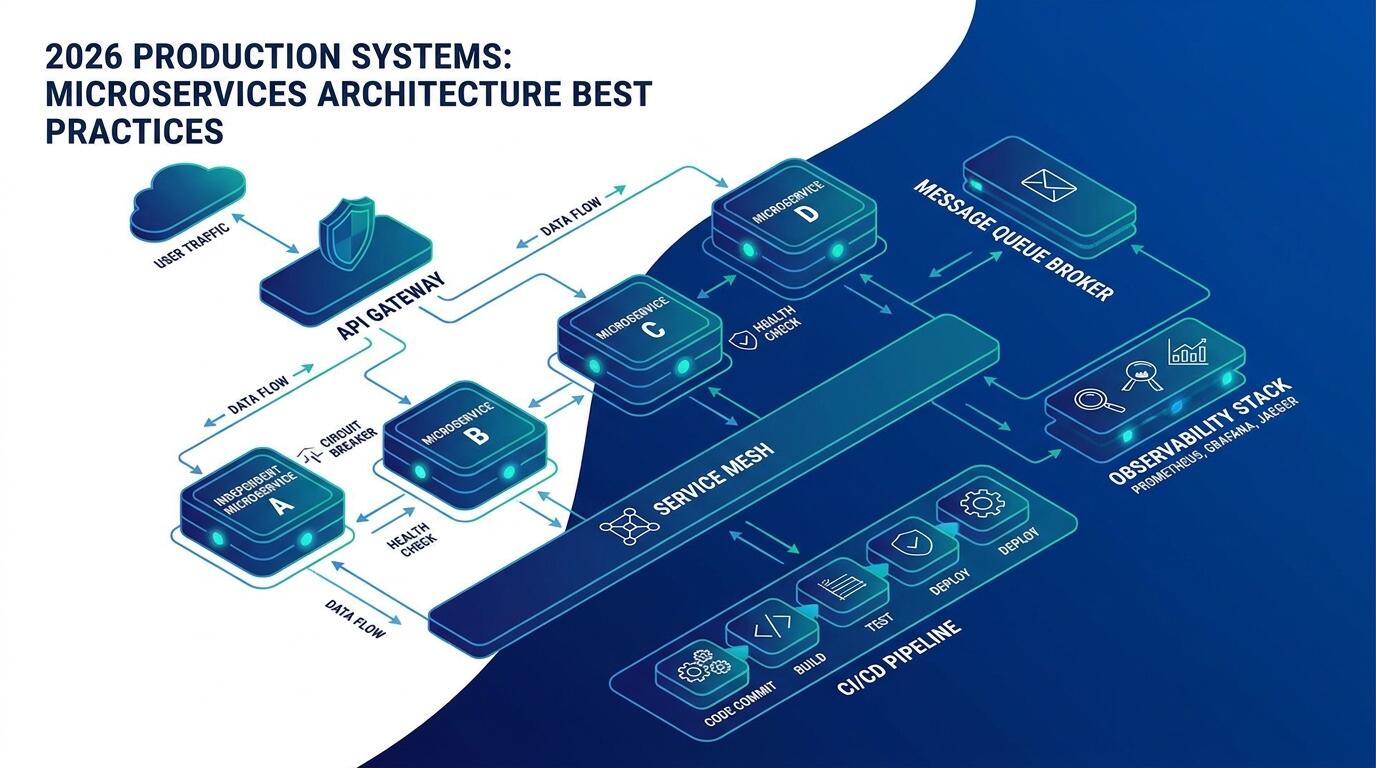
ALT: Microservices architecture best practices for production systems in 2026 engineering diagram
Production-Grade Microservices Architecture: What Actually Works in 2026
Imagine your team has just moved a monolith to microservices — deployments are faster, teams are more autonomous, and the initial rollout feels like a success. Then, three months later, a cascade failure takes down half the system because one upstream service started timing out, your distributed tracing is a mess, and nobody can agree on how service boundaries should be drawn. This is a pattern we consistently see in engineering organizations across maturity levels, and it is not a failure of effort — it is a failure of architecture discipline.
Microservices architecture is a design approach in which a software system is decomposed into small, independently deployable services that each own a specific business capability and communicate over well-defined interfaces. When done well, it enables high development velocity, fault isolation, and independent scaling. When done poorly, it creates a distributed monolith that has all the complexity of microservices with none of the benefits.
This list distills the most consequential best practices for running microservices in production in 2026 — drawn from hands-on work architecting and shipping live systems, not from vendor whitepapers. Each practice addresses a real failure mode. The items were selected based on their outsized impact on production reliability, team autonomy, and long-term maintainability. Whether you are designing a new system or hardening an existing one, treat this as a working checklist, not a theoretical guide.
The Core Practices: Building Microservices That Hold Up in Production
Design Services Around Business Capabilities, Not Technical Layers
Service boundaries are the single most consequential decision in a microservices architecture. A service boundary is well-drawn when it encapsulates a cohesive business capability — such as order management, user identity, or payment processing — and poorly drawn when it maps to a technical layer like "the database service" or "the validation service." The latter produces chatty inter-service communication and makes teams dependent on each other for even simple changes.
Domain-Driven Design (DDD) is the most rigorous framework for deriving service boundaries. The concept of a "bounded context" — a DDD term for a domain model that is internally consistent and deliberately isolated from neighboring models — maps almost directly to a microservice. In our work with clients, teams that invest in event storming workshops before cutting their first service boundary consistently ship more stable architectures than those who decompose based on intuition or convenience.
Best for: Greenfield systems and teams undergoing re-platforming from a monolith.
Watch out: Bounded contexts are not permanent. As the business evolves, service boundaries that made sense at launch may need to be redrawn. Build in the expectation that merging or splitting services will happen.
Enforce API Contracts and Version Them Deliberately
An API contract is the formal agreement between a service producer and its consumers, specifying what inputs are accepted, what outputs are guaranteed, and what error conditions are possible. In a microservices environment, breaking an API contract without a versioning strategy is equivalent to changing a shared database schema without warning — downstream teams break, and blame becomes diffuse.
The IEEE, which publishes standards on software engineering interface design, consistently emphasizes formal interface specification as a prerequisite for interoperability in distributed systems. In practice, this means adopting a contract-first approach — writing your API schema (OpenAPI for REST, Protobuf for gRPC) before writing implementation code, and enforcing it through automated contract tests using tools like Pact or Spring Cloud Contract. Semantic versioning for APIs, combined with a deprecation policy with teeth, prevents the slow accumulation of compatibility debt that drags production systems down. According to industry practitioners surveyed in sources such as the TekRecruiter microservices report, API versioning and contract enforcement are among the most commonly cited deficiencies in teams that experience avoidable production incidents.
Best for: Any organization where multiple teams or external partners consume the same services.
Watch out: Contract testing adds overhead. If your team is small and all services are owned by the same group, lightweight approaches (shared schema registries, integration tests) may deliver more value than a full Pact implementation.
Implement Resilience Patterns at Every Service Boundary
Resilience in microservices means designing every inter-service call as if the remote service will eventually fail. The three foundational resilience patterns are the circuit breaker, the retry with exponential backoff, and the timeout. A circuit breaker is a mechanism that detects repeated failures in a downstream dependency and temporarily stops forwarding requests to that service, preventing cascading failures from propagating through the system.
In our work with production systems, the most common failure mode we encounter is not a service going completely down — it is a service becoming slow. A slow dependency without timeouts will exhaust thread pools and connection limits in the calling service, creating a failure that is indistinguishable from an outage. Bulkheads, which isolate resource pools so that a failing integration does not starve other integrations, are underused but critical. Libraries like Resilience4j for Java and Polly for .NET make these patterns straightforward to implement. The key discipline is not just adding the library — it is configuring the thresholds based on measured latency distributions, not defaults.
Best for: Any production system with external dependencies or shared infrastructure.
Watch out: Aggressive circuit breaker thresholds can cause unnecessary failures during transient network blips. Tune thresholds in staging with realistic traffic profiles before applying them to production.
Centralize Observability: Logs, Metrics, and Traces as First-Class Citizens
Observability in a microservices system is the ability to understand the internal state of the system from its external outputs — logs, metrics, and distributed traces. Without all three, debugging production issues becomes archaeology: piecing together what happened from incomplete evidence scattered across dozens of services.
The OpenTelemetry project, now a graduated project under the Cloud Native Computing Foundation (CNCF), has become the de facto standard for instrumentation in distributed systems. It provides vendor-neutral SDKs for capturing traces, metrics, and logs in a unified schema. The practical discipline here is enforcing structured logging (JSON, not free-text), propagating trace context through every service call (including asynchronous message consumers), and establishing service-level objectives (SLOs) tied to real business outcomes, not just infrastructure metrics. Teams that invest in observability before they need it consistently diagnose and resolve incidents faster than those who bolt it on after their first major outage. For organizations evaluating broader AI system architecture patterns alongside their microservices strategy, observability infrastructure is a shared foundation — not a separate concern.
Best for: All production microservices environments, from the first service forward.
Watch out: Observability data volumes can become expensive quickly. Implement sampling strategies for traces (head-based or tail-based) and retention policies for logs before your bill scales faster than your service count.
Own Your Data: One Database Per Service
Database ownership is a structural rule in microservices architecture: each service owns its own data store, and no other service queries or writes to it directly. This isolation is what makes independent deployability real — if two services share a database schema, you cannot deploy them independently without coordinating schema migrations.
This practice generates the most friction in teams migrating from monoliths because it requires duplicating data and introducing eventual consistency where strict consistency previously existed. The trade-off is real: eventual consistency is harder to reason about, and distributed transactions (managed via sagas or outbox patterns) require deliberate design. But the long-term payoff — independent schema evolution, service-specific storage optimization (relational, document, time-series), and clear data ownership — is what makes microservices scale with team growth. As noted in best-practice analyses published by practitioners including those on LinkedIn's engineering community, shared databases are one of the most persistent anti-patterns preventing teams from realizing the autonomy benefits of microservices.
Best for: Teams serious about achieving independent deployability and data isolation.
Watch out: The outbox pattern (writing events to a local database table and publishing them transactionally) solves many eventual consistency problems, but it introduces operational complexity. Use a battle-tested implementation rather than rolling your own.
Automate Everything: CI/CD Pipelines as a Non-Negotiable
Continuous Integration and Continuous Delivery (CI/CD) is not optional infrastructure in a microservices system — it is load-bearing architecture. With dozens of independently deployable services, manual deployment processes become a bottleneck that negates the autonomy microservices promise. A mature CI/CD pipeline for microservices includes automated unit and integration tests, contract tests, container image builds, security scanning, and environment-progressive deployment (dev → staging → production) with automated rollback capabilities.
GitOps, which is an operational model that uses Git as the single source of truth for both application code and infrastructure state, has become the dominant pattern for Kubernetes-based deployments. Tools like ArgoCD and Flux implement GitOps natively. The discipline here is treating pipeline failures as production incidents — a broken pipeline means a team cannot ship, which is as serious as a service being down. Teams that ship frequently (multiple times per day per service) consistently have lower change failure rates than teams that batch changes into large, infrequent releases, a finding documented repeatedly in the annual State of DevOps reports published by DORA (DevOps Research and Assessment).
Best for: Any team operating more than three or four services.
Watch out: CI/CD pipeline maintenance is engineering work that is often underestimated. Budget dedicated time for pipeline reliability — treat it as a product.
Secure Services at the Boundary and Within the Mesh
Security in a microservices architecture operates on two layers: the external perimeter (what traffic is allowed into the system) and the service mesh (how services authenticate each other internally). Zero-trust networking, which is a security model that treats every network request as potentially hostile regardless of its origin, is the guiding principle for 2026 production systems.
At the internal layer, mutual TLS (mTLS), which authenticates both the client and the server in a TLS handshake, ensures that services can only communicate with verified peers. Service meshes like Istio or Linkerd implement mTLS transparently at the infrastructure layer, removing the burden from application code. For authorization, OAuth 2.0 and OpenID Connect (OIDC) remain the dominant standards for identity propagation across service boundaries. NIST Special Publication 800-204, which addresses security strategies for microservices-based applications, provides the most authoritative public guidance available and is worth reviewing for any team building systems with compliance requirements.
Best for: All production systems, with increasing urgency for systems handling sensitive data or regulated workloads.
Watch out: Service mesh adds latency and operational complexity. Measure its overhead in your specific environment before committing to it at scale, and ensure your team has the expertise to operate it safely.
Manage Configuration and Secrets Externally, Never in Code
Configuration management is the practice of separating application configuration (environment-specific values, feature flags, service endpoints) and secrets (credentials, API keys, certificates) from application code. Hardcoding configuration or secrets into container images or source repositories is a security and operational anti-pattern that remains surprisingly common in the systems we review.
The twelve-factor app methodology, which is a widely adopted set of principles for building software-as-a-service applications, defines environment-specific configuration stored in environment variables as a baseline requirement. For secrets, dedicated secret management systems — HashiCorp Vault, AWS Secrets Manager, or Kubernetes Secrets backed by a KMS — provide rotation, auditing, and access control capabilities that environment variables alone do not. Dynamic configuration (the ability to change feature flags or service behavior without redeployment) delivered via systems like LaunchDarkly or open-source alternatives reduces deployment risk and enables targeted rollouts. If your team is navigating decisions like this as part of a broader infrastructure build, the guidance in build vs. buy for AI infrastructure applies directly to tooling selection here as well.
Best for: All production environments.
Watch out: Secret rotation at scale requires automation. Secrets that require manual rotation will drift out of rotation policy — treat rotation as a testable, automated process from day one.
Quick Comparison at a Glance
| Practice | Best For | Key Strength | Limitation |
|---|---|---|---|
| Business-capability service boundaries | Greenfield systems, monolith migrations | Reduces coupling, enables team autonomy | Requires domain expertise to get right; boundaries evolve |
| API contract enforcement and versioning | Multi-team and partner integrations | Prevents breaking changes, enables independent evolution | Contract testing adds pipeline overhead |
| Resilience patterns (circuit breakers, timeouts, bulkheads) | All production services with dependencies | Prevents cascading failures, improves fault isolation | Requires careful threshold tuning |
| Centralized observability (logs, metrics, traces) | All production environments | Reduces MTTR, surfaces systemic issues | Data volume and cost management required |
| Database per service | Teams pursuing independent deployability | Enables schema autonomy and service-specific storage | Introduces eventual consistency complexity |
| Automated CI/CD with GitOps | Teams with more than three services | Enables high deployment frequency with reliability | Pipeline maintenance requires dedicated investment |
| Zero-trust security with mTLS and secrets management | All production systems | Reduces internal attack surface, enforces least-privilege | Service mesh adds latency and operational overhead |
| External configuration and secret management | All production environments | Separates concerns, enables auditing and rotation | Rotation automation requires upfront engineering investment |
How to Choose What to Prioritize First
Not every team is in the same position, and trying to implement all of these practices simultaneously is a reliable path to delivery paralysis. The right sequencing depends on where your system is today and what pain you are experiencing.
If you are starting a new system from scratch, prioritize service boundary design and API contract enforcement before writing a single line of implementation code. Getting these wrong early is far more expensive than getting them right late. Layer in CI/CD automation immediately — it pays dividends from the first deployment.
If you are migrating an existing monolith, start with the strangler fig pattern: carve off one bounded context at a time, establishing database ownership and observability for each extracted service before moving to the next. Resilience patterns become urgent once you have more than two or three services communicating — a single synchronous dependency chain without circuit breakers is a production incident waiting to happen.
If you are operating an existing microservices system that is struggling in production, observability is almost always the right first investment. You cannot fix what you cannot see. Establish distributed tracing and structured logging before attempting architectural refactoring, so your changes are validated with real data.
A common misconception worth addressing directly: many teams believe that adopting microservices architecture guarantees scalability. It does not. Microservices enable independent scaling of individual capabilities, but poorly designed services — especially those that share databases or create tight synchronous dependency chains — can perform worse under load than a well-tuned monolith. The architecture enables good outcomes; engineering discipline delivers them.

ALT: Engineering team reviewing a microservices architecture system design diagram for production deployment best practices in 2026
Common Questions
Q1: How do you prevent a microservices architecture from becoming a distributed monolith?
A distributed monolith is a system that has been decomposed into multiple services but retains tight coupling through shared databases, synchronous dependency chains, or coordinated deployments. Prevention requires enforcing database ownership per service from the start, designing for asynchronous communication where strict consistency is not required, and ensuring each service can be deployed independently without coordinating with other teams. Regularly auditing inter-service dependency graphs for cycles is a practical operational discipline that catches drift early.
Q2: Is a service mesh necessary for every microservices production system?
A service mesh is not necessary for every system, but it becomes increasingly valuable as the number of services and the security and observability requirements grow. Small systems with fewer than ten services may achieve sufficient observability and security through application-level instrumentation and API gateway controls. For larger systems — particularly those with compliance requirements around encryption in transit and mutual authentication — a service mesh like Istio or Linkerd provides infrastructure-level enforcement that is more reliable than relying on each service team to implement security correctly in application code.
Q3: How long does it typically take to migrate a monolith to microservices in a production environment?
There is no universal timeline — migration duration depends heavily on the monolith's size, the quality of its internal boundaries, the team's familiarity with distributed systems, and the tolerance for running hybrid architectures during the transition. The strangler fig pattern, which is the most widely recommended migration approach, allows teams to extract services incrementally without a big-bang rewrite. Well-executed migrations typically proceed service by service, with each extraction taking weeks to months rather than days. Planning for a multi-quarter effort is realistic for systems of meaningful size; planning for a multi-year effort is realistic for large, complex domains.
Wrapping Up
Microservices architecture in 2026 rewards disciplined engineering and punishes shortcuts more visibly than almost any other architectural style. The practices covered in this list are not theoretical — they are the difference between systems that hold up under production load and systems that create operational debt faster than teams can pay it down.
Key Takeaways:
- Service boundaries drawn around business capabilities, not technical layers, are the foundation everything else depends on.
- API contracts versioned deliberately and enforced through automated tests prevent the silent coupling that creates deployment dependencies between teams.
- Resilience patterns — circuit breakers, timeouts, and bulkheads — must be implemented at every service boundary, not just the ones that feel risky.
- Observability (structured logs, metrics, and distributed traces under a unified standard like OpenTelemetry) is load-bearing infrastructure, not an afterthought.
- Database ownership per service and external secret management are structural requirements for achieving genuine independence between services.
- CI/CD automation and zero-trust security are not optional accelerators — they are the operational prerequisites for running microservices safely at scale.
The next step is an honest assessment of where your current system stands against these practices. Identify the highest-leverage gap — the practice whose absence is causing the most production pain — and address it first, with measurement, before moving to the next.
Ready to move from architecture decisions to shipped production systems? Explore real-world engineering insights, live projects, and architectural guidance at the Darius website — and reach out if you're looking for a hands-on partner who builds things that actually ship.
References
- TekRecruiter. "Top 10 Microservices Architecture Best Practices for 2026".
https://www.tekrecruiter.com/post/top-10-microservices-architecture-best-practices-for-2026 - LinkedIn Pulse / MasterCRM. "Microservices Architecture in 2026: 5 Best Practices".
https://www.linkedin.com/pulse/5-microservices-architecture-best-practices-2026-from-mastercrm-lxdtf/ - Krishang Technolab. "Best Practices for Microservice Architecture in 2026".
https://www.krishangtechnolab.com/blog/best-practices-for-microservice-architecture/ - IEEE (Institute of Electrical and Electronics Engineers). IEEE Standards on Software and Systems Engineering.
https://www.ieee.org/ - Cloud Native Computing Foundation (CNCF). OpenTelemetry and Cloud Native Project Documentation.
https://www.cncf.io/
Note: Standards and best practices evolve; verify the latest official documentation before implementation, and consult qualified engineering advisors for your specific context.