Full-Stack Delivery Under Tight Deadlines: What Actually Works This Quarter
ALT: Full-stack delivery under tight deadlines using structured engineering and AI systems design
Shipping Under Pressure: What Full-Stack Delivery Actually Looks Like When Time Is Short
Tight deadlines are not exceptional in software development — they are the default condition for most teams building real products this quarter. Whether you are racing toward a product launch, responding to a competitive shift, or trying to close a funding round with a live demo, the pressure to ship quickly while keeping quality intact is a near-universal challenge. The teams that consistently succeed under these conditions are not the ones working the longest hours. They are the ones who have internalized a repeatable, disciplined approach to full-stack delivery that eliminates waste, front-loads risk, and keeps scope honest.
This article distills the patterns that genuinely work when time is compressed — drawing from the hands-on experience of delivering production systems under real constraints. The goal is not to offer motivational advice but to give you a practical framework you can apply starting this week.
Who This Applies To — and Who Should Pause
This framework is designed for specific situations. Understanding where it applies well — and where it does not — saves you from importing the wrong strategy.
Applicable scenarios:
- A startup building an MVP that needs to be live and functional within a defined sprint window, with real users waiting
- An engineering team preparing a product demo or launch milestone that cannot slip without material business consequences
- A technical founder or CTO who needs to coordinate frontend, backend, infrastructure, and AI components simultaneously without a large headcount
- A product team that has already validated demand (qualitatively or through customer conversations) and needs to execute on a clear scope
Not applicable or requires caution:
- Teams in highly regulated domains (healthcare data, financial compliance, certain government contracts) where shipping speed must yield to mandatory review cycles — rushing here creates liability, not velocity
- Projects where the problem itself is still undefined — if you have not validated what you are building or who it is for, delivery speed is premature; consider reading about how to validate a product idea with real customers before building, because scope instability is the fastest way to blow a deadline
Why Tight-Deadline Delivery Fails (and What the Pattern Actually Is)
Full-stack delivery under tight deadlines fails for a small number of predictable reasons, and almost none of them are technical in origin. Understanding this is the first step toward building a system that works.
The most common failure mode is scope creep that masquerades as refinement. A feature that seemed simple at kickoff grows three new requirements by the second sprint, and suddenly the team is two weeks behind on a four-week deadline. The second failure mode is decision latency — when the team cannot make architectural or product decisions quickly because the decision-makers are unavailable, misaligned, or paralyzed by optionality. A day lost to a blocked decision at the start of a sprint can cost three days of delivery at the end.
The third failure mode, and perhaps the most technically interesting, is the mismatch between architecture and timeline. Teams often carry over architectural patterns from large-scale, long-horizon systems and apply them to short-deadline builds. The result is over-engineered infrastructure that takes weeks to set up and never gets fully used. A microservices architecture designed for a team of forty engineers is not appropriate for a four-week build with a team of three.
Per the IEEE Software Engineering Body of Knowledge (SWEBOK), one of the foundational principles of software project management is that the choice of architecture and process should be proportional to the scale, risk, and constraints of the project — not borrowed wholesale from larger or more established systems. This principle is frequently violated under deadline pressure, often because teams default to what they know rather than what fits.
A pattern we consistently see in high-velocity delivery work is that the teams who ship reliably under pressure have made a set of explicit, upfront decisions that slower teams make implicitly or not at all: what is in scope, what is out, what architecture will serve the deadline, and what quality bar is acceptable for each component. These decisions, made deliberately before the first line of code is written, are what separate teams that ship from teams that scramble.

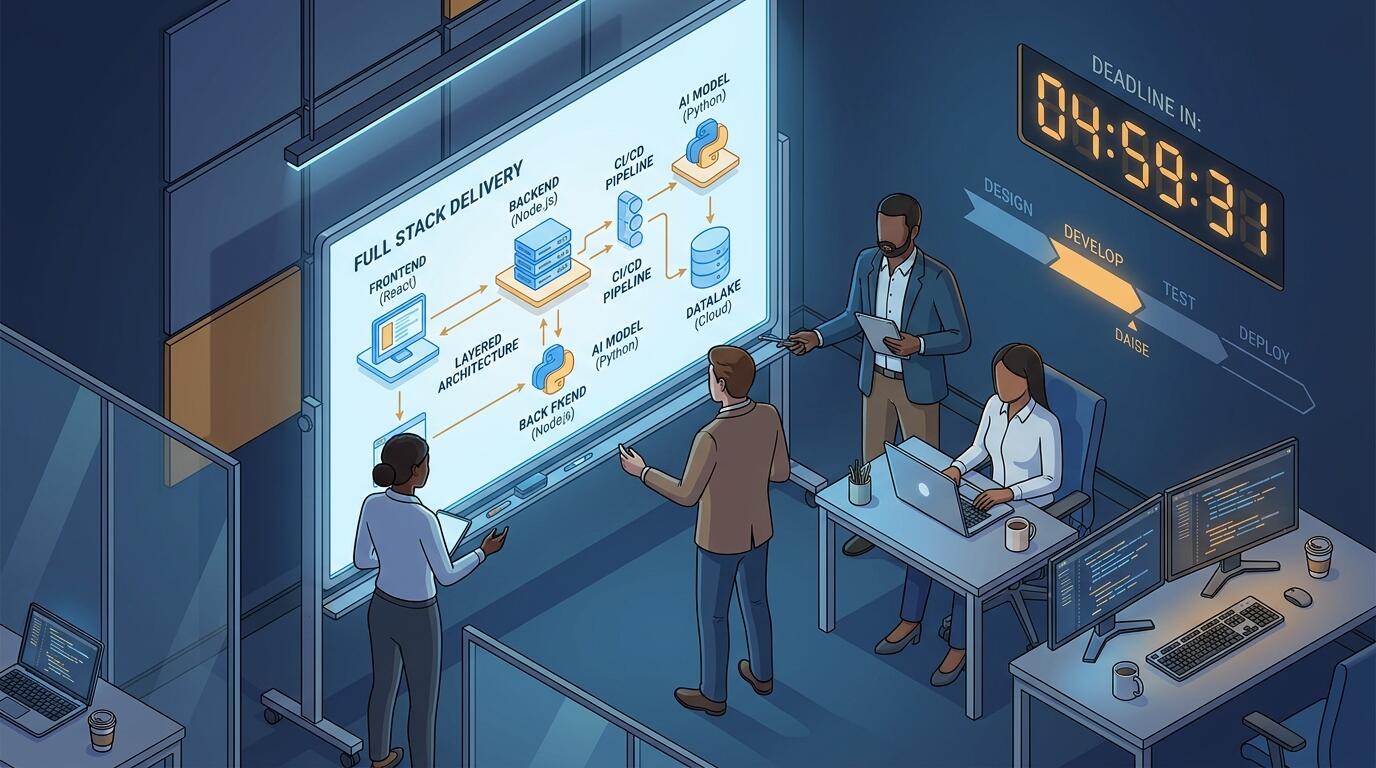
ALT: Engineering team mapping a delivery plan for a full-stack AI product under a tight production deadline, using structured systems design
The Practical Framework: How to Execute Full-Stack Delivery on a Compressed Timeline
A Three-Step Start That Sets the Whole Engagement Up
Step 1: Define the Vertical Slice
A vertical slice is a narrow, end-to-end working feature — one that touches every layer of the stack (frontend, backend, data, infrastructure) but does only one thing. Your first step is to identify the single most important user action in your product and build only that, end-to-end, before touching anything else. This should take no more than two to three days for a small team. The vertical slice exposes integration risks early, gives stakeholders something real to react to, and establishes a deployment pipeline that every subsequent feature can use.
Step 2: Time-Box Everything With a Hard Stop
Every task on the backlog gets a time box — a maximum duration after which the team ships what it has, wraps up cleanly, or explicitly descopes. Time-boxing is not about rushing; it is about forcing prioritization. A task that has run over its time box is a signal that the scope was wrong, not that the team needs more time. In our work with clients, implementing strict time-boxes in the second week of a build is often the single change that produces the most visible improvement in delivery rhythm. For each sprint cycle, we recommend a daily check: does every open task still belong in this sprint, or has new information made it a candidate for deferral?
Step 3: Ship to a Real Environment on Day One
The deployment pipeline — the mechanism that takes code from a developer's machine to a running server that real users can access — should be operational before significant application logic is written. This is counterintuitive for teams that treat deployment as a late-stage concern, but it is one of the most reliable predictors of whether a team will hit its delivery date. If you cannot deploy on day one, you will discover your infrastructure problems on the last day, when there is no time to fix them.
Comparing Delivery Approaches Under Deadline Pressure
Different delivery strategies make very different trade-offs under time constraints. The table below compares three common approaches across dimensions that matter most when the clock is running.
| Comparison Dimension | Monolith-First Approach | Microservices Approach | Modular Monolith |
|---|---|---|---|
| Time to first deployment | Fast — minimal infrastructure setup | Slow — service orchestration overhead is significant | Moderate — some structural overhead, but manageable |
| Complexity for a small team | Low — one codebase, one deployment unit | High — requires DevOps sophistication and distributed systems knowledge | Low to moderate — clean module boundaries without distribution complexity |
| Scalability after deadline | Requires deliberate refactoring later | Built-in horizontal scaling | Can evolve into microservices selectively |
| Recommended team size | Two to four engineers | Eight or more engineers with dedicated infrastructure support | Four to eight engineers |
| Risk under tight deadline | Low — failure modes are simple and local | High — distributed failures are harder to diagnose under pressure | Low to moderate — most failure modes remain local |
The modular monolith — a single deployable application with clearly separated internal modules — is the architecture we most commonly recommend for deadline-driven builds. It ships fast, stays debuggable under pressure, and does not foreclose future scaling options. When you are ready to think more broadly about build versus buy decisions for your infrastructure, revisiting the build vs. buy framework for AI infrastructure is a useful next layer of analysis.
The Technical Decisions That Make or Break a Deadline Build
Scope locking is a technical decision, not just a product decision. When a feature is descoped, it should be removed from the codebase — not commented out, not stubbed, not hidden behind a flag that is not yet wired. Dead code under deadline pressure is a tax on every engineer's mental model of the system. The practice of keeping the codebase clean and honest about what is actually built versus what is planned is one of the clearest markers of a high-functioning delivery team.
Testing strategy must be proportional to risk, not uniform. A team under deadline pressure that writes comprehensive unit tests for every utility function while leaving the critical payment or authentication flow untested has made a poor trade-off. The discipline here is to identify the highest-risk paths through the system — the ones where failure has material consequences for users or the business — and protect those with integration or end-to-end tests. Lower-risk UI variations can be tested manually or not at all at this stage. This is not a permanent posture; it is a deliberate choice made under a specific constraint.
AI components require an extra layer of scoping discipline. If your product includes AI-powered features — a recommendation engine, a generative UI element, a retrieval-augmented generation pipeline — these components tend to expand scope more aggressively than traditional software features because their behavior is probabilistic rather than deterministic. In our work with clients building AI products, a pattern we consistently see is that the AI component is initially scoped as "a simple API call" and then expands to include prompt engineering, evaluation frameworks, fallback logic, latency management, and cost controls. Each of these is legitimate work — but each needs to be explicitly scoped and time-boxed before the sprint begins. For a more detailed look at what this engagement looks like from the start, the article on what to expect when you start an AI architecture engagement is worth reviewing before committing to a sprint plan that includes AI features.
Observability is not optional, even under deadline. Logging, error tracking, and basic performance monitoring should be wired in during the first sprint, not added later. The reason is practical: when something breaks in production — and something always breaks in production — you need to be able to diagnose it in minutes, not hours. Teams that defer observability to "after the launch" routinely spend their first week post-launch firefighting blind, which erodes any momentum the successful launch created. A minimal observability stack — structured logs, an error alerting channel, and a single dashboard showing request latency and error rate — is achievable in a few hours and pays for itself the first time something goes wrong.
Advanced Considerations: When the Standard Playbook Is Not Enough
Handling shifting requirements mid-sprint. Requirements will change. The question is not whether they will, but whether you have a mechanism to handle change without chaos. The discipline we recommend is a simple weekly scope review where any new requirement is evaluated against the current sprint's committed scope. If a new requirement is added, something of equal or greater effort is removed. This is not a rule designed to resist change — it is a rule designed to make change explicit and deliberate rather than accidental and accumulative.
The misconception that speed and quality are opposites. A common belief in engineering culture is that shipping fast means shipping poorly. This is a false dichotomy that leads teams to make an unnecessary choice. Quality under deadline pressure means being precise about which qualities matter for which components. A rough but functional onboarding flow that can be refined post-launch is high quality for a deadline build. A fragile authentication system with no error handling is not — regardless of how quickly it was built. The goal is appropriate quality, distributed strategically across the system, not uniform quality applied to everything regardless of risk. This topic is explored in more depth in the guide on how to ship fast without sacrificing product quality, which covers the practical trade-offs in detail.
Coordinating across the full stack without a large team. One of the structural challenges of deadline builds with small teams is that the same engineer often owns work across multiple layers of the stack. This creates context-switching overhead that is frequently underestimated. The mitigation is to time-slice by layer rather than by feature — a morning spent entirely on backend logic followed by an afternoon on frontend integration tends to be more productive than interleaving the two continuously. Per research in cognitive science and software engineering, context switching between fundamentally different mental models (like API design and UI layout) carries a measurable performance cost that compounds over the course of a sprint.
Common Questions
How do you decide what to descope when a deadline is at risk?
The most reliable method is to rank every remaining feature by the ratio of user impact to implementation effort, then descope from the bottom of that list upward until the remaining scope fits the timeline. The key insight is that descoping should always be driven by user impact, not by engineering preference. Engineers tend to descope the features they find least technically interesting, which is not always aligned with what users actually need. A short conversation with the product owner or a founder, focused specifically on which features a user could not live without at launch, usually produces a defensible descoping decision quickly.
Is it possible to build AI features into a product under a tight deadline?
Yes, but it requires tighter scoping than traditional features. The most successful approach is to start with a single, well-defined AI interaction — one input, one output, one evaluation criterion — and build the surrounding scaffolding (prompt management, response handling, fallback logic) before expanding the feature set. Teams that try to build a general AI capability layer in a deadline build routinely discover that generality is expensive and specificity ships. Define the exact user problem the AI feature solves, constrain the input space, and treat the first version as a proof of concept that will be hardened post-launch.
How long does it realistically take to go from concept to a live, production-ready product?
This depends heavily on the complexity of the domain, the size and experience of the team, and the clarity of the scope. From experience working on production systems, a well-scoped MVP with a small, experienced team can reach a live, production-ready state in a matter of weeks — but only if the scope has been deliberately constrained and the infrastructure decisions have been made upfront. Unclear scope, deferred infrastructure, or frequent requirement changes each add material time. The most reliable way to get an honest estimate is to work backward from the deadline: define what must be live by that date, estimate the work required, and then cut scope until the estimate fits. Do not adjust the deadline to fit the scope.
Wrapping Up
Full-stack delivery under tight deadlines is a skill that can be developed and systematized. It is not a function of working harder — it is a function of making better decisions earlier and protecting those decisions through disciplined execution.
Key Takeaways:
- Define a vertical slice first — build one end-to-end feature before broadening scope, so integration risks surface early and a deployment pipeline exists from day one.
- Lock scope deliberately — every scope change should be explicit, evaluated, and balanced against a corresponding removal; silent scope creep is the primary cause of missed deadlines.
- Choose architecture proportional to your team and timeline — a modular monolith ships faster and fails more simply than a microservices design for most deadline-driven builds.
- Apply quality strategically — protect high-risk paths with automated tests; accept manual testing or deferred refinement for low-risk components.
- Wire in observability during the first sprint — the ability to diagnose production issues quickly is worth more than any feature you might build instead.
The teams that ship reliably under pressure are not exceptional — they are disciplined. The framework above is what that discipline looks like in practice.
Ready to turn your idea into a live, running product? Visit the Darius website to explore shipped projects and learn how an Engineering Director and AI Architect can help you move from concept to production — across AI architecture, systems design, and full-stack development.
References
- IEEE Computer Society. "Software Engineering Body of Knowledge (SWEBOK)".
https://www.computer.org/ - A Life Engineered. "How to Frame Tight Deadline Stories in Interviews — Delivery...".
https://www.linkedin.com/posts/a-life-engineered_how-to-frame-tight-deadline-stories-in-interviews-activity-7464322285248724992-Gc6s - Exponent. "Tell me about a time when you worked on a project with a tight deadline".
https://www.tryexponent.com/questions/941/project-with-tight-deadline
Note: Standards and guidance documents may be updated; please check the latest official publications or consult qualified advisors for current best practices.