Evaluating Full-Stack Candidates for Leadership-Track Roles: A Founder's Checklist

ALT: Founder reviewing full-stack engineering candidates for leadership-track roles using a structured evaluation checklist
What Founders Get Wrong When Hiring Full-Stack Engineers for Leadership Roles
Key Conclusion: Hiring a full-stack engineer for a leadership-track role is one of the highest-leverage decisions a founder can make — and one of the most commonly mishandled. This checklist distills the signals that separate engineers who can build from engineers who can lead: technical depth, systems thinking, communication across audiences, and the operational judgment that turns a growing codebase into a scalable organization. Use this list not as a rigid filter, but as a structured lens for reading candidates more clearly.
Most hiring frameworks for engineering roles are built around one question: can this person write good code? That question matters, but it is the wrong starting point when the role you are filling sits at the intersection of technical execution and organizational leadership. A pattern that consistently emerges in work with early-stage and growth-stage teams is that founders hire engineers who are strong individual contributors and then are surprised when those engineers struggle to set technical direction, mentor junior developers, communicate with product or business stakeholders, or make defensible architectural trade-offs under uncertainty.
The items in this checklist were selected because they represent the dimensions where leadership-track engineers most commonly diverge from strong senior individual contributors. They are drawn from the kinds of evaluation conversations, technical interviews, and post-hire retrospectives that reveal which signals actually predict long-term leadership performance — rather than which signals are easiest to test. Each item includes a practical indicator to look for, a note on who it applies most directly to, and an honest caveat about where the signal can mislead you.
The Eight Signals That Predict Engineering Leadership Potential
Systems Thinking Before Code
A leadership-track full-stack engineer is defined by their ability to reason about a system before they reason about implementation. This means they think first about data flow, service boundaries, failure modes, and team ownership — and only then about which framework or language to use. When asked how they would approach a new product feature, a strong candidate maps out dependencies and downstream effects. A candidate who jumps immediately to syntax or library choices is revealing an individual-contributor orientation.
Ask candidates to walk through a system they designed or significantly contributed to. Listen for whether they explain the forces that shaped their decisions — team size, expected load, third-party constraints, time pressure — rather than just describing what they built.
Best for: Early-stage founders hiring a first technical leader, or CTOs evaluating a potential VP of Engineering candidate.
Watch out: Candidates with strong systems vocabulary who cannot actually build. Assess whether their systems thinking connects to real implementation experience, not just theoretical architecture diagrams.
Communication That Scales Across Audiences
Engineering leaders spend a significant portion of their time translating between worlds: explaining technical constraints to product managers, surfacing risks to executives, and breaking down complex decisions for junior engineers. A full-stack candidate who can only communicate fluently with other engineers is a risk for a leadership-track role.
In practice, this signal shows up in how candidates describe their work during the interview itself. Do they automatically adjust their vocabulary and level of abstraction when talking to a non-technical interviewer? Do they use analogies effectively without being condescending? Can they explain a hard technical trade-off in two sentences without losing precision?
Per the Society for Human Resource Management, communication effectiveness is one of the most consistently cited differentiators in leadership hiring decisions, particularly in technically complex roles where cross-functional alignment is essential.
Best for: Companies with mixed technical and non-technical leadership teams, or founders who do not have a deep engineering background and need their technical leader to serve as a bridge.
Watch out: Do not conflate charisma with clarity. Some candidates are excellent at sounding confident without actually being precise. Ask follow-up questions that require them to be specific.
Evidence of Ownership Beyond the Ticket
Engineers who are ready for leadership roles carry a different relationship to their work than engineers who are optimizing for throughput. The distinction is ownership: a willingness to treat the outcome of a project — not just the completion of an assigned task — as their responsibility. This shows up in candidates who have proactively flagged architectural risks, pushed back on timelines they knew were unrealistic, or stayed engaged with a feature after it shipped to monitor its real-world behavior.
Ask candidates to describe a time they disagreed with a technical decision that was made above them. What did they do? Did they escalate, document their concern, or simply comply? The answer reveals how they navigate organizational authority while still acting with professional integrity — a critical capability for anyone who will eventually be setting direction for others.
As noted in research on startup hiring practices, candidates who demonstrate proactive ownership of problems — not just tasks — tend to become far more effective engineering leaders than those who excel within clearly defined scope.
Best for: Any founder hiring for a role that will eventually grow into technical leadership, even if the immediate scope is execution-heavy.
Watch out: Candidates can rehearse ownership stories. Probe for specifics: what exactly did they push back on, what was the outcome, and what would they do differently? Vague ownership narratives are a yellow flag.
Technical Depth Without Tunnel Vision
A strong leadership-track engineer has genuine technical depth — they understand how things work at a meaningful level, not just how to use them — but they are not dogmatic about technology choices. They can articulate why they prefer certain architectural patterns or languages without dismissing alternatives. They understand that in most real-world contexts, the best technology is the one that fits the constraints of the team, the timeline, and the business model.
This signal is particularly important for full-stack candidates, where the temptation to over-index on a specific stack is high. A candidate who insists that one framework is categorically superior to all alternatives, or who cannot engage seriously with the trade-offs of an unfamiliar technology, will struggle to lead diverse engineering teams or to adapt when the technical landscape shifts — as it always does.
Best for: Founders hiring for a role that will need to make durable technology decisions, including infrastructure choices, framework adoption, and build-vs-buy decisions.
Watch out: Technical depth is not the same as breadth. Some engineers know one domain extremely well but have shallow understanding outside it. For leadership roles, assess both: genuine depth in at least one area, and the intellectual curiosity to engage credibly across others.
A Track Record of Shipping
A leadership-track engineering candidate should be able to point to live, running products or significant features they have personally driven from concept to production. Not prototypes. Not internal tools. Not projects that are "almost done." Real shipped work that users have encountered and that has survived contact with production conditions.
This is not a superficial criterion. Shipping requires navigating ambiguity, making decisions with incomplete information, coordinating across teams, managing technical debt in real time, and maintaining quality under the kind of time pressure that rarely exists in side projects or academic settings. A candidate who has shipped repeatedly has developed a particular kind of practical judgment that is very difficult to develop any other way.
When reviewing portfolios or resumes, look for evidence of end-to-end ownership. Who else was involved? What was the candidate's specific contribution? What broke in production, and how was it resolved? For founders looking to validate a product idea with real customers before building, the ability to execute rapidly and iterate based on real feedback is a non-negotiable trait in a technical leader.
Best for: Startups in early or growth stages where velocity and delivery discipline are existential.
Watch out: "Shipped" means different things in different contexts. A developer who shipped features inside a massive tech company with dedicated DevOps, QA, and SRE teams has a different experience profile than one who shipped a product end-to-end in a three-person startup. Both are valuable — but they are not interchangeable.
The Ability to Build and Then Step Back
One of the most underappreciated signals in leadership-track evaluation is what happens after a candidate builds something. Strong engineering leaders build systems that other people can maintain, extend, and reason about. They document decisions. They write tests not just for coverage metrics but because they understand that tests are a form of communication to future engineers. They name things clearly and resist the temptation to create clever abstractions that only they can navigate.
In interviews, ask candidates about the last time someone else had to take over a codebase or system they built. What was that experience like for the person who inherited it? What would the candidate do differently? A candidate who has thought seriously about code and system legibility — not just correctness — is demonstrating a form of engineering leadership that does not require a formal title to be meaningful.
Best for: Companies that are scaling engineering teams and need technical leadership that multiplies the effectiveness of others, not just delivers output individually.
Watch out: This signal is hard to assess in a standard technical interview. Consider adding a code review exercise where candidates review someone else's code and explain what they would change and why — the comments they leave reveal their communication and mentorship instincts.
Comfort With Ambiguity and Incomplete Information
Technical leaders at early-stage and growth-stage companies are constantly making decisions without full information. The ability to make a reasonable, defensible decision under uncertainty — and to update that decision when new information arrives — is a core leadership competency that is distinct from pure technical skill.
In practice, this means assessing how candidates respond when interview questions do not have clean answers. When you ask them to estimate the cost or complexity of a system they have not fully specified, do they ask clarifying questions and reason out loud, or do they freeze or give an overconfident answer? Intellectual honesty about uncertainty is a strong positive signal; confident-sounding guesses that collapse under mild probing are a warning.
Understanding how to approach strategic decisions under uncertainty — such as whether to build or buy a particular capability — is a skill that separates great engineering leaders from merely good ones. The ability to think through frameworks, weigh evidence, and commit to a direction without paralysis is exactly what founders need from a technical leader during high-stakes moments.
Best for: Founders who need their first technical hire to shape architectural direction in an environment where requirements are still evolving.
Watch out: There is a difference between comfort with ambiguity and recklessness. You want candidates who reason carefully under uncertainty, not candidates who are unconcerned by it.
Cultural and Organizational Fit for the Stage You Are In
Leadership-track engineers who thrive at Series A companies often struggle at seed stage, and vice versa. A candidate who has only worked in large engineering organizations with mature processes, clear swim lanes, and dedicated support functions will face a steep adjustment curve in a five-person startup where everyone wears multiple hats. Conversely, a candidate who has only operated in fast-moving, low-process environments may struggle when the organization needs to scale and introduce more structure.
According to insights shared by experienced operators evaluating technical founders, the cultural and operational fit of a technical leader to the current stage of the company is one of the most predictive — and most overlooked — dimensions of a successful hire. This is not about personality fit in a superficial sense. It is about whether the candidate's mental model of how engineering organizations work is calibrated to the environment they are entering.
Ask directly: what does your ideal engineering culture look like? What process do you think is non-negotiable at a company of our current size? Where have you seen teams over-engineer their process, and where have you seen them under-invest in it? The answers will reveal whether their operational instincts are compatible with where you are now — not just where you hope to be in three years.
Best for: All founders, at every stage, but especially founders hiring their first engineering leader.
Watch out: Stage fit can be improved with self-awareness and intentional adaptation. Do not disqualify a candidate purely on stage experience if they demonstrate clear awareness of the gap and a credible plan for bridging it.
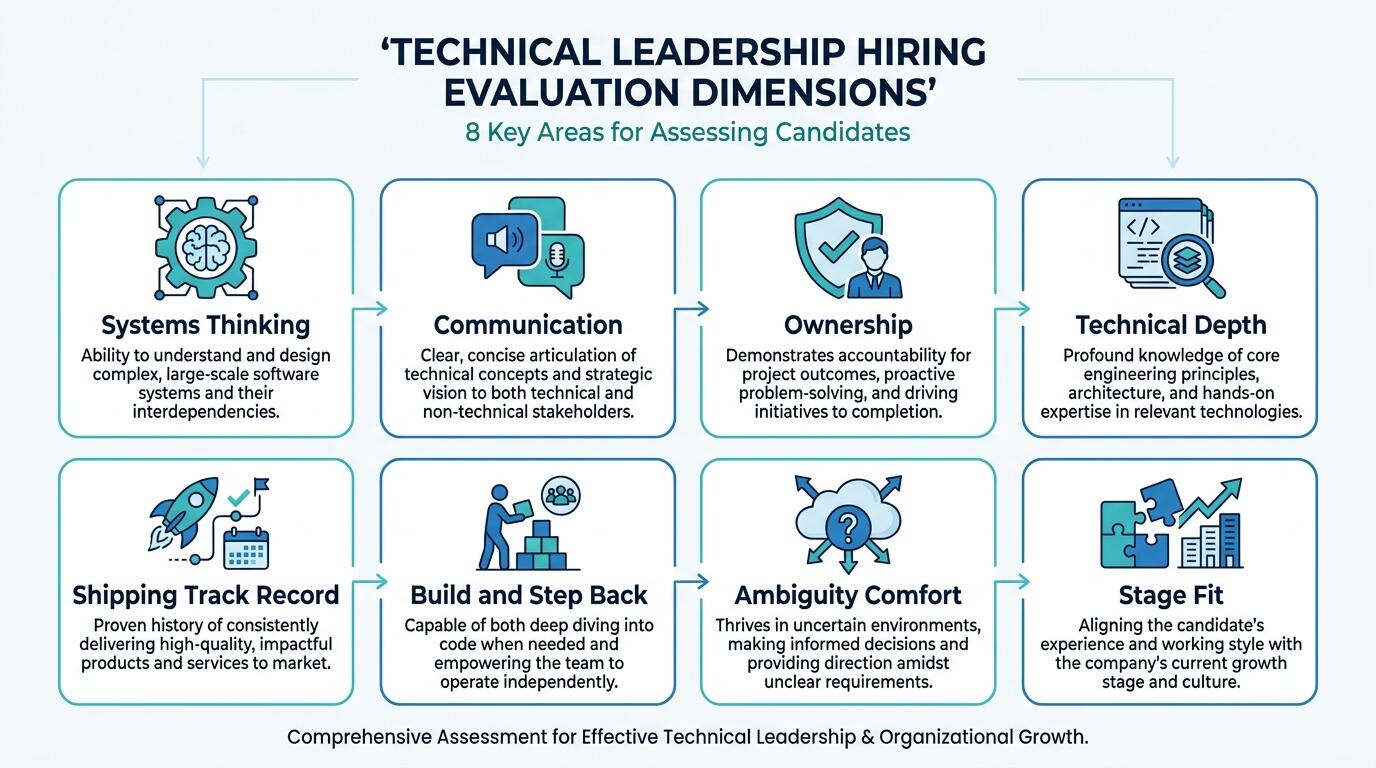
ALT: Structured evaluation framework showing eight key dimensions for assessing full-stack engineering candidates for technical leadership and management roles
Quick Comparison at a Glance
Use this table as a rapid reference when synthesizing candidate assessments across multiple hiring conversations.
| Signal | Best For | Key Strength | Limitation |
|---|---|---|---|
| Systems Thinking Before Code | First technical leader hires, VP-track candidates | Reveals architectural judgment early | Can be rehearsed with vocabulary without substance |
| Communication Across Audiences | Mixed technical/non-technical teams | Predicts cross-functional effectiveness | Charisma can mask lack of precision |
| Evidence of Ownership | All leadership-track roles | Differentiates leaders from executors | Can be over-rehearsed; probe for specifics |
| Technical Depth Without Tunnel Vision | Roles making durable technology decisions | Ensures adaptability as tech evolves | Depth and breadth can conflict; assess both |
| Track Record of Shipping | Early and growth-stage startups | Proves practical judgment under pressure | Shipping context matters; not all "shipped" is equal |
| Build and Then Step Back | Scaling engineering teams | Multiplies team effectiveness | Hard to assess in standard interviews |
| Comfort With Ambiguity | Early-stage companies with evolving requirements | Enables confident decisions under uncertainty | Ambiguity tolerance can shade into recklessness |
| Stage Fit | All companies, especially early-stage | Aligns operational instincts to current needs | Stage gaps are not always disqualifying |
How to Choose the Right Signals to Weight for Your Context
Not every signal on this checklist deserves equal weight in every hiring process. The right approach is to calibrate the checklist to the specific demands of the role and the current stage of your company.
If you are a pre-product-market-fit startup hiring your first technical leader, the most important signals are the track record of shipping, comfort with ambiguity, and stage fit. You need someone who can move fast, make defensible decisions without perfect information, and operate effectively in a resource-constrained environment. Systems thinking matters, but only if it translates to action.
If you are a growth-stage company hiring a VP of Engineering or a technical director, weight communication across audiences, the ability to build and then step back, and evidence of ownership more heavily. At this stage, the leverage points are organizational: you need someone who can shape culture, grow other engineers, and align technical direction with business goals.
A common misconception about evaluating full-stack candidates for leadership roles is that technical depth is the primary differentiator. In reality, most leadership-track failures are not caused by insufficient technical skill. They are caused by poor judgment about organizational dynamics, an inability to communicate effectively with non-technical stakeholders, or a mismatch between the candidate's operating model and the company's current stage. Technical depth is a necessary but not sufficient condition for leadership success.
For founders who are also evaluating broader technical strategy — for instance, thinking through how an engineering leader would approach AI infrastructure decisions — the build vs. buy framework for AI infrastructure offers a useful parallel exercise: the same kind of structured, trade-off-aware reasoning you want to see in a leadership candidate is the same reasoning that produces good infrastructure decisions.
When in doubt, run a practical exercise. Give candidates a real problem your team has faced — a scaling challenge, an architectural decision, a cross-team conflict — and ask them to work through it out loud. How they approach an ambiguous, real-world problem is far more predictive than how they perform on abstract algorithmic puzzles.
Questions & Answers
Q1: How should founders structure a technical interview for a full-stack candidate being evaluated for a leadership-track role?
Structure the interview in three layers: a technical depth assessment (architecture discussion, code review, or system design problem), a leadership and communication assessment (behavioral questions focused on ownership, conflict, and mentorship), and an operational judgment assessment (a real-world scenario with no clean answer). Avoid relying solely on algorithmic coding exercises — they are poor predictors of leadership performance and irrelevant to most full-stack engineering leadership contexts.
Q2: Are there meaningful differences between evaluating a full-stack candidate for a CTO role versus a VP of Engineering role?
Yes. A CTO role typically requires stronger external communication, product intuition, and technology vision — the ability to represent the technical strategy to investors, partners, and customers. A VP of Engineering role weights organizational leadership, hiring, process design, and team performance management more heavily. Both roles require the signals on this checklist, but the relative weight of each shifts significantly depending on which title and scope you are hiring for.
Q3: How much time should a founder invest in evaluating a leadership-track engineering candidate before making an offer?
The depth of evaluation should be proportional to the seniority and strategic importance of the role. For a first technical leader or head of engineering, a thorough process typically involves multiple conversations across different dimensions — technical, behavioral, and strategic — as well as reference checks with people who have worked closely with the candidate in demanding conditions. Rushing this process is one of the most expensive mistakes a founder can make; a misaligned technical leader can slow an engineering organization significantly.
The Bottom Line
Evaluating full-stack candidates for leadership-track roles requires a different frame than evaluating engineers for individual contributor positions. The three things that matter most: first, technical depth must be present, but it is not the differentiating factor — judgment, communication, and ownership are. Second, stage fit is one of the highest-leverage and most underweighted signals; a technically exceptional candidate who is calibrated to the wrong organizational context will underperform. Third, the best way to assess these signals is through practical, real-world exercises and deep behavioral probing, not algorithmic tests or resume pattern-matching.
Founders who invest in structured, signal-driven evaluation processes for leadership-track engineering roles build stronger, faster, and more resilient engineering organizations. Those who default to informal gut-feel hiring for these roles take on a disproportionate organizational risk — because the cost of a misaligned technical leader is rarely limited to one person's performance.
Use this checklist as a living document. Revisit it after every hire — good or bad — and update your understanding of which signals are most predictive for your specific company and team context.
If you are navigating hiring decisions alongside broader technical strategy questions — whether around AI architecture, systems design, or building a team capable of shipping at speed — explore hands-on insights and real project experience at the Darius website.
References & Further Reading
- SBOHub. "How top Operators evaluate Founders".
https://sbohub.substack.com/p/how-top-operators-evaluate-founders - Uplers. "A Founder's Hiring Vetting Checklist".
https://www.uplers.com/article/founders-hiring-vetting-checklist/ - LinkedIn / V. Anand. "Vibes Matter in Hiring: Trust and Chemistry in Startup Teams".
https://www.linkedin.com/posts/vaanand_i-want-to-give-every-startup-founder-permission-activity-7404899020810366976-eLeD - Society for Human Resource Management (SHRM). Resources on leadership hiring and communication competencies.
https://www.shrm.org/
Note: Hiring best practices and professional standards evolve; consult the latest official guidance or professional advisors for your specific context.