Extending a Web Product to Mobile: Full-Stack Considerations for Q4 2026
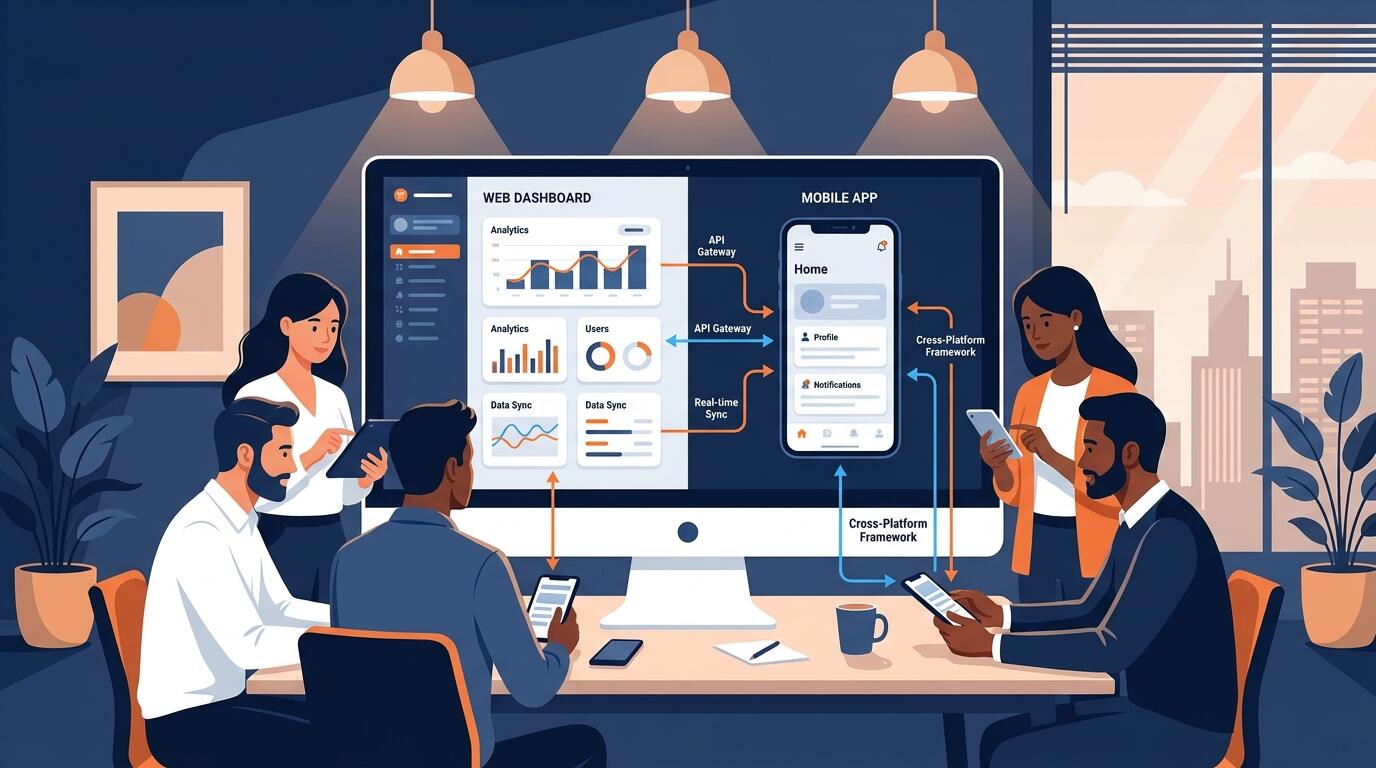
ALT: Full-stack engineering team extending a web product to mobile for Q4 2026 launch
Why Extending to Mobile Is a Full-Stack Problem, Not Just a Front-End One
You have a web product that works. Users are engaged, the architecture is reasonably clean, and the team has shipped consistently. Then the business makes a reasonable ask: "Can we get this on mobile?" What looks like a front-end project on the surface quickly reveals itself as a root-to-branch engineering challenge — touching your API contracts, authentication flows, offline behavior, CI/CD pipeline, and release process in ways nobody fully anticipated.
This tension is one of the most common patterns encountered in engineering leadership work: a mobile expansion that was scoped as a six-week sprint becoming a six-month architectural undertaking. The reason is almost always the same — the web product's full-stack assumptions were never designed with mobile clients in mind. As Q4 2026 approaches, the stakes are higher: mobile traffic continues to outpace desktop in most consumer and prosumer categories, cross-platform tooling has matured significantly, and users expect parity experiences across devices. This article breaks down where the real complexity lives and how to navigate it with pragmatism and architectural rigor.
The State of Web-to-Mobile Expansion Heading Into Q4 2026
Web-to-mobile expansion is the practice of taking an existing web application and delivering equivalent or complementary functionality through a native or hybrid mobile experience. As of late 2026, this is no longer a fringe engineering effort — it is a standard phase in the lifecycle of any digital product that reaches meaningful scale.
The tooling landscape has converged meaningfully over the past several years. React Native, Flutter, and progressive web app (PWA) patterns have all matured to the point where the "which framework" debate is less critical than the "how does our backend actually serve mobile clients" question. Per the React Native App Development Guide for modern applications, React Native in particular has become a dominant choice for teams already operating a JavaScript-heavy web stack, offering substantial code reuse between web and mobile surfaces.
At the same time, the cost of a poor mobile architecture has increased. App store review cycles, OS-level permission changes, push notification infrastructure, and platform-specific security requirements (such as iOS App Transport Security and Android's evolving permission model) add operational surface area that simply does not exist for web deployments. A team shipping a web product can push a fix in minutes; a mobile release may take days to reach users at scale.
The business context for Q4 2026 is also worth naming directly. Q4 is the highest-stakes quarter for most consumer and B2B SaaS products — peak usage, fundraising closes, and enterprise renewal cycles all converge. Shipping a mobile expansion in Q4 is either a strategic win or a liability, depending entirely on whether the architectural groundwork was laid in Q2 and Q3.
Where the Complexity Actually Lives: A Root-Cause Analysis
API Design and Contract Stability
The most consistently underestimated source of complexity in a web-to-mobile expansion is the API layer. Web applications frequently tolerate loose API contracts: over-fetching, inconsistent response shapes, and undocumented endpoints are manageable when the client is a browser that can be redeployed instantly. Mobile clients break this tolerance. A mobile app may sit on a user's device at version 1.3 for six months while the backend has moved to version 2.1. Every breaking API change during that window is a user-facing defect.
The practical mitigation is straightforward in principle and demanding in execution: API versioning, explicit deprecation policies, and field-level backward compatibility must become first-class engineering concerns before the first mobile release. Teams that skip this step consistently discover it the hard way during their first post-launch backend refactor.
Authentication and Session Management
Authentication flows designed for the web often rely heavily on browser-managed cookies and session state — mechanisms that do not translate directly to mobile environments. Mobile applications typically require token-based authentication (OAuth 2.0 with refresh token rotation is the current best practice), secure token storage at the OS level (iOS Keychain, Android Keystore), and handling for scenarios like app backgrounding, token expiry mid-session, and biometric re-authentication.
In practice, retrofitting a cookie-based web auth system to support mobile clients is a non-trivial backend and security engineering effort. It is also an area where shortcuts create serious vulnerabilities. This is one of the architectural decisions that benefits from early, deliberate design rather than bolt-on solutions added under launch pressure.
Offline Behavior and Data Synchronization
Web applications can generally assume a persistent network connection; mobile applications cannot. Offline-first design — the practice of building application logic that degrades gracefully and synchronizes state when connectivity is restored — is either a first-class architectural decision or an afterthought that haunts the team indefinitely.
The complexity here is not in the concept but in the implementation details: conflict resolution when a user edits data offline that was also edited server-side, queue management for actions taken without connectivity, and the UX contract that tells users what is "live" versus "pending sync." Teams that have not explicitly designed for this surface area ship a mobile product that behaves unpredictably in real-world network conditions — a particularly visible failure mode that damages user trust quickly.
Performance Constraints and Payload Optimization
Mobile devices, even modern flagships, operate under constraints that do not apply to desktop web: variable network quality, CPU throttling when the battery is low, and memory pressure from competing background processes. Payload optimization — reducing the size and complexity of API responses, implementing pagination and cursor-based loading, compressing assets aggressively, and using efficient serialization formats — matters significantly more for mobile clients than for web.
A pattern that surfaces repeatedly in full-stack engineering work is a web product that sends large, richly nested JSON payloads that are fast enough in a browser on a stable Wi-Fi connection but visibly slow on a mid-range Android device on LTE. The fix requires both backend changes (response shaping, GraphQL subscriptions or REST resource redesign) and frontend discipline — neither alone is sufficient.
Release Operations and CI/CD for Mobile
Mobile CI/CD is categorically different from web deployment pipelines. Web products can ship continuously; mobile products ship through app store review processes that introduce latency, policy risk, and version fragmentation. A mature mobile release pipeline requires code signing automation, environment-specific build configurations, beta distribution channels (TestFlight, Firebase App Distribution), crash reporting integration, and a clear strategy for forced upgrade scenarios when a breaking backend change cannot be avoided.
Teams that inherit a strong web CI/CD culture sometimes underestimate how much additional tooling and process is required to achieve comparable release confidence on mobile. According to guidance in the React Native App Development Guide, establishing this pipeline early — before it is needed for a critical release — is one of the highest-leverage investments a mobile-expansion team can make.
Evidence and Multi-Angle Comparison: Choosing Your Mobile Strategy
The "build native vs. cross-platform vs. PWA" question is the first decision most teams face, and it deserves an honest, multi-angle analysis rather than a framework vendor's marketing answer. When working with founders and CTOs navigating this exact decision, the right answer almost always depends on existing team skills, the nature of the product's core interactions, and timeline constraints — not on abstract performance benchmarks.
| Perspective / Approach | Strengths | Trade-offs | Best Fit |
|---|---|---|---|
| Progressive Web App (PWA) | Fastest time-to-mobile; no app store required; single codebase | Limited access to native device APIs; no presence in app stores; push notifications less reliable on iOS | Content-heavy products, early validation, B2B tools where users accept browser-based mobile UX |
| React Native (cross-platform) | Strong code reuse for JS/TS teams; large ecosystem; near-native performance for most use cases | Occasional platform-specific debugging complexity; bridge overhead for very high-frequency UI updates | Teams with existing React web codebases; products with standard mobile interaction patterns |
| Flutter (cross-platform) | Consistent UI rendering across platforms; strong performance; growing ecosystem | Dart language learning curve for teams not already using it; larger binary sizes | Greenfield mobile builds; teams willing to invest in a unified codebase from the start |
| Native iOS + Android | Maximum platform integration; best performance ceiling; full access to platform APIs | Two codebases to maintain; highest engineering resource requirement | Products where platform-specific behavior (camera, health data, ARKit/ARCore) is core to the value proposition |
The C-Suite Checklist for React.js Implementation for AI Digital products notes that React-based architectures offer particular advantages when the web product already uses a component-driven design system, because component logic can be shared or adapted for React Native with meaningful efficiency gains.
A point that is consistently underweighted in these framework discussions: the backend work is roughly the same regardless of which client framework is chosen. The API versioning, auth refactoring, offline design, and performance optimization described above must happen whether you build in React Native, Flutter, or native. Choosing a cross-platform framework saves engineering effort on the client; it does not reduce the backend investment.
For teams deciding between building custom mobile infrastructure and leveraging existing tooling and platforms, the principles explored in the build vs. buy framework for late 2026 apply directly here — particularly when evaluating whether to build a custom offline sync layer versus adopting an established solution.
Where This Is Heading and What It Means for Your Q4 Plan
Mobile-first user expectations are not softening. The gap between a polished mobile experience and a mediocre port of a web product continues to widen in users' perception, even as the tooling gap between web and mobile development narrows. Heading into Q4 2026, the teams that will ship successfully are those that treated mobile expansion as a full-stack architectural project starting at least two quarters ago — not those that kicked it off in October.
The near-term trajectory of web-to-mobile tooling points toward deeper integration between web and mobile development surfaces. Frameworks like React Native are moving toward better alignment with React's concurrent rendering model. PWA capabilities on iOS are expanding, if slowly. AI-assisted code generation is beginning to reduce the boilerplate cost of maintaining platform-specific code paths. These trends are favorable, but they do not eliminate the fundamental architectural work described in this article — they make it more tractable, not unnecessary.
For a Q4 2026 mobile expansion, the actionable priorities in order of urgency are:
- Audit your API contracts for mobile compatibility: identify over-fetching, undocumented endpoints, and any cookie-based session assumptions before writing a single line of mobile client code.
- Design your authentication flow for token-based mobile clients as a dedicated engineering workstream, not a sub-task.
- Make an explicit offline-behavior decision: even if the initial mobile release does not support full offline capability, define the degraded-state UX now so you are not retrofitting it under pressure.
- Stand up your mobile CI/CD pipeline before you need it for a real release.
- Choose your mobile framework based on your team's existing skills and the product's core interaction patterns — not on benchmark articles.
If your team is navigating the scope and sequencing of these workstreams under a tight Q4 timeline, the guidance in shipping fast without sacrificing product quality is directly relevant — particularly the sections on technical scoping and sequencing decisions under deadline pressure.
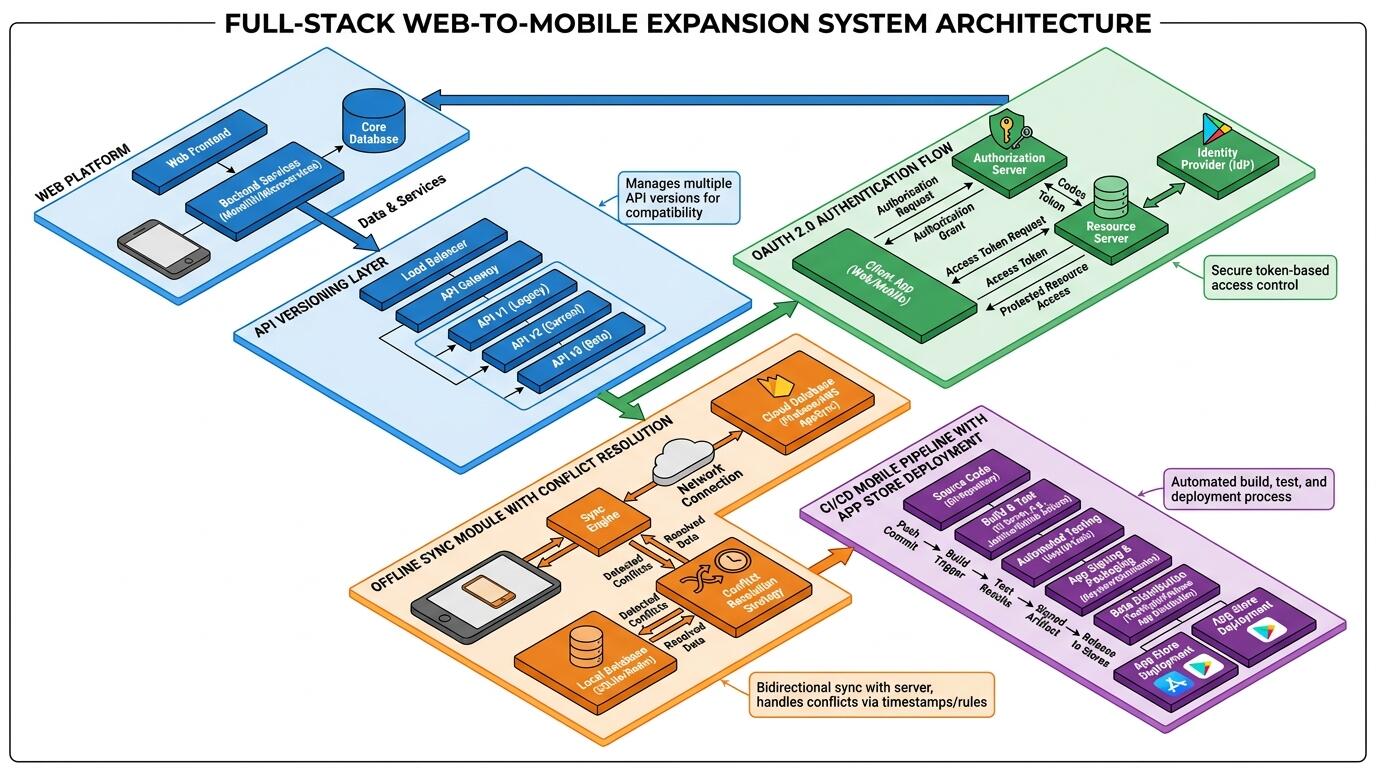
ALT: Full-stack mobile architecture diagram showing API versioning, authentication, offline sync, and CI/CD pipeline for web-to-mobile product expansion in Q4 2026
Questions & Answers
Q1: How should a team prioritize backend changes when extending a web product to mobile?
Prioritizing backend changes for mobile expansion should start with API contract stability and authentication. The highest-risk areas are undocumented or loosely typed endpoints that will break mobile clients during backend updates, and cookie-based session management that does not transfer to mobile environments. Tackle API versioning and token-based auth first, then address payload optimization and offline sync design as the client-side work matures. Sequencing backend work ahead of mobile client development reduces integration risk significantly.
Q2: Is a Progressive Web App sufficient to replace a native mobile app for most products?
A Progressive Web App is sufficient for a meaningful subset of use cases — particularly content-heavy, read-oriented, or B2B tools where users tolerate a browser-based mobile experience. However, PWAs currently face limitations on iOS around push notification reliability, access to certain native device APIs, and discoverability through the App Store. For products where engagement, retention, or native device integration (camera, biometric auth, background processing) are central to the value proposition, a native or cross-platform mobile app delivers a materially better outcome than a PWA alone.
Q3: How long does a web-to-mobile expansion typically take for a mature product?
Scope and timeline vary significantly by product complexity, but a credible mobile expansion for a mature web product — accounting for backend refactoring, client development, CI/CD pipeline setup, and app store submission — is rarely a project shorter than three to four months for a focused engineering team. Products with complex offline requirements, real-time features, or deeply entangled web-specific auth patterns should plan for longer. Teams that have validated their product and architecture rigorously before starting, as outlined in approaches to validating a product with real customers before building, tend to move faster because the core product decisions are already settled.
Summary
Extending a web product to mobile in 2026 is a full-stack engineering undertaking, not a front-end feature project. Three core findings from this analysis are worth anchoring on.
First, the backend work is the critical path. API versioning, authentication redesign, and payload optimization must precede mobile client development — not run in parallel with it. Teams that sequence these correctly ship faster and with fewer post-launch defects.
Second, the framework decision (React Native, Flutter, PWA, native) matters less than it dominates the discussion. Each approach has legitimate trade-offs, and the right answer is almost always determined by existing team skills and the product's core interaction patterns. The backend investment is roughly equivalent across all choices.
Third, mobile CI/CD and release operations are underestimated consistently. Building a mature mobile release pipeline before it is needed for a critical launch is one of the highest-leverage investments a team can make, and it requires deliberate effort that the web deployment culture does not automatically provide.
For Q4 2026 specifically: if the architectural groundwork described in this article has not started yet, the honest advice is to scope the Q4 mobile release conservatively, ship a stable foundation, and resist the temptation to pack full feature parity into the first release. A well-architected mobile foundation ships features faster in Q1 2026 than a rushed Q4 release that accumulates architectural debt from day one.
The engineering decisions made in the next eight to twelve weeks will determine whether the mobile expansion becomes a competitive advantage or an operational liability. Get the architecture right first.
For practitioners and technical leaders who want to go deeper on architectural decisions, tooling tradeoffs, and real-world engineering frameworks, the Darius engineering wiki is built exactly for that — practical, practitioner-authored thinking on the decisions that actually matter when shipping complex software products.
References
- RipenApps. "React Native App Development Guide for Modern Applications".
https://ripenapps.com/blog/guide-to-develop-react-native-app/ - Full Stack Techies. "C-Suite Checklist for React.js Implementation for AI Digital Products".
https://fullstacktechies.com/c-suite-checklist-for-react-js-implementation/ - Adventist Media. "Tracker for Web Development 2026".
https://adventist.org.ws/assets/uploads/hoB013Qv8FNn/Tracker_For_Web_Development_2026
Note: Standards and technical guidance may be updated; please verify against the latest official documentation or consult qualified technical advisors before making architectural decisions.