Designing APIs That Work Cleanly With LLM-Powered Features
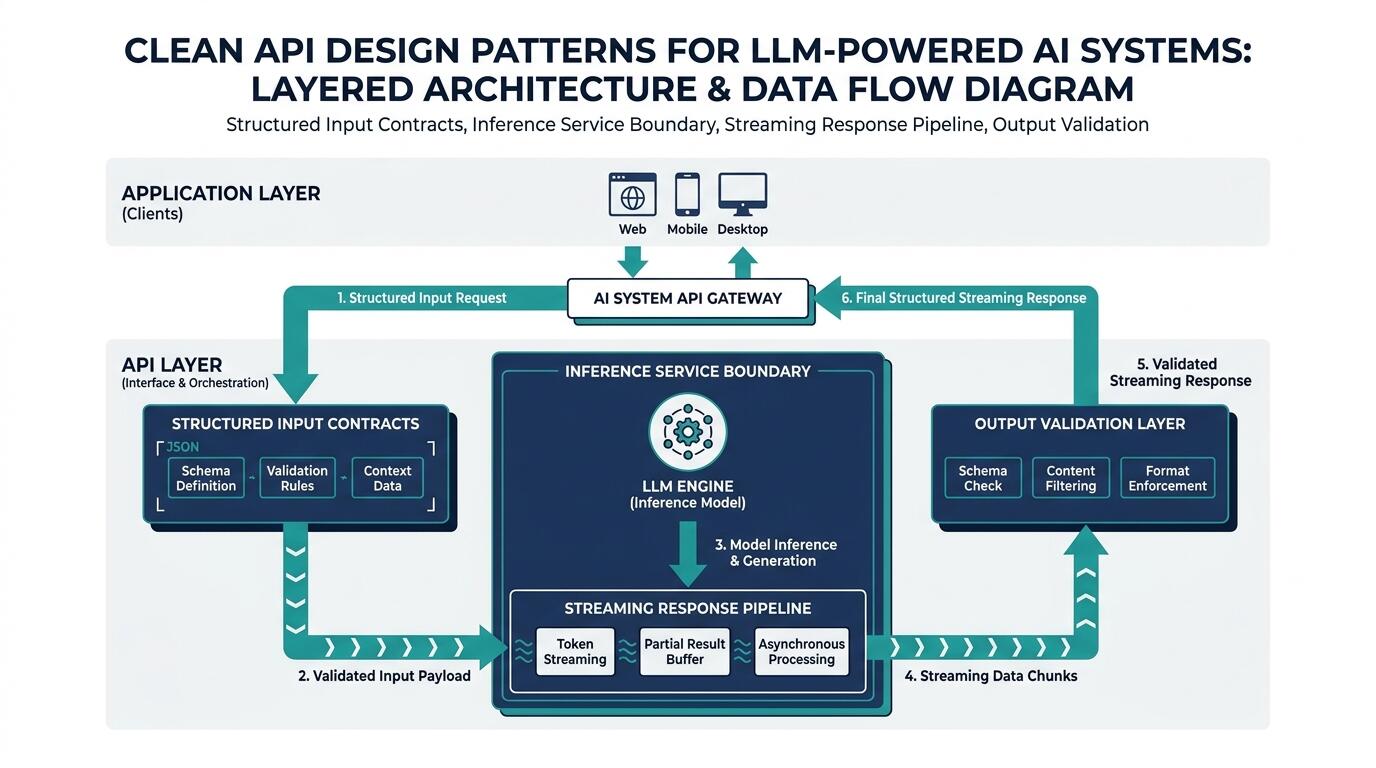
ALT: Engineering diagram showing clean API design patterns for LLM-powered AI features and systems
What You'll Achieve: A Practical Framework for LLM-Ready API Design
You've shipped a backend that works cleanly for traditional request-response cycles. Now you're adding an LLM-powered feature — maybe a context-aware assistant, a document summarizer, or a natural-language query interface — and suddenly the seams start showing. Response times stretch unpredictably, prompt logic bleeds into route handlers, and your data contracts feel fragile in ways they never did before. If this scenario sounds familiar, this guide is written for you.
Designing APIs that integrate cleanly with large language model features is a distinct discipline from conventional API design. The nondeterminism of model outputs, the latency profile of inference calls, and the stateful nature of conversational context all demand architectural decisions your standard REST or GraphQL playbook does not fully address. This guide walks through a concrete, step-by-step approach to building API surfaces that are robust, maintainable, and genuinely production-ready when LLM-powered capabilities are in the mix. It is aimed at startup CTOs, engineering leads, and senior engineers who are past the proof-of-concept stage and need to ship with confidence.
Before You Start: Prerequisites and Preparation for LLM API Design
Solid LLM API design is not a purely technical exercise — it requires clarity on product intent, infrastructure assumptions, and team conventions before a single endpoint is defined. Rushing into interface design without this groundwork is one of the most consistent failure patterns seen in early AI product builds.
What you need before starting:
- A working understanding of how LLM inference works at a conceptual level: token limits, completion versus chat interfaces, and the distinction between synchronous and streaming responses.
- A defined product requirement for the LLM-powered feature — not just "add AI" but a specific user action, input shape, and expected output contract.
- A chosen inference provider or local model strategy. The architectural implications differ meaningfully, and that decision should be settled before API design begins. The broader question of building versus buying your AI infrastructure is worth working through explicitly before locking in an approach.
- Familiarity with your existing API layer: authentication patterns, error taxonomy, versioning conventions, and how your current consumers handle failure.
- A clear stance on acceptable latency. LLM calls are not fast in the way a database read is fast. Your team needs shared expectations before designing the contract.
- An understanding of whether your feature requires stateless completions or stateful conversational context — this shapes virtually every subsequent design decision.
The work ahead is not trivial, but it is manageable when approached methodically. Teams that skip this preparation tend to discover the gaps at integration time, which is a significantly more expensive place to find them.
Step-by-Step Instructions: Building APIs That Work Cleanly With LLM-Powered Features
Step 1: Define a Strict Input Contract That Accounts for Prompt Variability
The first and most consequential decision in LLM API design is how you represent the input to your endpoint. A pattern that repeatedly causes problems is allowing raw user text to flow directly and unconstrained into the API as the sole input parameter. LLM behavior is sensitive to prompt structure, and that structure should be owned by your service layer — not improvised at runtime or delegated to the client.
Define a structured input schema that separates the semantic components of the request: the user's intent or query, any context documents or retrieved chunks, the conversational history (if applicable), and configuration parameters like tone, output format, or feature flags. Each of these has different validation, sanitization, and size-constraint needs, and conflating them into a single untyped string field makes all of those concerns invisible.
In practice, this means your endpoint accepts a typed payload — a JSON body with named fields and enforced schemas — and your service assembles the final prompt internally from those components. The client never sends a raw prompt string. This boundary is important: it keeps prompt engineering logic centralized and auditable, makes it possible to update prompts without changing the client contract, and gives you a clean place to enforce input validation before any inference call is made.
Tip: Treat your prompt assembly layer as a first-class internal module, not an inline string concatenation buried in a route handler. It will change frequently as you tune model behavior, and that change surface should be isolated.
Step 2: Design for Streaming from the Start, Not as an Afterthought
Most LLM inference calls produce output incrementally — the model generates tokens sequentially, and waiting for the full response before sending anything to the client produces a user experience that feels broken. Per the analysis published by Cyclr in "Why Better APIs Matter for AI and LLMs", the latency characteristics of LLM responses are a primary differentiator in how users perceive AI feature quality, and streaming is central to managing that perception.
Design your API to support streaming responses from the outset, even if your initial implementation sends the full payload at once. This means choosing a transport that supports it — Server-Sent Events and chunked HTTP transfer are the most common patterns for web-facing APIs — and establishing clear conventions for how your stream communicates status, partial content, errors, and completion signals to the consumer.
The failure mode to avoid is retrofitting streaming onto an API designed for synchronous JSON responses. That retrofit almost always produces a messy hybrid that is hard to consume reliably on the client side. Clients that built against the synchronous version need a migration path, internal tooling that parses the response needs to be rewritten, and the error handling semantics are almost always inconsistent. Starting stream-aware saves all of that cost.
Tip: Define a stream event envelope early — a consistent structure for each chunk that includes a type field (content, error, done), a payload, and optionally a sequence identifier. Consumers that handle the envelope protocol correctly will be robust to changes in payload shape.
Step 3: Isolate LLM Calls Behind an Internal Service Boundary
Direct coupling between your API route handlers and the LLM provider SDK is a structural liability. It makes provider substitution difficult, complicates retry and fallback logic, and ensures that any change in the provider's interface requires changes throughout your codebase.
Introduce an explicit inference service layer — a dedicated internal module or microservice whose sole responsibility is to execute LLM calls, apply retry strategies, handle provider-specific error codes, and enforce timeout budgets. Your route handlers call this service through a stable internal interface; they are agnostic to whether the underlying call goes to a hosted API or a locally deployed model.
This boundary also gives you a clean place to instrument. Logging prompt inputs, completion outputs, token counts, latency, and error rates at this layer gives you the observability you need to debug quality issues, track cost, and detect regressions when you update a model or prompt. Without this boundary, that instrumentation tends to end up scattered or missing entirely.
Tip: Design the internal interface of your inference service to accept a normalized request object — one that abstracts over provider-specific parameter names — so that switching providers requires changes only inside the service, not in every caller.
Step 4: Build a Consistent, Typed Error Taxonomy for LLM-Specific Failures
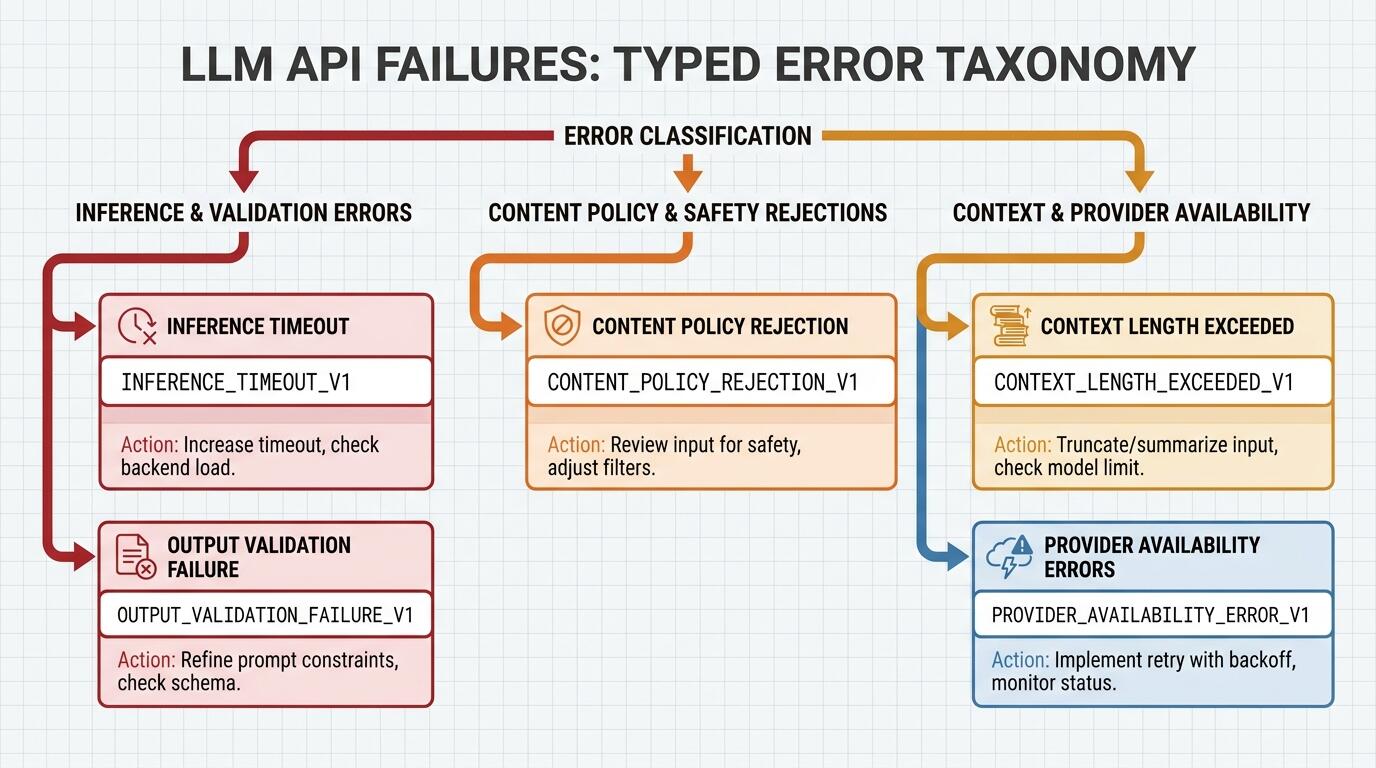
ALT: Diagram illustrating a typed error taxonomy for LLM API failures including timeout, content policy, and token limit errors
LLM-powered features introduce a class of errors that do not exist in conventional APIs, and your error contract needs to represent them explicitly. The categories that consistently appear in production systems include: inference timeout (the model call exceeded your latency budget), context length exceeded (the combined prompt and history exceeded the model's token window), content policy rejection (the provider refused the request on safety grounds), output validation failure (the model returned a response that does not conform to your expected format), and provider availability errors (rate limits, service degradation, quota exhaustion).
Each of these has different implications for the client. A timeout might be retried immediately. A context length error requires the client to truncate history. A content policy rejection should surface a user-facing message, not a generic 500. A provider availability error might trigger a fallback model path.
Map each failure category to an explicit error code in your API response — a stable string identifier, not just an HTTP status code. Include enough context in the error payload for the client to take appropriate action. Clients that receive a typed error code can handle it programmatically; clients that receive a generic "something went wrong" cannot.
Tip: Versioned error codes — strings like INFERENCE_TIMEOUT_V1 rather than opaque integers — give you room to evolve error semantics without breaking existing clients.
Step 5: Handle Conversational State Explicitly and at the Right Layer
Conversational LLM features require stateful context: the model needs the history of the exchange to produce coherent responses. The question of where that state lives and how it is managed is one of the most consequential architectural decisions in LLM API design, and it is one where teams frequently make the wrong call initially.
The tempting approach is to make the client responsible for maintaining and sending the full conversation history with each request. This keeps the server stateless, which is a virtue in conventional API design. But in LLM contexts, unbounded client-side history accumulation leads directly to token window violations as conversations grow, creates inconsistent context across client instances, and makes it impossible to apply server-side context policies — summarization, retrieval augmentation, or history pruning — transparently.
The more robust pattern is to manage conversation sessions server-side. The API issues a session identifier on conversation initialization; subsequent requests reference that identifier, and the server manages what history is actually sent to the model — applying summarization or RAG-based retrieval as appropriate to keep the effective context within token budget. The client remains simple; the complexity is centralized where it can be maintained and monitored.
Tip: Expose session management as an explicit API surface — endpoints for creating, retrieving, and clearing sessions — rather than making it implicit behavior. Explicit surfaces are easier to document, test, and reason about.
Step 6: Enforce Output Validation and Define a Degraded-Mode Contract
LLM outputs are nondeterministic. Even a well-tuned prompt will occasionally produce output that does not match your expected format — a JSON block that is malformed, a structured response that is missing a required field, or prose where a list was expected. Your API must handle this, and "handle" means something specific: validate the output, and define what happens when validation fails.
For features that require structured output — function call results, data extraction, classification labels — implement a validation step after the inference call and before the response is returned to the client. If validation fails, you have a decision tree: retry with an explicit correction prompt, return a typed validation failure error, or fall back to a degraded response that surfaces partial data with an explicit signal that the output is incomplete.
The key principle is that your API should never silently return a malformed LLM output as if it were valid. Silent failures in AI features are substantially harder to debug than explicit ones, and they erode user trust in ways that are difficult to recover from.
According to Stonebranch's published guidance on embedding LLM tasks in automation workflows, output validation and structured retry loops are among the most impactful patterns for making LLM integrations reliable in production — a finding that aligns exactly with what we see consistently in practice.
Tip: Use a schema validation library at the output layer — the same way you validate incoming request bodies — and treat LLM output validation as a first-class concern, not a post-launch fix.
Step 7: Version Your API Contract Thoughtfully, Including Prompt Semantics
API versioning in LLM contexts is more nuanced than in conventional services because the effective contract includes not just the request and response schema but the semantic behavior of the model. A prompt change that improves output quality for most users may break downstream consumers who built against the previous output style. This is a genuine versioning concern that most teams do not account for until it has already caused a problem.
Adopt a versioning strategy that distinguishes between breaking and non-breaking changes, and extend that distinction to cover prompt and model changes that materially alter output characteristics. Document your output semantics — the expected format, typical length, structure, and tone of responses — as part of the API contract, not just the schema. When those semantics change in ways that could affect consumers, treat it as a version bump.
For teams in the early stages of an AI architecture engagement, what to expect from an AI architecture engagement covers how this kind of forward-looking API planning fits into a broader system design process.
Tip: Maintain a prompt changelog alongside your API changelog. When output behavior shifts unexpectedly, the prompt history is the first place to look — and having it documented saves significant debugging time.
Common Mistakes and Troubleshooting in LLM API Design
| Symptom | Likely Cause | How to Fix |
|---|---|---|
| Clients receive 500 errors on long conversations | Token window exceeded with no graceful handling | Implement server-side context management with history summarization or pruning; return a typed CONTEXT_LIMIT error when the window is approached |
| Output format is inconsistent across requests | Prompt does not enforce output structure, or model temperature is too high | Add explicit format instructions to the system prompt; implement output schema validation with retry logic on failure |
| LLM provider changes break multiple parts of the codebase | Direct SDK coupling in route handlers instead of an isolated inference service | Refactor all provider calls behind a single internal service layer with a normalized interface |
| Streaming responses disconnect mid-generation | No reconnection logic or heartbeat in the stream protocol | Implement SSE reconnection tokens; send periodic heartbeat events to keep the connection alive during long generations |
| Latency spikes are invisible until users complain | No instrumentation at the inference service boundary | Add latency, token count, and error rate logging at the inference service layer; set up alerting thresholds |
| Prompt injection from user input corrupts model behavior | User text flows directly into prompt construction without sanitization | Enforce strict input schemas; assemble prompts in a centralized module that sanitizes and bounds user content before insertion |
Pro Tips for Better LLM API Design Results
Design for cost as a first-class constraint. Token consumption translates directly to inference cost, and APIs that do not enforce input and history size limits will produce unpredictable cost curves as usage scales. Build token budget enforcement into your inference service — set hard limits on prompt size, implement automatic history summarization when a threshold is approached, and log token usage per request so you can track cost by feature and user segment.
Use idempotency keys for non-streaming LLM requests. Retrying a failed LLM call without idempotency controls can produce duplicate side effects — particularly in agentic features where the model's output triggers downstream actions. Assign an idempotency key to each inference request and cache the result for a short window so that client retries return the original response rather than triggering a new call.
Separate read and write paths for features that persist LLM outputs. If your API stores model outputs — summaries, classifications, generated documents — treat the write path as eventually consistent and the read path as separate. LLM generation is inherently asynchronous even when you make it feel synchronous, and building around that reality produces cleaner semantics than forcing it into a synchronous write model.
Test prompt behavior as part of your CI pipeline. A common misconception is that prompt changes are low-risk configuration updates that do not require the same rigor as code changes. In practice, prompts are behavioral code — they define how your feature responds to inputs — and they should be tested with a suite of representative inputs and evaluated against expected output characteristics on every change. Regression testing for AI features is not optional in production systems.
Plan your fallback model path before you need it. Provider outages and rate limits are real operational events. The teams that handle them gracefully are the ones that designed a fallback path — a secondary provider, a smaller local model, or a graceful degradation response — before the incident occurred, not during it. The question of local versus hosted model strategy, as explored in the discussion of LLM API versus local model strategy, is worth settling with explicit fallback criteria in mind.
Questions & Answers
Q1: How should I handle authentication and authorization for LLM-powered API endpoints?
Authentication for LLM endpoints follows the same principles as any sensitive API — use token-based auth, enforce rate limiting per authenticated identity, and scope permissions to specific features rather than granting blanket access. The additional consideration is that LLM endpoints carry higher per-request cost than typical endpoints, so rate limiting should be tuned to both abuse prevention and cost control. Quota enforcement at the authentication layer, before any inference call is made, is a practical safeguard most teams add after their first cost spike.
Q2: Is it acceptable to expose raw LLM outputs directly to end users through the API?
Exposing raw LLM outputs without a validation or filtering layer is generally not advisable for production features. Model outputs can include hallucinated facts, formatting inconsistencies, or content that does not match your application's tone and safety requirements. A lightweight output processing stage — validation against an expected schema, content filtering, and optional formatting normalization — between the inference call and the client response provides meaningful protection against the failure modes that erode user trust most quickly. The overhead is low relative to the inference latency, and the benefit is significant.
Q3: How long does it typically take to refactor an existing API to support LLM features cleanly?
The effort is heavily dependent on how tightly the existing codebase couples business logic to request handling. Teams with clean service boundaries and good test coverage can often introduce an inference service layer and structured input contracts in a focused sprint. Teams with dense route handlers and no separation of concerns face a more substantial refactor. The highest-leverage starting point is almost always the isolation of LLM calls behind an internal service boundary — that single change enables all subsequent improvements without requiring a complete rewrite.
The Bottom Line
Designing APIs that work cleanly with LLM-powered features comes down to three foundational commitments: enforce strict, structured contracts at both the input and output boundaries; isolate all inference logic behind a dedicated service layer with proper instrumentation; and design for the failure modes that are unique to nondeterministic, high-latency model calls from the start.
These are not theoretical principles — they are the patterns that separate LLM features that hold up under real usage from ones that accumulate technical debt faster than they ship value. The teams that build these foundations early spend their time on product iteration; the ones that skip them spend it on incident response and structural refactors.
If you are building an AI-powered product and want to get the architecture right before the codebase calcifies around the wrong decisions, the time to address these design questions is before production load reveals them. Solid API design is how you make the move from demo to durable product. Explore more technical frameworks and practitioner-level engineering thinking at Darius's engineering wiki, where these patterns are developed in depth across real-world contexts.
Visit the Darius website to explore frameworks, architectural breakdowns, and practical guidance built from shipping real AI products — and to find out how an Engineering Director and AI Architect can help you design systems that are built to last.
Sources
- Cyclr. "Why Better APIs Matter for AI and LLMs".
https://cyclr.com/resources/ai/why-better-apis-matter-for-ai-and-llms - Stonebranch. "10 Clever Ways to Embed LLM Tasks in Automation Workflows".
https://www.stonebranch.com/blog/10-clever-ways-to-embed-llm-tasks-in-automation-workflows - LinkedIn / M. F. Williams. "LLM Strategy: API or Local Model?".
https://www.linkedin.com/posts/mfwilliams_local-llm-or-api-every-ai-product-hits-this-activity-7407168500529655808-Wq7P - IEEE. IEEE Standards for Software and Systems Engineering — covering API design principles and software architecture standards.
https://www.ieee.org/ - IETF (Internet Engineering Task Force). RFCs governing HTTP, Server-Sent Events, and API protocol standards relevant to streaming and REST design.
https://www.ietf.org/
Note: Standards and best practices in this domain evolve rapidly. Verify the latest official documents and consult qualified technical advisors for decisions with significant production or business impact.