Mobile App Frameworks Worth Considering for Cross-Platform Teams This Fall
ALT: Cross-platform mobile app frameworks comparison for engineering teams evaluating Flutter, React Native, and Kotlin Multiplatform
Choosing the Right Cross-Platform Mobile Framework for Your Team This Fall
Key Conclusion: For most cross-platform teams shipping mobile products this fall, Flutter offers the strongest balance of UI consistency, performance, and ecosystem maturity — but React Native remains the pragmatic choice for JavaScript-heavy organizations, and Kotlin Multiplatform (KMP) is earning serious consideration for teams that want native UI fidelity without sacrificing shared business logic. The right framework is not the most popular one; it is the one that fits your team's skills, product type, and delivery timeline.
Choosing a cross-platform mobile app framework is one of those decisions that feels tactical in the moment but shapes your product's architecture for years. This article compares three leading frameworks — Flutter, React Native, and Kotlin Multiplatform — across criteria that actually matter when you are trying to ship something real: developer experience, performance, ecosystem depth, AI/backend integration, and long-term maintainability. The goal is to give you a clear, opinionated read so your team can make a confident call before the quarter gets away from you.
Evaluation Criteria That Actually Matter for Cross-Platform Development
Selecting a mobile development framework deserves the same rigor you would apply to any architectural decision — because the wrong choice compounds over time. The following criteria define the dimensions of this comparison, chosen because they surface the trade-offs that most commonly derail cross-platform projects in practice.
Developer experience and hiring pool. A framework is only as good as the team that can use it. Dart (Flutter's language) has a steeper learning curve than JavaScript, but teams that invest in it tend to report high productivity after the initial ramp. React Native's JavaScript/TypeScript base means a vastly larger hiring pool. KMP requires Kotlin fluency, which correlates strongly with teams that already have Android engineers.
UI consistency and rendering model. This criterion separates frameworks that genuinely unify the mobile experience from those that merely share code while leaving UI fragmented. Flutter renders its own widgets using the Skia/Impeller engine, guaranteeing pixel-perfect consistency across platforms. React Native delegates UI rendering to native components, which means it looks native but can diverge between iOS and Android. KMP deliberately avoids a shared UI layer by default, leaving UI to platform-native code.
Performance characteristics. Cross-platform has historically meant a performance tax. Modern frameworks have narrowed the gap significantly, but the degree to which that gap matters depends on your product — a data-heavy dashboard behaves differently than a gesture-driven creative tool.
Ecosystem and third-party integrations. In practice, you will need SDKs, device APIs, analytics libraries, payment gateways, and often AI inference capabilities. Framework maturity directly affects whether those integrations exist out of the box or require you to write custom bridge code — a hidden cost that teams routinely underestimate.
AI and backend integration readiness. As more mobile products embed on-device inference, streaming AI responses, or real-time data pipelines, the ease with which a framework supports these patterns is increasingly a first-class concern. A pattern consistently emerging in cross-platform work is that teams who treat AI integration as an afterthought end up retrofitting their architecture at significant cost.
Long-term maintainability. Community health, corporate backing, upgrade path stability, and documentation quality all feed into whether a codebase is still pleasant to work with two years from now.
The Contenders: Flutter, React Native, and Kotlin Multiplatform
Flutter: Google's Widget-First Cross-Platform Framework
Flutter is an open-source UI SDK created by Google that uses the Dart programming language and a self-contained rendering engine to produce natively compiled applications for mobile, web, and desktop from a single codebase. Its defining characteristic is that it draws every pixel itself — rather than mapping to native UI components — which gives it exceptional consistency across iOS and Android. Flutter's package ecosystem (pub.dev) has matured substantially, and it has a strong presence in the enterprise mobile space. According to industry surveys and community reports, Flutter has become one of the most-used cross-platform frameworks among professional developers. For teams building products that depend on a polished, branded UI where visual consistency is non-negotiable, Flutter's rendering model is a genuine structural advantage.
React Native: Meta's JavaScript-Powered Mobile Bridge
React Native is an open-source framework developed by Meta (formerly Facebook) that allows developers to build mobile applications using JavaScript or TypeScript and React. Unlike Flutter, React Native does not own its rendering layer; instead, it bridges JavaScript code to native platform components. The New Architecture (introduced progressively over recent releases) replaces the old JavaScript bridge with JSI (JavaScript Interface) and Fabric, which meaningfully improves performance and interoperability. React Native's primary advantage is its enormous ecosystem: the JavaScript/TypeScript talent pool is the largest in software development, and the npm ecosystem gives teams access to a vast library of pre-built integrations. Teams with existing web-product codebases and React expertise consistently find React Native the fastest path to a working mobile product.
Kotlin Multiplatform: JetBrains' Shared-Logic, Native-UI Approach
Kotlin Multiplatform (KMP) is a technology from JetBrains that enables sharing Kotlin code — specifically business logic, data layers, and networking — across Android, iOS, and other targets, while leaving the UI to be written natively on each platform. KMP reached stable status, which signals JetBrains' commitment to long-term support. Unlike Flutter and React Native, KMP does not attempt to unify the UI layer by default; Compose Multiplatform (a separate, companion project) extends Kotlin's Compose UI to iOS and other platforms, but its iOS support is still maturing. The key value proposition of KMP is risk reduction for organizations that already have Android teams and want to share validated business logic with iOS without fully committing to a shared UI paradigm. It is the least "all-in" of the three approaches, which is both its strength and its limitation.
Head-to-Head Comparison of Leading Cross-Platform Mobile Frameworks
| Criterion | Flutter | React Native | Kotlin Multiplatform |
|---|---|---|---|
| Primary language | Dart | JavaScript / TypeScript | Kotlin |
| UI model | Self-rendered (Impeller/Skia) | Native components via bridge | Native UI per platform (Compose Multiplatform optional) |
| Performance | High — near-native across platforms | Good; improved significantly with New Architecture | Native — no shared-UI overhead |
| Hiring pool | Moderate (Dart is Flutter-specific) | Very large (JS/TS ecosystem) | Moderate-large (Kotlin Android developers) |
| Ecosystem maturity | Strong (pub.dev, growing) | Very strong (npm, large community) | Moderate (maturing rapidly) |
| AI / ML integration | Good (via TensorFlow Lite, platform FFI) | Good (via native modules, JS inference libs) | Excellent for Android; iOS AI integration via native layer |
| UI consistency across platforms | Excellent (pixel-perfect) | Good (native look, but divergence possible) | Varies (native per platform = authentic, not unified) |
| Learning curve | Moderate (Dart onboarding) | Low-moderate for JS teams | Low for Kotlin/Android teams; high for others |
| Long-term backing | Google (strong) | Meta (strong, active development) | JetBrains (stable, committed) |
| Shared code coverage | High (UI + logic) | High (UI + logic) | Logic-only by default; UI optional via Compose MP |
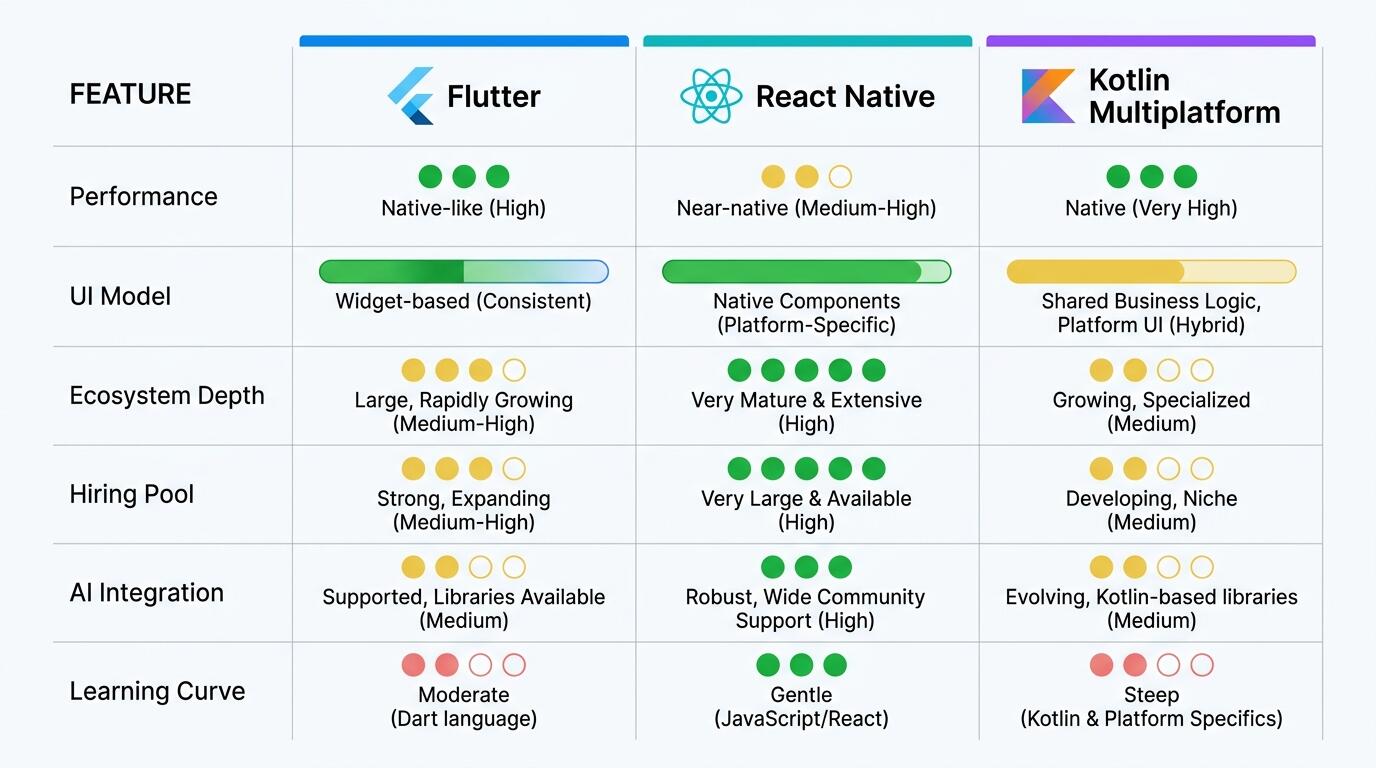
ALT: Comparison matrix showing Flutter, React Native, and Kotlin Multiplatform performance, UI model, and ecosystem depth for cross-platform mobile development teams
The most consequential difference in this table is the UI model column. Flutter's self-rendering approach means you get one codebase that looks identical on every device — but it also means your app will not automatically inherit platform UI conventions unless you deliberately build them in. That is a design and product decision, not just a technical one. Teams building consumer apps where users have strong expectations of "feeling native" should weigh this carefully.
React Native's move to the New Architecture addresses the performance concerns that plagued earlier versions, and teams already working in TypeScript will find the productivity gains immediate. The risk is the JS bridge complexity, third-party library inconsistency, and the occasional platform-specific bug that surfaces only on iOS or Android — these are real, recurring pain points that teams in cross-platform work encounter regularly. Per ongoing community documentation and developer experience reports from Meta's engineering blog, the New Architecture has substantially reduced these incidents, but they have not disappeared.
Kotlin Multiplatform is the most nuanced of the three. It does not ask you to bet on a single shared UI paradigm, which lowers the risk of a "wrong framework" decision — but it also means you are maintaining two UI codebases. For organizations with mature Android teams who want to share validated, tested business logic with an iOS team without disrupting existing workflows, KMP is frequently the most pragmatic path. According to resources such as those compiled by Evince Development, KMP adoption has accelerated markedly among enterprise teams, particularly those migrating from hybrid approaches toward more controlled, architecture-first strategies.
Which Framework Should You Choose? Scenario-Based Recommendations
Matching a framework to a team is not about picking the objectively best tool — it is about honest self-assessment of where your team is right now and where your product needs to be six months from now. If you are weighing how to ship fast without sacrificing product quality, the framework decision is one of the highest-leverage choices you will make early in a product cycle.
If your team is primarily JavaScript/TypeScript engineers with existing React knowledge, choose React Native. The productivity advantage of working in a familiar language and paradigm outweighs the framework's rough edges, provided you are disciplined about adopting the New Architecture and vetting third-party libraries for active maintenance.
If UI consistency and cross-platform visual polish are primary product requirements, choose Flutter. Fintech dashboards, design-forward consumer apps, and any product where brand coherence across iOS and Android is a competitive differentiator will benefit from Flutter's self-rendering model. The Dart learning curve is real but manageable, and the pub.dev ecosystem now covers most integration needs.
If you have an established Android Kotlin codebase and want to extend validated logic to iOS without a full rewrite, choose Kotlin Multiplatform. KMP is also the right choice if your organization is risk-averse about committing to a shared-UI paradigm — you get the shared logic benefit while keeping native UI control on each platform.
If you are an early-stage team with no existing mobile codebase and need to ship a first version quickly to validate product-market fit, React Native or Flutter are both defensible — but lean toward whichever language your founding engineers already know. Framework productivity is highest when the team is not also learning a new language simultaneously.
Avoid common pitfalls regardless of framework:
- Underestimating platform-specific integration work. Every cross-platform framework requires native module work at some point. Budget for it.
- Choosing based on hype rather than team fit. The most-discussed framework on social media is not necessarily the right one for your use case.
- Ignoring upgrade path stability. Check the framework's release history and breaking-change patterns before committing. A framework with a history of disruptive major releases will cost you in migration cycles.
- Treating AI integration as future-you's problem. If your roadmap includes on-device inference, AI-powered features, or streaming model responses, validate that your chosen framework supports those integration patterns before you commit. This is worth a focused spike in the early weeks of any new mobile project.
For teams also evaluating broader infrastructure decisions in parallel, the same rigor applies — frameworks for build vs. buy in AI infrastructure mirror the trade-offs you face here: the "best" option is the one aligned with your team's capabilities and your product's actual requirements.
People Also Ask
Q1: How do Flutter and React Native differ in terms of performance for production mobile apps?
Flutter and React Native both deliver near-native performance in most production scenarios, but they achieve it differently. Flutter compiles Dart code to native ARM and uses its own rendering engine, avoiding the overhead of a JavaScript bridge. React Native's New Architecture, which replaces the old bridge with JSI (JavaScript Interface), has significantly reduced its historically higher overhead. For most business applications, the performance difference is not perceptible to end users. Animation-heavy or graphics-intensive apps tend to show Flutter's rendering advantage more clearly.
Q2: Is Kotlin Multiplatform ready for production use in enterprise mobile projects?
Kotlin Multiplatform reached stable status as declared by JetBrains, signaling production readiness for its core value proposition: sharing business logic and data layers across Android and iOS. Enterprise teams at organizations including Netflix and VMware have documented KMP adoption for production systems. Compose Multiplatform — the companion shared-UI layer — is still maturing for iOS targets, so teams requiring a fully shared UI stack should evaluate its current stability against their timeline before committing.
Q3: How long does it typically take to migrate an existing native app to a cross-platform framework?
Migration timelines vary significantly based on app complexity, codebase size, and team experience. A straightforward app with limited native integrations might complete a React Native or Flutter migration in a few months with a small team. Apps with deep platform-specific integrations — camera, Bluetooth, payments, biometrics — can take considerably longer, as native bridge work requires careful testing on both platforms. Incremental migration strategies, such as KMP's "shared logic first" approach, tend to be lower-risk than full rewrites and allow value delivery throughout the migration.
Wrapping Up
Cross-platform mobile framework selection is an architectural bet — and like all architectural bets, it should be made deliberately, with clear eyes about your team's capabilities and your product's actual requirements rather than the framework's reputation alone.
Key Takeaways:
- Flutter is the strongest choice for teams that need pixel-perfect UI consistency and are willing to invest in Dart.
- React Native is the fastest path for JavaScript/TypeScript teams, especially with the New Architecture reducing historical performance concerns.
- Kotlin Multiplatform is the most pragmatic option for Android-first organizations that want shared business logic without committing to a shared UI paradigm.
- AI integration readiness is now a first-class evaluation criterion — validate your framework's support for on-device inference and streaming AI patterns before committing.
- The most expensive framework mistake is not choosing the wrong one — it is choosing based on hype rather than honest team and product assessment.
The next step is a focused team assessment: map your existing skills against the criteria above, run a two-week spike on your top candidate, and pressure-test the AI integration patterns your roadmap requires before the quarter locks in.
If this resonated with you, explore more insights and real-world engineering breakdowns at Darius's portfolio and wiki. Whether you're architecting an AI system from scratch, untangling a complex technical stack, or looking to turn an idea into a live product, Darius brings the hands-on experience of an Engineering Director and AI Architect who has done exactly that. Visit the site to dive deeper into frameworks, case studies, and thinking that helps you build and ship with confidence.
References & Further Reading
- Evince Development. "Top 15 Best Mobile App Development Frameworks".
https://evincedev.com/blog/best-mobile-app-development-frameworks-to-check-out/ - DevPulse. "10 Frameworks for Mobile Application Development in 2026".
https://devpulse.com/insights/frameworks-for-mobile-application-development/ - Tvisha Technologies. "Best Cross-Platform App Development Frameworks in 2026".
https://www.tvisha.com/blog/which-cross-platform-aapp-development-framework-is-better - IEEE. IEEE Standards and Technical Resources for Software Engineering.
https://www.ieee.org/ - JetBrains. Kotlin Multiplatform Official Documentation and Developer Resources.
https://www.jetbrains.com/
Note: Standards and framework documentation may be updated; please check the latest official documents or consult professional advisors before making architectural decisions.