Best Frameworks for Prioritizing Your Product Roadmap This Quarter
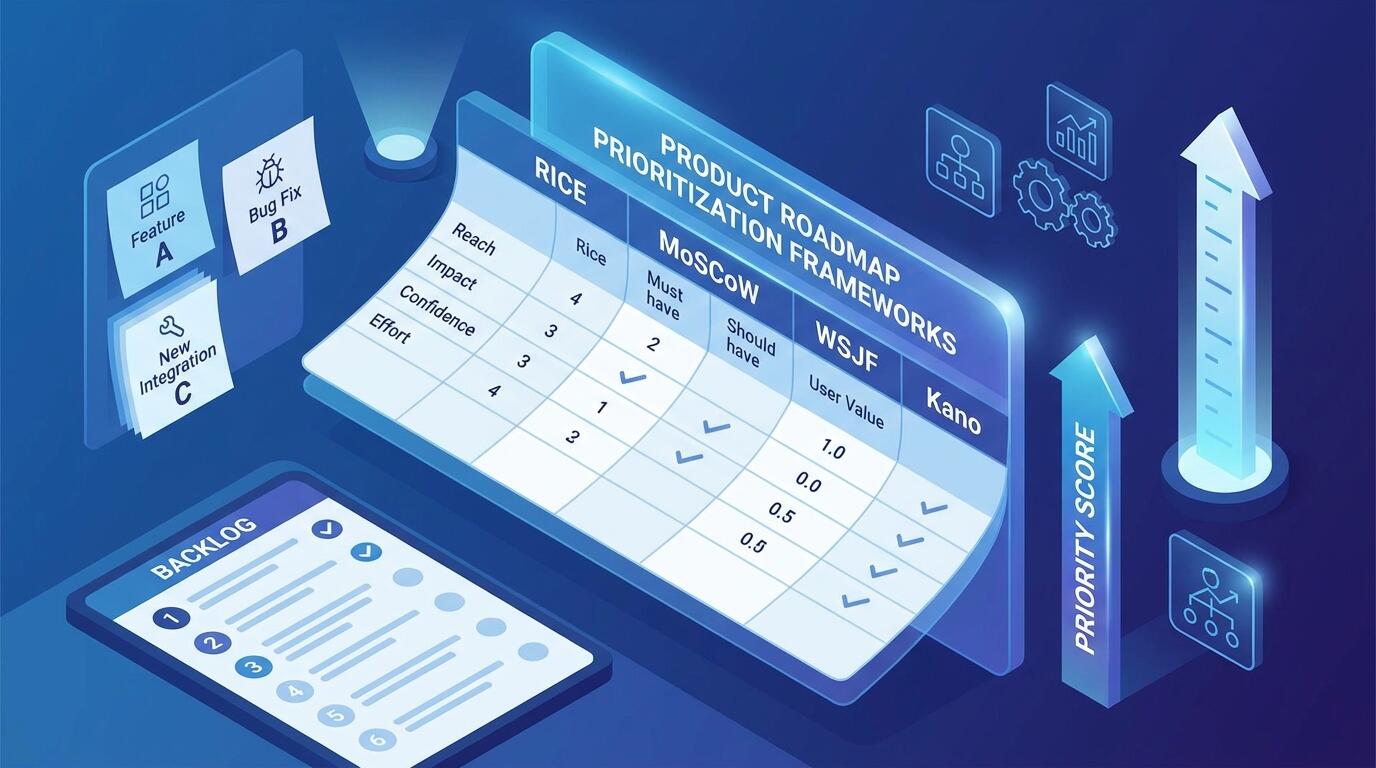
ALT: Best frameworks for prioritizing your product roadmap this quarter with clear decision criteria
Stop Guessing What to Build Next: Product Roadmap Prioritization Frameworks That Actually Work
Every engineering leader eventually faces the same painful question: with a backlog full of legitimate requests, competing stakeholder priorities, and a team of finite capacity, what do you build first this quarter? The answer is not intuition, and it is not whoever shouts loudest in the planning meeting. The answer is a framework — a structured, repeatable method for weighing value against effort, risk against impact, and short-term wins against long-term architecture.
This article lays out the most effective product roadmap prioritization frameworks in active use today, selected based on what consistently works when shipping real products under real constraints. Whether you are a CTO managing a platform migration, a startup founder deciding between features, or an engineering manager trying to align a cross-functional team, these frameworks give you a defensible basis for every prioritization decision you make this quarter.
The frameworks below were chosen for three reasons: they are battle-tested across product teams of different sizes, they produce decisions that can be communicated clearly to non-technical stakeholders, and they hold up when requirements shift — which they always do. Use them as a menu, not a mandate. Mix and match based on the maturity of your product and the nature of your current tradeoffs.
The Frameworks: Proven Methods for Smarter Roadmap Prioritization
RICE Scoring: Quantify the Unquantifiable
RICE is a scoring model developed by Intercom that evaluates each roadmap item across four dimensions: Reach, Impact, Confidence, and Effort. The formula produces a numeric score — higher scores indicate higher priority — giving teams a structured way to compare otherwise incomparable items.
Reach measures how many users or customers a feature will affect within a defined time period. Impact scores the degree of effect on a key metric, typically on a scale from minimal to massive. Confidence represents how certain you are in your Reach and Impact estimates, expressed as a percentage. Effort is the total person-time required to deliver the item.
RICE works because it forces specificity. Instead of arguing about whether a feature is "important," teams are forced to ask: important to how many users, by how much, and at what cost? According to Productboard's resource on product prioritization frameworks, scoring-based models like RICE reduce the influence of the loudest voice in the room and create a repeatable record of why decisions were made.
Best for: Teams that have enough usage data or customer research to make reasonable estimates. Works particularly well for SaaS products with defined user bases and measurable engagement metrics.
Watch out: RICE scores are only as good as the estimates behind them. Overconfident Impact or Reach numbers produce misleading results. Always flag low-confidence items explicitly and revisit them when better data is available.
MoSCoW Method: Align Stakeholders Around What Cannot Wait
The MoSCoW method is a prioritization technique that categorizes every roadmap item into one of four buckets: Must Have, Should Have, Could Have, and Won't Have (this time). The name is an acronym formed from the initials of these four categories.
Must Haves are non-negotiable — without them, the product or release fails. Should Haves are important but not critical to the current cycle. Could Haves are nice additions that would improve the experience if time permits. Won't Haves are explicitly deprioritized for now, which is as important to communicate as what is being built.
MoSCoW is especially powerful as a stakeholder alignment tool. In practice, the most common failure mode in quarterly planning is not a bad framework — it is the absence of explicit agreement on what is out of scope. MoSCoW forces that conversation early. A pattern seen consistently in cross-functional product teams is that the "Won't Have" list generates more alignment value than the "Must Have" list, because it gives stakeholders a place to park requests without feeling ignored.
Best for: Cross-functional teams that need to align quickly, sprint planning, and release scoping conversations where stakeholder expectations need to be set and managed.
Watch out: Without clear criteria for what constitutes a "Must Have," teams tend to inflate that category until it contains everything. Enforce a hard rule: if removing it would not cause the release to fail, it is not a Must Have.
Opportunity Scoring: Let User Needs Drive the Backlog
Opportunity scoring, sometimes called opportunity-gap analysis, is a framework pioneered by strategist Tony Ulwick that maps the gap between how important a customer outcome is and how satisfied customers are with current solutions. Items where importance is high and satisfaction is low represent the highest-priority opportunities.
The process involves surveying customers on two axes: "How important is this outcome to you?" and "How satisfied are you with existing solutions?" The opportunity score is then calculated as: Importance + (Importance minus Satisfaction), capped at a defined maximum. High scores point directly to underserved needs — the sweet spot for differentiated product development.
This framework is particularly relevant for teams considering whether to build AI-powered capabilities into their products. Understanding which workflows users find critical but poorly served by current tools — manual data extraction, document summarization, context-aware search — often reveals exactly where AI integration delivers disproportionate value rather than complexity for its own sake.
Best for: Product discovery phases, market positioning decisions, and teams building in competitive markets where differentiation is the core strategic challenge.
Watch out: Opportunity scoring requires quality customer research. Small or biased samples produce misleading gap analyses. Invest in the research infrastructure before relying on this method to drive major investment decisions.
Weighted Shortest Job First (WSJF): Optimize for Flow, Not Just Value
Weighted Shortest Job First, commonly abbreviated as WSJF, is a prioritization model used in scaled agile environments — particularly within the Scaled Agile Framework (SAFe) — that sequences work by calculating the cost of delay relative to job duration. The goal is to identify which items, if delayed, will cost the most, and to do those first.
Cost of Delay is estimated by combining three factors: user and business value, time criticality (does this opportunity close?), and risk reduction or opportunity enablement. WSJF then divides Cost of Delay by job size to produce a priority score. Shorter, high-cost-of-delay items float to the top — a discipline that counteracts the natural tendency to tackle big, exciting projects while smaller high-value items sit idle.
WSJF is grounded in queuing theory and flow economics. It treats a product backlog like a system of work in progress, and recognizes that the true cost of a prioritization decision is not just effort — it is the value you fail to capture while waiting. Teams operating in fast-moving markets, where timing determines whether a feature ships before or after a competitor, often find WSJF produces more commercially defensible sequencing than effort-only estimates.
Best for: Larger engineering teams operating in agile release trains, or any team working in a market where timing and competitive windows are meaningful constraints.
Watch out: WSJF requires honest estimation of Cost of Delay, which is genuinely difficult. Teams that treat Cost of Delay as a subjective gut feel rather than a reasoned estimate defeat the purpose of the model.
Value vs. Effort Matrix: The Fast Alignment Tool
The Value vs. Effort matrix — also called an Impact/Effort matrix — is a two-by-two grid that plots roadmap items across two axes: the value they deliver to users or the business, and the effort required to build them. The resulting quadrants are commonly labeled Quick Wins (high value, low effort), Major Projects (high value, high effort), Fill-Ins (low value, low effort), and Time Sinks (low value, high effort).
This framework is the fastest way to create visual alignment in a planning session. It requires no scoring formulas and no customer data — just informed judgment from people who understand the product and the codebase. In a ninety-minute workshop, a team can sort an entire backlog into these quadrants and surface immediate consensus on where to start.
According to the data-driven roadmap analysis published by Statsig, visual prioritization tools like the Value vs. Effort matrix are most effective when combined with quantitative scoring later in the process. Use the matrix to narrow the field quickly, then apply RICE or WSJF to the shortlisted candidates for a more rigorous final ranking.
Best for: Early-stage teams or quarterly kickoff sessions where speed of alignment matters more than scoring precision. Also useful for quickly culling a bloated backlog.
Watch out: "Value" and "Effort" are only as good as the team's shared understanding of both. Without a common definition of what constitutes high value — revenue, retention, NPS, strategic positioning — the matrix reflects individual biases rather than product strategy.
Kano Model: Build What Delights, Not Just What Satisfies
The Kano model is a framework developed by professor Noriaki Kano that classifies product features into five categories based on how they affect customer satisfaction: Basic Needs (expected features whose absence causes dissatisfaction), Performance Needs (features where more is better, linearly), Excitement Needs (unexpected features that disproportionately delight), Indifferent features (neither satisfying nor dissatisfying), and Reverse features (features some users actively dislike).
The practical insight of the Kano model is that not all features are equal in their satisfaction curve. A missing basic need destroys trust instantly. An excitement feature — something users did not know they wanted — can drive word-of-mouth and retention far beyond its engineering cost. Teams that only build Performance features (more speed, more storage, more options) often find themselves in commoditization traps where no amount of incremental improvement produces meaningful differentiation.
For teams building AI-powered products, the Kano model is especially clarifying. Many AI capabilities start as Excitement features — users are surprised and delighted — and rapidly migrate to Basic Needs as the market matures. Generative AI assistants in productivity tools followed exactly this arc. Identifying where your AI features sit on this curve today determines whether you should be investing in novelty or reliability.
Best for: Product strategy conversations, especially when deciding whether to invest in polish and reliability versus new capabilities. Critical for teams in maturing markets where user expectations are shifting.
Watch out: Kano classification requires direct customer input through structured surveys. Assuming you know which category a feature belongs to without data leads to systematic misjudgment — usually over-investing in Performance features and under-investing in Basic Needs.
Now / Next / Later Roadmap: Communicate Strategy Without Locking In Dates
The Now / Next / Later roadmap is a planning structure that organizes work into three time horizons — what the team is actively building, what is confirmed for the near future, and what is under consideration for later — without committing to specific delivery dates. It is a framework as much about communication as it is about prioritization.
This approach directly addresses one of the most common tensions in product planning: the pressure from stakeholders for date commitments that engineering teams cannot honestly make. By replacing date-based roadmaps with horizon-based roadmaps, teams communicate strategic direction and relative priority clearly, while preserving the flexibility to respond to new information. As outlined in Cake & Arrow's analysis of digital product roadmap frameworks, the Now / Next / Later structure is particularly effective in organizations undergoing change or operating in high-uncertainty environments.
For engineering leaders managing AI system development, this framework is especially relevant. AI projects carry inherent uncertainty — model performance, data quality, integration complexity — that makes hard date commitments structurally dishonest. A horizon-based roadmap sets accurate expectations while still projecting a coherent strategy to leadership and investors. When you are also navigating decisions like build vs. buy for AI infrastructure, the Now / Next / Later model gives you the flexibility to adjust as vendor evaluations resolve.
Best for: Teams communicating roadmaps to external stakeholders — investors, customers, or board members — where strategic transparency matters more than Gantt-chart precision. Also valuable for early-stage products where the right features are still being discovered.
Watch out: "Later" can become a graveyard for ideas that never get revisited. Set a cadence for reviewing the Later column and retiring items that no longer align with strategy, or the roadmap loses credibility over time.
Quick Comparison at a Glance
The right prioritization framework depends on your team's size, your available data, and the nature of the decision you are making. This table summarizes where each framework performs best.
| Framework | Best For | Key Strength | Limitation |
|---|---|---|---|
| RICE Scoring | Data-rich teams comparing many features | Numeric, repeatable, bias-reducing | Requires reliable estimation inputs |
| MoSCoW Method | Sprint scoping and stakeholder alignment | Fast, forces explicit out-of-scope decisions | "Must Have" inflation without clear criteria |
| Opportunity Scoring | Discovery and market differentiation | Reveals underserved customer needs directly | Requires quality customer research data |
| WSJF | Scaled teams, timing-sensitive markets | Accounts for cost of delay, not just effort | Cost of Delay is hard to estimate honestly |
| Value vs. Effort Matrix | Fast alignment in planning sessions | Visual, quick, requires no data infrastructure | "Value" definition can be subjective |
| Kano Model | Strategy: novelty vs. reliability investment | Differentiates satisfaction curves by feature type | Requires structured customer surveys |
| Now / Next / Later | Stakeholder communication under uncertainty | Preserves flexibility, sets honest expectations | Later column can become a permanent backlog |
How to Choose the Right Framework for Your Situation
Choosing the right prioritization framework is itself a prioritization decision — and the answer depends on three questions: What kind of decision are you making? How much data do you have? And who needs to be aligned?
If you are in a planning session and need fast team alignment without data preparation, start with the Value vs. Effort matrix to narrow the field, then apply RICE or WSJF to the finalists. If you are doing product discovery and want to understand what to build in a competitive market, Opportunity Scoring is the right starting point. If you are communicating strategy to non-engineering stakeholders, Now / Next / Later protects you from false precision. If you are building in a market where customer expectations are shifting — particularly in AI-enabled products — the Kano model adds the strategic layer that pure effort-value models miss.
A common misconception is that you must pick one framework and apply it uniformly across all prioritization decisions. In practice, mature product teams use different frameworks for different types of decisions in the same quarter. RICE for feature ranking, MoSCoW for sprint scoping, and Now / Next / Later for investor updates are not contradictions — they are appropriate tools for different audiences and different levels of precision.
The same principle applies when you are setting architectural priorities. If your quarterly roadmap includes AI components, understanding the structural tradeoffs early matters as much as the feature sequencing. The AI system architecture patterns that CTOs should evaluate this quarter are directly relevant to roadmap decisions involving AI infrastructure, because the architectural choice constrains what can realistically be delivered in each time horizon.
The most important rule is to use any framework consistently rather than switching mid-quarter when results are inconvenient. A defensible prioritization process — one you can explain, revisit, and audit — builds more organizational trust than any individual feature decision.

ALT: Engineering team using product roadmap prioritization frameworks to align quarterly planning decisions around value and effort
People Also Ask
Q1: How do you prioritize a product roadmap when stakeholders all disagree?
When stakeholders disagree on roadmap priorities, the most effective resolution path is to surface a shared scoring model — such as RICE or MoSCoW — and let stakeholders contribute their estimates transparently rather than advocate for outcomes. Disagreement about scores is more productive than disagreement about opinions. Facilitated scoring sessions, where each stakeholder rates Reach and Impact independently before discussion, consistently produce faster alignment than top-down decisions, because the process itself demonstrates what the data supports.
Q2: Are prioritization frameworks effective for AI product development specifically?
Prioritization frameworks are effective for AI product development, but they need to account for factors that traditional software roadmaps often ignore — model accuracy thresholds, data availability, infrastructure cost, and regulatory compliance. The Kano model is particularly useful for AI features, because it forces teams to ask whether a given AI capability is still an excitement feature or has become a basic expectation in the market. WSJF is also valuable for AI teams, because the cost of delay in AI development often includes the cost of training on stale data or missing a market window.
Q3: How often should a product roadmap be re-prioritized?
A product roadmap should be re-prioritized on a regular cadence — typically quarterly at the strategic level and weekly or bi-weekly at the sprint level. Many high-performing teams treat quarterly planning as a structured reprioritization event, using frameworks like RICE or WSJF to re-rank the backlog with fresh data. The Now / Next / Later structure accommodates this well, because it is designed for continuous refinement rather than annual commitment. Mid-quarter re-prioritization should be triggered by major new information — a competitor launch, a significant customer loss, or a technical discovery — not by stakeholder pressure alone.
The Bottom Line
Effective product roadmap prioritization is not about finding the perfect framework — it is about applying a consistent, transparent process that your team can defend, communicate, and revisit as conditions change. Three principles hold across every framework covered here.
First, explicit trade-offs beat implicit ones. Every prioritization decision deprioritizes something else. Making that explicit — particularly through MoSCoW's "Won't Have" list or the Time Sinks quadrant of the Value vs. Effort matrix — builds more organizational trust than pretending the backlog is infinite.
Second, data quality determines framework quality. RICE scores built on wishful thinking are worse than no framework at all, because they produce false confidence. Invest in the customer research, usage analytics, and cost estimation that make your inputs honest before committing to a scoring model.
Third, the right framework for your team this quarter may not be the right one next quarter. As your product matures, as your team grows, and as your market evolves, your prioritization process should evolve with it. Rigidity in process is as costly as rigidity in architecture.
If you are navigating these decisions while also managing the complexity of AI-enabled products — where architecture choices, infrastructure costs, and shifting user expectations all intersect with your roadmap — the depth of that challenge deserves a practitioner-level partner. Explore real-world engineering insights and shipped AI projects at Darius.
Sources & Further Reading
- Cake & Arrow. "Six frameworks to help you focus, align, and prioritize your digital product roadmap".
https://cakeandarrow.com/newsfeed/2025/02/11/six-frameworks-for-prioritizing-your-digital-product-roadmap/ - Productboard. "Product Prioritization Frameworks".
https://www.productboard.com/glossary/product-prioritization-frameworks/ - Statsig. "Data-Driven Product Roadmap: Prioritization Frameworks".
https://www.statsig.com/perspectives/data-driven-roadmap-frameworks - IEEE (Institute of Electrical and Electronics Engineers). Standards and professional resources on software engineering and systems design.
https://www.ieee.org/ - Project Management Institute (PMI). Professional standards and frameworks for project and product management practice.
https://www.pmi.org/
Note: Standards and frameworks may be updated; please check the latest official documents or consult professional advisors.