Turning an AI Experiment Into a Shippable Feature This Quarter
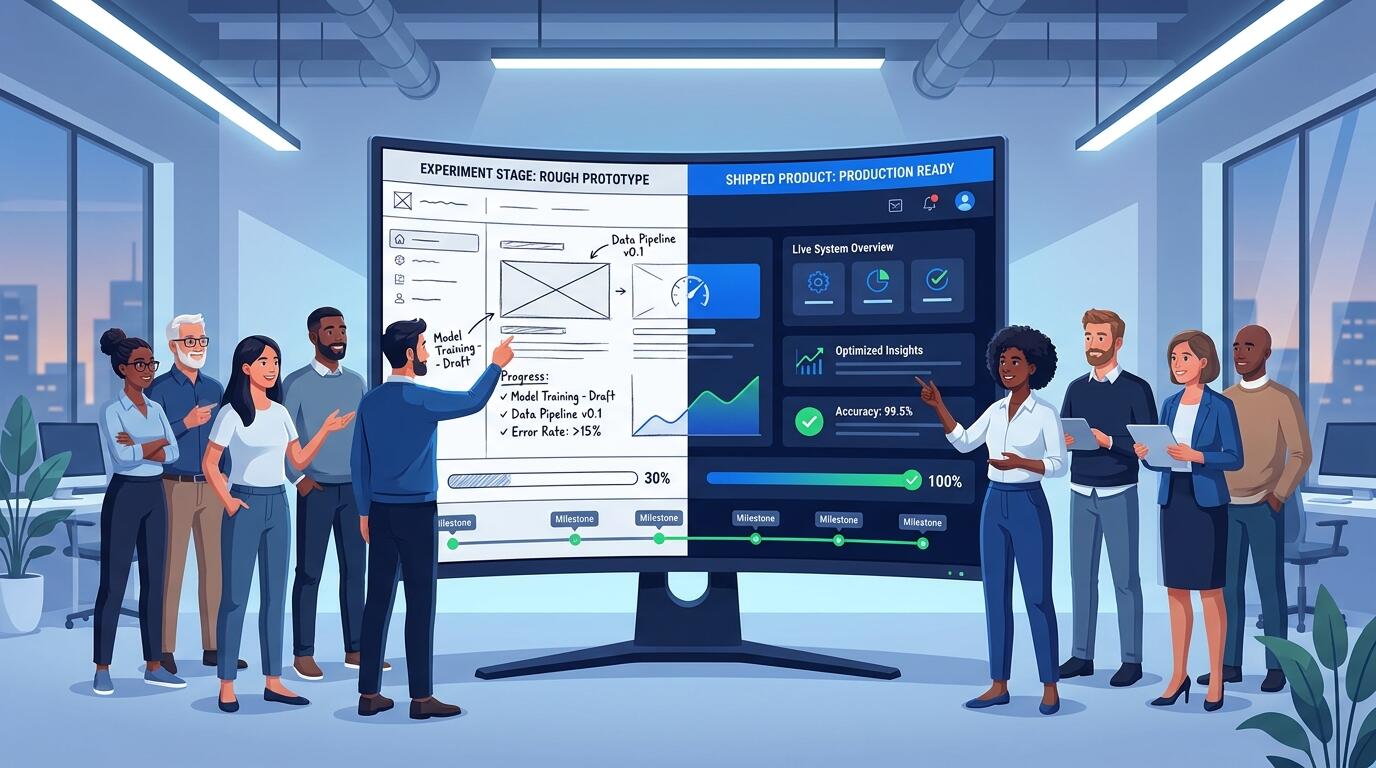
ALT: Engineering team turning an AI prototype into a shippable product feature this quarter
From Experiment to Shipped Feature: The Real Gap Between AI Prototypes and Production Code
You have a working AI prototype. It impresses in demos, the team is excited, and someone in the last sprint review said the phrase "we should just ship this." But three weeks later, you are still not sure what "shipping it" actually means — what the success criteria are, which users it serves, or whether the underlying model behavior is stable enough to trust in production. This is the gap where most AI experiments die.
Turning an AI experiment into a shippable product feature within a single quarter is not primarily a technical challenge. It is a systems challenge: aligning architecture decisions, product scope, and engineering workflow so that the experiment's value survives contact with real users. The comparison that matters here is between two fundamentally different operating modes — prototype thinking versus production thinking — and understanding which mode you are in, and when to switch, determines whether your AI capability ships this quarter or gets shelved indefinitely.
Evaluation Criteria: How to Judge Whether an AI Experiment Is Ready to Productize
The decision to productize an AI experiment should be judged against five criteria, each of which surfaces a different failure mode that teams commonly overlook.
Behavioral stability is the first gate. An AI feature is behaviorally stable when its outputs are consistent and predictable enough that you can write acceptance criteria for them. If you cannot describe, in plain language, what the system should do and what it should refuse to do, you are not ready to ship. A pattern we consistently see in early-stage AI work is that the model performs well on the demo dataset but degrades on the long tail of real user inputs — and that long tail is exactly where support tickets come from.
Scope containment is the second criterion. Experiments are unbounded by nature; features are not. A shippable feature has a defined entry point, a defined exit point, and a clear set of user actions it supports. Teams that skip scope containment end up in a months-long productization cycle because every new edge case expands the problem definition.
Observability readiness measures whether you can actually tell, after shipping, whether the feature is working. For AI systems, this means logging inputs and outputs, tracking latency, and capturing user signals — not just infrastructure uptime. Per guidance from the IEEE on AI system quality, observability in machine learning systems requires instrumenting the model's decision boundary, not just the surrounding application.
Failure mode tolerance asks whether the system degrades gracefully when the AI component produces a low-confidence or incorrect output. Hard failures in AI features — blank responses, hallucinated content surfaced directly to users, or silent errors — erode trust faster than they accumulate it.
Time-to-validate is the pragmatic forcing function. Within a quarter, you have roughly eight to ten working weeks after accounting for planning, review cycles, and deployment preparation. Any productization path that cannot produce a testable version with real users within that window is a scope problem, not a timeline problem.
The Contenders: Prototype Thinking vs. Production Thinking in AI Development
Prototype Thinking: The AI Experiment Mode
Prototype thinking is the operating mode that produces working AI experiments. In prototype thinking, the goal is to demonstrate that a capability is possible: the model can summarize documents, the recommendation engine can surface relevant items, the classifier can separate signal from noise. Constraints are intentionally relaxed — accuracy thresholds are informal, data pipelines are manual, and the deployment environment is a notebook or a local server. Prototype thinking is valuable and necessary. The mistake is staying in it too long.
Teams in prototype mode routinely underestimate the work that lies between "it works on my machine" and "it works for users." They optimize for demo-readiness rather than edge-case handling. They build around the happy path because that is what generates excitement. And they accumulate technical debt in the places that matter most: data validation, model versioning, and input sanitization.
Production Thinking: The Shippable Feature Mode
Production thinking is the operating mode required to ship. In production thinking, the goal is to make the AI capability reliable, observable, and bounded enough to trust in a live system. Production thinking asks uncomfortable questions early: What happens when the model returns garbage? Who owns the feature's behavior when it changes after a model update? How does this interact with the existing data access controls?
The shift from prototype to production thinking is not a handoff — it is a gradual mode switch that should begin as soon as a prototype shows enough signal to be worth pursuing. A pattern we consistently apply in AI architecture engagements is to introduce a "production fitness review" at the end of the prototype phase, before any engineering resources are committed to build-out. This review does not require that the system be production-ready — it requires that the team be honest about what production-readiness will actually cost.
For teams navigating this transition for the first time, understanding what a structured AI architecture engagement looks like can clarify what questions need answers before the first sprint of productization work begins.
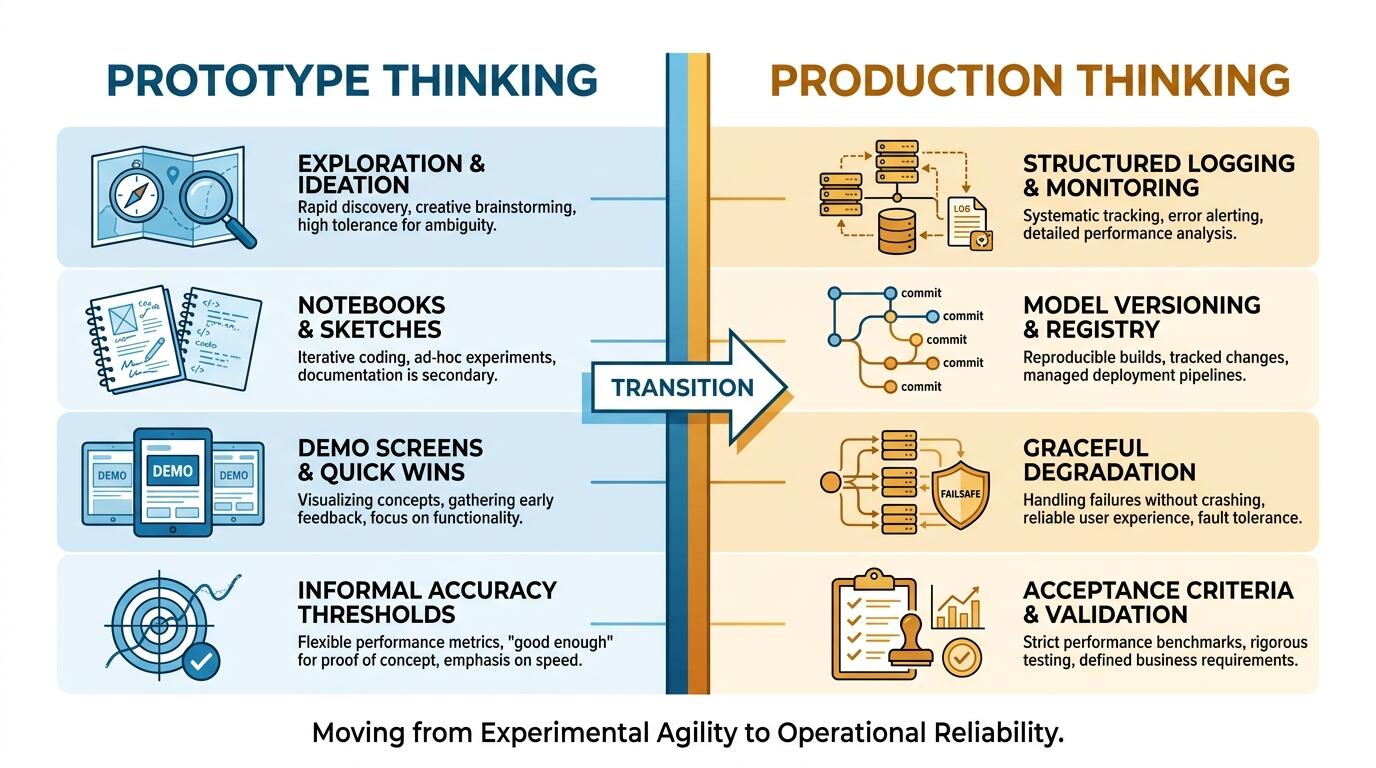
ALT: Side-by-side comparison of AI prototype thinking and production feature thinking for engineering teams shipping AI features this quarter
Head-to-Head Comparison: Prototype Thinking vs. Production Thinking
| Criterion | Prototype Thinking | Production Thinking |
|---|---|---|
| Primary goal | Demonstrate feasibility | Deliver reliable user value |
| Scope | Open-ended, exploratory | Bounded, acceptance-criteria-driven |
| Data handling | Manual, curated, happy-path | Validated, sanitized, edge-case-aware |
| Failure handling | Ignored or manually reviewed | Graceful degradation by design |
| Observability | Minimal (logs if remembered) | Structured logging, latency tracking, user signal capture |
| Model versioning | Implicit (whatever ran last) | Explicit, with rollback capability |
| Time horizon | Until it demos well | Until it passes acceptance criteria consistently |
| Team mindset | "Can we make this work?" | "How do we know when it breaks?" |
The table above reveals the core tension: prototype thinking optimizes for speed of discovery, while production thinking optimizes for reliability of delivery. Neither mode is wrong — the error is applying the wrong mode at the wrong time.
The most costly mistake teams make is committing full engineering resources to build-out while still operating in prototype mode. They invest weeks in infrastructure before the behavioral scope is settled, then spend equal time rebuilding when the model's behavior turns out to be different at scale than it was in the demo. This is the primary reason AI features slip quarters — not because the technology failed, but because the team shipped the wrong abstraction.
Equally common is the inverse error: staying in prototype mode well past the point of diminishing returns, running "just one more experiment" when the real work needed is engineering hardening. A useful forcing function is to set a firm date — not a sprint, a calendar date — by which the team must either commit to productizing the current prototype or abandon it. Ambiguity about that decision is itself a schedule risk.
For teams wrestling with whether to build core AI infrastructure in-house or leverage external components, the build vs. buy decision for AI infrastructure is worth working through systematically before committing to an architecture, because that choice compounds across the entire productization timeline.
Which Should You Choose? Scenario Recommendations for Moving from Experiment to Ship
The right operating mode depends on where you are, not on a universal best practice. The following scenarios map common situations to the right next action.
If your prototype performs well in demos but you have never tested it with real, unscripted user inputs: run a structured behavioral review before committing to productization. Gather a representative sample of real user inputs — even a small set — and evaluate the model's outputs against acceptance criteria you write before you see the results. If you cannot write those criteria, you are not ready to productize.
If your team has been iterating on the experiment for more than two sprints and the scope keeps expanding: apply hard scope containment now. Define the minimum feature boundary — the smallest set of user actions the feature must support to deliver meaningful value — and treat everything outside that boundary as a post-launch enhancement. Expanding scope during productization is the single most reliable way to miss the quarter.
If you are unsure whether your AI component's behavior is stable enough to ship: instrument it before you ship, not after. Add structured logging of inputs, outputs, and confidence signals. Run the instrumented system in a shadow mode — receiving real inputs but not surfacing outputs to users — for at least two weeks before going live. This surfaces behavioral drift and edge cases without exposing users to them.
If your engineering team is strong but has limited AI production experience: the gap is usually not in the model work — it is in the surrounding systems: data validation pipelines, model versioning, rollback procedures, and user-facing failure states. Treat these as first-class engineering tasks, not afterthoughts. Teams that maintain quality discipline while shipping at speed do so by building the scaffolding around the AI component in parallel with the component itself, not sequentially.
If you are choosing between shipping a narrower feature this quarter or waiting for a more complete one next quarter: ship narrower. A live feature with real users generates the signal you need to make better decisions about the next iteration. An experiment that ships next quarter competes with everything else on the roadmap that also got delayed.
Pros and cons summary for the two core approaches:
Committing to prototype-first exploration gives you higher confidence in the core capability before investing in infrastructure, but risks schedule overrun if the mode switch to production thinking is delayed. Committing to production thinking early gives you a cleaner engineering path and earlier user signal, but risks over-engineering an experiment that turns out not to work at the required quality level.
Questions & Answers
Q1: How do you know when an AI experiment is ready to move into production engineering?
An AI experiment is ready for production engineering when it meets three conditions: you can write stable acceptance criteria for its outputs, you have tested it against a representative sample of real (not curated) inputs, and the team can articulate how it will fail gracefully when the model produces a low-confidence result. If any of these three conditions cannot be met within a week of honest effort, the experiment needs more iteration before productization begins.
Q2: Is it realistic to turn an AI experiment into a shippable feature in a single quarter?
A single quarter — roughly eight to ten working weeks of net engineering time — is a realistic window for productizing a well-scoped AI experiment, but only if the behavioral scope is locked at the start of the quarter and the team has already completed the prototype-to-production-thinking transition. Teams that begin the quarter still in exploratory mode routinely find that the quarter is spent finishing the experiment rather than shipping the feature.
Q3: How long does the production hardening phase typically take for an AI feature, and what drives the timeline?
Production hardening for an AI feature — covering data validation, model versioning, observability instrumentation, and failure mode handling — typically takes a meaningful portion of the overall shipping timeline, and the primary driver of timeline variance is how well-defined the behavioral scope was before hardening began. Scope changes during hardening multiply effort non-linearly. Teams that lock scope before hardening consistently deliver faster than those that treat hardening as an opportunity to also refine the feature's behavior.
Wrapping Up
Turning an AI experiment into a shippable product feature within a quarter is achievable — but it requires deliberately switching from prototype thinking to production thinking at the right moment, containing scope before committing engineering resources, and building observability into the system from the start rather than adding it after the first production incident.
The three principles that consistently separate teams that ship from those that slip are: first, know which mode you are in and why; second, lock behavioral scope before the first line of production code is written; and third, treat failure handling and observability as core feature work, not technical debt to address later.
The next concrete step is a production fitness review of your current experiment — an honest assessment of behavioral stability, scope clarity, and failure mode handling before any resourced sprint begins. That review is the most valuable hour you can spend before committing the quarter.
Visit Darius's portfolio and wiki for hands-on engineering breakdowns, AI architecture frameworks, and practitioner-level guidance on shipping complex technical products. Whether you are taking an AI capability from prototype to production, structuring a technical roadmap, or looking for a trusted thought partner to pressure-test your architecture decisions, the work and thinking collected there is built for exactly that. Explore the full depth of what is available at the site and reach out when you are ready to move from experiment to shipped.
References & Further Reading
- IEEE. "IEEE Standards for Artificial Intelligence — Quality and Reliability in AI Systems".
https://www.ieee.org/ - ACM. "Association for Computing Machinery — Software Engineering and AI Systems Practice".
https://www.acm.org/ - NIST. "National Institute of Standards and Technology — AI Risk Management Framework".
https://www.nist.gov/ - Dartmouth Admissions. "The Quarter System? What's That About?!"
https://admissions.dartmouth.edu/follow/blog/kabir-beotra/quarter-system-whats-about
Note: Standards and frameworks may be updated; verify the latest versions through official issuing organizations or qualified technical advisors.