Agile vs. Waterfall Heading Into 2027: Which Fits Your Team Now
ALT: Agile vs. Waterfall methodology comparison for software teams heading into 2027 planning cycles
Agile vs. Waterfall in 2027: Why the Old Debate Still Determines Whether Teams Ship or Stall
Picture this: a founding team is six months into a product build. Half the engineers are Agile veterans who expect weekly sprints and continuous reprioritization. The other half came from enterprise backgrounds where every feature was spec'd, signed off, and sequenced before a line of code was written. The result is not a hybrid — it is organizational friction burning through runway. This scenario plays out constantly, and it is entirely avoidable if you make a deliberate methodology choice before the team is under pressure.
Agile and Waterfall are not just project management styles — they are fundamentally different theories about where uncertainty lives in a software project and who bears the cost of it. Heading into 2027, with AI integration compressing product cycles and distributed teams becoming the norm, the choice between Agile and Waterfall carries more operational weight than it did even a few years ago. This article compares both approaches across the criteria that matter most to modern engineering teams, then maps those criteria to concrete team situations so you can make the call with confidence.
Why Methodology Selection Matters More Heading Into 2027
The right methodology for a software team is the one that matches the distribution of uncertainty in that team's specific project — not the one that sounds more innovative or carries the more impressive conference pedigree.
Agile, Waterfall, and hybrid approaches are being evaluated today against a backdrop of accelerating AI tooling, tighter capital environments, and increasingly global engineering teams. Per Atlassian's project management research, the tension between these methodologies is not theoretical — it shows up directly in delivery timelines, team morale, and stakeholder trust. In our work across product builds, a pattern we consistently see is that teams which mismatch methodology to project type spend a disproportionate share of their time on process overhead rather than building.
The criteria used to evaluate these two approaches in this article are: adaptability to change, planning overhead, stakeholder visibility, team autonomy, suitability for AI and modern tooling integration, and risk concentration. These dimensions were chosen because they represent the levers a CTO or Engineering Director actually pulls when determining how a team operates week-to-week.
The Contenders: Understanding Each Approach on Its Own Terms
Agile: Iterative Delivery Built for Uncertainty
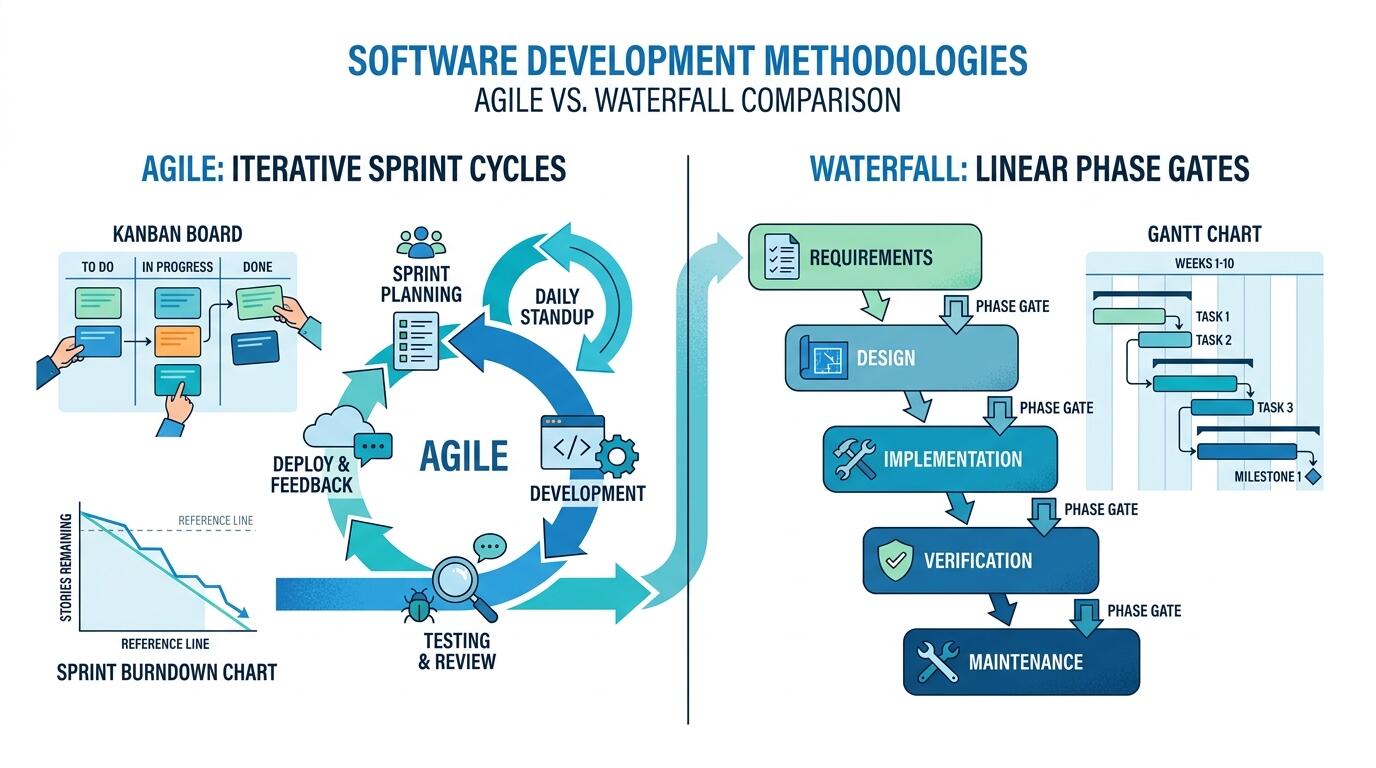
Agile is a software development philosophy — formalized in the Agile Manifesto — that prioritizes iterative delivery, customer collaboration, and responsiveness to change over comprehensive upfront planning. It is not a single process; Scrum, Kanban, SAFe, and XP are all Agile frameworks, each with its own cadence and artifact set.
In practice, Agile teams work in short cycles — typically one to four weeks — and treat each cycle as a planning, execution, and review unit. The backlog is a living document. Scope is expected to evolve. The cost of changing requirements is deliberately kept low by avoiding deep investment in any single design decision before it has been validated with working software.
Agile works best when the problem space is not fully understood at project start, when customer feedback needs to loop back into the product continuously, or when the team is small enough to communicate informally and replan quickly. A pattern we consistently see is that Agile creates enormous value in early-stage product development but introduces noise and instability when applied naively to large-scale infrastructure work where the design decisions need to be locked before construction begins.
The risks worth flagging: Agile without disciplined backlog management and a clear product owner becomes scope drift disguised as flexibility. Teams that mistake "responding to change" for "never committing to anything" routinely ship products that are technically coherent but strategically incoherent. If you are validating a new product idea with real customers before building, Agile's short cycles are exactly the right vehicle — but only if the feedback loop is actually closed, not just scheduled.
Waterfall: Sequential Execution Built for Known Requirements
Waterfall is a linear, phase-gated software development methodology in which each stage — requirements, design, implementation, verification, and maintenance — must be completed and signed off before the next begins. It was the dominant model in enterprise software development for decades and remains the standard in industries where requirements are truly fixed: defense contracting, regulated medical devices, civil infrastructure, and certain categories of enterprise ERP implementation.
The core premise of Waterfall is that the cost of change rises sharply the later it is introduced, so the right investment is exhaustive upfront specification. When requirements genuinely are stable, this premise holds. A construction project does not benefit from an iterative facade redesign every two weeks. Neither does a compliance-driven financial reporting system where the regulatory specification is handed down before the project begins.
The risks here are equally significant: Waterfall's front-loaded planning process creates the illusion of certainty. Teams that produce detailed Gantt charts and comprehensive design documents can mistake documentation completeness for design correctness. In our work with clients building technically complex systems, a common failure pattern is discovering — at integration — that two well-documented modules make incompatible assumptions. By that point, the rework cost is severe. Waterfall concentrates risk at the end of the project, which is precisely when teams have the least time and budget to absorb it.
Head-to-Head Comparison: Agile vs. Waterfall Across the Criteria That Matter
| Criterion | Agile | Waterfall |
|---|---|---|
| Adaptability to change | High — change is expected and accommodated each cycle | Low — changes mid-project are expensive and disruptive |
| Planning overhead | Distributed across sprints; lower upfront, higher ongoing | Heavy upfront; lower overhead once execution begins |
| Stakeholder visibility | Continuous via working demos and sprint reviews | Milestone-gated; stakeholders see progress in phases |
| Team autonomy | High — teams self-organize within sprint goals | Lower — teams execute against a pre-defined plan |
| AI and modern tooling fit | Strong — iterative cycles align with model training, evaluation loops | Moderate — works for AI projects with fixed pipeline specs |
| Risk concentration | Distributed across cycles; early failures are recoverable | Concentrated at integration and testing phases |
| Documentation discipline | Often lighter; can create technical debt without explicit effort | Stronger by default; documentation is a deliverable |
| Regulatory/compliance suitability | Requires adaptation; audit trails need deliberate effort | Native fit — phase gates align with compliance checkpoints |
The most consequential difference between Agile and Waterfall is not speed or documentation — it is where risk accumulates and when it becomes visible. Agile surfaces failures early and cheaply. Waterfall surfaces failures late and expensively. That asymmetry is the single most important factor when choosing between them, and it explains why teams building novel products or AI systems with uncertain data behavior should default toward iterative approaches.
A second critical difference is the nature of stakeholder engagement. Waterfall offers periodic clarity — stakeholders get a complete picture at each phase gate, which works well when those stakeholders are executives who review quarterly. Agile requires continuous stakeholder engagement, which is an asset when the product owner is embedded and responsive but a liability when they are unavailable or indecisive. Per the comparative analysis in the Rock.so 2026 guide to Agile and Waterfall, agencies and product teams that succeed with hybrid models tend to do so precisely because they use Waterfall's structure to manage stakeholder expectations while using Agile's iteration to manage technical uncertainty.
The third dimension worth understanding is documentation. Waterfall produces documentation as a primary artifact. Agile teams, left to their own devices, often under-document — which creates maintenance and handoff problems that only appear six to twelve months after launch. When evaluating AI development tools before signing a contract, this documentation gap matters: underdocumented AI systems are extremely difficult to audit, retrain, or hand off to a new engineering team.
Which Methodology Should Your Team Choose? Scenario Recommendations
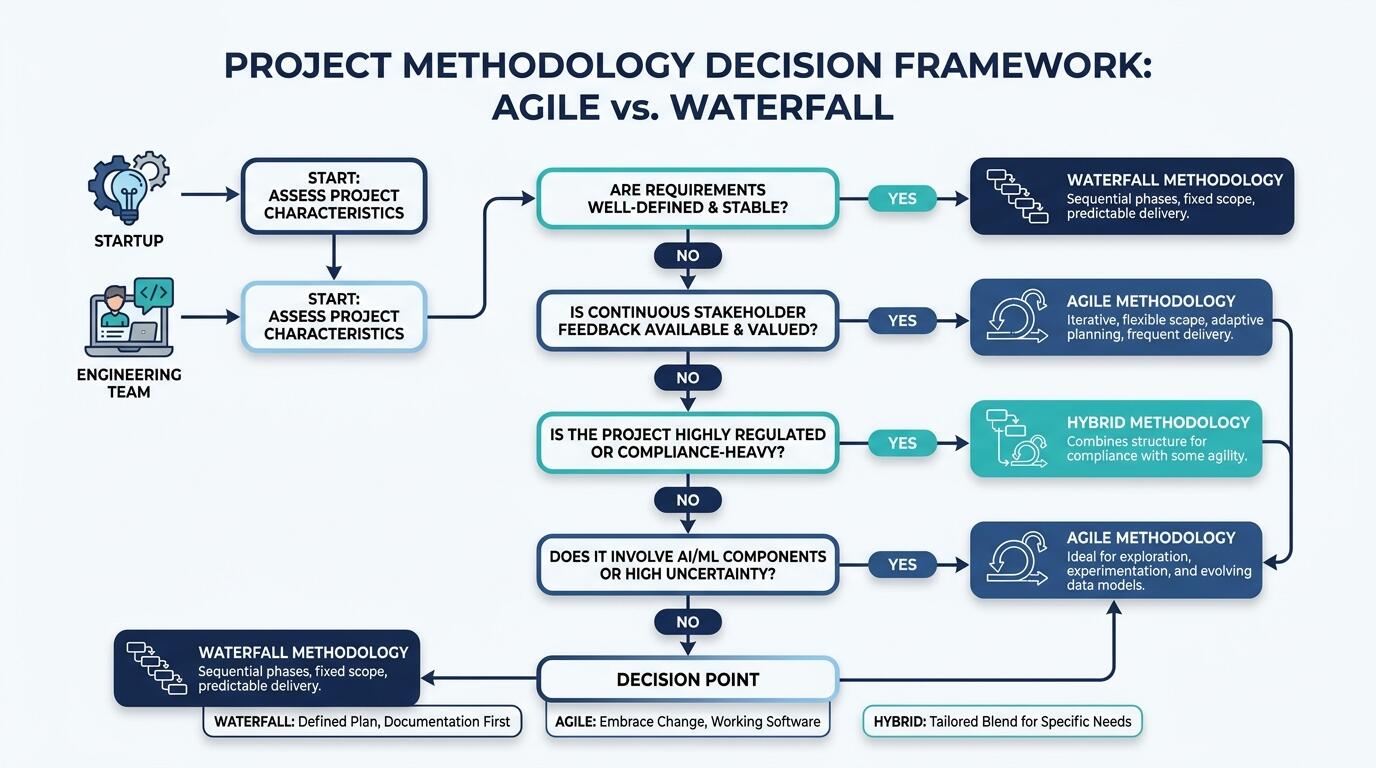
The best methodology for your team is determined by four variables: how well-defined the requirements are at project start, how available your stakeholders are for continuous feedback, the regulatory context you operate in, and your team's size and communication density.
If you are building a new consumer or B2B product with uncertain product-market fit — choose Agile. Your primary risk is building the wrong thing. Agile's iteration cycles let you validate assumptions with working software before committing to a full build. The sooner you get a testable artifact in front of real users, the sooner you can correct course without catastrophic rework cost.
If you are building regulated software in healthcare, finance, or defense — lean toward Waterfall or a structured hybrid. Compliance frameworks like FDA 21 CFR Part 11, SOC 2, or ISO 13485 expect documented phase gates and traceable requirements. Pure Agile can satisfy these requirements, but only with deliberate audit trail infrastructure that most Agile teams do not build by default. The phase-gated discipline of Waterfall maps more naturally to audit preparation.
If you are integrating AI or machine learning components into an existing product — use Agile for the AI-specific work, but consider Waterfall or structured milestones for the surrounding infrastructure. AI components have inherent uncertainty: model behavior changes with data, and performance benchmarks set in sprint zero rarely survive contact with production data distributions. Iterative cycles accommodate that uncertainty. The surrounding API layer or data pipeline, by contrast, may benefit from upfront design discipline. For teams thinking through how to build machine learning pipelines that scale past the prototype stage, the architectural decisions made early carry disproportionate long-term cost — which argues for intentional upfront design on the infrastructure layer, even within an otherwise Agile program.
If your team is distributed across multiple time zones with asynchronous communication — Agile is workable, but the synchronous ceremonies (standups, sprint reviews, retrospectives) need deliberate adaptation. A common mistake is applying a co-located Agile playbook to a distributed team without accounting for the communication overhead, resulting in ceremonies that are attended but not genuinely collaborative. Waterfall's asynchronous-friendly documentation model can actually complement distributed teams when milestone deliverables replace real-time coordination.
If you are a startup with a runway constraint and an investor milestone deadline — do not romanticize Agile's flexibility to the point where you lose planning discipline. Agile without a roadmap is not lean — it is reactive. Combine Agile execution at the sprint level with a Waterfall-style milestone structure at the product level: know what you need to ship and by when, then use sprints to manage the how.
Pros and cons summary:
Agile's strengths are early risk visibility, high adaptability, and tight customer feedback loops. Its weaknesses are susceptibility to scope creep, lighter documentation, and dependency on engaged, responsive stakeholders.
Waterfall's strengths are comprehensive upfront design, predictable milestone structure, and natural compliance alignment. Its weaknesses are late risk discovery, high cost of mid-project change, and false confidence from detailed documentation.
ALT: Decision framework showing when to choose Agile vs. Waterfall for software teams and AI projects heading into 2027, including hybrid approach indicators for startup CTOs and engineering directors
Common Questions
Q1: How do Agile and Waterfall handle mid-project requirement changes differently?
Agile treats requirement changes as expected inputs — the backlog can be reprioritized at the start of any sprint, and scope adjustments carry low process cost. Waterfall treats mid-project changes as exceptions that require formal change control: the affected phases must be revisited, signed off again, and the downstream schedule revised. For teams in fast-moving markets, this difference is not cosmetic — it determines how much organizational energy a pivot consumes.
Q2: Is a hybrid Agile-Waterfall approach actually viable, or is it just a compromise that delivers the worst of both?
A hybrid is viable when the two methodologies are applied to genuinely different layers of the project. Waterfall-style upfront design at the architecture and infrastructure level combined with Agile sprints at the feature delivery level is a coherent pattern — not a contradiction. The failure mode is using "hybrid" as a label to avoid committing to either discipline, which typically results in neither the planning rigor of Waterfall nor the iteration speed of Agile. According to the Rock.so 2026 analysis, many agencies that describe themselves as hybrid actually apply each methodology to distinct project phases with clear handoff points — that structural intentionality is what makes it work.
Q3: How long does it take for a team to transition from Waterfall to Agile effectively?
There is no single timeline — it depends on team size, existing tooling, and how deeply Waterfall processes are embedded in the organization's approval workflows. In our experience, teams that transition with a dedicated Scrum Master or Agile coach and executive sponsorship tend to reach stable sprint velocity faster than those that adopt Agile tooling without changing the underlying approval and sign-off culture. The tooling change is fast; the cultural change is what takes time, and skipping it is the most common reason Agile transitions fail to deliver their promised acceleration.
The Bottom Line
Heading into 2027, the Agile vs. Waterfall decision is not a philosophical preference — it is an operational risk management call. Three principles should anchor it.
First, match your methodology to the location of your project's primary uncertainty. If uncertainty lives in the problem definition and customer behavior, iterate. If uncertainty has been resolved and the work is primarily execution against a known spec, sequence.
Second, never treat either methodology as a complete system that requires nothing else. Agile without backlog discipline becomes drift. Waterfall without integration checkpoints becomes a late-stage rework event. The methodology is the frame; the discipline is what you build inside it.
Third, your team's actual communication patterns and stakeholder availability matter as much as the methodology's theoretical properties. A team that cannot get stakeholder feedback weekly cannot run effective Agile sprints. A distributed team that cannot produce documentation cannot run effective Waterfall phases. Know your operating constraints before you pick your process.
If you are navigating these decisions — whether you are standing up a new engineering team, integrating AI into an existing product, or recovering from a methodology mismatch — the choices you make at the process level compound into the outcomes you live with at the product level.
Visit Darius's website to explore technical insights, real shipped projects, and practical guidance for your next build — whether you are deciding on methodology, architecture, or both.
Sources & Citations
- Atlassian. "Agile vs. Waterfall Project Management Methodology".
https://www.atlassian.com/agile/project-management/project-management-intro - Rock.so. "Agile vs Waterfall: Why Most Agencies Use Both (2026 Guide)".
https://www.rock.so/blog/agile-vs-waterfall - YouTube. "Agile vs. Waterfall vs. Scrum: Which Project Management Methodology Is Right for You?".
https://www.youtube.com/watch?v=7BTZE-Smbhw
Note: Methodology standards and frameworks evolve continuously. Verify current guidance against the latest official documentation or consult qualified practitioners before making organizational process changes.