Thinking Machines opens 594B-parameter Inkling 2 Small, Gemini connects to Google Wallet read-only, Gemini 4 Hydrogen arrives in Copilot
Today's thread is how much access to grant: Google lets Gemini read a wallet but not move money, a contrast with OpenAI letting agents pay the same day, while GitHub puts both AI scanning and new models under org policy. If you build products, decide read versus write and on-by-default versus off before shipping features.
A 48-layer sparse MoE decoder routing each token to 8 of 384 experts; natively multimodal with text and image input and a context window of up to 1M tokens.
Pretraining, midtraining and post-training were all done in NVFP4; the NVFP4 checkpoint needs at least 500 GB of VRAM (e.g. 2x B300 or 4x H200), the MXFP8 one at least 800 GB.
Local inference is supported on SGLang, vLLM, TokenSpeed and Unsloth; API access is available through NVIDIA, Fireworks, Together, Baseten, Nebius, Modal, Cloudflare and others.
In the vendor's table it scores 30.6 on the Artificial Analysis Index v5.0 (GLM-5.3-Flash 27.8, DeepSeek-V4.1-Flash-1017 32.6), 90.2% on BrowseComp and 94.6% on OmniDocBench v1.6.
Builder's takeIt says Small, but this is not a model you run locally: the floor is two B300s. I would go through a hosted API first and compare cost per task against DeepSeek V4.1-Flash on my own work; the OmniDocBench score makes me want to try it on scanned documents and tables in AI Cloud Drive, but every number here is self-reported, so retest on your own samples.
Rolling out to all Gemini app users in the US on web, Android and iOS; users can optionally link credit card and bank accounts to Wallet through Plaid.
Tag @Google Wallet in a chat to ask things like charting cash flow and budgets, finding recurring subscriptions that went up in price, or setting a holiday budget from last year's spending.
Gemini can only read account information; it cannot move, manage or invest money, and the connection can be turned on or off under Connected Apps in Personal Intelligence settings.
Google also added Memory Summary, a single view of the preferences, interests and goals Gemini remembers, which users can review, edit or remove.
Builder's takeRead it alongside the ChatGPT Wallet item from 11-14: both are wiring wallets into assistants, but OpenAI started with pay-after-approval while Google started read-only. I would sequence my own products Google's way: ship read-only access and a user-visible memory summary first, then talk about write actions.
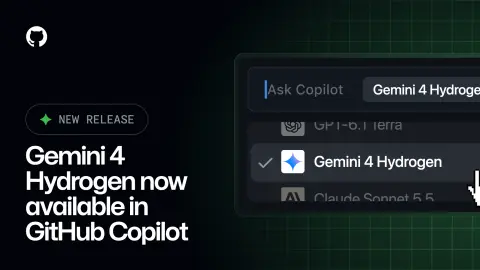
GitHub describes Hydrogen as built for fast, efficient agentic coding, tool use and multistep workflows, with better instruction following than Gemini 3.8 Flash.
It is billed at provider list price under usage-based billing and available to Copilot Pro, Pro+, Max, Business and Enterprise users, rolling out gradually.
It appears in the model picker in VS Code, Visual Studio, Copilot CLI, the Copilot coding agent, the Copilot app, github.com, GitHub Mobile, JetBrains IDEs, Xcode, Eclipse and the Copilot SDK.
Business and Enterprise admins control it through model policy; under default enablement new models are on automatically unless the global default is off or the model is disabled.
Builder's takeTeams that must drop 3.8 Flash before 12-14 can run their common tasks on Hydrogen now instead of waiting for the cutoff. Also note that new models are enabled by default: for cost-sensitive orgs I would turn off the global default and approve models one at a time after testing.
Both inbound JWT authorizers and outbound OAuth credential providers can now be configured with an OAuth 2.0 authorization server discovery URL.
Previously AgentCore Identity accepted only OIDC discovery URLs; authorization servers that implement OAuth 2.0 without OIDC publish metadata at a different well-known path and could not be used.
Available in all AWS Regions where AgentCore is offered, at no additional cost.
Builder's takeA small update, but it is the other half of the Cognito token exchange item from 11-14: when an agent calls downstream on a user's behalf, the identity layer has to fit the authorization servers companies already run. If you wrote a shim because a server lacked OIDC, you can remove it.
A repository_scan setting is added to the existing AI Scan enablement endpoints: GET / PATCH /orgs/{org}/code-scanning/ai-scan and /repos/{owner}/{repo}/code-scanning/ai-scan.
If an org disables it, repos cannot enable it; if the org enables it, repos inherit and can opt out; an enterprise policy that blocks it returns 422; updating it with pr_scan in one request is all-or-nothing.
Enabling it does not start a scan; users with write access run scans on demand, and each scan consumes GitHub Code Security AI credits.
It covers org-owned public repos and private or internal repos with GitHub Code Security or Advanced Security; GitHub Enterprise Server is not supported.
Builder's takeAs more code is written by AI, AI scanning should be managed as configuration like CI, not clicked on repo by repo. I would enable it at org level and let people with write access run it on demand; since every scan costs credits, try it on core repos for a month and count how many findings are real.
After adding a GHES account to the Copilot app you can work with remote repositories, issues and pull requests; this was previously an opt-in preview.
You first sign in with a GitHub.com or GHE.com account, then choose GitHub Enterprise Server under Settings > Accounts > Add account.
It requires Copilot app 1.2.0 or later; cloud sessions are not available for GHES.
Builder's takeFor teams whose code cannot leave the internal network, this means coding agents can at least run locally; but without cloud sessions, long tasks tie up the developer's own machine. I would start with issue triage and small changes and keep long tasks on self-hosted runners.
Inside AI Studio you can create a Google Developer Program profile, claim credits, link billing and track the balance, with usage shown at aistudio.google.com/billing.
Google AI Pro and Ultra plans include monthly Google Cloud credits, each valid for 12 months from issue; grants stack month to month and the earliest-expiring credits are spent first.
Drawing down credits on the Gemini API through Cloud billing requires a $5 minimum prepaid balance; only the primary subscriber can use the credits, not family members.
Builder's takeIf you already pay for AI Pro or Ultra, there may be several months of unclaimed credits waiting; they suit prototypes and evaluations, such as running Hydrogen against your current model on the same tasks. They are personal credits, though, so keep production traffic off them.
Researched and drafted with AI assistance; editorial standards and views set by Darius.
Every Monday, the week in AI in one email
Every Monday morning: the 6 AI stories that mattered most in the past seven days, with my take, in your inbox.
Your email is only used to send the weekly and is never shared. Every email has a one-click unsubscribe link. See the latest issue →