Turning One Written Issue Into Video Across Nine Platforms
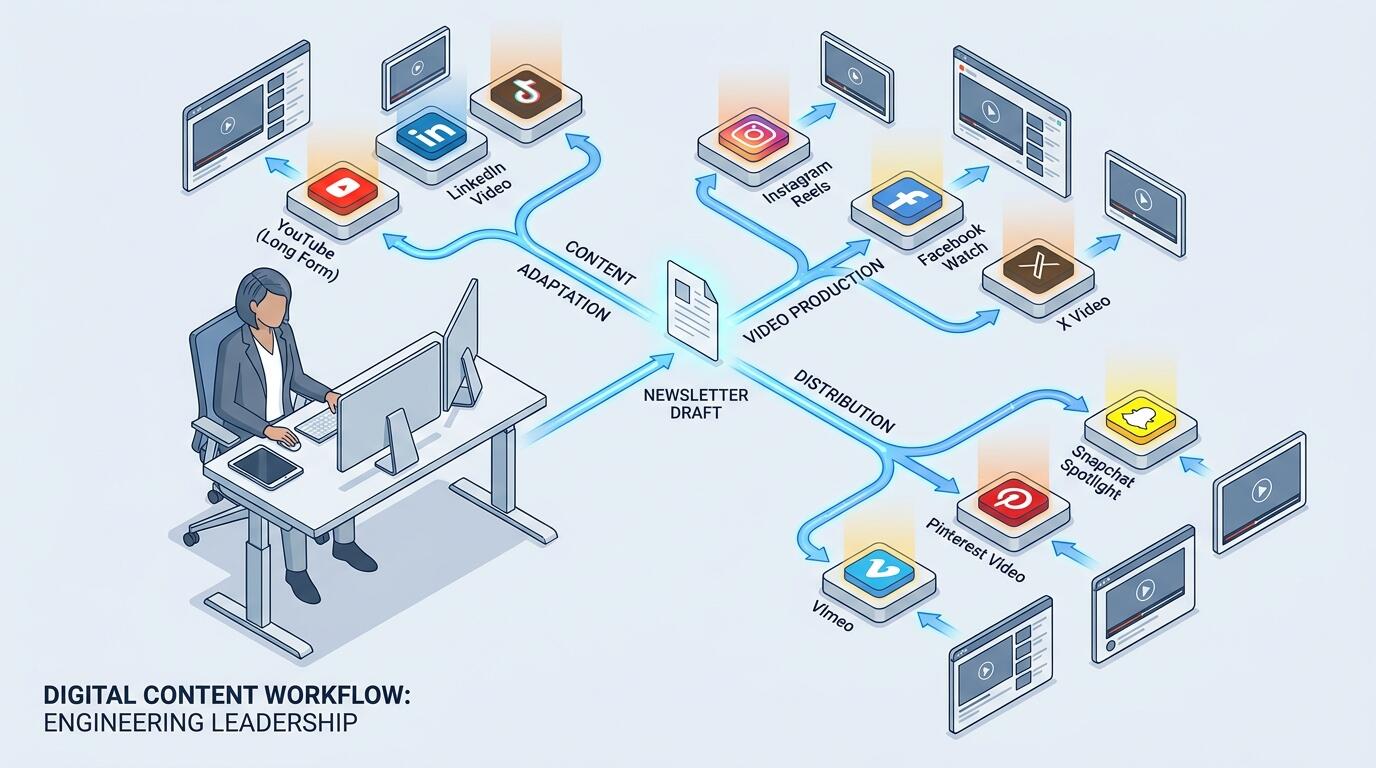
ALT: Engineering director converts a single written newsletter issue into video content across nine distribution platforms
Why Distributing One Written Issue Across Nine Video Platforms Is an Engineering Problem, Not a Creative One
The central question most technical newsletter operators ask is: how do you extract more reach from content you have already written without proportionally increasing production overhead? The direct answer is this — converting a single written issue into video across nine platforms is primarily a pipeline design problem, and the teams that solve it well treat it as an engineering workflow, not a content marketing campaign.
This topic deserves serious analysis right now because the production toolchain for AI-assisted video has matured enough that the gap between "written-first" and "video-first" creators is closing mechanically, not creatively. The opportunity is real, and the trap — building a fragile, manually intensive conversion process — is equally real.
The Current Landscape: From Written Newsletters to Multi-Platform Video Distribution
Written newsletters occupy a structurally privileged position in technical content. They are authoritative, searchable, citable, and optimized for depth. But according to research consistently published by the Reuters Institute for the Study of Journalism, video continues to capture a disproportionate share of mid-funnel engagement time across platforms, even among professional and technical audiences.
For newsletter operators who write for developers and engineering leaders, the traditional response has been to ignore video entirely — the production cost felt too high, and the audience felt too text-native to care. That calculus is changing for two reasons.
First, AI-assisted video production tools — text-to-video narration, automated talking head generation, LLM-based script condensation — have dropped the marginal cost of converting a 1,500-word written issue into a structured video script to near zero in terms of manual labor. What once required a producer, a studio, and post-production editing can now be prototyped in a single afternoon by one engineer with a clear pipeline.
Second, the platform landscape has fragmented. A "video strategy" no longer means YouTube. It now means YouTube long-form, YouTube Shorts, LinkedIn video, X (formerly Twitter) video clips, Instagram Reels, TikTok, Bilibili (relevant for Chinese-language audiences), podcast video feeds, and embedded video on the newsletter's own website. That is nine distinct distribution surfaces, each with different aspect ratios, length constraints, caption expectations, and algorithmic behaviors.
The engineering challenge is not producing one video. It is designing a pipeline that takes one written input and fans out to nine derivative outputs without introducing a maintenance burden that outpaces the original production savings. This is precisely the kind of workflow problem that a technically grounded newsletter like Darius confronts directly — building systems that survive production reality rather than collapsing under it.
Root-Cause Analysis: Why Most Written-to-Video Pipelines Fail at Scale
Most attempts to convert a written newsletter into multi-platform video fail for reasons that are structural, not creative. Breaking them down reveals three distinct failure modes.
The Monolithic Script Problem
The most common mistake is treating the written issue as a script. A newsletter issue is written for a reading pace — dense, linear, citation-heavy. A video script requires a spoken pace — shorter sentences, explicit transitions, rhetorical signposting. When teams copy-paste newsletter prose into a teleprompter or text-to-speech system, the output is technically a "video" but is unwatchable.
Script condensation is a first-class engineering step, not a cosmetic one. For a 1,500-word written issue covering five AI news items, the corresponding video script might run 400–600 words for a seven-minute long-form video, and 80–120 words for a 60-second short-form clip. This is a lossy compression problem, and the compression logic needs to be explicitly designed — which three of the five items are "lead stories" for video? Which item has enough visual explainability to work without reading the primary source?
A pattern that works in practice: use an LLM to generate a tiered condensation of each newsletter item — a 150-word spoken summary, a 30-word headline version, and a 10-word caption version. Each tier serves a different platform tier. The 150-word version feeds the long-form video; the 30-word version feeds the short-form clip; the 10-word version feeds the caption overlay and platform description field.
The Format Mismatch Problem
Platform format requirements are not just aesthetic preferences — they are hard constraints that determine whether a video is surfaced by the platform's algorithm at all. According to documentation maintained by platform-specific developer relations teams, aspect ratio, video length, and caption file format all affect distribution eligibility.
The nine-platform distribution surface roughly segments into three technical tiers:
- Long-form horizontal (16:9, typically four to fifteen minutes): YouTube, embedded website video, podcast video feeds
- Short-form vertical (9:16, typically thirty to ninety seconds): YouTube Shorts, Instagram Reels, TikTok, Bilibili vertical clips
- Square or flexible (1:1 or 4:5, typically thirty to sixty seconds): LinkedIn, X video clips
A pipeline that produces only one video in one format has failed before distribution begins. The minimum viable architecture produces at least two master cuts — one horizontal long-form and one vertical short-form — from which the remaining seven platform variants are derived through automated trimming, reframing, and caption injection.
The Metadata Debt Problem
Metadata — titles, descriptions, tags, thumbnails, chapter markers — is where most written-to-video pipelines accumulate the most technical debt. It is also where organic discoverability is won or lost. Each of the nine platforms has a distinct metadata schema, and the metadata that performs well on YouTube (keyword-rich, long-tail description, timestamps) is different from what performs well on LinkedIn (professional framing, no hashtag stuffing) or TikTok (hook-first description, trending keyword clusters).
Per guidance from the IEEE Internet Computing community and published platform API documentation, programmatic metadata generation — using LLMs to produce platform-specific title and description variants from the same underlying written issue — is now a tractable, repeatable step. The key insight is that metadata is not a creative task to be done manually after production. It is a templated transformation that should be baked into the pipeline's output stage.
Evidence and Multi-Angle Comparison: Approaches to Written-to-Video Conversion
Teams working on content repurposing at a systems level typically cluster around three distinct approaches. Each has genuine strengths, real trade-offs, and a clear best-fit profile.
| Perspective / Approach | Strengths | Trade-offs | Best Fit |
|---|---|---|---|
| Manual production (human writer converts each issue) | Highest editorial quality; voice and tone consistent with the original | Does not scale; typically produces one video per issue maximum; cost-prohibitive for small teams | Teams with dedicated video producers and low publication cadence |
| AI-assisted single-pipeline (LLM script + text-to-speech or talking head, automated rendering) | Low marginal cost per issue; high cadence sustainable; format variants automatable | Output quality ceiling is lower; requires initial engineering investment to build and maintain pipeline | Engineering-led newsletter teams with weekly publication cadence; technical founders |
| Hybrid (LLM draft + human review + partial automation for distribution) | Balances quality and scale; allows editorial judgment at the script stage | Still requires recurring human time; risk of the human review step becoming a bottleneck | Teams with one dedicated editor who can review but not produce from scratch |
In practice, the pattern we consistently see among technically sophisticated newsletter operators is that they start with the AI-assisted single-pipeline approach, discover specific quality failure points (usually in the script condensation and metadata stages), and then selectively insert human review at exactly those two stages. The distribution and formatting stages remain fully automated. This hybrid-by-necessity approach is pragmatic and honest about where human judgment actually adds value versus where it just adds latency.
The written-to-video conversion workflow also forces a useful architectural discipline: every piece of written content must be structured cleanly enough for a machine to extract the core claim, the supporting context, and a call to action. Teams that have been writing loosely structured prose discover quickly that their newsletter format needs to tighten up — which is a net positive for the written product as well.
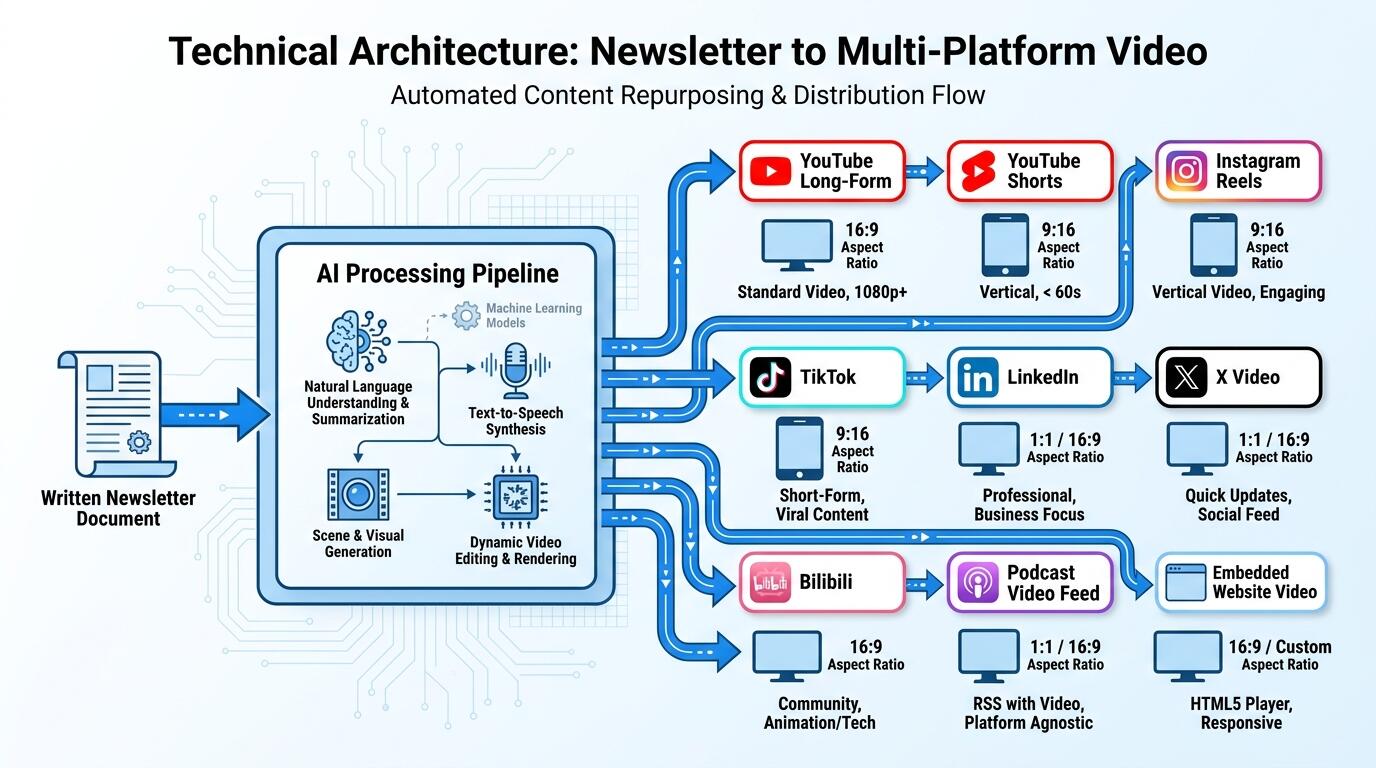
ALT: Diagram illustrating written newsletter issue being converted through AI pipeline into nine platform-specific video formats including YouTube Shorts Instagram Reels and LinkedIn video
Outlook: Where Written-to-Video Pipelines Are Heading and What It Means for Technical Newsletter Operators
The trajectory of AI-assisted video production tools points clearly toward lower barriers and higher output quality — not the reverse. Models capable of generating natural-sounding narration from written text are improving in voice quality and in their ability to preserve technical terminology without mispronunciation. Automated video editing systems are beginning to support template-driven production workflows that can be version-controlled like software.
For technical newsletter operators specifically, the implication is that the competitive advantage in the next two to three years will not come from deciding whether to produce video — the toolchain will make that decision trivially easy. The advantage will come from how well the underlying written content is structured for machine-readable transformation, and how cleanly the distribution pipeline handles the nine-platform output surface without accumulating operational debt.
Three actionable takeaways for engineering teams starting this transition now:
Build the condensation logic first, not the production infrastructure. The single highest-leverage step is defining exactly how a 1,500-word written issue maps to a 400-word long-form script and an 80-word short-form clip. That logic, once defined and tested, becomes the foundation for every downstream automation decision.
Design for the two master cuts from the beginning. Every production decision — b-roll selection, caption timing, intro/outro length — should be made with horizontal long-form and vertical short-form in mind simultaneously. Retrofitting a horizontal video into vertical later is expensive and usually produces a poor result.
Treat metadata as a pipeline output, not a post-production task. Generate platform-specific titles, descriptions, and tags programmatically from the same written input that feeds the script. This is where most teams leave the most organic discoverability on the table.
Questions & Answers
Q1: How do you maintain editorial voice and technical accuracy when an LLM condenses a written newsletter issue into a video script?
Maintaining technical accuracy in LLM-generated video scripts requires treating the condensation step as a constrained task rather than a free-form summarization. In practice, this means providing the LLM with explicit instructions to preserve named entities (model names, paper titles, organization names), retain the core engineering implication of each item, and flag any item where the original source is a primary research document. A human review pass specifically focused on technical accuracy — not tone or phrasing — is the right intervention point. The LLM handles compression; the human verifies the claims have not been distorted.
Q2: Are there platform terms of service concerns with publishing AI-generated video content across all nine surfaces?
Platform policies on AI-generated content are evolving, and the specific requirements differ across platforms. As of current platform documentation available from YouTube's Creator Academy and Meta's Content Policies, the primary requirement is disclosure of AI-generated synthetic media (particularly synthetic voice and synthetic likeness), not a prohibition on AI-assisted production. Operators should check the current content policy for each platform individually, since these policies are updated more frequently than most third-party summaries reflect. Building disclosure language into the video description template is a reasonable default.
Q3: How long does it realistically take to build a working written-to-video pipeline that covers nine platforms?
Building a functional pipeline — from LLM script condensation through automated format rendering to metadata generation — typically requires a focused engineering investment measured in weeks, not months, for a team with prior experience in API integration and workflow automation. A minimal viable pipeline covering the two master cuts (long-form horizontal and short-form vertical) plus automated metadata generation is achievable in a shorter timeframe than building out all nine distribution surfaces simultaneously. Prioritize the two or three platforms where your existing audience is already active, get the pipeline stable, then extend to additional surfaces.
Key Takeaways
- Converting a written newsletter issue into video across nine platforms is a pipeline engineering problem, not a creative production problem. The creative work happens in the written issue; the pipeline's job is lossless-enough transformation.
- The minimum viable architecture produces two master cuts — one horizontal long-form and one vertical short-form — from a single written input. All nine platform variants are derived from these two masters through automated trimming and reframing.
- Script condensation is the highest-leverage engineering step. Define explicit compression ratios for each platform tier (long-form, short-form, caption) before building any production infrastructure.
- Metadata generation should be a pipeline output, produced programmatically from the written input, not a manual post-production task. This is where most teams leave organic discoverability unrealized.
- Human review is most valuable at two stages: script condensation (to verify technical accuracy) and platform-specific metadata (to check for tone appropriateness). Automating everything else is a reasonable default for engineering-led teams.
The next step is concrete: map your current written issue format to the three-tier condensation model described above, and identify which of the nine distribution surfaces already overlaps with your existing reader base. Start there, build the pipeline for those two or three surfaces, and extend progressively.
If this analysis is useful to you, subscribe to the Darius bilingual AI newsletter — each issue selects five to ten AI developments with primary sources and production-grounded engineering commentary, helping you cut through the noise and find the signals that actually matter for teams building AI products in production.
Sources & Further Reading
- Reuters Institute for the Study of Journalism. "Digital News Report."
https://reutersinstitute.politics.ox.ac.uk - IEEE. "IEEE Internet Computing — Platform and Pipeline Research."
https://www.ieee.org - YouTube. "YouTube Creator Academy — Platform Policies and Content Guidelines."
https://www.youtube.com
Note: Standards and platform policies may be updated frequently; please check the latest official documentation from each platform or standards body before making implementation decisions.