When You Need an Agent and When a Plain Workflow Is Enough
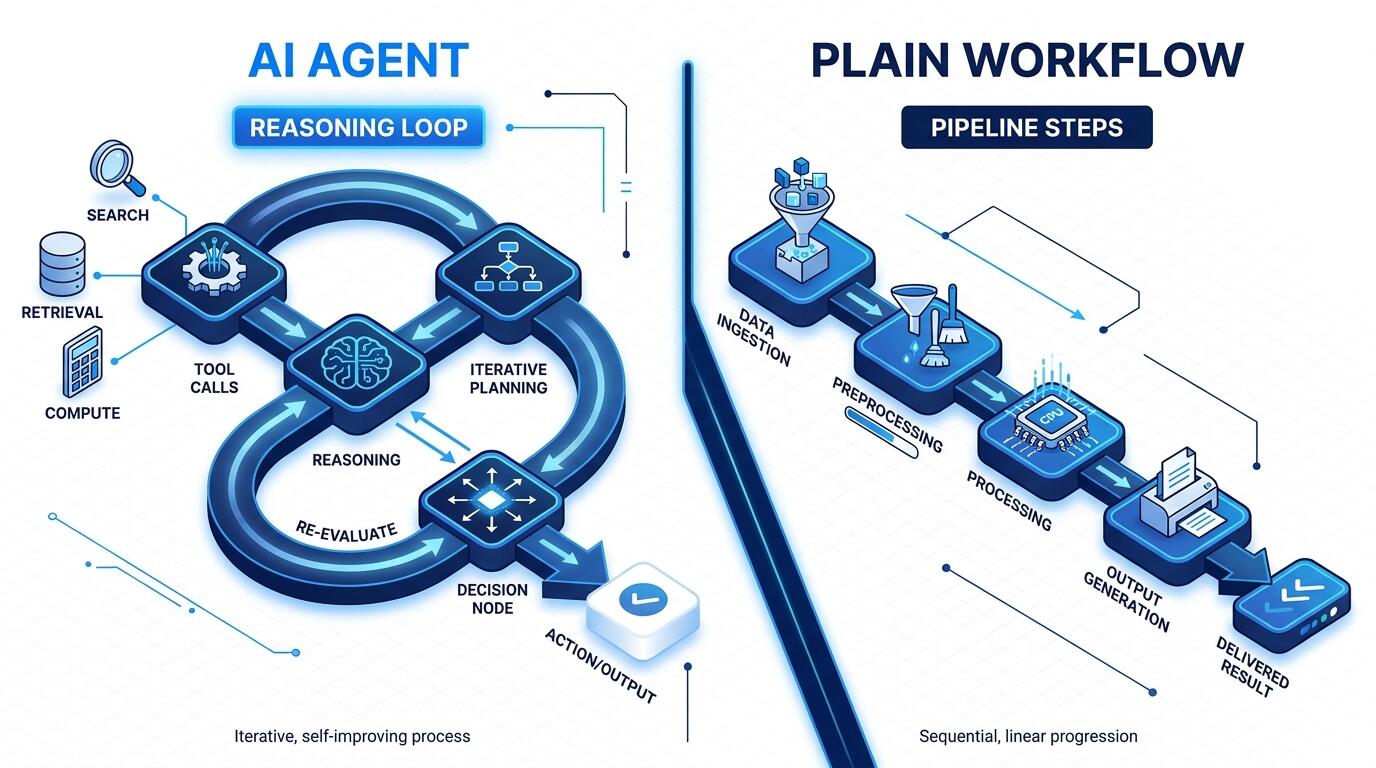
ALT: AI agent versus plain workflow decision framework for engineers building production AI products
Agents vs. Workflows: How to Choose the Right Architecture for Your AI Product
The choice between an AI agent and a plain workflow is one of the most consequential architectural decisions an AI product builder will make — and it is also one of the most commonly botched. A pattern we consistently see in the field: teams reach for agents because they feel modern, then spend weeks debugging non-deterministic behavior that a simple DAG-based workflow would have solved in an afternoon. The inverse also happens — teams build brittle, hardcoded pipelines where an agent's adaptive reasoning would have saved them months of edge-case handling.
This article compares two fundamental paradigms: AI agents (systems that reason, plan, and act dynamically with tool access) versus plain workflows (deterministic, pre-defined processing pipelines that may or may not call an LLM). The comparison is judged on reliability, cost, latency, maintainability, and the complexity of the problem being solved. The goal is not to crown a winner — both are legitimate tools — but to give you a clear framework for choosing the right one at the right time.
Evaluation Criteria: What Actually Matters When Choosing Between Agents and Workflows
The right architecture is the one that ships reliably, costs what you can afford, and is maintainable by the team you actually have. Five criteria drive this comparison.
Reliability and predictability. A system's ability to produce consistent, auditable outputs is foundational for production use. Workflows are deterministic by design; agents introduce non-determinism through model decisions, tool invocations, and retry loops. For regulated domains, customer-facing features, or anything with SLA commitments, predictability is not optional.
Operational cost. Every LLM call costs tokens; every agent loop multiplies those calls. In our experience running multiple production AI products, agent architectures can consume significantly more tokens per task than an equivalent workflow — especially when the agent spins up multi-step reasoning chains for problems that could have been resolved with a single, well-structured prompt. Cost scales with usage, and the gap widens fast.
Latency. Workflows execute in a known number of steps. Agents plan at runtime, which means the number of LLM calls is variable and can balloon under ambiguous inputs. For real-time or near-real-time user experiences, latency unpredictability is a serious UX liability.
Maintainability and debuggability. When something breaks in production, how quickly can an engineer identify root cause and fix it? Workflows have clear step boundaries and logs. Agent traces are harder to reason about — a chain-of-thought that worked in testing may fail in production in ways that are difficult to reproduce.
Problem-space fit. Some problems are genuinely open-ended, require multi-step tool use, or involve dynamic decision trees that cannot be enumerated at design time. Others are well-bounded, have known input-output schemas, and follow a fixed logic path. The shape of the problem should drive the architecture, not the other way around.
The Contenders: Defining Agents and Plain Workflows in Production Terms
AI Agents: Autonomous, Reasoning Systems with Tool Access
An AI agent is a system that uses a large language model (LLM) as its reasoning core, equips it with tools (APIs, code interpreters, search, database access), and lets the model decide at runtime which tools to invoke, in what order, and when the task is complete. Agents are characterized by autonomy — they do not follow a pre-defined execution path. Instead, they plan, act, observe results, and adapt.
The agent pattern is most powerful when the task space is genuinely open-ended: "Research competitors in this market and produce a structured brief," "Debug this failing test suite using the available shell and file tools," or "Manage my calendar given these constraints and preferences." These tasks require judgment that cannot be fully expressed as a finite state machine.
The cost of that power is complexity. Agents require careful prompt engineering to constrain behavior, robust tool definitions to prevent misuse, loop-detection to avoid runaway execution, and extensive testing across diverse inputs. They are also expensive — multi-step reasoning chains with tool calls are not cheap, and the cost is hard to cap in advance.
Plain Workflows: Deterministic, Composable Pipelines
A plain workflow is a pre-defined sequence (or directed acyclic graph) of processing steps that may include LLM calls, but where the control flow — which steps run, in what order, under what conditions — is determined by the engineer at design time, not by the model at runtime.
A workflow might look like: extract entities from a document, classify the intent, route to one of three downstream handlers based on the classification, generate a structured response using a template-bound prompt, and write the result to a database. Each step is explicit, observable, and testable in isolation.
Workflows are the right default for the majority of production AI features. They are cheaper to run, faster to debug, easier to test, and simpler to explain to stakeholders. The trade-off is inflexibility — if the task requires reasoning paths that were not anticipated at design time, a workflow will fail or produce incorrect outputs silently.
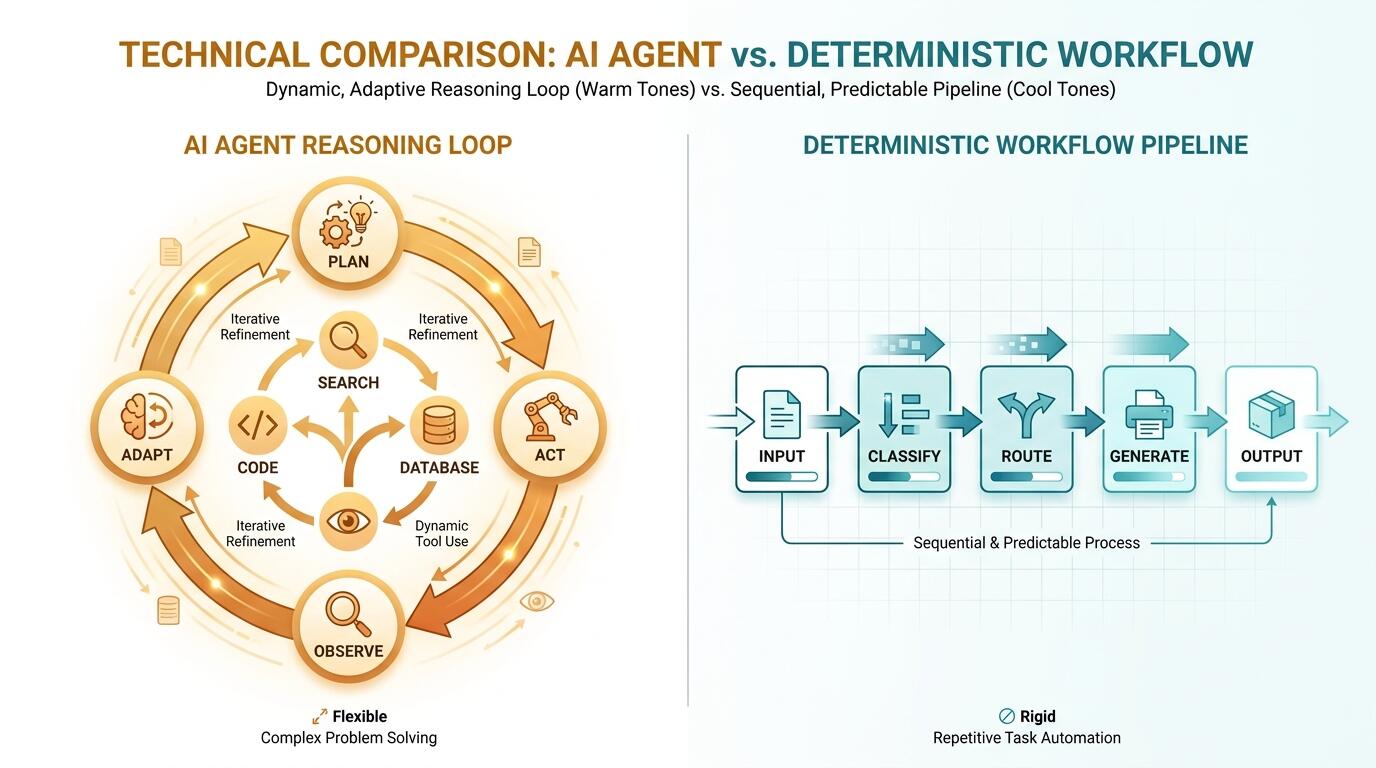
ALT: Side-by-side comparison diagram of an AI agent reasoning loop and a plain deterministic workflow pipeline for production AI product engineering
Head-to-Head Comparison: Agents vs. Plain Workflows Across Key Dimensions
| Criterion | AI Agent | Plain Workflow |
|---|---|---|
| Reliability / Predictability | Variable — model decisions introduce non-determinism | High — execution path is fixed at design time |
| Token Cost per Task | High and variable — multiplied by reasoning steps | Low and predictable — bounded by step count |
| Latency | Variable — depends on runtime planning and tool calls | Predictable — bounded by known step count and I/O |
| Debuggability | Hard — traces require agent-specific tooling | Easy — standard logging and step inspection |
| Maintainability | Complex — prompt changes can cascade across behaviors | Modular — each step can be updated independently |
| Problem-Space Fit | Open-ended, dynamic, multi-tool tasks | Well-bounded, known input-output schemas |
| Time to Production | Longer — requires testing across diverse reasoning paths | Shorter — deterministic logic is easier to validate |
| Failure Mode | Unpredictable or silent incorrect outputs | Loud, traceable, easier to catch in CI |
The table reveals a consistent pattern: agents trade reliability, cost, and debuggability for flexibility and autonomous problem-solving capability. Plain workflows are the inverse — they sacrifice adaptability in exchange for everything that makes production systems maintainable.
The most important practical implication is cost. In our experience building and operating AI products in production, a poorly scoped agent can cost an order of magnitude more per task than an equivalent workflow — because every LLM call in the reasoning loop costs tokens, and agents reason before acting, sometimes extensively. Research published by AI engineering practitioners (including analysis covered by Redis Engineering and discussed in depth on ModelRiver) consistently points to token cost as the primary reason teams abandon agents and refactor back to structured workflows after initial deployment.
Latency is the second major factor. A workflow with a fixed number of LLM calls has a predictable p95 latency that can be load-tested and bounded. An agent that must plan before acting has an unbounded latency profile — in practice, ambiguous inputs can trigger extended reasoning chains that push response times well outside acceptable UX ranges. For any feature where the user is waiting on a response, this matters.
Maintainability compounds over time. A workflow can be updated by any engineer on the team who can read a DAG. An agent's behavior depends on the interaction between its system prompt, its tool definitions, and the model's current behavior — changes to any one of these can produce unexpected emergent behaviors. This is not a theoretical concern; it is something we encounter in every production agent deployment.
Which Should You Choose? Scenario Recommendations for Builders
Choose a plain workflow if:
You are building a feature with a well-defined input-output schema. Document extraction, classification, summarization with a fixed template, retrieval-augmented generation (RAG) over a known corpus, content moderation — these are all workflow-shaped problems. The reasoning path is enumerable, the failure modes are predictable, and the cost is controllable.
You are working with a limited token budget or serving high-volume, cost-sensitive workloads. If you are processing thousands of requests per day and every request needs to be cheap, a workflow is the only responsible default.
You need auditability or compliance traceability. In domains where you must be able to explain every decision — finance, healthcare, legal tech — a workflow's explicit step-by-step execution is far easier to audit than an agent's chain-of-thought.
Your team is small or the system will be maintained by engineers who were not involved in the original build. Workflows are more transferable and less fragile under change.
Choose an agent if:
The task genuinely cannot be fully specified at design time. If the user's request requires dynamic tool selection — for example, "find me all the relevant information and synthesize it" across a heterogeneous set of data sources — an agent's runtime planning adds real value that a workflow cannot replicate without becoming an unmaintainable maze of conditional branches.
The problem space is exploratory or research-oriented. Competitive research, code generation with iterative testing, long-horizon planning tasks — these benefit from an agent's ability to observe intermediate results and adjust its approach.
Failure is recoverable and not customer-facing. Internal tooling, developer-facing assistants, and async batch tasks with human review are better candidates for agents than synchronous customer-facing features.
Pros and cons summary:
Plain workflows — predictable, cheap, debuggable, fast to build, fast to audit. Limited to tasks where the logic can be fully specified in advance.
AI agents — flexible, powerful for open-ended tasks, capable of handling novel reasoning paths. Expensive, non-deterministic, hard to debug, slower to ship reliably.
A hybrid approach is often the right answer in practice: a workflow that calls a lightweight agent step for the one sub-task that genuinely requires dynamic reasoning, while keeping the surrounding orchestration deterministic. This contains the agent's cost and non-determinism to a bounded scope.
Common Questions
Q1: How do I know if my task is too complex for a plain workflow?
A task outgrows a plain workflow when the number of conditional branches you would need to handle all realistic inputs becomes unmanageable — typically when the logic tree cannot be fully enumerated in a reasonable design session. A practical test: if your workflow diagram requires more than a handful of decision nodes and you find yourself writing "and so on" to cover edge cases, the problem may be agent-shaped. Start with a workflow and escalate to an agent only when the workflow's failure rate under real inputs demonstrates the need.
Q2: Are agents always more expensive than workflows for the same task?
Agents are almost always more expensive per task, because they use the LLM not just for output generation but also for planning, tool selection, and iterative reasoning — each of which consumes tokens. For simple tasks, an agent may use many times more tokens than a single-step workflow prompt. The cost gap narrows only when the task is genuinely complex and would require extensive conditional logic or multiple hardcoded LLM calls to replicate in a workflow.
Q3: How long does it typically take to move from a workflow to an agent architecture?
Refactoring a production workflow into an agent architecture is rarely a small project. Beyond rewriting the orchestration layer, teams typically need to rebuild their evaluation harness (since agent outputs are non-deterministic), redesign their logging and observability stack to capture agent traces, and invest significant time in adversarial testing to catch failure modes that only surface under diverse real-world inputs. In a pattern we see consistently, teams underestimate this by at least half. Start with the simplest possible agent scope and expand incrementally.
Key Takeaways
- A plain workflow is the correct default for production AI features. Reach for an agent only when the task genuinely requires dynamic, runtime reasoning that cannot be expressed as a finite set of pre-defined steps.
- Cost and latency are not secondary concerns — they are primary architectural constraints. Agents multiply your token spend and introduce latency variance; both compound at scale.
- Debuggability degrades significantly with agents. If your team cannot efficiently trace and reproduce failures in production, your agent architecture will accumulate invisible technical debt faster than a workflow would.
- The most practical production pattern is a hybrid: a deterministic workflow for orchestration, with a bounded agent step for the one sub-task that genuinely requires flexible reasoning.
- Architecture decisions should be driven by the shape of the problem, not by what feels current. Choosing agents for their novelty is one of the most expensive mistakes an AI product team can make.
The clearest next step is to audit your current or planned AI features against the five criteria above — reliability needs, cost envelope, latency requirements, maintainability burden, and problem-space openness — and reclassify each as workflow-first or agent-necessary. Most features will land in the workflow column.
If you are building AI products and want to cut through the noise, subscribe to Darius — a bilingual AI briefing written by an engineering lead who runs multiple AI products in production. Each issue covers five to ten curated AI developments with firsthand, practitioner-grade analysis, so every piece of industry signal maps directly to your next technical decision.
Sources & Further Reading
- Redis Engineering. "AI Agents vs Workflows: When to Use Each".
https://redis.io/blog/agents-vs-workflows/ - ModelRiver. "When Do You Actually Need an AI Agent?".
https://modelriver.com/blog/do-you-really-need-an-ai-agent - Gurrpreet Sinngh. "When (and When Not) to Use Agents".
https://www.linkedin.com/pulse/when-use-agents-gurrpreet-sinngh-jkcsc
Note: The AI engineering field evolves rapidly; verify that any referenced frameworks, tools, or cost benchmarks reflect current platform behavior before applying them to production decisions.