Vibe Coding vs. Disciplined Development: Finding the Right Balance in 2026
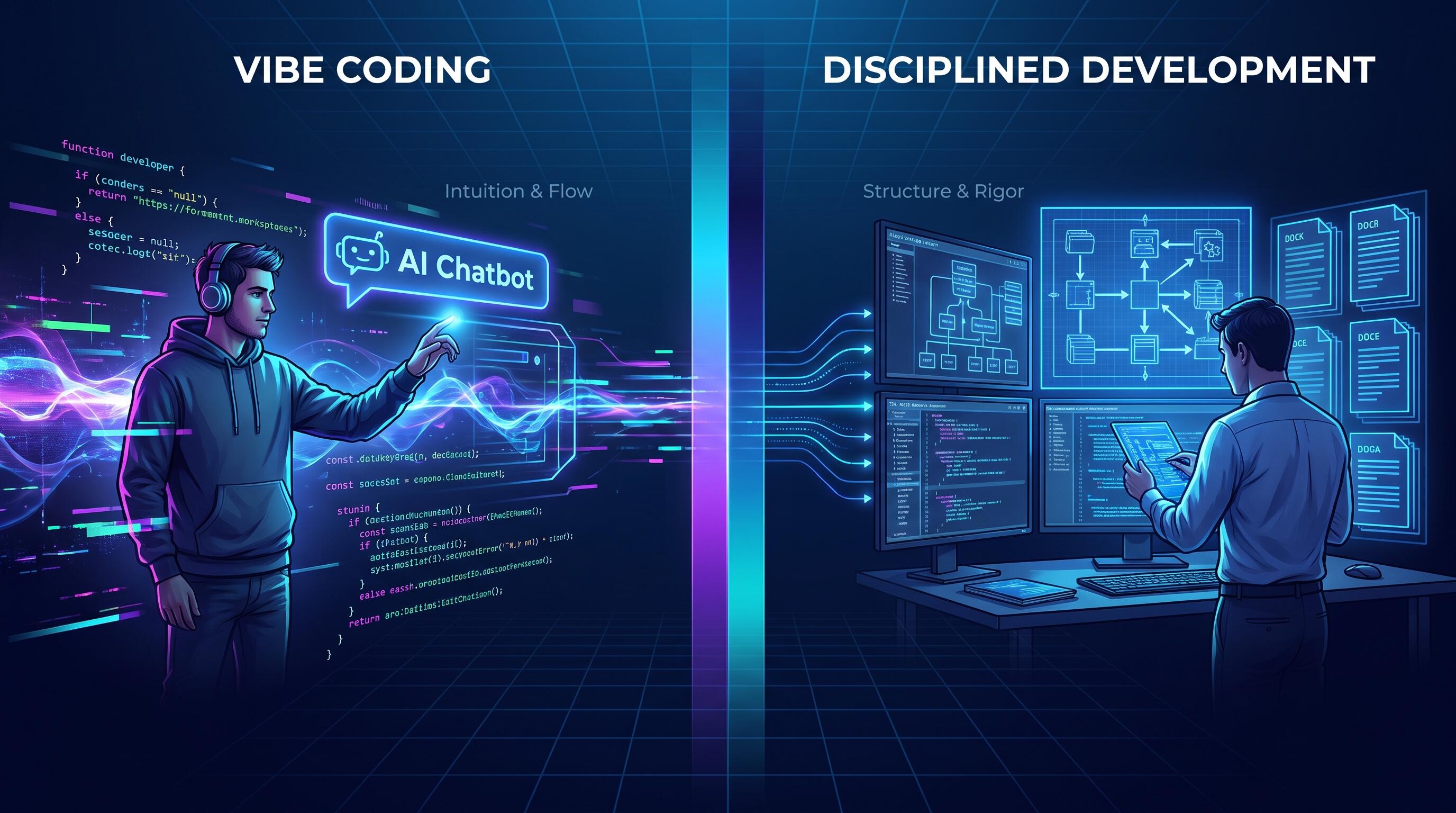
ALT: Vibe coding versus disciplined systems design and full-stack development practices compared in 2026
The 2026 Developer Dilemma: When Speed Meets Structural Integrity in Software Engineering
Key Conclusion: The tension between vibe coding and disciplined development is not a binary choice — it is a spectrum that every engineering team must deliberately navigate. In 2026, the most effective builders combine rapid AI-assisted prototyping with rigorous systems design, grounded technical consulting, and battle-tested full-stack development practices. Getting this balance right separates teams that ship functional products from those that ship fragile ones.
The emergence of large language models as co-pilots, code generators, and architectural advisors has fundamentally altered how software gets built. What once took weeks of careful scaffolding can now be roughed out in hours. But speed has a shadow side: technical debt, brittle architectures, and systems that work brilliantly in demos and collapse quietly in production.
For tech founders, startup CTOs, and senior engineers, the real challenge in 2026 is not choosing between intuition-driven development and engineering discipline — it is knowing when to apply each, and how to blend them without sacrificing either velocity or structural soundness. That judgment call is exactly what distinguishes senior engineering leadership from enthusiastic hacking.
Who This Applies To — and Who Should Proceed Carefully
✅ Applicable Scenarios:
- Startup founders and CTOs who are actively using AI-assisted coding tools and need a framework for when to trust fast output and when to slow down and architect properly
- Engineering leads managing small-to-medium product teams who want to adopt modern development velocity without accumulating crippling technical debt
- Organizations evaluating external technical consulting or fractional engineering leadership to help structure their development process before scale
❌ Not Applicable/Cautions:
- Teams building in strictly regulated industries (healthcare, fintech, aerospace) where every decision requires compliance validation and rapid prototyping without governance is inherently risky
- Organizations expecting a single methodology to replace proper architectural planning — neither vibe coding nor rigid waterfall processes alone constitutes a full engineering strategy
- Developers conflating "vibe coding works for me personally" with "vibe coding is the right approach for our production system at scale"
The Rise of Vibe Coding — and Why It Demands a Serious Response
The term "vibe coding" entered the engineering lexicon in earnest around 2024-2025, popularized by practitioners describing a workflow where you describe intent to an AI, accept or lightly edit the output, and move on. It is fast, it is often surprisingly capable, and for certain problem classes — rapid prototyping, internal tooling, throwaway scripts, proof-of-concept demos — it is genuinely productive.
But the conversation has since overheated. Proponents sometimes imply that disciplined engineering practices are relics of a slower age, unnecessary friction imposed by overly cautious architects. Critics, meanwhile, dismiss AI-assisted development entirely as code that "no one really understands." Both camps are wrong, and both stances are expensive.
The market data is instructive. Developer adoption of AI coding tools has grown at a pace few technologies have matched. GitHub's internal research has shown measurable productivity gains for certain task categories. But production incident rates and architectural quality have not improved at the same rate — in some organizations, they have worsened, as poorly understood AI-generated code propagates into systems that nobody can confidently debug.
The real cost of undisciplined development is not visible on day one. It surfaces six months later when a new engineer joins and cannot understand the codebase, when a database migration breaks three undocumented dependencies, or when scaling a feature requires rewriting the entire service because the original design made no accommodation for load. These are not hypothetical risks — they are the lived experience of teams that shipped fast and paid the price later.
What the industry needs is not a verdict on vibe coding, but a principled framework for integrating it responsibly into real engineering workflows. That is what this article provides.
Practical Framework: Integrating Speed and Discipline Without Choosing Between Them
Three-Step Quick Start for Balanced Development in 2026
Step 1: Classify the Work Before You Start
Before opening a chat window with an AI assistant or pulling up your IDE, spend ten to fifteen minutes classifying the task at hand. Is this a prototype that will be thrown away after a stakeholder demo? Is it internal tooling used only by the team? Or is it a core service path that will handle real user data at scale? The answer should directly determine how much architectural rigor you apply. Fast and loose is appropriate for throwaway work. Anything touching production data, external APIs, or user-facing reliability requires deliberate design before a single line is written.
Step 2: Apply the Right Workflow Layer for Each Task Type
Once you have classified the work, match the development approach to the classification. Prototypes and exploratory spikes can absolutely leverage vibe coding — use AI generation freely, move fast, and do not over-engineer. For production-bound work, require a brief written design document (even one page) that captures the key architectural decisions, expected load characteristics, failure modes, and integration points. This does not have to be a formal RFC — it just has to exist. The act of writing it forces the clarity that pure vibe coding skips.
Step 3: Build in a Structured Review Gate Before Merging to Main
The review gate is where speed and discipline converge. For AI-assisted code going into production, require that at least one engineer who did not write the code can explain what it does, why key decisions were made, and what would happen if a dependency failed. This is not about gatekeeping — it is about collective ownership. Teams that skip this step create systems where knowledge lives only in the AI chat history, which is a liability no engineering organization can afford. This review step typically adds modest time upfront but saves substantial debugging time later.
Comparing Development Approaches: A Practical Matrix
Different situations call for different postures. The following comparison is intended to help engineering leaders make deliberate choices rather than defaulting to habit or trend.
| Comparison Dimension | Pure Vibe Coding | Hybrid Balanced Approach | Fully Disciplined Engineering |
|---|---|---|---|
| Time to first working output | Fastest | Moderate | Slowest |
| Architectural integrity | Low | High | Highest |
| Suitability for prototypes | Excellent | Good | Poor fit |
| Suitability for production systems | High risk | Appropriate | Appropriate |
| Team knowledge retention | Low | High | High |
| Debugging complexity over time | Increases significantly | Manageable | Lowest |
| Cost of rework at scale | Very high | Moderate | Low |
| Recommended team size for effective use | Individual / pair | Any size | Mid to large teams |
The hybrid approach is not a compromise that delivers mediocrity in both directions. When executed well, it delivers near-vibe-coding speed in appropriate contexts while maintaining the structural soundness that only disciplined engineering practice produces.
Deep Dive: What Disciplined Development Actually Looks Like in 2026
Systems Design Is Not Optional — It Is the Multiplier
Systems design is the practice of defining how components interact before you build them, anticipating failure modes, and making deliberate choices about data flow, service boundaries, and scalability constraints. In 2026, this has not become less important — it has become more important, precisely because AI tools can generate plausible-looking implementations that paper over architectural mistakes with functional-seeming code.
Consider a common scenario: a startup CTO uses an AI assistant to scaffold a microservices architecture. The generated code works in local testing. But the AI has made implicit assumptions about synchronous communication between services that will create cascading failures under real load. Without a systems design review that examines these assumptions explicitly, the team ships something that appears to function and fails in ways that are genuinely difficult to diagnose.
Good systems design does not require months of upfront planning. It requires the discipline to ask the right questions before committing to an approach: What are the read and write patterns? Where is the single source of truth for each data entity? What happens when this external API is unavailable? How does this service scale horizontally? These questions take time to answer, but they take far less time than debugging a production system that was designed without asking them.
Full-Stack Development Discipline in an AI-Assisted World
Full-stack development in 2026 means maintaining coherent ownership across the entire product surface — from database schema through API contracts through frontend behavior through deployment infrastructure. AI tools can contribute meaningfully at each layer, but they tend to generate each layer somewhat independently, without enforcing the cross-layer contracts that make a system maintainable.
A practical example: an AI might generate a React component that calls an endpoint with a particular response shape, and separately generate a backend handler that returns a slightly different shape. Both pieces of code look correct in isolation. In integration, they break. Human engineering discipline — specifically, the practice of defining and versioning API contracts before implementing either side — prevents this category of error.
The teams that use AI-assisted full-stack development most effectively are those that maintain a clear mental model of the entire system and use AI to accelerate implementation within a well-understood structure, rather than using AI to define the structure itself.
Technical Consulting and the Art of Knowing What You Don't Know
One of the highest-value interventions available to a startup or scaling team is bringing in experienced technical consulting at the right moment — specifically, at architecture decision points before they become irreversible. The cost of bad architectural choices compounds over time, and the organizations that fare best are those that invest in senior technical judgment early, not after the damage is done.
A common question in this space is how much product development services typically cost when engaging external engineering expertise. This varies significantly based on scope, engagement model, and the seniority of the advisor, and the right answer depends heavily on what stage of the product you are in and what decisions are on the table. A fractional engagement that prevents one major architectural rework typically delivers returns that far exceed its cost. The calculus is almost always favorable for teams at the architecture decision stage.
When it comes to best practices for hiring engineering consultants, the most important signal is not credentials or resume length — it is demonstrated evidence of shipping. Has this person actually taken a product from architectural concept to live deployment? Can they show you the system, the decisions made, the tradeoffs navigated? A consultant who has only designed systems in theory is a fundamentally different resource than one who has built and shipped them.
Remote Engineering Teams and Structural Discipline
The question of best practices for managing remote software development teams intersects directly with the vibe-coding-versus-discipline conversation. Remote teams have less incidental communication, which means the implicit shared understanding that co-located teams develop organically simply does not exist in the same way. Documentation, design review processes, and explicit architectural decisions are not bureaucratic overhead for remote teams — they are the connective tissue that keeps distributed engineers working coherently on the same system.
Teams that operate with a vibe-coding-heavy approach and are also fully remote tend to accumulate the highest rates of architectural entropy. The combination of low-documentation development and distributed communication creates systems where understanding is diffuse, inconsistent, and fragile. The remedy is not to eliminate AI-assisted development — it is to pair it with the documentation and review practices that replace the in-person communication it cannot replicate.
Recommended team structure for most early-stage product teams involves a senior technical lead (whether internal or fractional) who owns architectural decisions and maintains the system's coherent design, supported by mid-level engineers who implement within that structure and junior contributors who operate in well-scoped areas with active mentorship. This hierarchy is not about organizational status — it is about matching judgment and experience to the decisions that have the highest consequence.
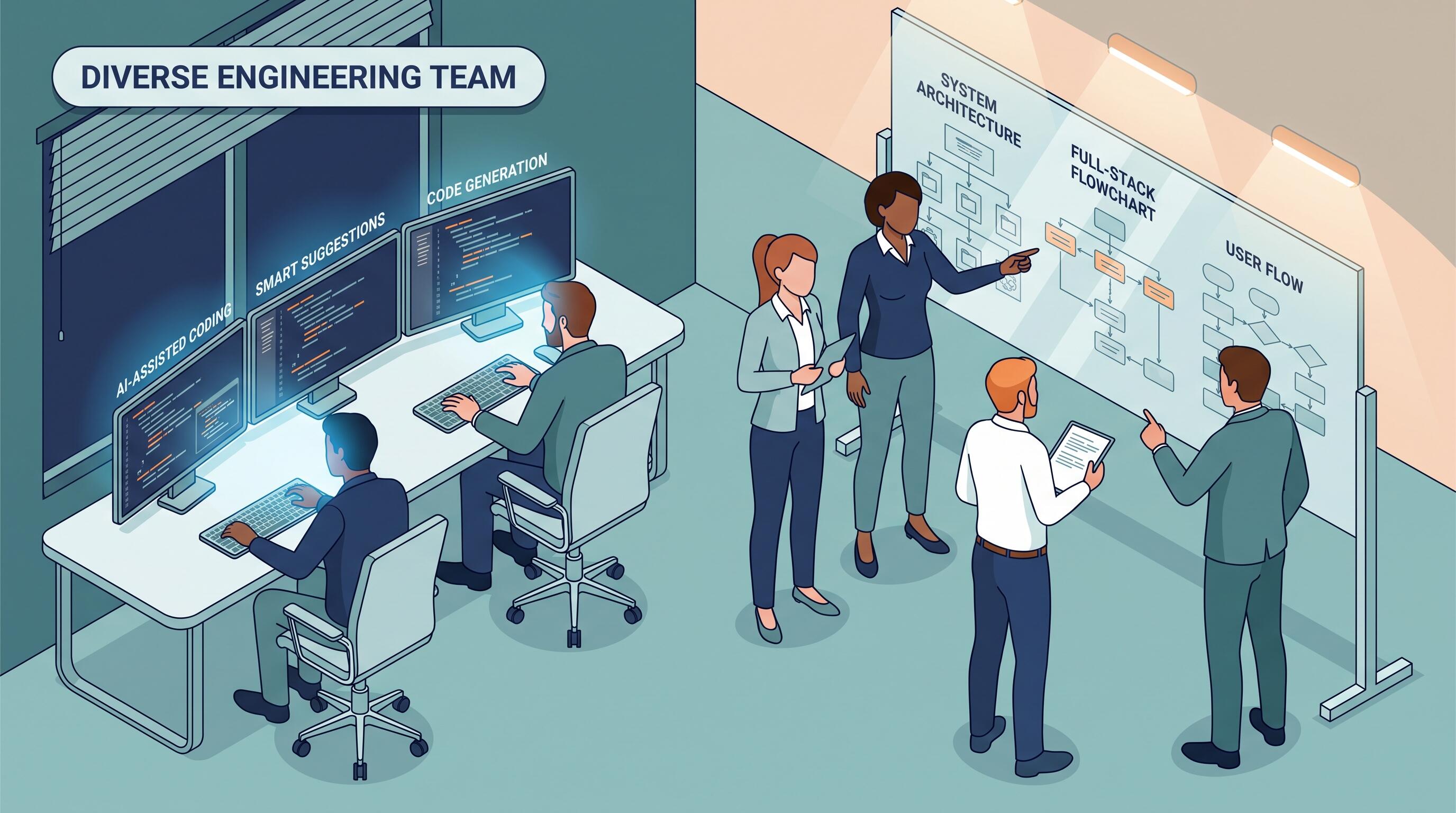
ALT: Engineering team using AI tools alongside disciplined systems design and full-stack development practices for balanced software delivery in 2026
Advanced Considerations: Edge Cases, Misconceptions, and What Changes at Scale
When Vibe Coding Is Genuinely the Right Choice
It is worth being direct: there are genuine use cases where vibe coding is not just acceptable but optimal. Internal developer tooling, one-off data migration scripts, rapid customer-facing prototypes built explicitly to be thrown away, and exploratory research spikes all fall into this category. The key characteristic they share is consequence isolation — if the output breaks or turns out to be wrong, the blast radius is limited and recovery is inexpensive.
The mistake is not using vibe coding for these cases. The mistake is failing to recognize when a task has crossed out of this category and requires a different approach.
The Most Common Misconception: "AI-Generated Code Is Someone Else's Problem"
A surprisingly persistent misconception is that AI-generated code carries lower engineering accountability — that if the AI wrote it, the human engineer is less responsible for its behavior. This is categorically false and professionally dangerous. Code that ships under your name or your team's name is your responsibility regardless of how it was generated. The engineer who merges AI-generated code without understanding it has made a professional judgment: they have decided this code is correct and production-worthy. If it is not, the professional accountability is unchanged.
What Changes When You Scale
The balance point between vibe coding and disciplined engineering shifts as systems scale. Early-stage products can tolerate more architectural ambiguity because the cost of rewriting is low. As user load increases, data accumulates, team size grows, and external integrations multiply, the cost of ambiguity rises exponentially. Teams that successfully navigate this transition are those that begin building disciplined practices before they feel necessary — specifically, before the first architectural crisis makes them mandatory.
Frequently Asked Questions FAQ
Q1: How do I know when a feature is too important to vibe-code?
Apply a simple consequence test: if this feature failed silently in production, what would happen? If the answer involves data loss, user-facing errors, revenue impact, or security exposure, it is not a candidate for pure vibe coding. That does not mean you cannot use AI assistance — it means you need design review, test coverage, and code that at least one engineer fully understands before it ships. The higher the consequence, the more discipline the implementation warrants.
Q2: Are AI coding tools genuinely useful for complex systems design work?
AI tools are genuinely useful for specific sub-tasks within systems design — generating boilerplate, suggesting common architectural patterns, writing draft documentation, and exploring tradeoff spaces quickly. They are not reliable for the judgment work at the core of systems design: deciding which tradeoffs are acceptable for your specific context, your specific team, and your specific scale. That judgment requires experience that AI tools do not possess. Use them as a force multiplier on your thinking, not as a replacement for it.
Q3: What does it typically cost to bring in external technical consulting for architecture review?
Engagement costs for senior technical consulting and fractional engineering leadership vary significantly based on scope, duration, and the specific decisions being reviewed. Rather than stating a number that may be misleading out of context, the more useful framing is return on investment: a focused architectural review before a major build decision typically prevents rework costs that are an order of magnitude larger. The investment is almost always justified at architecture inflection points. For specific engagements, direct consultation to scope the work accurately is advisable.
Summary
The vibe coding versus disciplined development debate is a false binary that obscures the real engineering challenge: building the judgment to know which approach is right for which situation, and the organizational discipline to apply that judgment consistently.
Three core principles bear repeating. First, classify work before you start — the appropriate development posture depends entirely on the consequence profile of what you are building. Second, maintain systems design integrity regardless of how code is generated — AI tools accelerate implementation but do not replace architectural thinking. Third, invest in team knowledge ownership — code that only the AI understands is a liability, not an asset.
For engineering leaders and technical founders, the practical next step is to audit your current development workflow against these principles. Where is AI assistance being used in low-consequence contexts? Good — lean into that velocity. Where is it being used in high-consequence contexts without design review or test coverage? That is the risk that needs to be addressed before it compounds.
The teams that will ship the most reliably in 2026 are not the ones using the most AI assistance or the least — they are the ones using it with the clearest judgment about when it serves the product and when it creates hidden risk.
If you're looking to turn your next big idea into a live, working product, Darius brings the rare combination of AI architecture depth, systems thinking, and full-stack execution to make it happen. Explore real projects, technical insights, and professional background at https://www.darius.wiki. Whether you're building from scratch or scaling an existing system, Darius is the engineering partner who ships.
References
- GitHub. "GitHub Copilot: The AI Coding Assistant That Boosts Developer Productivity".
https://github.blog/2023-06-27-the-economic-impact-of-the-ai-powered-developer-lifecycle/ - ACM (Association for Computing Machinery). "Technical Debt and Its Management in Software Systems".
https://dl.acm.org/doi/10.1145/2600821 - IEEE Software. "Agile Architecture: Strategies for Scaling Agile Development".
https://ieeexplore.ieee.org/document/7725239 - McKinsey & Company. "Unleashing developer productivity with generative AI".
https://www.mckinsey.com/capabilities/mckinsey-digital/our-insights/unleashing-developer-productivity-with-generative-ai - Stack Overflow. "Developer Survey 2024: AI Tools and Developer Experience".
https://survey.stackoverflow.co/2024/
Note: Standards may be updated, please check the latest official documents or consult professional advisors.
About the Author
Darius is an Engineering Director and AI Architect specializing in transforming ideas into live, running products — with hands-on expertise spanning AI architecture, systems design, and full-stack development, backed by 3 shipped live projects. Learn more at darius.wiki.
© Darius. All rights reserved. The views and technical insights expressed in this article are based on the author's independent professional experience. This content is provided for informational purposes only and does not constitute formal consulting or legal advice.