Validating a New Product Idea With Real Customers This Quarter

ALT: Founder validating a new product idea with real customers before building full product
Smoke Test vs. Concierge vs. Prototype: Choosing Your Validation Method This Quarter
Key Conclusion: Validating a new product idea with real customers this quarter comes down to matching your method to your riskiest assumption. Smoke tests are fastest for demand validation, concierge approaches reveal the deepest user truth, and interactive prototypes bridge the gap when buyers need to "see" before they commit. No single method wins universally — the right choice depends on your product stage, the nature of your uncertainty, and how much runway you can afford to burn.
Founders and CTOs routinely build things nobody asked for. Not because they lack intelligence — but because they conflate enthusiasm with evidence. This article compares three structured approaches to idea validation: the smoke test, the concierge method, and the interactive prototype. Each is evaluated against criteria that matter when time is short and capital is real: speed, cost, signal quality, scalability, and decision clarity. If you are trying to get honest answers from real customers this quarter, this comparison will help you pick the right tool for your specific situation.
Evaluation Criteria: What Makes a Validation Method Worth Your Time
A useful validation method for a new product idea must satisfy five practical criteria, each of which separates real insight from comfortable noise.
Speed to first signal. The goal of early validation is to compress your uncertainty cycle. A method that takes three months to yield data is not a validation tool — it is a slow-motion build. For a quarterly timeline, the threshold is roughly two to four weeks from decision to first meaningful customer response. Speed matters most when you are burning runway or trying to align co-founders and investors around a go/no-go.
Cost and resource footprint. Validation should be cheap relative to the full build cost. The point is to spend a small amount of time and money to decide whether a larger investment is justified. A method that requires a functional backend, a design team, and QA cycles before you can test a hypothesis has already partially committed you to the product — which undermines the test.
Signal quality. Not all customer feedback is equal. People say they would pay for things they never actually buy. The gold standard is behavioral evidence — did the customer take an action that costs them something (time, money, social capital)? Methods that capture stated intent are useful but weaker than those that capture revealed preference.
Scalability of learning. A validation method should produce findings you can act on at a higher level of confidence. A single conversation is a data point; a pattern across a dozen or more is a signal. The method should be repeatable enough that you can accumulate evidence without rebuilding the testing apparatus every time.
Decision clarity. The best validation generates a clear binary: build further, or kill it. Methods that produce ambiguous results — "people seemed interested" — push the real decision downstream, where it becomes more expensive. A good method forces a hypothesis and measures against it.
The Contenders: Three Approaches to Validating a Product Idea
Smoke Tests: Validating Demand Before a Single Line of Code
A smoke test is a demand-validation technique in which you present a product offer to potential buyers before the product exists, then measure whether they take a commitment action. The most common form is a landing page describing the product with a call to action — email signup, pre-order, waitlist enrollment, or a payment initiation — backed by a small paid traffic campaign.
Smoke tests are the fastest method available. You can have a credible landing page live within 48 hours and be reading conversion data within a week. The cost is low: primarily the time to write compelling copy and a modest ad budget to drive qualified traffic. The signal is also behaviorally grounded — someone entering their email or clicking "Pre-order" is a stronger signal than someone nodding in a user interview.
The limitation of smoke tests is specificity. They tell you whether demand exists for the category and value proposition as you described it. They tell you little about which features matter, what price point the market will bear at scale, or why users who did not convert chose not to. They are also susceptible to copy quality — a poorly written page can suppress conversion even when real demand exists. According to lean startup methodology, as documented by practitioners at institutions like MIT Sloan School of Management, the smoke test is best treated as a go/no-go trigger, not a strategy-defining research instrument.
The Concierge Method: Manual Delivery as a Learning Engine
The concierge method is a validation approach in which you manually deliver the core value of your product to a small number of real customers, without any automated systems behind it. The name comes from the hotel concierge metaphor: you are doing by hand what the software would eventually do automatically.
If your product idea is an AI-powered contract review tool, the concierge version is you (or your team) reviewing contracts manually and delivering the output to paying clients. The "automation" is a fiction maintained for the customer — they experience the outcome; you absorb the operational burden in order to learn.
The concierge method produces the highest-quality signal of the three approaches. It forces you to deeply understand the job-to-be-done, surfaces edge cases that no prototype could expose, and generates granular qualitative data about what customers actually value versus what they think they value. Researchers in product management, including those affiliated with Harvard Business School's entrepreneurship faculty, consistently identify early manual-delivery approaches as the most reliable mechanism for understanding customer workflow and switching behavior.
The tradeoff is scale and time. You can realistically concierge for a handful of customers simultaneously — five to fifteen is a common range — and the operational overhead is high. This method does not scale beyond the discovery phase, and it can create awkward expectations if customers later discover the "product" was entirely manual. It also requires that you already have customers to serve, which means some prior demand generation is needed before the concierge phase begins.
Interactive Prototypes: Making the Abstract Tangible for Buyers
An interactive prototype is a clickable, navigable mock-up of a product that simulates core user flows without a functional backend. Tools in this category allow designers and engineers to build high-fidelity representations of a product that feel real enough for buyers and users to form genuine opinions about.
Prototypes sit between smoke tests and concierge in terms of speed and cost. Building a credible interactive prototype for a moderately complex product typically requires one to two weeks if you have design capacity, and the cost is the design effort. The signal quality is moderate: users can interact with something tangible, which reduces the abstraction problem of smoke tests, but they are not yet experiencing real value delivery, so behavioral evidence remains hypothetical.
The prototype method is particularly effective when your product hypothesis involves a specific interaction pattern or workflow that is difficult to describe in words. For enterprise software, AI-assisted tools, or anything with a nuanced UX, prototypes let buyers react to something concrete. They are also useful for internal alignment — getting a founding team or a CTO and their engineering leads aligned on what is being built before committing to the architecture.
A pattern we consistently see in our work with clients at the architecture stage is that prototypes surface stakeholder disagreements that would otherwise have emerged mid-build — which is a far more expensive time to discover them. If your riskiest assumption is about UX acceptance rather than category demand, a prototype is the right first instrument.
Head-to-Head Comparison: Smoke Test vs. Concierge vs. Interactive Prototype
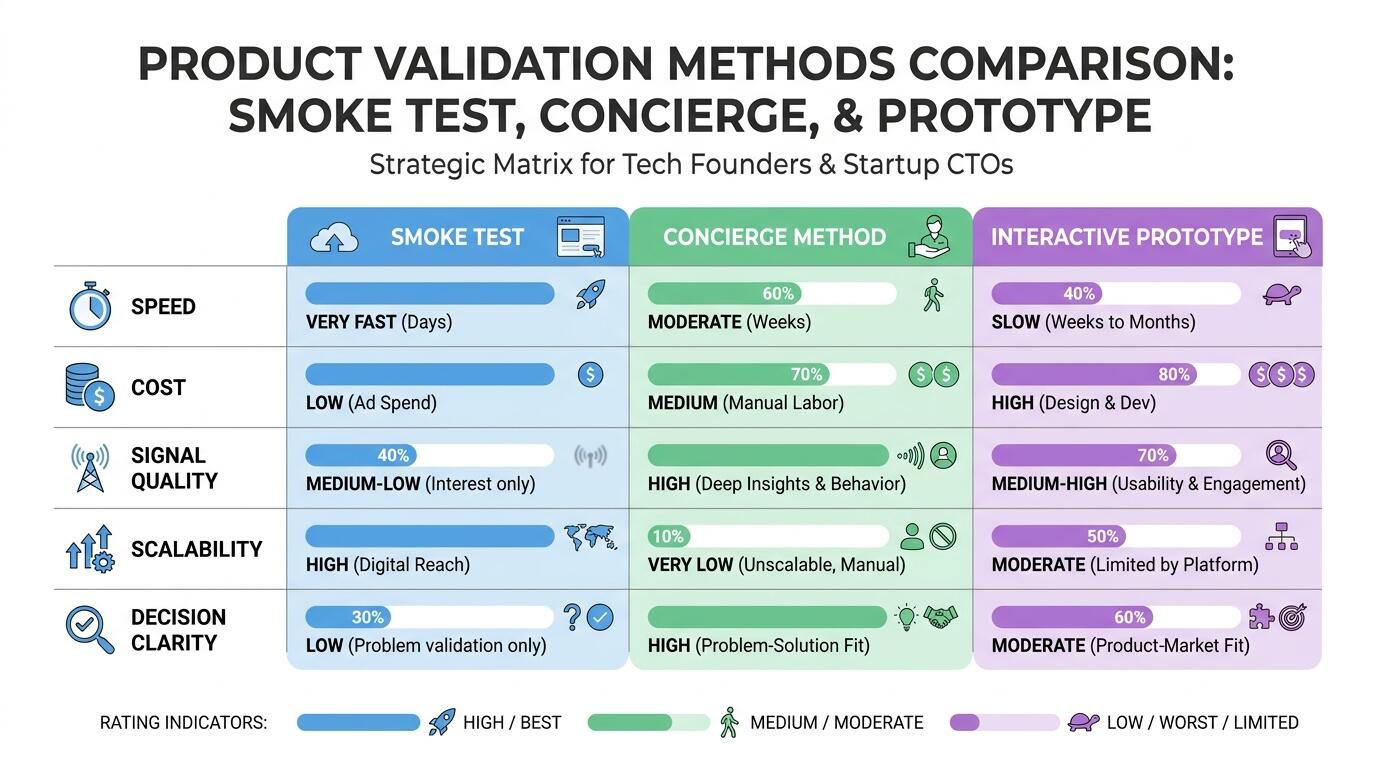
| Criterion | Smoke Test | Concierge Method | Interactive Prototype |
|---|---|---|---|
| Speed to first signal | Very fast (days to one week) | Moderate (two to four weeks setup) | Moderate (one to two weeks) |
| Cost and resource footprint | Low (copy + ad spend) | Medium-high (team time) | Medium (design effort) |
| Signal quality | Behavioral, but narrow | Behavioral and deep | Stated preference, tangible |
| Scalability of learning | High (repeatable with traffic) | Low (manual, few users) | Medium (shareable artifact) |
| Decision clarity | High for demand validation | High for workflow understanding | Medium-high for UX/buy-in |
| Best for | Demand existence | Job-to-be-done depth | Interaction design and alignment |
| Requires existing customers | No | Yes | Ideally yes |
The table reveals a clear hierarchy that depends entirely on what question you are actually trying to answer. Smoke tests win on speed and repeatability but sacrifice depth. The concierge method wins on signal quality but requires customer access and operational tolerance for manual work. Interactive prototypes occupy a middle position that is often undervalued: they are more informative than a smoke test but less operationally demanding than a concierge engagement.
One nuance worth dwelling on: these methods are not mutually exclusive and are often most powerful when sequenced. A smoke test establishes that demand exists in a category. A concierge engagement then reveals the precise job-to-be-done and the critical edge cases. A prototype can then be used to validate the proposed solution approach with a broader set of stakeholders before the build begins. When clients ask us which method to use, the more useful question is often which method to use first — and the answer depends on what they currently know versus what they need to know.
Signal quality also deserves a more granular interpretation. According to research frameworks developed by institutions studying lean product development — including documented work from Stanford's d.school — the most dangerous form of false validation is when a method captures intent rather than behavior. Smoke tests partially solve this by requiring a click or a payment action. Concierge fully solves it by delivering real value. Prototypes are the most vulnerable to intent-behavior divergence, which is why prototype testing should always be accompanied by structured observation rather than relying solely on what users say they would do.
Which Should You Choose? Scenario Recommendations for Validating Your Product Idea
Choosing the right product validation approach this quarter depends on the nature of your riskiest assumption and the resources you have available.
If you are not sure whether demand exists at all, start with a smoke test. Build a landing page that articulates your value proposition with the clarity you would use in a sales call, drive qualified traffic, and measure conversion. A strong signal is not perfection — it is a conversion rate that is meaningfully above zero from the right audience. If nobody converts, rewrite the copy and test again before concluding demand does not exist. The smoke test is the right tool when your core uncertainty is "does anyone want this?"
If you know demand exists but do not understand the customer's workflow or pain depth, run a concierge engagement. Find five to ten customers willing to pay — even a nominal amount — for the outcome your product would deliver. Deliver it manually. Document every step. Record where you spend disproportionate time, where customers ask unexpected questions, and where your assumptions about the process turn out to be wrong. This is the highest-value activity for a first-time founder building in a domain where they do not yet have deep operator experience. Understanding how to validate a product idea with real customers before building is foundational to making concierge findings actionable at an architectural level.
If you are building enterprise software or an AI-integrated tool where the UX is the product, prioritize an interactive prototype. Enterprise buyers and technical decision-makers need to see how something works before they can give you honest feedback. A prototype surfaces the right questions: "Can this integrate with our existing workflow?" "Who on my team would use this?" "What happens when the edge case occurs?" These are not questions a smoke test can answer.
If you have time for more than one approach, sequence them: smoke test first to confirm demand, concierge second to understand the job, prototype third to validate the solution. This is the approach we advocate for founders with a three-to-six month pre-build window, and it maps well onto the kind of product discovery work that precedes a serious AI architecture engagement.
Pros and cons, plainly stated:
- Smoke test: fast and cheap, but tells you little beyond "demand exists or does not"
- Concierge: highest signal quality, but slow, operationally taxing, and requires existing customer access
- Interactive prototype: best for complex UX validation and stakeholder alignment, but produces stated rather than revealed preference
ALT: Comparison chart of smoke test, concierge, and prototype methods for validating a new product idea with real customers
Common Questions
Q1: How long does it typically take to validate a product idea with real customers?
Validating a product idea with real customers can take as little as one week with a smoke test or as long as four to six weeks with a concierge engagement. The practical answer depends on how quickly you can reach your target customers and how complex the value proposition is to communicate. Most founders underestimate the time required to recruit real users for concierge or prototype sessions — customer acquisition for research is a skill in its own right.
Q2: Is a landing page smoke test actually reliable as product validation?
A smoke test is reliable for a narrow question: does enough demand exist to justify further investigation? It is not reliable for understanding why customers convert, what features they expect, or whether they will retain after experiencing the product. The most common mistake founders make is over-indexing on smoke test conversion rates as proof of business viability rather than treating them as a demand signal requiring deeper follow-up validation.
Q3: How much should a founder spend on early product validation this quarter?
Early validation should cost significantly less than the first sprint of product development. A smoke test can be executed for the cost of a few hours of copywriting and a modest ad budget. A concierge engagement costs primarily in team time. The principle, consistent with lean product development frameworks, is that validation expense should be at least one order of magnitude lower than the build cost it is meant to de-risk. If your validation is approaching your build cost, you are building, not validating.
Summary
Validating a new product idea with real customers this quarter is not a question of whether to validate — it is a question of which method gives you the clearest signal for your specific uncertainty. Smoke tests are the fastest path to demand confirmation. The concierge method is the most honest way to understand a customer's real job-to-be-done. Interactive prototypes are the right tool when your risk lives in UX acceptance and stakeholder buy-in.
Three points worth carrying forward: First, match your method to your riskiest assumption, not to your comfort zone. Most technical founders gravitate toward prototypes because building is familiar — but if demand is unproven, a smoke test is a better first move. Second, treat any single validation method as a question, not an answer. The signal from one method informs the design of the next. Third, good validation is not about getting "yes" answers — it is about getting honest ones. The value of customer validation is proportional to its capacity to change your mind.
The practical next step is to write down the single riskiest assumption behind your product idea — the one that, if wrong, would invalidate the whole concept — and choose the method that most directly tests that assumption. If that process surfaces architectural or AI integration questions downstream, understanding how to evaluate AI development tools before signing a contract will help ensure your validated idea maps to a build strategy grounded in real-world tradeoffs.
If this resonated with you, explore more insights and real-world engineering breakdowns at the Darius website — the professional portfolio of an Engineering Director and AI Architect who specializes in turning ideas into live, running products. Whether you're designing an AI system, architecting a scalable backend, or looking for a seasoned technical perspective, Darius is here to help you build smarter and ship faster.
Sources & Citations
- MIT Sloan School of Management. "Lean Startup and Customer Validation Frameworks."
https://mitsloan.mit.edu - Harvard Business School. "Entrepreneurship and Early-Stage Customer Discovery Research."
https://www.hbs.edu - Stanford d.school (Hasso Plattner Institute of Design). "Design Thinking and Human-Centered Product Validation Methods."
https://dschool.stanford.edu
Note: Methodologies and frameworks in product validation continue to evolve; please check the latest official publications from these institutions or consult experienced practitioners for current guidance.