How to Validate a Technical Idea Before Writing a Single Line of Code
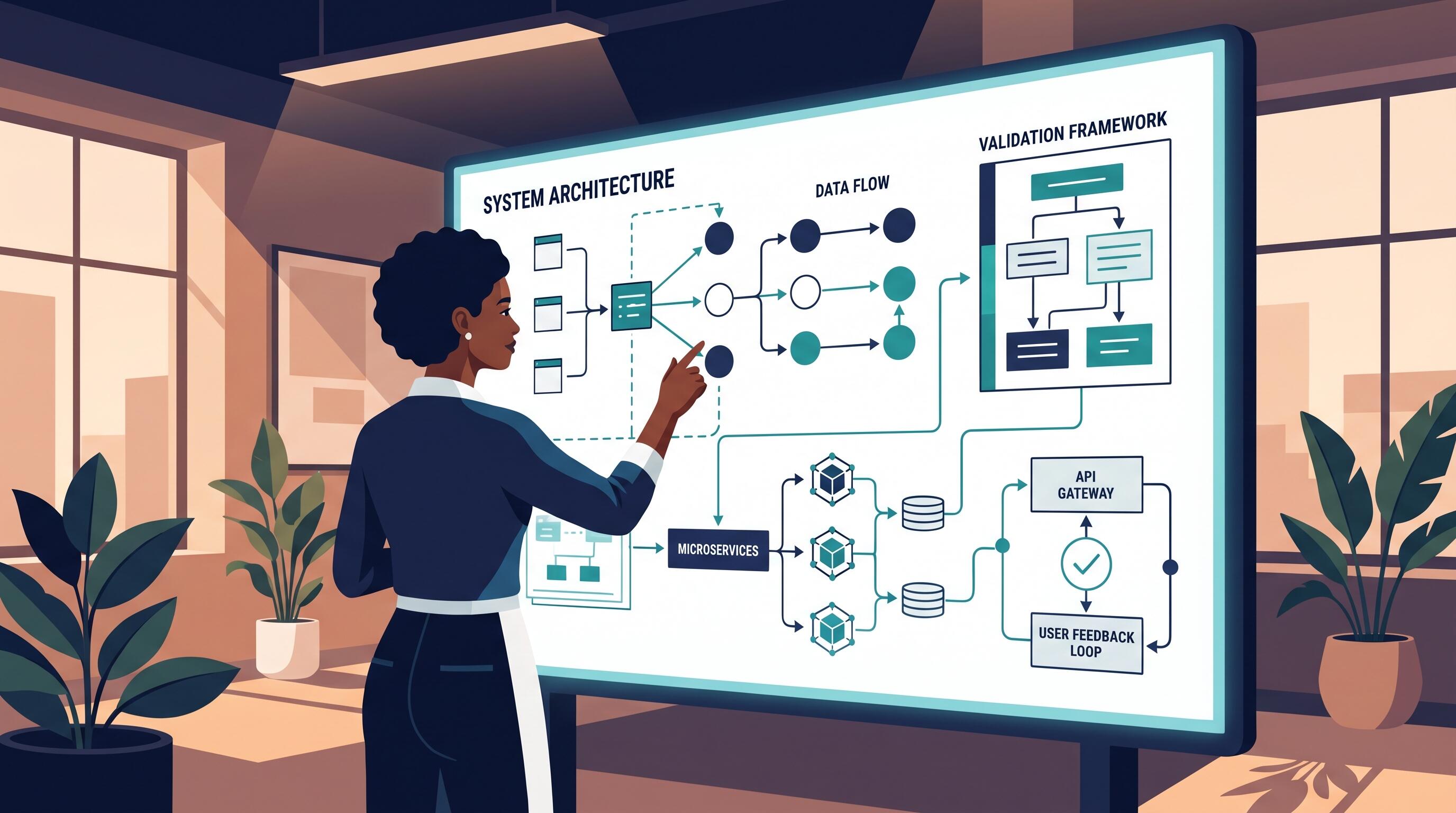
ALT: Engineer validating a technical idea through systems design before writing code
Why Validating Your Technical Idea Is the Most Important Engineering Decision You'll Make
Key Conclusion: Before a single line of code is written, the most impactful work in scalable systems and engineering leadership happens at the whiteboard — or its digital equivalent. Rigorous upfront validation through structured systems design thinking is what separates products that survive contact with reality from those that collapse under it. The teams and founders who do this well ship faster, spend less, and build architectures that actually scale.
Most technical failures aren't caused by bad engineers. They're caused by premature execution — someone had a compelling idea, someone else started building, and six months later the team discovered they'd been solving the wrong problem in the wrong way with the wrong architecture. The irony is that the fix rarely involves more code. It involves going back to the beginning and asking the questions that should have been asked on day one.
Validation — real, structured, pre-code validation — is not a luxury reserved for large organizations with dedicated research teams. It is, arguably, the single highest-leverage activity available to any founder, product manager, or engineering leader. Done well, it compresses months of wasted iteration into days of focused inquiry, and it gives your eventual architecture a foundation that can actually scale.
Who This Guide Is For
✅ Applicable Scenarios:
- Startup founders with a technical idea they're preparing to pitch or build
- Product managers who need to translate a product vision into engineering requirements without misaligning the team
- Engineering directors and technical leads evaluating whether a proposed architecture is worth investing in
- Builders planning AI-powered features who need to assess feasibility before committing infrastructure
❌ Not Applicable/Cautions:
- Teams already deep in active development of a well-validated concept (this guide is pre-build, not mid-build)
- Projects with a fixed, non-negotiable spec handed down from above — where the "what" is already locked and only the "how" is in play
The Hidden Cost of Building Without Validating
There's a pervasive mythology in the startup world: move fast, ship early, iterate. The advice isn't wrong — but it's dangerously incomplete. Moving fast without directional clarity doesn't produce agility. It produces expensive chaos that gets called agility in retrospect.
The real risk isn't moving slowly. It's investing weeks or months of engineering effort into a direction that fails its first serious real-world stress test — whether that's user rejection, technical brittleness, cost blowout, or an AI model that can't generalize beyond its training distribution.
The market has been signaling this reality loudly. As AI capabilities expand, the gap between "impressive demo" and "production-ready product" has widened, not narrowed. Many teams build impressive prototypes that collapse the moment real usage patterns, edge cases, and scale demands land on them. The reason, almost universally, is that foundational systems design decisions — data flows, state management, model serving strategy, failure handling — were deferred rather than deliberated.
Scalable systems don't emerge from iterative luck. They are designed. And the design process begins before implementation, with validation. This is a foundational principle in serious engineering leadership: the questions you ask before building determine the quality of what you build.
The methodology described in this article is rooted in that principle. It's the same approach used when architecting AI systems and full-stack products that need to work not just in demos, but in production — under real load, with real users, across real edge cases.
The Validation Framework: Three Steps Before You Touch a Keyboard
Three-Step Quick Start
Step 1: Decompose the Idea Into Falsifiable Claims
Every technical idea contains hidden assumptions. Your first job is to surface them. Spend focused time mapping out what must be true for your idea to work — technically, economically, and from a user behavior perspective. Write each assumption as a falsifiable claim: not "users will find this useful" but "users who currently solve this problem manually will prefer an automated solution if it reduces time-to-output by more than 50%." This process typically takes a few hours to a full working day, and its output is a ranked list of your riskiest assumptions.
Step 2: Design the Smallest Possible Test for Each Critical Assumption
Once you have your assumption map, identify the three to five claims that, if wrong, would invalidate the entire idea. These are your critical path risks. For each one, design the smallest, cheapest test that could produce meaningful signal. This might be a user interview, a paper prototype, an API call to an existing model, a back-of-envelope systems design calculation, or a lightweight spike. The goal is evidence, not proof — enough signal to either proceed confidently or pivot intelligently.
Step 3: Stress-Test the Architecture on Paper
Before any environment is stood up, sketch the architecture and run it through a structured stress test. Ask: What happens at ten times the expected load? Where is the single point of failure? What does the data flow look like if the primary model is unavailable? How does state get managed across services? This is where real systems design discipline pays dividends — catching architectural fragility before it's baked into thousands of lines of code. A well-stress-tested paper architecture is worth far more than a working prototype built on shaky foundations.
Choosing the Right Validation Approach: A Comparison
Different types of technical ideas call for different validation strategies. There's no universal approach, but there is a structured way to think about tradeoffs. The table below compares three common validation paths across key dimensions:
| Comparison Dimension | Assumption Mapping + Expert Review | Technical Spike / Prototype | User Research + Feasibility Study |
|---|---|---|---|
| Primary Risk Addressed | Architectural and technical feasibility | Implementation feasibility and complexity | Market fit and behavioral assumptions |
| Time Investment | Low to moderate | Moderate to high | Moderate |
| Best For | AI architecture, systems design decisions, infrastructure choices | New integrations, unknown APIs, novel algorithms | Consumer-facing features, UX flows, demand validation |
| Output | Ranked risk map, architecture decision record | Working proof of concept, complexity estimate | User insight data, demand signal |
| Engineering Leadership Value | High — forces deliberate design decisions early | Medium — produces evidence but can drift into premature building | Medium — essential for product alignment |
| Scalability Signal | Strong — directly surfaces architectural constraints | Weak — prototypes rarely reveal scale limits | Weak — users don't think in systems |
The most robust validation processes don't pick one column — they sequence across all three, starting with assumption mapping, then targeted spikes, then user validation for the highest-risk behavioral claims.
Deep Validation: What It Actually Looks Like in Practice
Mapping Assumptions Before Anything Else
The instinct when you have an exciting technical idea is to start building. Resist it. The first artifact produced should not be a repository — it should be an assumption map. This is a structured document that lists every claim your idea depends on, organized by category: technical feasibility, user behavior, economic viability, and integration dependency.
Technical feasibility claims include things like: "Our inference latency will be acceptable at P95 under expected load." Behavioral claims include: "Users will engage with an AI-generated recommendation even when they don't understand how it was generated." Both types of claims need to be tested — but they require completely different testing approaches.
The most common failure mode at this stage is conflating confidence with evidence. A founding team that has deep domain expertise will often feel certain about behavioral claims that turn out to be completely wrong. Engineering teams will often feel certain about performance claims that collapse under real usage. Assumption mapping makes these blind spots visible before they become expensive.
Designing Architecture on Paper: The Systems Design Imperative
Once your assumptions are mapped, the next critical artifact is a paper architecture. This doesn't mean a final design — it means a first-principles sketch of how data flows through the system, where intelligence is applied, and what the failure boundaries look like.
The best practices for designing scalable AI architecture systems at this stage are consistent regardless of the specific domain: reason about the system as a set of contracts between components, not as a collection of features. Each component should have a clear input/output contract, a failure mode, and a scaling strategy.
For AI-powered systems specifically, paper architecture validation must address several questions that are often deferred too late:
- Model serving strategy: Is inference happening in real-time, batch, or hybrid? What are the latency tolerances?
- Data pipeline integrity: What happens when upstream data is delayed, malformed, or missing?
- State management: Is the system stateless by design or does it maintain user/session state? How is that state persisted and recovered?
- Cost at scale: What does the per-request cost look like at ten times current projections? Is the model serving architecture cost-effective enough to survive growth?
These questions don't require a running system to answer. They require structured thinking and honest estimation. The goal of paper architecture is not to produce a perfect design — it's to surface the constraints that will shape every subsequent decision.
Spikes: Targeted Evidence Without Premature Commitment
A technical spike is a focused, time-boxed experiment designed to answer a single specific question. It is not a prototype. It is not MVP work. It is a deliberate probe into an unknown.
Good spikes are narrow. "Does GPT-4 produce structured JSON output reliably enough for our use case without post-processing?" is a good spike question. "Let's build a quick demo of the product" is not a spike — it's premature development dressed up as exploration.
The output of a spike should always be a written finding: what was tested, what was discovered, and what it implies for the architecture. This artifact is part of your validation record, and it feeds directly into the architecture decision records that mature engineering leadership teams maintain as living documents throughout a project's life.
When to Involve a Technical Leader Before Building
One of the most common and costly mistakes founders and PMs make is deferring external technical scrutiny until after significant investment has been made. The ideal moment to bring in an experienced engineering director or AI architect is not "once we have something to show" — it's before the technical direction is locked.
An experienced reviewer will ask questions the internal team hasn't thought to ask, identify architectural patterns that have failed at scale in similar contexts, and stress-test the paper architecture against real-world edge cases that only come from shipping systems, not theorizing about them.
This is especially true for AI systems, where the gap between what's technically possible in a demo and what's deployable in production is wider than in any other category of software. The best practices for managing outsourced software development projects follow the same logic: technical due diligence happens before the contract is signed, not after.
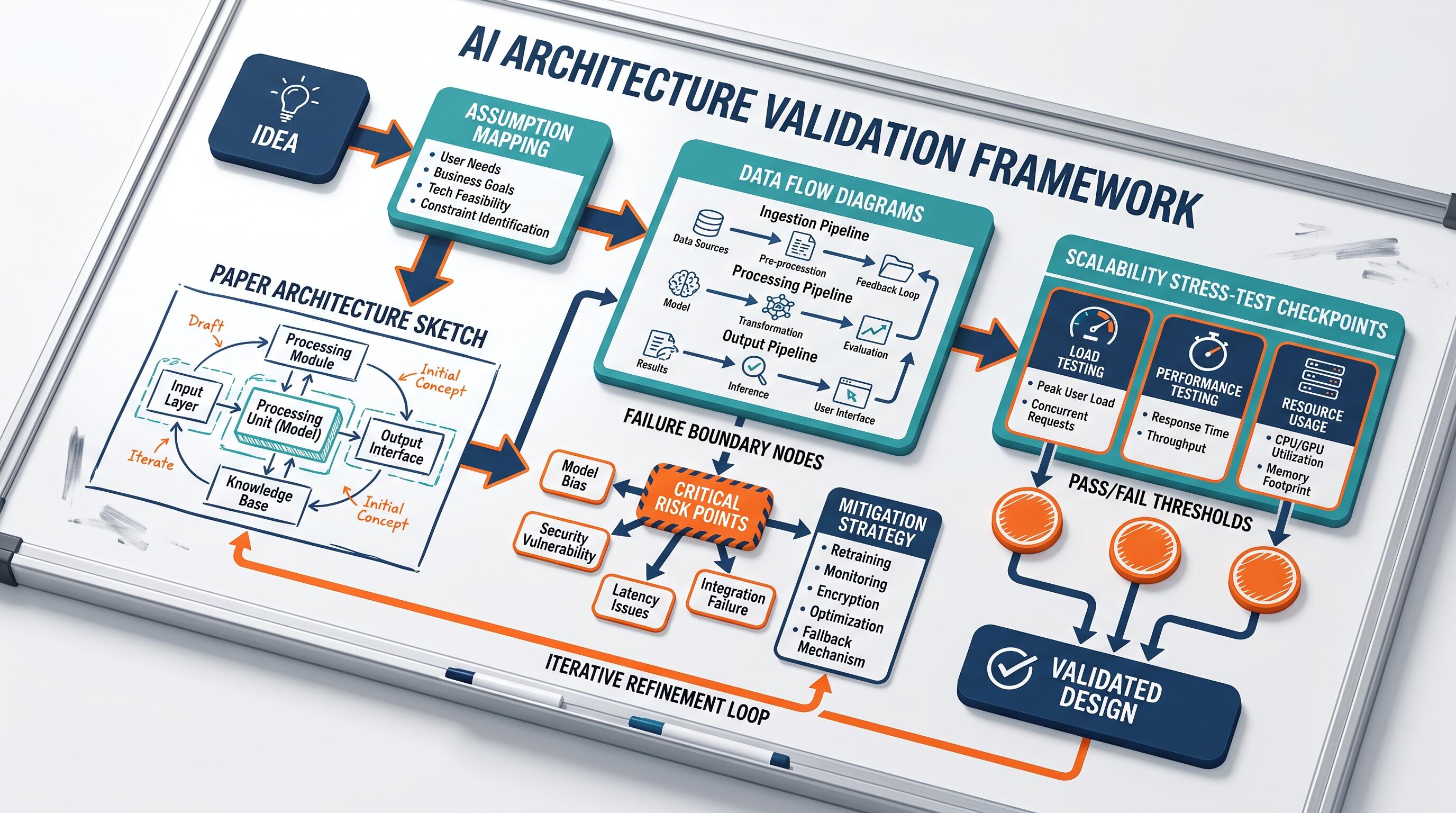
ALT: Systems design whiteboard showing AI architecture validation framework for scalable technical idea assessment
Advanced Considerations: Edge Cases and Common Misconceptions
When the Idea Is Novel Enough That No Prior Art Exists
For genuinely novel AI architecture problems — areas where existing benchmarks, case studies, and architectural patterns provide limited guidance — the validation process needs to be extended, not skipped. Novel problems require more rigorous assumption mapping, not less. The absence of prior art means the failure surface is larger and less understood, which makes upfront validation more valuable, not less necessary.
The "We'll Refactor Later" Trap
One of the most persistent misconceptions in early-stage engineering is that foundational architectural decisions can be deferred and corrected later with a refactor. In practice, architectural decisions made under time pressure in the early stages of a product become load-bearing walls. Changing them later doesn't just require rewriting code — it requires rewriting the mental models, team conventions, and data structures that have grown up around the original decision. Validation is the tool that prevents bad architectural decisions from becoming permanent ones.
Validation Is Not the Same as Analysis Paralysis
There's a legitimate concern that rigorous upfront validation can become a vehicle for avoidance — endless documentation, continuous research, perpetual refinement that never reaches a shipping decision. The antidote is time-boxing. Each validation activity should have a defined output and a deadline. The goal is not certainty — it's sufficient evidence to make a confident engineering decision. Validation should take days to weeks, not months.
The Relationship Between Validation and Agile Development
Validation is not in tension with agile methodology. The best practices for implementing agile methodology in development teams actually reinforce the validation imperative: agile works best when the team is iterating on a validated foundation. The sprint cadence is not designed to discover whether you're building the right thing — it's designed to build the right thing efficiently, once the direction has been validated.
Frequently Asked Questions FAQ
Q1: How do you validate the technical feasibility of an AI system without building it first?
The most effective approach combines assumption mapping with targeted technical spikes. Map every technical claim the system depends on — latency, throughput, model reliability, data availability — and then design the smallest test that can produce evidence for each critical claim. For AI systems specifically, a well-scoped spike against a real API endpoint, with realistic input data, will reveal more about production feasibility than weeks of architectural speculation. The output should be a written finding, not just code.
Q2: Is it possible to design for scalable systems without knowing the exact scale requirements upfront?
Yes — and in fact, this is the norm. The goal of early systems design is not to optimize for a specific scale target, but to ensure the architecture doesn't have structural constraints that would prevent scaling. Design for clear component contracts, stateless services where possible, and explicit bottleneck identification. The best practices for designing scalable AI architecture systems consistently emphasize separating concerns early so that individual components can scale independently when the need arises.
Q3: How long should the pre-code validation phase realistically take for a complex AI product?
For most AI-powered products, a structured validation process should take between one and three weeks, depending on complexity and novelty. This includes a day or two for assumption mapping, several days for critical-path spike work, and time for paper architecture review and expert feedback. Projects with significant infrastructure unknowns — novel model serving strategies, custom data pipelines, multi-cloud architecture — warrant the longer end of that range. Spending this time upfront consistently reduces total time-to-ship, not increases it.
Summary
The case for rigorous pre-code validation is not philosophical — it's empirical. The engineering teams and technical leaders who ship reliable, scalable systems consistently are not the ones who build fastest. They're the ones who think most clearly before they build.
Three points stand above everything else in this framework:
First: Every technical idea is a bundle of hidden assumptions. Making those assumptions explicit and testable is the most valuable thing you can do before writing a single line of code.
Second: Systems design is not a phase that happens after validation — it is part of validation. Paper architecture review, stress testing on a whiteboard, and structured reasoning about failure modes are how you catch expensive mistakes before they're baked into your codebase.
Third: Engineering leadership means knowing when to slow down in order to go faster. The pre-code validation phase is not overhead — it is the investment that makes everything downstream more efficient, more reliable, and more scalable.
The next step is straightforward: take your current idea and write down every assumption it depends on. Not what you believe — what you're assuming. The gap between those two lists is exactly where validation needs to happen.
Call to Action
If you're ready to turn your idea into a live, running product, Darius brings the full-stack engineering and AI architecture expertise to make it happen — with 3 shipped projects as proof of concept. Visit https://www.darius.wiki to explore his work, dive into technical insights, and discover how he can help you architect, build, and ship your next big thing.
References
- MIT Sloan Management Review. "Building AI-Powered Products That Work in Production".
https://sloanreview.mit.edu/ - IEEE Software Engineering Standards. "Best Practices in Software Architecture and Systems Design".
https://www.ieee.org/standards/index.html - ACM Digital Library. "Architectural Decision Records and Engineering Leadership in Scalable Systems".
https://dl.acm.org/ - Stanford HAI (Human-Centered Artificial Intelligence). "AI System Design: From Prototype to Production".
https://hai.stanford.edu/ - McKinsey Global Institute. "The state of AI in early 2024: Gen AI adoption spikes and starts to generate value".
https://www.mckinsey.com/capabilities/quantumblack/our-insights/the-state-of-ai-2024
Note: Standards and research may be updated. Please consult the latest official documents or professional advisors for the most current guidance.
About the Author
Darius is an Engineering Director and AI Architect specializing in transforming ambitious ideas into live, production-ready products — spanning AI architecture, systems design, and full-stack development. With 3 shipped live projects and deep cross-disciplinary expertise, Darius delivers end-to-end technical leadership that bridges strategy and execution. Learn more at darius.wiki.
© Darius. All rights reserved. The content of this article is intended for informational purposes only and reflects the author's professional experience and opinions. Nothing herein constitutes formal engineering, legal, or business advice. Reproduction or redistribution of this content without prior written permission is prohibited.