How a Startup Can Implement AI Architecture Without a Full AI Team

ALT: Startup team implementing AI architecture and machine learning solutions without a dedicated AI team
Why Startups Can Ship Real AI Solutions Without Building a Full AI Team
Key Conclusion: Most startups don't need a full AI team to implement meaningful ai architecture — they need the right strategy, the right tooling, and the right expertise at the right moment. With modern machine learning platforms, open-source infrastructure, and a lean systems-design mindset, founders can ship production-grade ai solutions faster and more cost-effectively than hiring a dedicated team. The key is knowing which decisions require deep expertise and which can be automated or outsourced.
The default assumption in most startup circles is that AI is expensive, slow to deploy, and requires a bench of ML engineers, data scientists, and AI researchers before you can ship anything meaningful. That assumption is wrong — and acting on it costs startups months of runway and competitive positioning.
The reality is more nuanced. AI has undergone a profound infrastructure shift. Foundation models, managed cloud services, and pre-built ML pipelines have lowered the barrier to building real AI products dramatically. What startups actually need isn't headcount — it's architectural clarity, disciplined prioritization, and someone who has shipped AI systems in production before.
Who This Guide Is For
✅ Applicable Scenarios:
- Early-stage startups (pre-Series B) that want to embed AI capabilities into their product without committing to a large AI team
- Product managers and technical co-founders who need to validate AI-driven features before investing in full ML infrastructure
- Organizations exploring AI consulting engagements to accelerate delivery without permanent hires
- Engineering leaders looking to scope an MVP with embedded machine learning features in a resource-constrained environment
❌ Not Applicable/Cautions:
- Organizations that require fully proprietary, deeply customized model training at scale from day one (e.g., large-scale NLP research labs or autonomous vehicle perception systems) — these require substantial dedicated AI teams
- Startups with no engineering capacity at all — some minimum technical leadership is needed to implement and own AI architecture decisions responsibly
- Scenarios where regulatory compliance (e.g., FDA-grade medical AI) demands extensive internal validation teams before any deployment
The Real Problem: AI Talent Is Scarce, But AI Capability Is Not
For most of the last decade, "implementing AI" meant hiring expensive, specialized talent, building custom models from scratch, and managing complex ML infrastructure in-house. That world still exists — but it's no longer the only path.
The market has matured significantly. Foundation models from providers like OpenAI, Anthropic, Google, and open-source communities like Hugging Face have commoditized a huge portion of the cognitive work that previously required dedicated ML researchers. On top of that, managed AI services — from vector databases to embedding APIs to serverless inference endpoints — have reduced the operational overhead of running AI in production.
What hasn't been commoditized is architectural judgment. Deciding which AI components belong in your system, how they interact, where the failure points are, how to design for latency and cost at scale, and how to avoid accumulating the kind of technical debt that buries teams six months after launch — that still requires experience. It requires someone who has made these decisions in production, not just in theory.
This is exactly the gap that strategic AI architecture consulting fills. Rather than hiring five engineers to figure it out iteratively, a startup can engage a seasoned AI architect to define the system design, establish engineering patterns, and hand off a production-ready foundation to a small internal team.
This is the model that works. And it's how startups today can ship sophisticated ai solutions that would have required armies of specialists just a few years ago.
The Practical Playbook: Three Steps to AI Architecture Without a Full AI Team
Three-Step Quick Start
Step 1: Define Your AI Scope Before You Touch Any Tools
Before selecting a model, a framework, or a cloud provider, you need to define precisely what AI is supposed to do in your product. This sounds obvious, but most early-stage teams skip it. They gravitate toward "let's use LLMs" or "let's add recommendations" without anchoring those ideas to specific user problems or measurable outcomes.
Spend time mapping your core user journeys and identifying where AI creates genuine leverage — not novelty. Is it reducing manual effort? Improving decision quality? Personalizing experiences? Once you know the why, you can scope the what precisely enough to avoid over-engineering. This step typically takes one to two focused working sessions and saves weeks of misaligned development downstream.
Step 2: Choose a Layered Architecture That Separates AI Logic from Product Logic
The single biggest architectural mistake startups make is coupling their AI logic too tightly to their product logic. When your recommendation engine, your LLM prompts, and your business rules are tangled together, every model update or API change becomes a production incident.
Design your system in layers: a product layer that handles user interactions and business rules, an AI orchestration layer that manages model calls, context management, and fallback logic, and a data layer that feeds clean, structured inputs into your AI components. This separation makes your system maintainable, testable, and upgradeable without rewrites. It's a foundational principle of solid machine learning systems design that pays dividends every sprint.
Step 3: Ship an Instrumented MVP, Then Iterate With Data
One of the best practices for MVP development is to ship the simplest version that generates real user signal — not the most impressive version you can imagine. An AI MVP should be instrumented from day one: log model inputs and outputs, capture user feedback signals, and track latency and cost per inference.
This instrumentation turns your MVP into a learning machine. You'll know within weeks which AI features users actually value, which ones are expensive to run relative to their impact, and where the model behavior diverges from user expectations. That data drives your next architecture decisions — not guesswork. Ship fast, instrument everything, iterate with evidence.
Comparing AI Implementation Approaches for Startups
Not all AI implementation paths are equal. Startups typically face three strategic choices when it comes to building AI capabilities: hire a full in-house AI team, use fully managed AI platforms with no custom architecture, or engage a specialized AI architecture consultant to design and bootstrap the system.
| Comparison Dimension | Full In-House AI Team | Managed AI Platform Only | AI Architecture Consultant |
|---|---|---|---|
| Time to First Production Feature | High — months of hiring and ramp-up | Low — days to weeks | Low-to-medium — weeks with clear scope |
| Architectural Control | High | Low | High |
| Cost Structure | High fixed cost (salaries, benefits) | Low fixed, variable usage costs | Moderate, project-based or retainer |
| Technical Debt Risk | Medium — depends on team quality | High — vendor lock-in, limited customizability | Low — architecture designed for longevity |
| Scalability of the System | High — if team is strong | Medium — platform-dependent | High — designed for scale from the start |
| Best For | Post-Series B with AI as core IP | Prototyping or non-core AI features | Seed to Series A building AI-powered products |
The hybrid model — using managed services intelligently within a well-designed architecture, guided by an experienced AI architect — consistently outperforms the extremes for early-stage companies. You get speed without sacrificing structural integrity.
How to Actually Balance Roadmap, Technical Debt, and AI Ambition
One of the hardest questions startup technical leaders face is how to balance customer requests with technical debt in the roadmap while simultaneously building AI capabilities. The honest answer is that you can't do everything — but you can sequence intelligently.
Prioritize AI investments that reduce future technical work, not add to it. Well-designed AI architecture, implemented early, can actually reduce long-term engineering complexity by automating decisions that would otherwise require manual logic trees, rules engines, or fragile conditional code. When evaluating roadmap features, ask: does this AI capability reduce downstream complexity, or does it add a new system I need to maintain?
A practical framework for prioritizing product roadmap features in an AI context is to score each feature on three axes: user impact (how much does this improve the core user value?), implementation leverage (does this unlock multiple downstream capabilities?), and architectural cleanliness (does this fit naturally into the existing system design, or does it require structural compromise?). Features that score high on all three get built next. Features that score high on impact but low on cleanliness go into a design spike before development.
Treat technical debt as a first-class roadmap item, not a background concern. In AI systems, technical debt is particularly dangerous because it accumulates in places that are hard to observe — model drift, prompt fragility, stale embeddings, unmonitored inference costs. Schedule explicit debt-reduction sprints before they become crises. A good rule of thumb is to allocate meaningful development capacity per cycle to architectural maintenance and observability improvements.
When it comes to hiring engineering consultants, the best practices are straightforward: engage them early enough to shape the architecture rather than audit it after the fact, define clear deliverables and success criteria upfront, and ensure there is an internal owner who will maintain the system after the engagement ends. A consultant who ships a system with no knowledge transfer has done you a disservice. The best engagements leave your team more capable than they were before.
What "Best Practices for Shipping Products Fast" Actually Means in AI Development
Speed in AI product development doesn't come from cutting corners on architecture — it comes from making fewer irreversible decisions early and building feedback loops that accelerate learning.
Use pre-trained models as your default starting point. Unless you have a clearly defined need for custom model training (and the data to support it), start with state-of-the-art foundation models accessed via API. This gives you production-quality AI capabilities on day one. You can always train fine-tuned models later when you have enough task-specific data and a clear performance gap to close.
Design for replaceability, not permanence. One of the most valuable architectural decisions you can make is to ensure your AI components are swappable. If your entire product is built around one specific model's API, you're one pricing change or deprecation notice away from a crisis. Abstract your model interactions behind clean interfaces so that changing the underlying model is a configuration change, not a rewrite.
Invest in evaluation infrastructure early. The teams that ship AI products fastest are the ones who can evaluate model behavior quickly. Build simple evaluation pipelines — even spreadsheet-level golden datasets at first — that let you assess whether a model change improves or degrades behavior before you push to production. This sounds slow but actually accelerates shipping because it reduces the cost of experimentation.
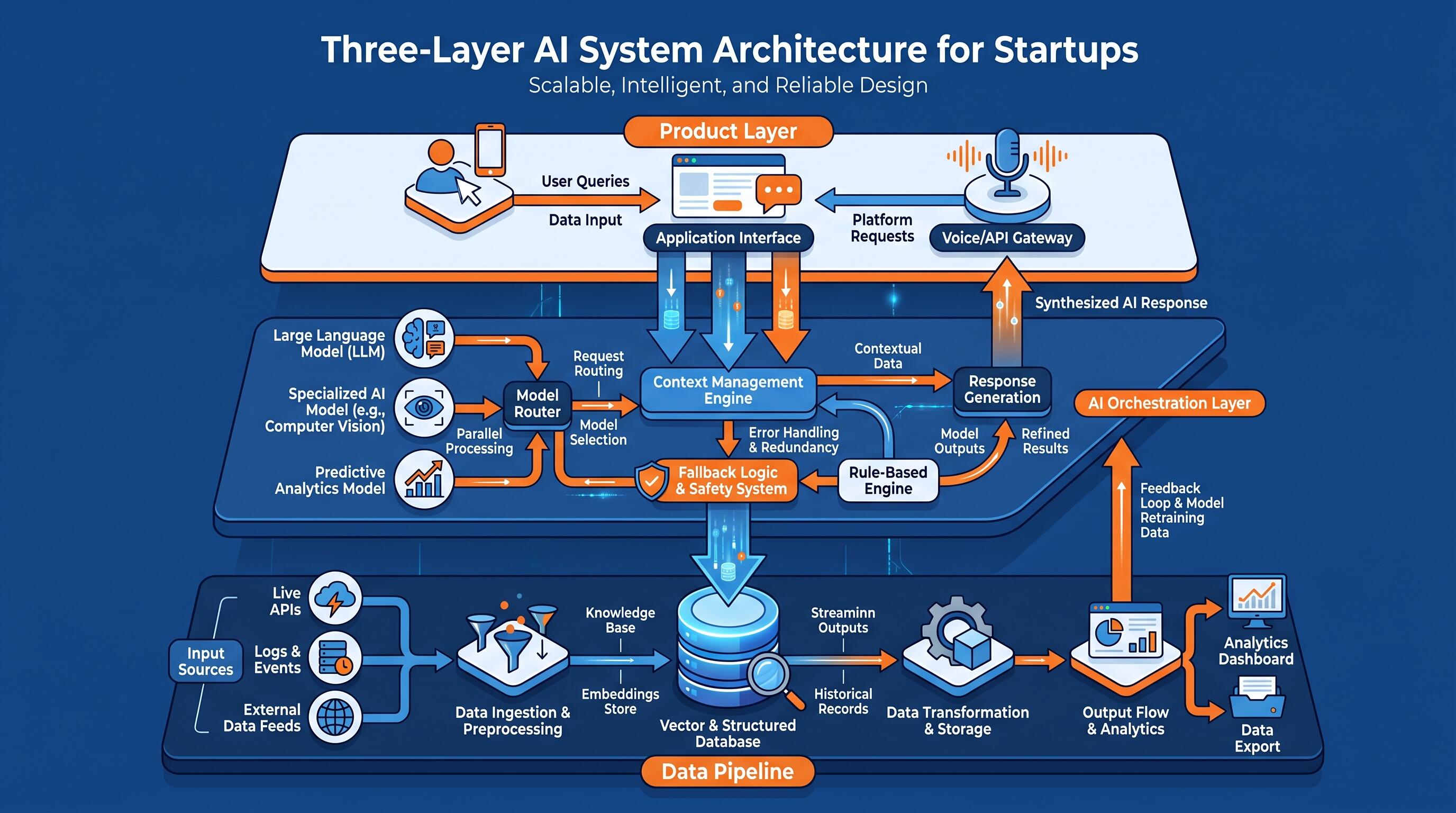
ALT: Layered AI architecture design showing separation of product logic, AI orchestration, and data pipeline for startup machine learning solutions
Advanced Considerations: When Simple Isn't Enough
Handling AI Complexity as You Scale
The three-step approach works well for getting to your first production AI feature. But as your product matures, you'll encounter scenarios that require deeper architectural thinking.
Multi-model orchestration becomes relevant when a single model can't handle the full complexity of your use case. For example, a routing model might classify user intent and direct requests to specialized models for different task types. Designing the orchestration layer cleanly — with proper context management, error handling, and latency budgets — is a non-trivial systems design challenge that benefits enormously from prior experience.
RAG (Retrieval-Augmented Generation) architecture is now one of the most common patterns for startups building AI products on top of their own data. The implementation looks simple on the surface — embed your documents, store them in a vector database, retrieve relevant chunks, pass them to an LLM — but the production reality involves chunking strategy, embedding model selection, re-ranking, query transformation, and evaluation that can make or break the user experience.
A common misconception is that more data always means better AI. In practice, poorly structured, inconsistently labeled, or low-quality data fed into even a sophisticated model produces worse results than clean, well-scoped data in a simpler system. Before investing in data collection at scale, invest in data quality and schema design.
Another misconception is that AI architecture is a one-time decision. It isn't. It's a living design that evolves as your models, data, and user behavior evolve. Budget for architectural review cycles the same way you budget for security reviews.
Frequently Asked Questions FAQ
Q1: How do you implement AI architecture if your startup has only one or two engineers?
With one or two engineers, the priority is to minimize the AI surface area you're directly managing. Lean heavily on managed services and foundation model APIs for the AI core, and focus your engineering effort on the product and data layers. Engage an AI architecture consultant to define the system design and establish patterns your team can execute. The goal is a clean, minimal architecture that your small team can own and operate — not a complex ML platform they'll spend all their time maintaining.
Q2: Is it possible to build a production-grade AI product without training custom models?
Yes, for the vast majority of startup use cases. Modern foundation models — accessed via API — deliver production-grade performance on tasks like text generation, classification, summarization, question answering, and code assistance without any custom training. Fine-tuning becomes relevant when you have a specialized domain with clear performance gaps relative to general-purpose models and sufficient task-specific training data. Most startups should exhaust the potential of prompt engineering, RAG, and tool use before investing in custom model training.
Q3: What does it typically cost to engage an AI architecture consultant versus hiring full-time?
The cost structures differ fundamentally. A full-time senior AI engineer represents a significant ongoing salary commitment plus benefits, equity, and management overhead — and hiring the right person can take months. An AI architecture consulting engagement is project-scoped and delivers defined outputs: a system design, an implemented foundation, and knowledge transfer. For early-stage startups, the consulting model typically offers faster time-to-value and lower total cost for the initial architecture phase. Specific pricing varies by scope and engagement model — direct consultation with the provider is the right approach for accurate estimates.
Summary
The key insight from everything covered here is simple: AI architecture is accessible to startups without full AI teams — if approached with the right strategy.
The three core takeaways are:
- Architectural clarity beats headcount. A well-designed AI system implemented by a small team outperforms a poorly designed system built by a large team. Start with the design, then staff to it.
- Managed services and foundation models have commoditized AI capabilities — what remains scarce is the judgment to assemble them into coherent, scalable, maintainable systems. That judgment is what you hire for, not raw implementation capacity.
- Shipping fast in AI means designing for replaceability, instrumenting from day one, and iterating with real user data. The best practices for MVP development remain constant: minimize irreversible decisions, maximize learning velocity, and don't let the perfect architecture block the useful one.
The next step is to audit your current or planned AI feature set against these principles: Is your architecture layered and maintainable? Are your AI components swappable? Do you have evaluation infrastructure? If the answers are unclear, that's the signal to bring in architectural expertise before it becomes a rewrite.
Call to Action
If you're ready to turn your idea into a live, running product, Darius brings the full-stack engineering and AI architecture expertise to make it happen — with 3 shipped projects as proof of concept. Visit https://www.darius.wiki to explore his work, dive into technical insights, and discover how he can help you architect, build, and ship your next big thing.
References
- McKinsey & Company. "The state of AI in early 2024: Gen AI adoption spikes and starts to generate value".
https://www.mckinsey.com/capabilities/quantumblack/our-insights/the-state-of-ai-2024 - MIT Sloan Management Review. "Building AI-Powered Products: Architecture Principles for Practitioners".
https://sloanreview.mit.edu/article/making-ai-work/ - Stanford HAI (Human-Centered AI). "AI Index Report — Artificial Intelligence in Industry".
https://aiindex.stanford.edu/report/ - Hugging Face. "Open Source Machine Learning and AI Model Hub Documentation".
https://huggingface.co/docs - Y Combinator. "Startup Engineering Best Practices and Technical Founder Resources".
https://www.ycombinator.com/library
Note: Standards may be updated, please check the latest official documents or consult professional advisors.
About the Author
Darius is an Engineering Director and AI Architect specializing in transforming ambitious ideas into live, production-ready products — spanning AI architecture, systems design, and full-stack development. With 3 shipped live projects and deep cross-disciplinary expertise, Darius delivers end-to-end technical leadership that bridges strategy and execution. Learn more at darius.wiki.
© Darius. All rights reserved. The content of this article is intended for informational purposes only and reflects the author's professional experience and opinions. Nothing herein constitutes formal engineering, legal, or business advice. Reproduction or redistribution of this content without prior written permission is prohibited.