What to Expect When Starting an AI Architecture Engagement This Quarter

ALT: Engineering director reviewing AI architecture engagement plan with system diagrams and technical roadmap
What Founders and CTOs Should Know Before Starting an AI Architecture Engagement
You have a product idea that genuinely requires AI at its core — not as a feature wrapper, but as a structural component. You've had preliminary conversations with potential technical partners, everyone seems aligned, and now you're wondering: what actually happens when the engagement kicks off? What does the first quarter look like, and how do you know if it's going well?
Starting an AI architecture engagement is not like spinning up a standard software project. The discovery phase runs deeper, the decisions made in the first few weeks carry disproportionate long-term weight, and the gap between "aligned on vision" and "aligned on implementation" can reveal itself in uncomfortable ways once technical work begins. This article lays out — from the practitioner's side of the table — exactly what a well-structured engagement looks like, what you should expect at each stage, and how to recognize the early warning signs that an engagement is drifting off track. Whether you're a founder bringing in your first AI architect or a CTO augmenting your existing team, understanding the shape of this process will help you extract maximum value from the collaboration.
When This Guide Applies to Your Situation
This article is designed for product leaders and engineering decision-makers who are actively planning or beginning a formal AI architecture engagement — not those experimenting informally with AI tooling on the side.
Applicable scenarios include:
- You are a founder or startup CTO preparing to engage an external AI architect or fractional technical lead to design or validate your AI system's foundation.
- Your team has already built a proof of concept and needs structured architectural guidance before committing to production infrastructure.
- You are evaluating whether your existing system architecture is compatible with the AI capabilities you intend to ship within this quarter.
This guide is not the right fit in the following situations:
- You are still in pure ideation mode with no defined product scope — architectural engagement requires at least a working problem statement.
- You expect the engagement to replace hands-on engineering delivery from day one, without a prior discovery phase. Architecture work without discovery is guesswork.
Why AI Architecture Engagements Are Structurally Different
An AI architecture engagement is a structured technical collaboration in which an experienced architect works with an organization to design, validate, and plan the implementation of AI-powered systems — from data pipelines and model integration to infrastructure and operational governance. It differs from conventional software consulting in several important ways.
Traditional software projects benefit from relatively stable requirements. Once you know what you're building, the architectural decisions — frameworks, databases, service boundaries — can be made with reasonable confidence. AI systems introduce a different class of uncertainty. Model behavior is probabilistic. Performance characteristics change with data distribution shifts. Costs scale in nonlinear ways depending on inference volume and model selection. The architecture must account not just for what the system does on day one, but how it degrades, retrains, and evolves over time.
According to research published by the IEEE, AI and machine learning systems require distinct architectural patterns compared to traditional software — particularly around data management, model lifecycle management, and explainability requirements. This isn't theoretical; in practice, we consistently see teams underestimate the operational surface area of AI systems, treating a deployed model as a static artifact rather than a living component requiring ongoing attention.
The market context also matters. AI infrastructure tooling is evolving rapidly, and decisions made about model providers, vector databases, orchestration layers, and deployment strategies carry different trade-off profiles than they did even twelve months ago. A good AI architect brings current knowledge of this landscape — including which tools are production-ready, which are still maturing, and where vendor lock-in risks are highest. For a deeper look at the build-versus-buy dimension of this landscape, this framework for evaluating AI infrastructure decisions covers the key considerations in detail.
The Shape of a First-Quarter AI Architecture Engagement
Three-Step Quick Start for a Well-Structured Engagement
Step 1: Scope Alignment and Stakeholder Calibration
Before any technical output is produced, the engagement must establish a shared understanding of what problem the AI system is actually solving, and for whom. This sounds obvious, but in practice it's where the most consequential misalignments surface. Expect the first one to two weeks to involve structured conversations — not just with the technical lead, but with product, operations, and ideally a sample of end users. The output of this phase is not a document; it's a calibrated shared model of the problem space that the rest of the engagement can build on.
Step 2: Technical Discovery and Constraint Mapping
With scope established, the architect dives into the existing technical environment: data sources and their quality, current infrastructure, team capabilities, integration constraints, and any regulatory or compliance boundaries. This phase typically spans one to three weeks depending on the complexity of the existing stack. The goal is not to audit everything — it's to identify the constraints that will shape architectural choices. Skipping or abbreviating this step is the single most common cause of architectural decisions that look clean on paper but fail in production.
Step 3: Architecture Design and Decision Documentation
The design phase produces the actual architectural output: system diagrams, data flow models, component boundaries, model integration patterns, and a prioritized list of technical decisions with their rationale. Critically, this phase should also document the decisions not taken and why — this institutional knowledge becomes invaluable when the team evolves or requirements shift. Plan for this phase to take two to four weeks, with active review cycles between the architect and your internal leads.
Comparing AI Architecture Engagement Structures
Different organizations engage AI architects in different ways, and each model carries distinct trade-offs. Understanding these structures before committing helps you select the model that matches your current stage and resource profile.
| Comparison Dimension | Embedded Fractional Architect | Project-Scoped Architecture Sprint | Advisory and Review Model |
|---|---|---|---|
| Engagement depth | High — participates in ongoing decisions | Moderate — focused on specific deliverables | Low — periodic input only |
| Time commitment | Multi-month, part-time ongoing | Fixed duration, intensive | As-needed, lighter touch |
| Best suited for | Early-stage teams building foundation | Teams with a specific design challenge | Teams with internal capability needing validation |
| Ramp-up cost | Higher upfront | Moderate | Low |
| Risk of misalignment | Lower — continuous feedback loops | Moderate — requires strong brief upfront | Higher — limited context |
| Output type | Living architectural documentation and decisions | Defined deliverable set | Review reports and recommendations |
The right model depends heavily on your team's existing technical maturity and what you actually need. Consult your engagement partner directly to determine which structure fits your situation — a reputable AI architect will diagnose this honestly rather than default to the model that maximizes their hours.
What Happens Week by Week Inside the Engagement
The first two weeks are diagnostic, not generative. A pattern we consistently see in early engagements: clients expect the architect to start producing design outputs immediately. In reality, the most valuable thing an experienced architect does in the opening weeks is ask structured questions and listen carefully to the answers. The questions are designed to surface assumptions — about data availability, user behavior, system scale, and team capacity — that would otherwise go unexamined until they become problems.
The middle weeks are where the real architectural work happens. Once constraints are mapped and scope is validated, the design work proceeds with focus. This is where decisions about model selection, retrieval architecture, prompt engineering strategy, and deployment topology get made. Each decision should be traceable to a specific constraint or requirement — arbitrary architectural choices are a sign the discovery phase didn't run deep enough.
For teams building AI-native products that touch model APIs from providers like OpenAI or Anthropic, the integration architecture deserves careful attention early. The way you structure API boundaries, handle rate limits, manage context windows, and instrument for cost visibility will shape your operational reality for months. Getting this right upfront is substantially cheaper than refactoring under production load.
The final weeks of the quarter focus on handoff and continuity. A well-run first-quarter engagement ends with your internal team holding genuine ownership of the architectural decisions — not dependency on the external architect to explain every choice. This means the documentation has to be written for the team that will live with it, not for the architect who produced it. We prioritize this handoff deliberately: the engagement succeeds when the team can make confident forward decisions independently.
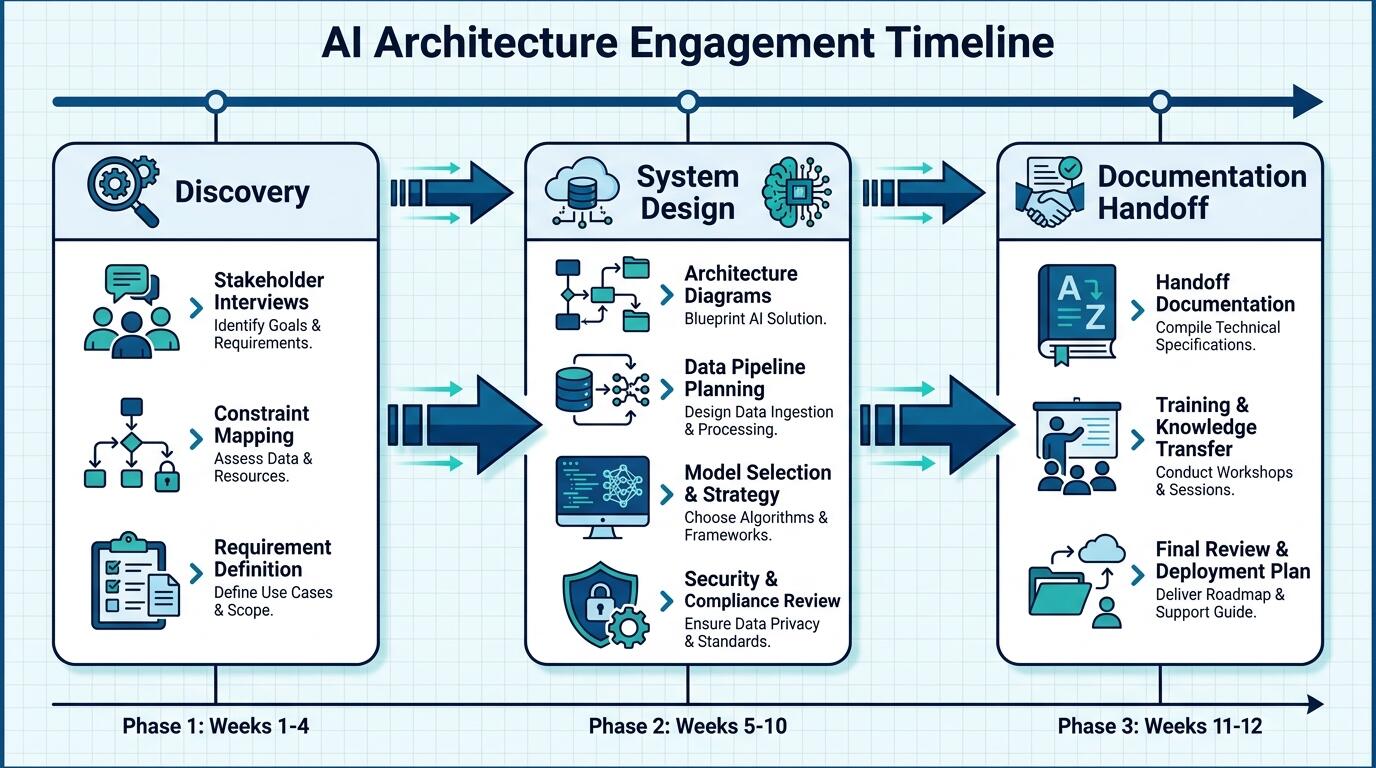
ALT: Phased AI architecture engagement diagram showing discovery, system design, and documentation handoff for production AI systems
Advanced Considerations: What Experienced Teams Often Overlook
Governance and observability aren't an afterthought. In our work with clients, the element most frequently deferred — and most frequently regretted — is observability design. Knowing how your AI system is performing in production requires deliberate instrumentation: logging model inputs and outputs, tracking latency and cost per inference, monitoring for drift in model behavior over time. Per guidance from IEEE and the broader AI engineering community, these operational concerns should be treated as first-class architectural requirements, not bolt-ons. If your engagement doesn't surface observability discussions in the design phase, push for them.
The data question is always harder than expected. Every organization believes their data is in better shape than it actually is when examined rigorously. A common misconception is that having data is equivalent to having useful data for AI. Data quality assessment — coverage, freshness, labeling quality, schema consistency — is a prerequisite for meaningful architectural decisions. According to research from academic and industry sources aligned with the Association for Computing Machinery (ACM), poor data quality is among the leading causes of AI system underperformance in production. An engagement that glosses over data assessment is building on uncertain ground.
Team capability shapes architecture as much as technical requirements do. The best architecture for your system is the one your team can build, maintain, and evolve. A sophisticated microservices-based AI orchestration layer might be technically optimal in the abstract, but if your engineering team has limited distributed systems experience, it creates operational risk that outweighs the technical benefit. Experienced architects calibrate design complexity to team capability — and are honest about this trade-off rather than defaulting to architectural prestige.
Before committing to a particular technical direction, it's also worth evaluating whether your current AI tooling choices are well-matched to your product's needs. Assessing AI development tools before signing on is a step that pays dividends across the entire engagement.
Common Questions
Q1: How long does it typically take before an AI architecture engagement produces usable outputs?
Usable outputs — meaning documented architectural decisions that can guide engineering work — typically emerge by the third or fourth week of a well-structured engagement. The first two weeks are primarily diagnostic: constraint mapping, stakeholder alignment, and data assessment. Teams that rush this phase in pursuit of faster deliverables often receive outputs that look complete but are built on unexamined assumptions, which surfaces as expensive rework later in the development cycle.
Q2: Is it realistic to expect a production-ready architecture plan within a single quarter?
A single quarter is sufficient to produce a well-validated architecture plan for most early-stage AI products — provided scope is clearly defined and discovery runs properly. What a quarter does not typically produce is a fully deployed production system. The output of a first-quarter engagement is an architectural foundation and decision framework that guides implementation — not the implementation itself. Teams that conflate these two things often feel disappointment that is actually a scoping misalignment from the start.
Q3: What does a fair engagement look like in terms of workload on our side?
Expect your internal team to invest meaningful time, particularly in the first two weeks. Discovery quality depends on your team's availability and candor — the architect cannot map constraints they aren't shown. After the discovery phase, internal workload typically decreases to structured review cycles. A good engagement partner will make the demands on your time explicit upfront and respect your team's bandwidth rather than generating unnecessary overhead.
Key Takeaways
- An AI architecture engagement is structurally distinct from conventional software consulting — it requires deeper discovery, higher tolerance for ambiguity early on, and explicit attention to operational concerns like observability and data quality.
- The first quarter of an engagement follows a clear shape: scope alignment, technical discovery, and architecture design — each phase building on the last. Skipping or compressing discovery is the most common source of architectural failure.
- The right engagement model (fractional architect, sprint-based, or advisory) depends on your team's maturity and what you actually need — and an honest technical partner will diagnose this for you rather than default to the most expansive option.
- Data quality is a structural prerequisite, not a detail. Every engagement eventually surfaces data readiness as a critical variable; addressing it early prevents expensive late-stage surprises.
- A successful first-quarter engagement ends with your team holding genuine ownership of the architectural decisions — the measure of success is their independence, not their dependence on the external architect.
The right next step is a direct conversation about where your product actually is and what your architecture needs to support. If you're uncertain whether you're ready for a full engagement or need to validate your current direction first, that uncertainty itself is worth surfacing early. Visit darius.wiki to explore how a structured AI architecture engagement can take your product from concept to a solid, production-ready foundation — and get in touch to discuss what your specific situation actually requires.
Sources & Citations
- IEEE Computer Society. "AI and Machine Learning System Architecture Patterns and Engineering Practices".
https://www.ieee.org - National Institute of Standards and Technology (NIST). "Artificial Intelligence Risk Management Framework".
https://www.nist.gov - The Linux Foundation. "MLOps and AI System Lifecycle Management Principles".
https://www.linuxfoundation.org - MIT Computer Science and Artificial Intelligence Laboratory (CSAIL). "Production AI Systems: Operational Architecture and Deployment Research".
https://www.csail.mit.edu
Note: Standards and research publications may be updated; please check the latest official documents or consult professional advisors for current guidance.