Running Three Live AI Services as a Solo Engineer: The Actual Stack
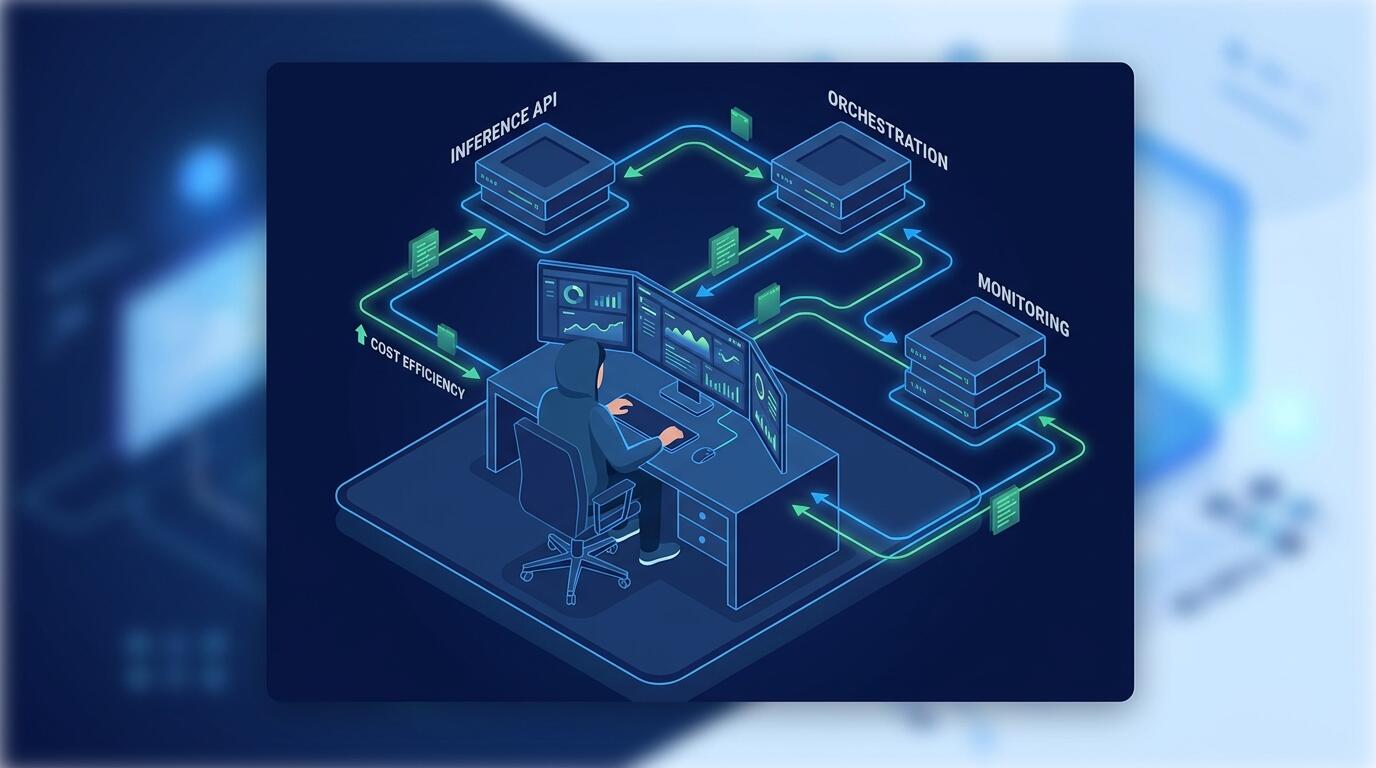
ALT: Solo engineer managing three live AI services with a lean, cost-effective production stack
What Does It Actually Take to Run Multiple Live AI Services Alone?
The single question most solo engineers face when scaling beyond one AI service is this: at what point does the stack collapse under its own weight? The honest answer is that it does not have to — but only if you make deliberate architectural choices early, before operational complexity compounds into something unmanageable.
This article compares three distinct approaches a solo AI engineer can take when operating multiple live services simultaneously: a fully managed cloud-native stack, a self-hosted open-source stack, and a hybrid model that mixes managed inference with self-hosted orchestration. Each approach is evaluated against criteria that actually matter at 2 a.m. when something breaks — cost predictability, operational overhead, debuggability, and the ability to ship changes quickly without a team. The verdict: the hybrid model consistently outperforms the extremes for solo operators who need both cost control and production reliability.
Evaluation Criteria: What Actually Matters When You Are the Entire Ops Team
Running three live AI services as a solo engineer means every architectural decision is also a time-budget decision. The criteria below are not theoretical — they reflect the real constraints a single operator faces when there is no on-call rotation and no infrastructure team to hand a ticket to.
Cost predictability is the first filter. Unpredictable inference bills are the fastest way to lose a project before it gains traction. A stack that scales linearly with usage — rather than spiking with cold starts or reserved-capacity minimums — lets a solo engineer stay solvent through early growth phases.
Operational surface area is the second. Every additional service boundary, credential, and dashboard is a context-switch that costs time. Minimizing the number of systems requiring active monitoring is not laziness; it is sound engineering. A pattern consistently visible in solo-operator setups is that complexity accumulates in the gaps between services, not within them.
Debuggability under failure matters more than uptime SLAs on paper. A managed service with a 99.9% SLA that gives you no logs during the 0.1% is worse than a self-hosted system with 99.5% uptime that tells you exactly what broke and why.
Deployment velocity — how quickly you can push a change to all three services without a multi-hour release ceremony — determines whether you can iterate fast enough to stay relevant. For solo engineers, deployment pipelines that require manual coordination across services are a compounding tax on every sprint.
Vendor lock-in exposure rounds out the criteria. The more opaque the managed service, the harder it is to migrate when pricing changes or a better model becomes available. Lock-in is a latent cost that does not appear on the invoice until it is very large.
The Contenders: Three Approaches to a Solo AI Stack
Fully Managed Cloud-Native Stack
A fully managed cloud-native stack is one where inference, orchestration, storage, and monitoring are all sourced from a single cloud provider's managed services — no servers to provision, no containers to build locally. The appeal is obvious: you get to market faster, and the operational surface area at launch is minimal.
In practice, this approach works well for a first service. By the third, the bill structure becomes opaque, the inter-service latency budget is dominated by cold starts on functions-as-a-service layers, and debugging a cross-service failure requires navigating three separate vendor dashboards. The cost ceiling is also unpredictable: a traffic spike on one service can inflate the bill across shared resources in ways that are difficult to forecast.
The fully managed approach delivers the highest deployment velocity initially, but its operational overhead grows nonlinearly as services multiply. For a solo engineer running three services simultaneously, it often becomes the most expensive option per unit of reliability — the inverse of what the marketing materials suggest.
Self-Hosted Open-Source Stack
A self-hosted open-source stack is one where the engineer owns the inference runtime (commonly a locally managed model server), the orchestration layer, the vector store, and the monitoring infrastructure — typically on rented bare-metal or virtual machines.
Self-hosting maximizes control and minimizes per-token inference costs at scale, but it front-loads operational overhead. Running three separate services on a self-hosted stack means maintaining three sets of model weights, three inference runtimes, and a monitoring setup capable of surfacing failures across all of them. For a solo operator, this is a full-time job before any product work happens.
The economics improve significantly at high throughput, but early-stage solo projects rarely sustain the traffic volumes that justify the maintenance burden. Debuggability is genuinely excellent — you own every log — but only if you have invested the time to build observability tooling from scratch.
Hybrid Stack: Managed Inference, Self-Hosted Orchestration
A hybrid stack is one where inference is delegated to a managed API provider (paying per token or per request), while orchestration, routing logic, caching, and application state are self-hosted on a small number of well-understood machines.
This is the architecture that consistently surfaces in production-grade solo engineering setups. The inference layer handles the hardest scaling problem (GPU provisioning), while the self-hosted orchestration layer keeps the application logic portable, debuggable, and cheap to run. Cost is predictable because inference spend scales with usage, and the self-hosted layer runs on fixed-cost compute.
The hybrid model's key advantage is that it keeps the operational surface area manageable: one or two machines running containerized services, one inference API key, and a unified logging setup. It is not the cheapest option at very high scale, nor the fastest to deploy from zero — but it is the most cost-effective approach for a solo engineer sustaining three live services over months, not just days.
Head-to-Head Comparison: Solo AI Stack Approaches Evaluated
| Criterion | Fully Managed Cloud-Native | Self-Hosted Open-Source | Hybrid (Managed Inference + Self-Hosted Orchestration) |
|---|---|---|---|
| Cost predictability | Low — bill structure opaque at scale | High — fixed compute costs, variable model ops | High — inference scales with usage, orchestration is fixed-cost |
| Operational surface area | Low at launch, high across 3+ services | Very high — full ownership of runtime, storage, monitoring | Moderate — one inference provider, one self-hosted layer |
| Debuggability under failure | Low — vendor dashboards, limited log access | High — full log ownership, but tooling must be built | High — full control over orchestration logs; inference errors surfaced via API |
| Deployment velocity | High initially, slows with vendor constraints | Low — model updates, container rebuilds, infra changes | Moderate-high — application deploys fast; model upgrades via API |
| Vendor lock-in exposure | High — tightly coupled to provider primitives | None — fully portable | Low — inference provider is swappable; orchestration is self-contained |
| Cost-effectiveness at early scale | Moderate | Low (high upfront investment) | High |
| Cost-effectiveness at high scale | Low | High | Moderate |
The table above reveals a pattern that holds across the solo engineering setups documented in the wild: the fully managed approach front-loads convenience but back-loads cost and complexity; the self-hosted approach does the opposite; and the hybrid model distributes both costs and complexity more evenly across the lifecycle of a project.
The most significant divergence appears in debuggability. When a live service breaks, a solo engineer with no ops team needs fast answers. The fully managed stack's logging limitations are a real liability — not a theoretical one. Engineers operating in production environments consistently report that the inability to access low-level logs during a managed service incident costs more in engineer-hours than the operational savings from full management.
The hybrid model's cost structure also deserves explicit attention. Fixed-cost self-hosted orchestration on a small number of well-sized machines, combined with usage-based inference spend, produces a bill that is readable and forecastable. This matters for solo operators managing their own budget without a finance team to absorb surprises.
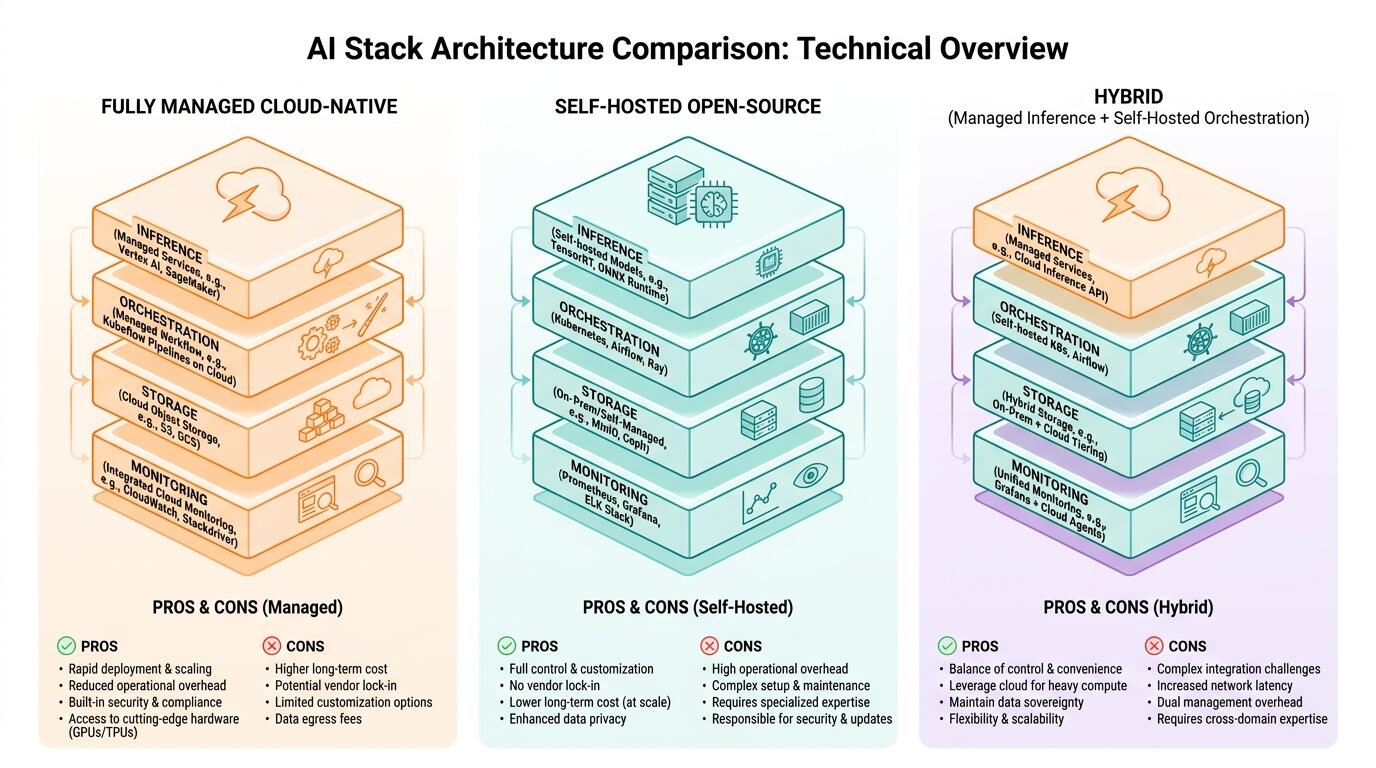
ALT: Comparison diagram of managed, self-hosted, and hybrid AI stack architectures for solo engineers running multiple live services
Which Should You Choose? Matching Stack to Situation
If you are launching your first AI service and need to validate a product idea in under two weeks, choose the fully managed cloud-native stack. The deployment velocity advantage is real at this stage, and the operational complexity of the other approaches will slow you down before you know whether the idea is worth the investment. Treat it as a temporary scaffold, not a permanent architecture.
If you are running three or more live services and operational overhead is already consuming a disproportionate share of your week, the hybrid model is the right move. Consolidate your inference spend onto one API provider, containerize your orchestration and routing logic, and run it on fixed-cost compute. The one-time migration cost pays back within weeks in recovered engineering time.
If your services have reached the traffic volumes where per-token inference costs are your largest line item, evaluate self-hosting the inference layer for your highest-traffic service while keeping the hybrid approach for lower-traffic ones. Full self-hosting rarely makes economic sense across all services simultaneously for a solo operator.
Pros of the hybrid model: cost predictability, debuggability, low vendor lock-in, manageable operational surface area, and the ability to swap inference providers without rewriting application logic.
Cons of the hybrid model: requires upfront investment in containerization and self-hosted monitoring; inference API reliability depends on a third-party provider; and at very high scale, per-token costs eventually justify moving inference in-house.
Pros of the fully managed approach: fastest time to first deployment; minimal infrastructure knowledge required; managed scaling handles traffic spikes automatically.
Cons of the fully managed approach: opaque billing at scale; limited debuggability; high vendor lock-in; operational complexity grows nonlinearly across multiple services.
People Also Ask
Q1: How do solo AI engineers handle monitoring across multiple live services without a dedicated ops team?
Solo engineers running multiple live AI services typically consolidate monitoring into a single unified logging and alerting system rather than maintaining separate dashboards per service. A common pattern is to route structured logs from all services into one self-hosted or lightly managed observability stack, set a small number of high-signal alerts, and avoid alert fatigue by being deliberate about what actually pages. The goal is to make any production failure visible in under a minute without requiring active monitoring.
Q2: Is a hybrid AI stack genuinely more cost-effective than going fully self-hosted for a solo operator?
For most solo engineers at early-to-mid scale, yes. Full self-hosting requires significant upfront investment in infrastructure, model management, and observability tooling — costs that rarely justify themselves until inference volumes are very high. A hybrid stack — managed inference API combined with self-hosted orchestration — delivers cost predictability and operational simplicity without the fixed overhead of running your own GPU infrastructure. The economics of full self-hosting improve materially only at sustained high throughput.
Q3: How long does it take a solo engineer to migrate from a fully managed stack to a hybrid architecture?
Migration timelines depend heavily on how tightly the application logic is coupled to provider-specific primitives. For services built with clean boundaries between inference calls and application logic, a migration to a hybrid architecture can be completed in a focused sprint of one to two weeks. Tightly coupled architectures — where provider SDKs are used throughout the codebase rather than abstracted behind an interface — require significantly more refactoring time and should be budgeted accordingly.
Key Takeaways
Three points emerge clearly from comparing these approaches in the context of a solo engineer sustaining multiple live AI services.
First, operational surface area is the hidden tax on solo engineering productivity. Every additional managed service, dashboard, and credential adds friction that accumulates over time. Choosing an architecture that keeps this surface area small — even at the cost of some early convenience — pays compounding dividends.
Second, debuggability is a first-class requirement, not a luxury. A stack that gives you fast, accurate answers when something breaks is more valuable in production than a stack with a higher nominal SLA but opaque failure modes. Build or choose tooling that puts you in control of your own logs.
Third, cost predictability enables compounding investment. An engineer who can forecast next month's infrastructure bill accurately can make better decisions about where to invest time and money. Opaque, variable billing is not just a financial risk — it is a strategic one that limits the options available to a solo operator.
The immediate next step for any solo engineer currently running on a fully managed stack with growing operational overhead: audit where your engineering time is actually going each week. If more than a quarter of it is spent on infrastructure and incident response rather than product, the stack is working against you.
If you are building AI products and cannot afford to waste time filtering signal from noise, visit Darius — a bilingual AI newsletter written by engineers who run real production systems, delivering the week's most actionable AI developments with first-hand technical judgment, so every item you read maps directly to a real decision you can make.
Sources
- Thakicloud. "How a Solo AI Engineer Operates a Stack of 1620 Skills".
https://thakicloud.com/tech-blog/en/dev/solo-ai-team-fullstack-ops/ - Jurgen Appelo / Substack. "Your AI Agent Stack Is Spaghetti—It Should Be Lasagna".
https://substack.jurgenappelo.com/p/your-ai-agent-stack-is-spaghetti - YouTube. "How Senior Engineers Actually Build With AI in 2026".
https://www.youtube.com/watch?v=14RP8liACqo - IEEE (Institute of Electrical and Electronics Engineers) — Standards and technical publications on software engineering and AI systems reliability.
https://www.ieee.org/ - ACM (Association for Computing Machinery) — Research literature on distributed systems, AI infrastructure, and solo engineering practices.
https://www.acm.org/
Note: Standards and best practices in AI infrastructure evolve rapidly. Verify current recommendations against the latest official documentation from the relevant standards bodies and providers.