Signs Your Startup Needs Senior Engineering Leadership Right Now

ALT: Signs your startup needs senior engineering leadership right now — key indicators for tech founders and CTOs
When Good Code Isn't Enough: Recognizing the Signs Your Startup Needs Senior Engineering Leadership
Key Conclusion: Every high-growth startup eventually hits an inflection point where technical execution outpaces organizational capacity. This article identifies the clearest warning signs that your startup needs senior engineering leadership — not someday, but right now. Whether you're a founder making your first engineering hire above mid-level, or a CTO realizing the team has grown beyond informal coordination, these signals help you act before technical debt and delivery failures become existential risks.
The signals covered here are drawn from a practitioner's vantage point — patterns observed repeatedly in the work of architecting and shipping production-grade AI and full-stack systems across early and growth-stage startups. Each sign is specific enough to recognize in practice, distinct enough not to overlap, and serious enough to warrant real attention. Use this list as a diagnostic: if three or more apply to your organization today, the conversation about senior engineering leadership is overdue.
The Warning Signs: Indicators Your Startup Urgently Needs Senior Engineering Leadership
Your Codebase Is Growing Faster Than Your Team's Understanding of It
Technical debt is a natural byproduct of moving fast, but unmanaged knowledge fragmentation is a different problem entirely. When no single person — or small group of people — can reliably explain how the system fits together, the codebase has outgrown the team's collective mental model of it. This is one of the earliest and most commonly overlooked signs that senior engineering leadership is missing.
In practice, this manifests as engineers spending disproportionate time navigating unfamiliar modules, onboarding taking weeks longer than it should, and recurring "we're not sure what will break" conversations before every deployment. A senior engineering leader's primary value in this context isn't writing more code — it's establishing the architecture, documentation practices, and shared conventions that keep the system legible as it scales.
Best for: Startups that have crossed the threshold from a two- or three-person founding engineering team to a broader group where informal knowledge sharing has broken down.
Watch out: Hiring a senior leader to "clean up the codebase" as a first priority is a trap. The cleanup matters, but the real job is building the systems that prevent re-accumulation of the same debt.
Every Major Technical Decision Gets Escalated to the Founder
When a founder — particularly a non-technical one — is the final word on database choices, API design, or infrastructure configuration, that is a structural gap masquerading as a culture of ownership. This pattern is a reliable sign that senior engineering leadership is absent, because these decisions should be owned by someone with the technical authority and product context to make them confidently.
A pattern consistently seen in early-stage companies is that founders default to this role not because they want to, but because there is no one else with the seniority to carry it. The cost compounds over time: decisions slow down, founders get pulled away from strategy, and engineers feel underempowered. A senior engineering leader — whether an Engineering Director, VP of Engineering, or a strong Staff Engineer — creates a decision-making layer that keeps product velocity intact without requiring founder involvement at every technical fork.
Best for: Founder-led startups with engineering teams of five or more, where technical decisions are bottlenecking product momentum.
Watch out: Installing a senior leader without genuinely delegating decision-making authority defeats the purpose. The structural change must come with real ownership transfer.
Your Deployment Pipeline Is a Source of Fear, Not Confidence
A deployment that the team dreads is not an engineering quality problem — it is a leadership and systems design problem. When releasing to production triggers anxiety, requires manual steps performed by one specific person, or frequently results in incidents, the underlying cause is almost always the absence of senior engineering guidance that would have established reliable delivery infrastructure from the start.
According to research and practitioner documentation on startup technical leadership, including the insights published at marcgg.com, the early years of a startup's engineering journey are precisely when foundational delivery practices are set — and getting them wrong creates compounding costs. If your team is shipping with fear rather than confidence, the window to establish healthy practices is closing, not opening.
Best for: Startups preparing to scale user-facing features, moving toward enterprise clients, or operating in domains where reliability is a competitive differentiator.
Watch out: Investing in CI/CD tooling without the leadership context to make it stick is common and wasteful. Tools follow process; process follows leadership.
You're Building AI Features Without Anyone Who Has Shipped AI to Production
Integrating large language models, building agentic workflows, or designing AI-powered product features is categorically different from standard software development. The failure modes are different, the testing surfaces are different, and the architecture decisions — around latency, cost, observability, and model selection — carry consequences that are not obvious until a system is live under real load.
A startup attempting to build AI-powered products without someone who has actually shipped AI systems to production is flying without instruments. This is not a criticism of capable engineers — it reflects the reality that production AI architecture is a specialized discipline. As the thinking around scalable AI architecture for production makes clear, the gap between a working prototype and a production-grade AI system is wide and consequential. Senior engineering leadership with direct AI shipping experience is the most reliable bridge across that gap.
Best for: Product teams with AI features on their roadmap, or startups that have already deployed AI capabilities and are experiencing reliability or cost issues in production.
Watch out: Consulting advisors who have designed AI systems but never shipped them carries the same risk. Production experience is the filter that matters.
Your Engineering Team Has No Shared Definition of "Done"
When one engineer ships a feature with tests, documentation, and observability hooks, and another ships with none of those things, and both are considered equally "done," the team lacks a shared engineering culture. This inconsistency is not a personnel issue — it is a leadership vacuum. Senior engineering leaders establish and maintain the standards that make a team's output coherent and trustworthy over time.
The absence of shared quality standards shows up in specific ways: code reviews that vary wildly in rigor, monitoring gaps that only surface during incidents, and onboarding experiences that differ dramatically depending on which part of the codebase a new engineer first touches. As noted in perspectives on senior engineering leadership skills, the work of establishing team-wide engineering standards is fundamentally a leadership function, not something that self-organizes from a group of talented individual contributors.
Best for: Teams that have grown beyond the founding engineers and are beginning to show internal quality inconsistency across features or services.
Watch out: Attempting to solve this with documentation alone — style guides, wikis, handbooks — rarely works without a leader who actively models and enforces the standards in practice.
You're Losing Engineers You Wanted to Keep
Voluntary attrition from your engineering team is one of the clearest and most expensive signals of a leadership gap. Engineers — especially strong ones — leave environments where they feel directionless, where technical decisions seem arbitrary, where their growth is unclear, or where the work does not feel professionally meaningful. These are all leadership-addressable problems.
A pattern consistently observed in engineering organizations undergoing rapid growth is that the first engineers to leave are often the strongest ones, because they have the most options and the most acute sense of what a well-led team feels like. If your retention data shows a pattern of losing experienced contributors while retaining less experienced ones, the problem is almost certainly not compensation — it is the absence of the kind of technical leadership that gives strong engineers a reason to stay and grow.
Best for: Startups that have experienced two or more senior or mid-level engineering departures in a short period without a clear external cause.
Watch out: Exit interview data is notoriously unreliable for surfacing the real reason engineers leave. Look at the pattern across multiple departures, not the stated reason from any single one.
Your Architecture Decisions Are Being Made by Default, Not by Design
A startup's architecture should be a series of deliberate choices, made with awareness of trade-offs and future implications. When architecture emerges by default — because no one had the authority or expertise to make a considered choice — the result is systems that are hard to scale, expensive to modify, and deeply resistant to the new product directions that a growing business inevitably requires.
This sign is particularly acute for AI-powered products, where the cost of architectural misalignment compounds quickly. Choosing the wrong data pipeline design, embedding strategy, or service boundary early in development can mean months of rework later. Bringing in experienced engineering leadership — someone who has navigated these choices in production environments — ensures that the architecture your startup builds today can support the product you are trying to become. If your team is making infrastructure decisions based on what engineers happen to know rather than what the system actually needs, senior leadership is the intervention.
Best for: Startups with more than one service, any kind of data-intensive or AI workload, or those approaching a significant scaling event such as a funding round, enterprise contract, or major user growth.
Watch out: Hiring a solution architect without giving them organizational authority is a common mistake. Architectural leadership requires the ability to make binding decisions, not just recommendations.
Your Product and Engineering Teams Are Operating in Separate Realities
When product managers and engineers regularly disagree about what is feasible, what is estimated correctly, or what was actually agreed upon in a planning session, the root cause is almost always the absence of a senior engineering leader who can translate between technical and product disciplines fluently.
This gap shows up as chronic estimation failures, last-minute scope changes driven by late-discovered technical constraints, and a growing sense on both sides that the other team "doesn't get it." Senior engineering leadership — at the Director or VP level — exists precisely at this boundary. The job is not to take sides, but to create the shared language, planning processes, and mutual understanding that allow product and engineering to operate as a coherent system. Per practitioner writing on engineering leadership from Igor Asom, the skill of translating between technical complexity and product reality is one of the defining competencies of senior engineering leaders.
Best for: Startups with dedicated product management and engineering functions that are experiencing growing friction at the handoff points between the two.
Watch out: Solving this with process tools — more detailed tickets, longer planning sessions, more documentation — without the leadership layer to make them work is a common and futile substitution.
Quick Comparison at a Glance
Summarizing the eight signs so you can quickly assess which apply to your current situation.
| Sign | Best For | Key Strength as a Diagnostic | Limitation to Watch |
|---|---|---|---|
| Codebase outpacing team understanding | Teams past the founding-engineer stage | Surfaces knowledge fragmentation early | Easy to mistake for a documentation problem |
| All technical decisions escalate to the founder | Founder-led teams of 5+ engineers | Directly measures leadership vacuum | Requires honest self-assessment from founders |
| Deployment is feared, not trusted | Scaling teams and reliability-sensitive products | Ties delivery culture to leadership directly | Tooling investment without leadership won't fix it |
| Building AI without production AI experience | AI-feature roadmaps or existing AI products | Flags a high-stakes execution gap | Advisory experience is not a substitute |
| No shared definition of "done" | Growing teams with quality inconsistency | Reveals culture and standards gaps | Cannot be solved with documentation alone |
| Losing engineers you wanted to keep | Teams experiencing senior attrition | Correlates leadership gaps with retention cost | Exit interview data unreliable |
| Architecture made by default | Multi-service, data-intensive, or scaling startups | Connects current decisions to future cost | Architectural leadership needs real authority |
| Product and engineering in separate realities | Startups with dedicated PM and engineering functions | Pinpoints translation and process failures | Process tools without leadership are insufficient |
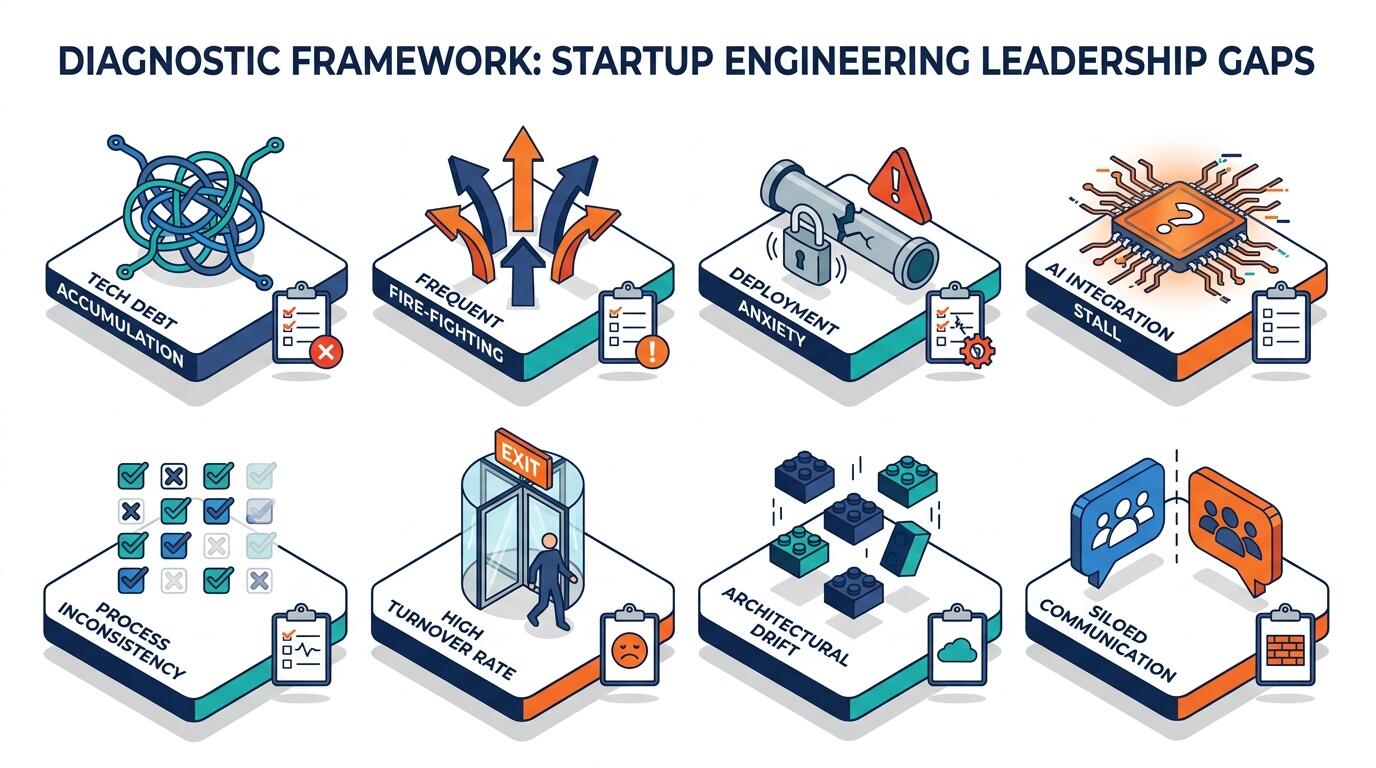
ALT: Startup engineering leadership gap diagnostic framework showing warning signs for tech founders and CTOs needing senior technical leaders
How to Choose the Right Response When You Recognize These Signs
The first decision is whether you need a senior individual contributor — a Staff or Principal Engineer — or a true engineering leadership hire, such as a Director or VP of Engineering. These are not interchangeable roles, and conflating them is one of the most expensive mistakes a growing startup makes.
A Staff Engineer solves technical problems with depth and influence. An Engineering Director solves organizational problems through people, process, and architecture. If the signs you are recognizing are primarily technical — architectural drift, production instability, AI execution gaps — a Staff or Principal engineer with the right experience may be the right first move. If the signs are primarily organizational — escalation bottlenecks, team fragmentation, product-engineering misalignment — you need someone who leads people, not just technology.
For startups navigating both simultaneously (which is common during rapid growth phases), the sequencing matters. In work with founders and engineering teams, a pattern that consistently works is bringing in senior technical leadership first to establish architecture and delivery foundations, then layering in organizational leadership as the team grows. The reverse rarely works: installing people management structure on top of a broken technical foundation amplifies the dysfunction rather than resolving it.
A common misconception is that senior engineering leadership is a luxury for later — something to figure out after product-market fit. The reality is that the technical decisions made before senior leadership arrives are often the ones that become the most expensive to fix after it does. The earlier you address the signs, the more options you have.
If your startup is beginning to build AI-powered features and you recognize the signs above, the urgency is higher than in a purely conventional software context. The path from concept to live product is compressed and consequential when AI is in the stack — the architectural and leadership choices compound faster.
Frequently Asked Questions FAQ
Q1: How do I know if my startup needs a VP of Engineering versus a CTO?
The distinction between a VP of Engineering and a CTO is fundamentally about orientation: a CTO is typically externally and strategically focused — representing technical vision to investors, partners, and the market — while a VP of Engineering is internally focused on building and running the engineering organization. Most early-stage startups need the VP of Engineering function first, because the internal delivery system is the more urgent constraint. If your founding CTO is handling both, recognize that one function is likely being shortchanged.
Q2: Is it too early to hire senior engineering leadership at the seed stage?
It depends entirely on your technical complexity and team composition. Startups building AI-powered products, operating in regulated industries, or with non-technical founders often need senior engineering leadership at the seed stage precisely because the early architectural decisions carry outsized long-term consequences. The right question is not "are we too early?" but "what is the cost of getting the foundational technical decisions wrong at this stage?" For many startups, that cost is existential.
Q3: How long does it typically take to see impact after bringing in senior engineering leadership?
Impact from senior engineering leadership is rarely immediate, and expecting it to be is a setup for premature disappointment. Organizational and architectural changes propagate on timescales of weeks to months. A realistic framing is: the first period should focus on diagnosis and relationship-building, the middle period on establishing standards and removing blockers, and the later period on measurable improvements in delivery velocity, retention, and system reliability. Leaders who claim to turn things around in days are usually optimizing for appearances, not outcomes.
Summary
Recognizing the signs that your startup needs senior engineering leadership is not about admitting failure — it is about reading the system accurately and acting before the cost of inaction compounds further.
Key Takeaways:
- Knowledge fragmentation, escalation bottlenecks, and delivery fear are early signs of a leadership vacuum, not technical problems with purely technical solutions.
- Building AI-powered products without production AI experience in your leadership is a high-stakes gap that no amount of capable junior engineering compensates for.
- Retention signals are leadership signals — strong engineers leaving is a diagnostic, not a coincidence.
- The distinction between a senior technical contributor and a senior engineering leader matters enormously — misidentifying which you need leads to the wrong hire.
- Acting early on these signs preserves architectural and organizational options that become unavailable once technical debt and team dysfunction are deeply entrenched.
The next step is honest assessment: count the signs that apply to your organization today, and use that count to frame the urgency and the type of leadership intervention your startup actually needs.
If you are ready to bring in engineering leadership that has shipped production-grade AI and full-stack systems — and can move from diagnosis to delivery quickly — explore the work and connect directly at the Darius website.
References & Further Reading
- Marc Gauthier. "Typical First Years of Startup Engineering Leadership".
https://marcgg.com/blog/2024/07/17/startup-technical-leadership/ - Jason Heck. "The armchair guide to startup engineering leadership".
https://www.linkedin.com/pulse/armchair-guide-engineering-leadership-jason-heck - Igor Asom. "Being a senior engineering leader. Skills that you can start building already".
https://medium.com/@asom_igor/being-a-senior-engineering-leader-skills-that-you-can-start-building-already-30e883bc7a52 - IEEE — Institute of Electrical and Electronics Engineers. Standards and professional resources on software engineering and systems design.
https://www.ieee.org/ - ACM — Association for Computing Machinery. Research and practitioner literature on software engineering leadership and organizational design.
https://www.acm.org/
Note: Standards and practitioner guidance may be updated; always consult the latest official documents and qualified professional advisors for current best practices.