Why Shipping Beats Planning: A Developer's Guide to Bias for Action

ALT: Developer shipping a live AI product instead of waiting for a perfect plan, bias for action in engineering
Stop Planning, Start Shipping: Why Bias for Action Is the Developer's Superpower
You have a product idea. It's been living in a Notion doc for three months, the architecture diagram keeps getting refined, and every sprint planning meeting ends with "let's think about this a bit more." Meanwhile, a competing team with half the resources quietly ships a working version and starts collecting real user feedback. This is not a hypothetical — it is a pattern that appears, with striking regularity, across startups and engineering teams at every stage of growth.
This guide is for the founder, CTO, product manager, or engineering lead who already understands technology but struggles to escape the gravitational pull of planning. The central argument is direct: shipping — getting working software in front of real users — consistently produces better outcomes than extended planning cycles. This is not recklessness dressed up as a principle. It is a disciplined approach to learning faster, deciding better, and building products that actually survive contact with the real world.
Before You Start: Prerequisites and What You Need to Embrace This Mindset
Adopting a bias for action is not simply a matter of moving faster. It requires a specific set of preconditions — intellectual, organizational, and technical — without which "ship faster" becomes a recipe for chaos rather than progress.
What you need beforehand:
A clear problem statement. Not a solution, not a feature list — a concise articulation of whose pain you are addressing and why that pain matters. Without this, speed only accelerates travel in the wrong direction.
A working definition of your minimum viable scope. This is not the same as a minimum viable product in the marketing sense. It means identifying the smallest coherent unit of functionality that can be deployed, observed, and learned from. This distinction matters enormously in practice.
A deployment environment. You cannot ship if you have nowhere to ship to. A basic cloud environment, a CI/CD pipeline however simple, and a way to get software in front of at least one real user are the floor-level requirements.
A team or individual with the authority to decide. Bias for action collapses in organizations where decisions require extended committee approval. Someone must be empowered to say "this is good enough to ship" and mean it.
A tolerance for imperfection — not a tolerance for negligence. There is a meaningful difference between shipping software that is incomplete and shipping software that is broken in ways that harm users or destroy trust. The former is the goal; the latter is the failure mode to avoid.
Checklist before starting:
- Problem statement written in one or two plain sentences
- Minimum shippable scope defined and agreed upon by the team
- Deployment target ready (staging or production environment)
- At minimum one feedback loop established (user interviews, analytics, or direct observation)
- Decision authority clearly assigned — someone can say "ship it"
- Rollback or mitigation plan for the most likely failure modes
The time investment to get these preconditions in place is typically short. The cost of skipping them, however, shows up immediately and compounds over time.
The Step-by-Step Path From Planning Paralysis to Shipping Consistently
Step 1: Define the Smallest Honest Slice of Value
The most common cause of planning paralysis is scope. Teams intuitively reach for the full vision — the complete feature set, the perfectly scaled architecture, the polished UI — because the full vision is what motivated the work in the first place. Resisting this pull is the first and most important discipline.
Identify what a user actually needs to experience value from your product. Not what would impress them, not what would be defensible in a board meeting, but what would solve their problem well enough that they would use it again. In AI-powered products specifically, this often means shipping a workflow with a single model integration and manual fallback steps, rather than waiting for an autonomous pipeline to be complete.
Tip: Write the smallest slice on a sticky note (physical or digital) and put it somewhere the team sees it every day. If the scope starts expanding beyond what fits on that note, something has gone wrong.
Step 2: Set a Hard Shipping Deadline and Work Backward
A bias for action is not a vague aspiration — it is a time constraint that forces prioritization. Set a specific date by which working software will be in front of real users. The date should feel slightly uncomfortable but not delusional. Then work backward to determine what must be built, what can be skipped, and what can be faked or mocked to hit that date.
Working backward from a deadline is a fundamentally different cognitive exercise than working forward from a feature list. It forces honest conversations about trade-offs that planning cycles tend to defer indefinitely. Amazon's leadership principles — which codified "bias for action" as a named practice — describe this as the recognition that many decisions and actions are reversible, and that the cost of delay often exceeds the cost of a correctable mistake. This framing, widely cited in engineering and product leadership communities, reframes speed not as recklessness but as appropriate calibration to the actual cost of uncertainty.
Tip: Announce the shipping date to a small external audience — a potential user, an advisor, anyone outside the team. External accountability has a disproportionate effect on focus.
Step 3: Choose Architecture That Enables Delivery, Not Architecture That Impresses
Architecture decisions made in the planning phase are frequently optimized for theoretical scale rather than actual delivery. In our work with engineering teams, a pattern that appears consistently is what might be called "architecture astronauts" — teams so committed to designing the perfect system that no working system ever ships.
The right architecture for a first version is the one that lets you ship. It should be simple enough that a small team can maintain it without heroics, observable enough that you can detect failures quickly, and extensible enough that you can refactor when you have real usage data to inform those decisions. For teams building AI-powered products, this often means starting with straightforward LLM integration patterns and a monolithic deployment before introducing microservices or complex orchestration layers.
Tip: Ask, for every architectural decision: "Does this help us ship sooner, or does it help us feel more prepared?" These are different questions, and the honest answer is often illuminating.
Step 4: Ship to One Real User Before You Ship to Many
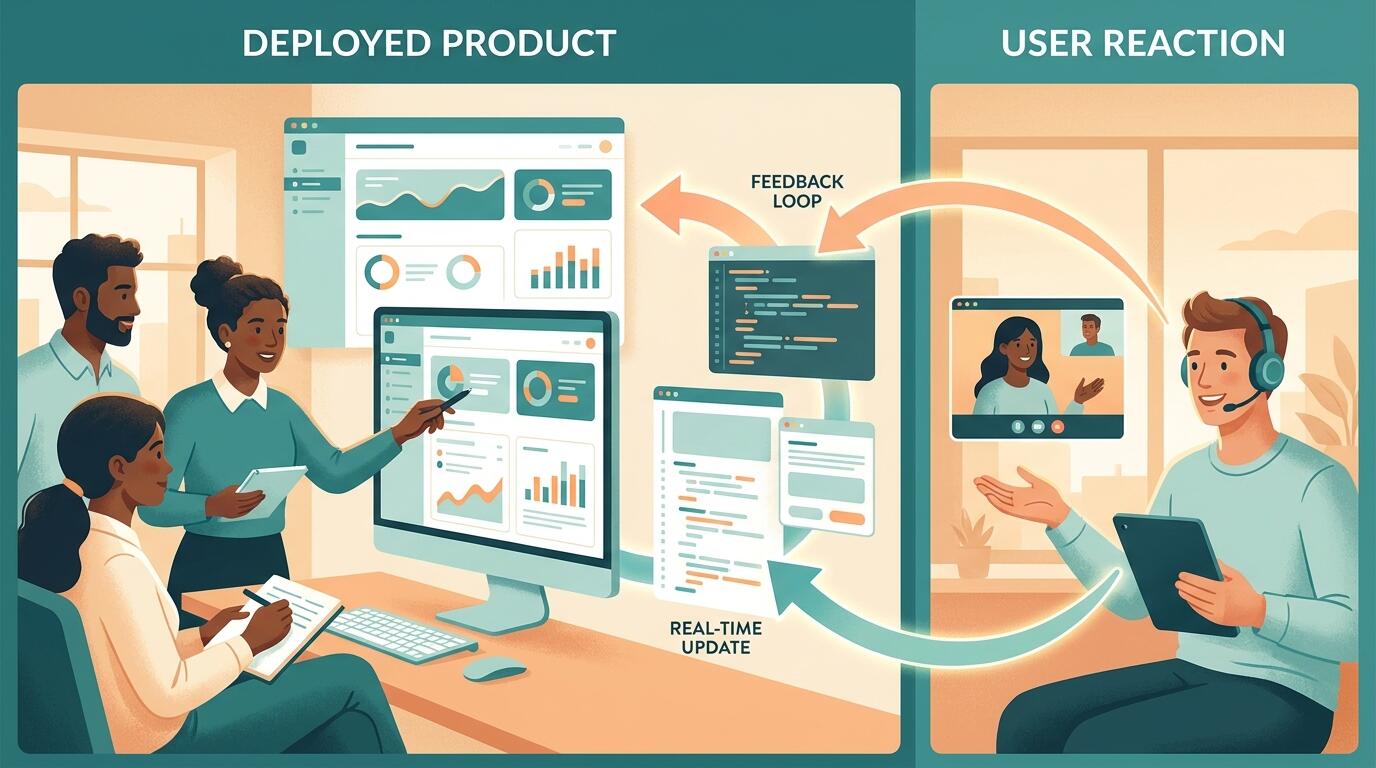
ALT: Engineering team deploying a live AI product to an early user to gather real-world feedback and iterate fast
The distinction between "shipped" and "launched" matters enormously in practice. A public launch to thousands of users before you have validated core assumptions is a high-risk event. Shipping to a single real user — someone who genuinely has the problem you are solving, is willing to tell you what they actually think, and does not have a vested interest in flattering you — is a low-risk, high-return learning event.
This is where planning consistently fails: no amount of internal discussion, user story writing, or prototype review replicates the information produced by a real user interacting with real software. In our experience working across AI-powered products and full-stack systems, the feedback from a single genuine user interaction routinely invalidates assumptions that weeks of planning had treated as settled.
Ship to one user. Observe. Fix what breaks or confuses. Then ship to more. This sequencing is not timidity — it is efficiency. As described in practice by engineering leaders who have applied Amazon's bias for action principle, the goal is speed of learning, not speed of announcement.
Tip: Sit next to the first user (physically or via screen share) if at all possible. Reading passively logged data is valuable; watching someone struggle silently with your interface in real time is irreplaceable.
Step 5: Treat Every Shipped Version as a Question, Not a Statement
A shipped product is a hypothesis in executable form. The question it asks is: "Does this solve a real problem well enough that real people will use it?" Every metric, every support ticket, every user complaint or compliment is data that answers that question.
Teams with a strong planning orientation often relate to their shipped software as a declaration — a statement of what the product is. This creates psychological resistance to changing things that users consistently indicate are not working. Teams with a genuine bias for action relate to their shipped software as a probe — something designed to generate information that updates the next decision.
This reframing has concrete engineering implications. It means investing in observability early: logging, monitoring, and error tracking should be part of every initial deployment, not an afterthought added after problems emerge. It means designing features in a way that makes them easy to remove or replace, not just easy to add. And it means keeping feedback loops short — ideally, you should be able to take a user observation on Monday and have a fix or experiment running by Wednesday.
Tip: Create a simple internal document — a single shared page — where every piece of user feedback is logged immediately. Review it at the start of every team sync. This habit alone changes the culture of how teams relate to shipped software.
Step 6: Build a Rhythm of Shipping, Not a Series of Events
Shipping once is an achievement. Shipping consistently is a capability. The goal of a bias-for-action culture is not a heroic launch but a sustainable delivery rhythm where working software reaches real users on a cadence that keeps learning velocity high.
This is where organizational habits matter as much as technical practices. Teams that ship consistently tend to have short iteration cycles, clear definition of what "done" means, and a shared understanding that a small ship is more valuable than a large plan. Teams that struggle with this often have long release cycles, unclear ownership of deployment decisions, and a cultural norm that equates caution with professionalism.
For engineering leaders building or scaling AI-powered products, establishing this rhythm early is one of the highest-leverage investments available. Guides like how to ship your first live product in 30 days offer concrete frameworks for compressing early delivery timelines without sacrificing quality. The key insight is that shipping rhythm is a muscle — it atrophies without use and strengthens with practice.
Tip: Track time-to-ship as a team metric, not just output quality. If the team has not shipped anything to a real user in more than two weeks, treat that as a signal worth investigating, not a normal state.
Step 7: Refactor With Real Data, Not Hypothetical Concerns
Every experienced engineer has a list of things they want to improve about a codebase. The question is not whether to improve them but when. The correct answer is almost always: after you have evidence from real usage that the improvement matters.
This is where bias for action connects directly to sustainable technical quality. Premature optimization — optimizing for load patterns you have not yet observed, refactoring for flexibility you do not yet need — is a form of planning that masquerades as engineering discipline. Real discipline is shipping a system that works well enough for current users, instrumenting it to observe where it actually struggles, and then making targeted improvements that address observed problems rather than hypothetical ones.
For AI-powered systems specifically, this principle is especially important. Model performance, latency, cost, and reliability characteristics in production are routinely different from what was projected during planning. Sound AI architecture for production — the kind detailed in approaches to designing scalable AI architecture for production — is built through iteration on real data, not through upfront design of theoretically optimal systems.
Tip: Before any significant refactoring sprint, write down the user-observable problem that the refactoring will solve. If you cannot articulate one, the refactoring should be deprioritized.
Common Mistakes and How to Fix Them
| Symptom | Likely Cause | How to Fix |
|---|---|---|
| Team is always "almost ready to ship" but shipping keeps slipping | Scope creep disguised as quality standards; no hard deadline | Set a non-negotiable ship date; explicitly log and defer any feature added after scope was agreed |
| First version shipped but no useful feedback received | No real feedback loop established before shipping; shipped to wrong audience | Identify one or two users with genuine versions of the problem; establish direct contact, not just passive analytics |
| Team ships fast but accumulates technical debt that slows everything down | Speed prioritized without minimum quality standards; no refactoring rhythm | Define a baseline quality floor (tests, observability, documentation) that is non-negotiable even in fast cycles |
| Architecture decisions keep delaying the first ship | Over-engineering for hypothetical future scale; no clear "good enough" criterion | Define architecture requirements based on current user count plus one order of magnitude; treat everything else as premature |
| Team treats shipped software as finished rather than as a learning instrument | Cultural norm that equates shipping with completing; no feedback review habit | Establish a regular ritual for reviewing user feedback; make it a standing agenda item, not an optional activity |
| Individual contributors feel no urgency because deadlines are soft | Leadership models caution as default; no visible accountability for delivery pace | Leaders must model bias for action explicitly — ship small things publicly, reward learning from mistakes, not just success |
Pro Tips for Better Results
Use time-boxing as a scoping tool, not just a project management technique. When a feature or capability is time-boxed — meaning the team commits to shipping whatever is complete at the end of the box, not whatever was planned at the start — it forces continuous prioritization. The team always asks "what is the most important thing to complete next?" rather than "what is left on the list?" This is a fundamentally different and more productive question.
Distinguish between reversible and irreversible decisions. The cost-benefit calculation for bias for action depends heavily on reversibility. Decisions that can be easily undone — a UI change, a model swap, a feature toggle — deserve fast, low-overhead decision-making. Decisions that are difficult or costly to reverse — a database schema, a public API contract, a fundamental data model — deserve more deliberation. Conflating these two categories is what produces both recklessness and paralysis, depending on which direction the team errs.
Make your deployment process boring. The most effective predictor of shipping frequency is deployment friction. Teams that can deploy in minutes, with confidence and without heroics, ship more often. Teams for whom deployment is a multi-day coordination event ship rarely and anxiously. Investing in a boring, reliable deployment process is one of the highest-ROI engineering investments available, and it pays dividends across every future project.
Separate the act of shipping from the act of announcing. Many teams conflate these two things and, as a result, delay shipping because they are not ready to announce. Dark launches, feature flags, and staged rollouts decouple delivery from publicity. You can ship to a subset of users, learn from them, and iterate before broader announcement. This removes a significant source of artificial delay.
Common misconception to address: Bias for action does not mean shipping carelessly or ignoring quality. The principle, as articulated by practitioners who have applied it at scale, is specifically about calibrating the threshold for action to the actual cost of delay and the reversibility of the decision — not about eliminating judgment. The Bias for Action principle, as documented by practitioners applying Amazon's leadership principles, emphasizes speed without recklessness: the goal is to move with appropriate urgency when the cost of waiting exceeds the cost of an imperfect but correctable action.
Common Questions
Q1: How do you maintain code quality while shipping quickly?
Maintaining quality under delivery pressure requires defining a non-negotiable quality floor before the pressure starts. This floor typically includes automated tests for critical paths, basic observability (logging, error tracking), and a documented rollback procedure. Everything above this floor is negotiable based on time constraints. The key insight is that quality and speed are not inherently in conflict — they conflict only when quality standards are undefined and therefore expand to fill all available time.
Q2: Is bias for action appropriate for all types of engineering decisions?
Bias for action is most appropriate for reversible, learning-oriented decisions — feature experiments, UX changes, model integrations, deployment configuration. It is less appropriate for decisions with high switching costs or significant user-trust implications, such as fundamental data architecture, security model design, or compliance-sensitive implementations. Experienced engineering leaders develop a calibrated sense of which category a given decision falls into; for newer teams, making this categorization explicit — before the decision, not after — is a practical substitute for that intuition.
Q3: How long does it typically take to establish a consistent shipping rhythm in a team?
Establishing a reliable shipping rhythm is a cultural and process change, which means the timeline depends more on organizational factors than technical ones. Teams that already have deployment automation and clear ownership can often shift their cadence within a few weeks of deliberate focus. Teams that need to build those foundations first — deployment pipelines, defined quality floors, clear decision authority — should expect the transition to take longer and to require sustained leadership attention. The investment is worthwhile: teams that ship consistently learn faster and build better products over time.
Key Takeaways
Shipping beats planning because real users produce real information, and real information produces better decisions than any planning process can. This is not a statement against thinking carefully — it is a statement about where the most valuable thinking happens. The most useful insights about your product emerge from contact with reality, not from continued refinement of a plan that has not yet met it.
Three core points to carry forward:
First, define the smallest honest slice of value and ship that before adding anything else. Scope discipline is the foundation of delivery speed. Second, treat every shipped version as a question, not a statement. Observability, feedback loops, and willingness to change based on evidence are what convert shipping into learning. Third, build a shipping rhythm, not a shipping event. Consistent delivery is a team capability that must be deliberately cultivated, and it compounds in value over time.
The practical next step is to identify the one thing your team is currently planning that could instead be shipped — in a constrained, partial, or rough form — within the next two weeks. Define the minimum scope. Set the date. Establish a feedback loop. Ship it.
If you're ready to move from planning to shipping on your AI-powered or full-stack product, visit the Darius website to explore shipped projects, technical insights, and how to connect with an engineering partner who has navigated exactly this journey.
Sources
- LinkedIn / Brett Miller. "Bias for Action: Speed Without Recklessness".
https://www.linkedin.com/posts/brett-miller-mba-28359356_the-amazon-leadership-principle-i-still-use-activity-7449445064897880064-N1gK - iGotAnOffer. "Amazon Bias for Action Interview Questions (+ How to Answer)".
https://igotanoffer.com/en/advice/amazon-bias-for-action-interview-questions - Candost Blog. "Bias For Action".
https://candost.blog/bias-towards-action/ - IEEE (Institute of Electrical and Electronics Engineers). Standards and professional resources on software engineering and delivery practices.
https://www.ieee.org/ - ACM (Association for Computing Machinery). Research and professional literature on software development processes and engineering practice.
https://www.acm.org/
Note: Standards and professional guidance may be updated; consult the latest official documents or professional advisors for current best practices.