Setting Expectations With a Remote Engineering Director From Day One
ALT: Remote engineering director setting expectations with a distributed team from day one
Why Setting Expectations With a Remote Engineering Director Defines the Entire Engagement
The most important question founders and product leaders ask when bringing on a remote Engineering Director is deceptively simple: What should we agree on before the first line of code is written? The direct answer is this — the quality of your first-week alignment determines the quality of every technical decision that follows. Organizations that invest in deliberately structured onboarding conversations from day one consistently build faster, escalate less, and ship with fewer costly misunderstandings than those who defer clarity in favor of moving fast.
Setting expectations with a remote Engineering Director is not a soft-skills exercise or a matter of good manners. It is a foundational engineering practice, no different from writing an Architecture Decision Record or agreeing on a branching strategy. When a senior technical leader joins your team remotely — whether as a fractional advisor, a full-time hire, or an embedded consultant — the absence of physical co-location removes many of the informal feedback loops that teams normally take for granted. What replaces those loops is deliberate structure, documented agreements, and explicit shared language. This article walks you through exactly how to build that structure, what traps to avoid, and how to calibrate the relationship so it produces maximum technical value from the first interaction onward.
Where This Guidance Applies — and Where It Doesn't
Applicable Scenarios:
- Startups and scale-ups bringing on a fractional or full-time remote Engineering Director to lead technical strategy for a new AI-driven product
- Product leaders and CTOs engaging an external technical partner for systems design, architecture review, or full-stack execution on a production system
- Distributed engineering teams where the technical leadership role is being filled remotely for the first time and there is no established onboarding playbook
Not Applicable/Cautions:
- Co-located leadership situations where informal daily interaction already creates natural alignment — the frameworks here are optimized for the structural gaps introduced by remote distance
- Highly mature engineering organizations with deeply established remote leadership culture; those teams may find some steps here redundant, though the documentation discipline is universally valuable
The Real Cost of Misaligned Expectations in Remote Technical Leadership
Remote work has moved from exception to default for senior engineering roles. According to the IEEE, distributed software teams face compounded coordination costs when roles, responsibilities, and decision rights are not codified early. The challenge is not that remote Engineering Directors are less effective — in practice, the best ones operate with remarkable independence and discipline. The challenge is that the implicit knowledge transfer which happens naturally in an office — overheard conversations, hallway check-ins, reading body language in a planning meeting — simply does not occur remotely. Every assumption that goes unspoken becomes a potential failure point.
A pattern we consistently see in early-stage and growth-stage product organizations is what might be called the expectations debt spiral: a new technical leader starts executing on their best understanding of the role, the founders operate on a different set of assumptions, and neither party surfaces the gap until a significant decision has already been made. Retrofitting alignment after weeks of divergent effort is expensive, demoralizing, and sometimes irreversible when it involves architectural choices. The fix is front-loading the alignment work into a structured day-one protocol.
For teams preparing to begin an AI architecture engagement specifically, this problem is even more acute — the scope of decisions, from model selection to data pipeline design to infrastructure tradeoffs, is enormous. If you are approaching that kind of engagement, reviewing what to expect when you start an AI architecture engagement can help you understand the full surface area of alignment required before you even begin onboarding your technical lead.
The market trend driving urgency here is clear: as organizations increasingly build AI-native products, the technical leadership function has become more complex and more consequential. A remote Engineering Director who also carries AI architecture responsibilities is operating across a far broader decision space than a traditional software engineering manager. The expectations framework has to match that complexity.
Building the Day-One Alignment Protocol: Core Content
Three Steps to Establish the Foundation
Step 1: Draft a Shared Operating Agreement Before the First Meeting
Before any introductory call, the hiring organization should prepare a one-to-two-page document that articulates the current state of the product, the immediate technical priorities, the communication norms in place, and the decision-making authority the Engineering Director is expected to hold. This does not have to be polished — rough clarity is more valuable than polished vagueness. Expect this to take two to four focused hours for the founder or CTO to produce. The act of writing it surfaces gaps in the organization's own thinking before they are imported into the leadership relationship.
Step 2: Conduct a Structured Kickoff Session Focused on Constraints and Non-Negotiables
The first working session with a remote Engineering Director should be explicitly structured around constraints — not aspirations. What is the technology stack that cannot change? What are the regulatory or compliance requirements the architecture must satisfy? What are the timelines that are genuinely fixed versus aspirational? What does "done" mean for the first milestone? This session typically runs ninety minutes to two hours and should result in documented answers to each of these questions, agreed upon by both sides before any technical work begins.
Step 3: Establish the Feedback and Escalation Cadence on Day One
Agree explicitly on three things: how often the Engineering Director will provide structured progress updates, what the escalation path looks like when a decision exceeds their delegated authority, and how disagreements about technical direction will be resolved. These sound bureaucratic in isolation, but in a remote context they are load-bearing agreements. A weekly written update, a defined async communication channel, and a clear "who has final say on architecture decisions" policy collectively prevent the most common failure modes of remote technical leadership.
Comparing Alignment Approaches for Remote Engineering Directors
Different organizations approach the day-one alignment challenge differently, and each approach carries distinct tradeoffs. The table below compares three common patterns.
| Comparison Dimension | Informal Onboarding | Structured Protocol | Documented Operating Agreement |
|---|---|---|---|
| Time to productive alignment | Slow — weeks of gradual calibration | Fast — aligned within first week | Fastest — pre-aligned before day one |
| Risk of expectation misalignment | High — assumptions stay implicit | Medium — surfaces gaps in real time | Low — gaps identified before work begins |
| Suitability for AI/systems architecture scope | Poor — complexity demands explicitness | Good — works for most technical scopes | Excellent — essential for high-stakes architecture roles |
| Founder/CTO time investment upfront | Minimal | Moderate | Highest upfront, lowest ongoing |
| Scalability across distributed teams | Poor | Good | Excellent |
The pattern we consistently recommend for remote Engineering Directors operating in AI architecture or systems design contexts is the documented operating agreement, used as the baseline for the structured kickoff session. It costs more time on day zero and saves disproportionately more on every subsequent week.
The Five Dimensions of a Complete Expectations Agreement
Decision Authority and Scope
The most consequential dimension to align on is decision authority — specifically, what the remote Engineering Director can decide unilaterally, what requires consultation, and what requires explicit approval. In a pattern we observe repeatedly, this dimension is the one most commonly skipped during onboarding, and it is almost always the source of the first significant conflict. Authority should be mapped to categories: technology stack choices, vendor selection, architectural patterns, hiring recommendations, and tradeoffs between speed and technical debt. Each category needs a clear answer before work begins.
Communication Norms and Async-First Discipline
Remote engineering leadership at a senior level functions best when the default communication mode is async and the synchronous time is protected for decisions that genuinely require real-time dialogue. Agree explicitly on the tools, the expected response times, the format of written updates, and the meeting cadence. An Engineering Director who sends a detailed weekly written update covering decisions made, blockers encountered, and risks identified is giving their stakeholders a qualitatively different level of visibility than one who reserves everything for a weekly video call.
Technical Standards and Non-Negotiable Constraints
Every organization has constraints that the incoming technical leader needs to understand before making their first architectural recommendation. These include technology choices that are fixed due to existing team skills, compliance requirements such as data residency or security certifications, and performance or cost envelopes that define what "good enough" means for the current stage. A remote Engineering Director who does not know that the product must operate within a specific cloud provider's ecosystem, for example, may spend their first two weeks evaluating options that were never on the table. Surfacing these constraints explicitly is a prerequisite to productive technical leadership.
Milestones, Metrics, and the Definition of Success
Agreement on what success looks like at thirty, sixty, and ninety days is not just a management ritual — it is the mechanism by which a remote Engineering Director calibrates their own prioritization. In a co-located environment, a technical leader picks up on contextual signals about organizational priorities continuously. Remotely, those signals have to be made explicit. The clearest agreements define not just the deliverable but the quality standard: is the goal to ship a working prototype, a production-ready system, a reviewed architectural plan, or a team that has been upskilled on a new technical approach? Each answer implies a radically different allocation of the Engineering Director's time.
Cultural and Working Style Alignment
This dimension is often dismissed as too soft for a technical onboarding conversation, but it carries real operational weight. Does the organization expect the Engineering Director to challenge every product decision with technical rigor, or to execute within boundaries set by the product team? Is disagreement expected to be raised in public forums or through direct private communication first? How does the team handle mistakes — with blameless post-mortems or with something closer to accountability culture? A remote technical leader who misjudges the cultural norms of their client organization will expend significant energy managing perception rather than delivering technical value.
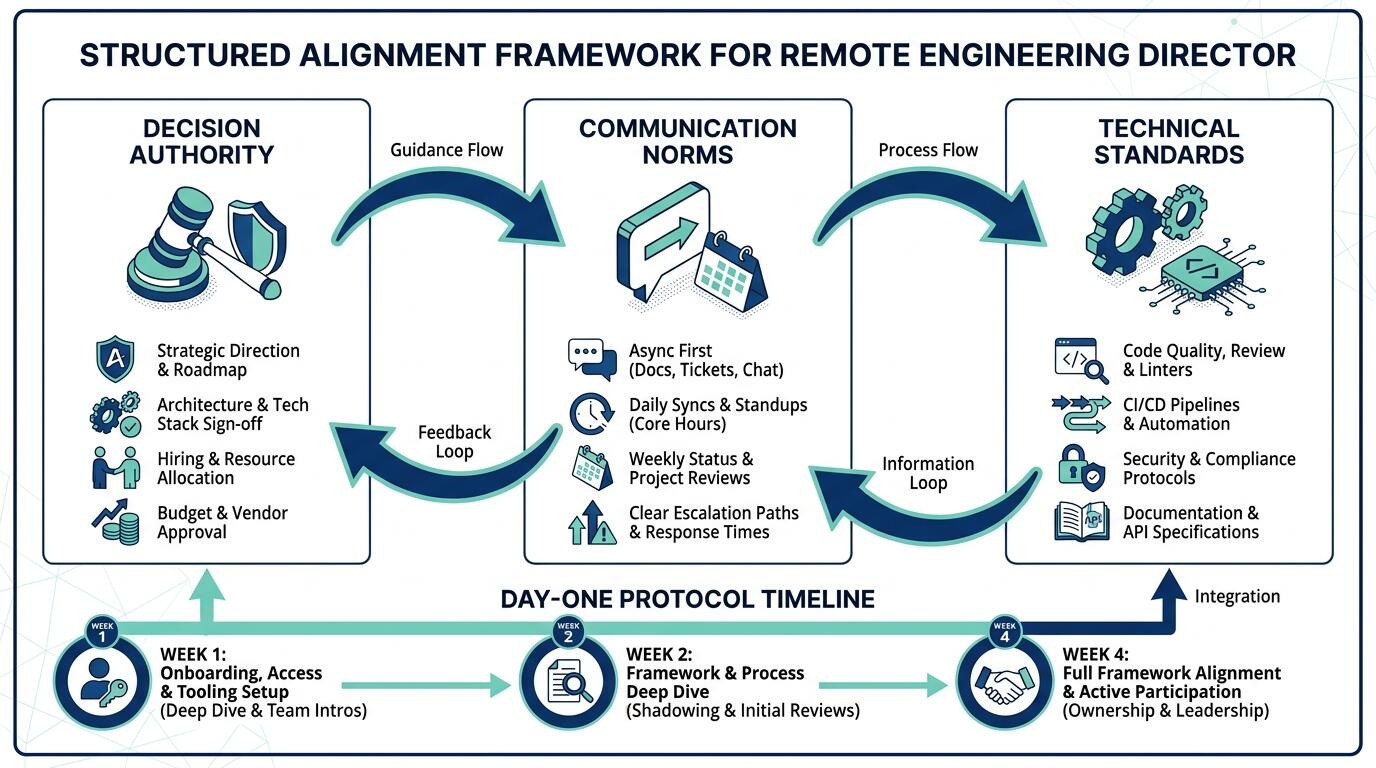
ALT: Structured alignment framework for setting expectations with a remote engineering director from day one across decision authority, communication, and technical standards
Advanced Considerations: When Standard Protocols Are Not Enough
Handling High-Ambiguity Scopes
Some engagements begin with a significant degree of product or technical ambiguity — the organization knows it needs AI capabilities but has not yet validated the specific use case, or the systems architecture is in flux because the business model is still evolving. In these situations, the standard day-one protocol needs to be augmented with an explicit agreement that the Engineering Director's role for an initial period is discovery and framing, not execution. Trying to set firm thirty-day deliverables in a genuinely ambiguous context creates pressure to produce outputs that are not yet meaningful. The better agreement is to define what will be known and documented by the end of the discovery phase, and to set deliverable expectations relative to that outcome.
The Common Misconception About Remote Autonomy
A widespread assumption — particularly among organizations hiring a senior remote technical leader for the first time — is that more seniority means less need for structured communication. This is precisely backwards. Senior engineering leaders operate across a broader decision surface, which means the surface area for misalignment is larger, not smaller. The structured protocol is not a sign of distrust; it is a sign of professional respect for the complexity of the role. Organizations that impose strong communication structure on their remote Engineering Directors consistently report higher satisfaction with the engagement than those who default to "just get things done."
Relationship With Other Engagement Frameworks
The day-one expectations protocol is the entry point for what should be an ongoing alignment practice, not a one-time event. Technical strategy engagements that begin with strong alignment tend to develop into deeply productive partnerships precisely because the foundation supports honest, low-friction course correction as circumstances evolve. If the engagement involves selecting or building AI infrastructure, pairing the expectations protocol with a rigorous evaluation of tooling and infrastructure choices from the start — as described in the guidance on evaluating AI development tools before signing a contract — ensures the technical leader is operating within a coherent and well-chosen technical environment from the beginning.
People Also Ask
Q1: How should a founder structure the first meeting with a remote Engineering Director?
The first meeting should be structured around constraints and authority, not aspirations. Come prepared with a written summary of the current technical state, the non-negotiable constraints, and the decision-making boundaries the Engineering Director is expected to operate within. Spend the majority of the meeting surfacing implicit assumptions on both sides, and close with documented agreements on communication cadence and the definition of the first milestone. Keep the agenda visible and shared in advance so the Engineering Director can prepare substantively.
Q2: Is a formal operating agreement necessary for a fractional Engineering Director engagement?
A formal operating agreement is especially important for fractional engagements, because the reduced weekly hours make every hour of misalignment disproportionately costly. A fractional remote Engineering Director who spends two hours a week resolving ambiguity about their scope is losing a meaningful fraction of their available capacity to non-productive overhead. A one-to-two-page written agreement covering authority, communication expectations, and success metrics is a minimal investment that pays for itself within the first week.
Q3: How long does it typically take to reach productive alignment with a remote Engineering Director?
With a structured day-one protocol — including a pre-written operating agreement and a focused kickoff session — productive alignment typically takes less than one working week. Without deliberate structure, the calibration period commonly extends to three to five weeks, during which time the Engineering Director is executing on assumptions rather than confirmed agreements. The productivity difference between these two paths compounds over the full engagement duration, making the upfront investment in structure one of the highest-leverage actions available to a technical organization.
Wrapping Up
Setting expectations with a remote Engineering Director from day one is the highest-leverage technical leadership practice available to founders, product leaders, and CTOs who are serious about shipping production-ready systems efficiently. The alignment work done before and during the first week does not just reduce friction — it actively enables faster, more confident decision-making across the entire engagement.
Key Takeaways:
- Draft a shared operating agreement before the first meeting to surface implicit assumptions on both sides before they calcify into conflict
- Structure the day-one kickoff around constraints and non-negotiables, not aspirations
- Document decision authority explicitly — this is the single most commonly skipped and most consequential alignment dimension
- Establish the async-first communication protocol on day one, including update format, cadence, and escalation path
- Treat the expectations protocol as a living document that supports ongoing alignment, not a one-time checkbox
The organizations that get the most value from remote technical leadership are not the ones with the most flexible processes — they are the ones with the clearest upfront agreements. Start there, and the rest of the engagement has a foundation to build on.
If you are ready to bring on technical leadership with the depth to take your product from concept to shipped reality, explore Darius's approach to AI architecture, systems design, and full-stack engineering at the Darius website — and get in touch to discuss how a structured engagement could accelerate your next build.
Sources & Citations
- IEEE. "Software Engineering Standards and Distributed Systems Coordination".
https://www.ieee.org/ - Harvard Business Review. "Managing Remote Technical Leaders and Distributed Engineering Organizations".
https://www.hbr.org/
Note: Standards and best-practice guidance may be updated; please check the latest official documents or consult professional advisors.